Crux immissa. Crux capitata. Crux commissa. Crux immissa. Crux ansata. Cruz gammata.
The cross. It is the most ancient and universal symbol, which in pre-erudite cultures often symbolized a duality. Associated with the horizontal beam of the cross were the symbols of the feminine, which included the characteristics of passivity, earthiness, destruction, and death. On the other hand, the vertical beam suggested its masculine counterpart, which was considered celestial, eternal, creative, positive, active, and full of life.But before the cross became a religious and holy symbol, it was used in a cruel method of execution called crucifixion, where a victim was tied and nailed by the wrists and feet to a large wooden cross and left to hang there until dead. This practice was believed to have begun with ancient Persians, and Alexander the Great introduced crucifixion throughout his empire when he crucified a general who disagreed with his campaign plans. Later, the Roman Empire adopted the custom from Carthage and used it for slaves, rebels, enemies and criminals. After Jesus of Nazareth had been put to death, Saint Helena was said to have discovered the cross that Christ died upon in the fourth century AD. Helena was instrumental in converting the crumbling Roman Empire into the Christian Holy Roman Empire, and when Christianity became the state religion, Emperor Constantine abolished crucifixion.
Now, when it comes to religious symbol body art, the cross tattoo is by far the most popular tattoo design.
What Cross Tattoo Designs Represent On A Man Or Woman
Cross tattoos have the distinction of being one of the few tattoo designs that are, for the most part, unisex. It represents that same thing for women and men, as the symbol of the cross deals with the spiritual rather than the physical.
What Type Of Person Gets A Cross Tattoo Design
People who get cross tattoos are in tune with their spirituality and they know that they’re more than just their physical bodies. Their intuition and faith factor in heavily when the solution to a problem is beyond reasoning and thinking. Most of the problems we face day to day are intangible, so in seeking answers, these people transcend physical limitations. Cross tattoos also help spiritual people be at peace with themselves, and they seldom feel alone. The cross tattoo serves as a reminder that they are loved by God all the time, and feeling this love, they are peaceful, compassionate, open and loving to all human beings. With cross body art, a special relationship with God is implied.
Different Types Of Crosses
The Crux Immissa is shaped like a lower case “t”, with the horizontal beam inserted (which is what immissa means) at right angles to the upright post. This is the most common form of the Christian cross, and it was on a cross such as this that Christ actually died (for that reason it is sometimes referred to as the Passion cross). This cross is also called Crux Capitata (“with a head”) and the Latin cross.
The Crux Commissa is shaped like a capital “T” (commissa means “joined” or “attached”) and it is more widely known as the Tau Cross or St. Anthony’s cross.
The Crux Decussata is an “X” shaped cross (decussata comes from decus, Latin for “distinction”, “honor”, “glory” and “grace”). The crux decussata is seen in the elaborate Chi Rho Cross and Baptismal Cross, and the simple St. Andrew’s cross.
The Crux Ansata, or ansated cross, is most commonly known as the Ankh (a looped Tau cross that serves as the ancient Egyptian hieroglyph meaning “life”). The hieroglyph itself is a sketch of the womb and the sexual union of male and female genitalia, which signifies zest, energy, reproduction, regeneration, and immortality. The symbol closely resembles the Hindu depiction of a Hermaphrodite standing on a lotus flower.
The Cross of Triumph is similar to the design of the Latin cross, only it adds a large circle to the base with the outline of an upside-down T inside. This cross is a symbol that testifies to the universal triumph of the Gospel throughout the world.
The Calvary Cross is like the Crux Immissa on it’s mounted on three steps (which represent the hill of Calvary or, more often, “faith”, “hope” and “love”. It is also known as the Graded cross.
The Eastern Orthodox Cross (also known as the Russian Cross and Byzantine Cross) is another cross that is similar to the Latin Cross with two additional cross beams that sit above and below the original horizontal beam. The upper is shorter in length and runs parallel to the original cross beam while the lower slopes down from left to right at an angle.The top beam bears the plaque conveying Pontius Pilate’s inscription, “INRI” (Iesus Nazarenus Rex Iudaeorum) which is Latin, Greek and Hebrew for “Jesus the Nazorean, King of the Jews”. The true meaning of the bottom beam is a little more of a mystery. One popular theory (circa the eleventh century) is that it represents a footrest and the slant symbolizes a balance scale showing the good thief, St. Dismas, having accepted Christ would ascend to heaven, while the thief who mocked Jesus would descend to hell. In this interpretation, Christ and the cross is a balance of justice.
The Templar Cross features horizontal and vertical beams of equal length, the ends of which are flared. To fully understand the history of the cross, we must go back to the year 1118, when a military order was formed by nine French noble knights, whose ranks included Hugues de Payens and Geoffrey de Saint-Omer. The founding knights of this order, known as “The Poor Knights of Christ”, took monastic vows and were devoted to the protection of pilgrims and the defense of the Holy Land. When the King of Jerusalem, King Baldwin II (circa 1118-1131), installed the order in a part of the Palace of Jerusalem called, Solomon’s Temple, for their residence and armory, the order became known as Knights of the Temple or Templars.In 1128, the Knights of the Temple were confirmed by Pope Honorius II, and they received the white vestment as a symbol of the purity of their life, to which Pope Eugenius, in 1146, added “the red cross with two bars”. Despite many years of sacrifices and rendering service to bit Christianity and civilization, Philip the Fair, King of France (who was in the Order’s debt), arrested all the Templars in 1307, and seized their goods and possessions. But Phillip was unable to judge the Order, as it was answerable only to the Pope, so he set about to coerce Pope Clement V to act against the Order. The Pope eventually yielded to pressure in 1312 and the Order was forced to revert to its original status of a Secular Military Order of Chivalry.In 1314, noted Templar Grand Master Jacques de Molay was burned at the stake near Notre Dame Cathedral, Paris. And in England, though Edward II did not take immediate action against the Order, he permitted the Inquisitors to judge the Order at the Church of All Hallows By-the-Tower, and then set about seizing the Templar lands and possessions, including the Temple in London, for himself rather than passing them on to the nominated custodians, the Knights of Saint John.
The biggest misconception regarding the Knights Templar is that they always wore the cross as part of their raiment, when in actuality it wasn’t until 1147 that the Pope Eugene III granted the Templars the right to wear a red cross, sewn above the heart on the left side of the Templar garment. Before this time the knights wore only a white coat and their sergeants wore a brown one.
The Crusader’s Cross (also called the Jerusalem Cross) is symbolized as the crux immissa surrounded by four smaller crosses and usually represents Christ’s command to spread the Gospel around the world, a mission that started in Jerusalem. Although the true meaning of this cross is unknown, the most popular beliefs are:
* The larger cross represents the Old Testament teachings and the smaller crosses incorporate the New Testament teachings. The four apostles, Matthew, Mark, Luke and John, surrounding Christ in the center Christianity (the center cross) being broadcast by missionaries to the four corners of the world
* Five crosses representing the five wounds of Jesus on the cross (hands, feet and side)
It is believed that the name Crusader’s Cross came about because the symbol was on the papal banner given to the crusaders by Pope Urban II.
The Maltese Cross is comprised of four triangles who apexes meet to form an eight-pointed star that has varies shapes (blunt, curved and sharp). Originally used by the Knights of the Hospitaller Order, so known due to their charity toward the sick and poor in setting up hospices and hospitals, the symbol is still in use today by fire and ambulance services. During this time, battle armor was often extensive, covering bodies and faces and making it difficult in battle to differentiate friend from foe, so the need for an identifiable insignia for the knights became vital. Since they fought for a holy cause, they selected the symbol of the cross and when the Knights of Saint John of Jerusalem moved to the Island of Malta, the emblem inherited the island’s name. The Maltese cross represented the principles of charity, loyalty, chivalry, gallantry, generosities to friend and foe, protection of the weak, and dexterity in service. Because of its connection with the Knights of St. John, this cross is also called St. John’s Cross.
The Celtic Cross is simply a Latin cross with a ring in the center, and as is the case with most of the other crosses listed here, this cross is called different things by different people. For example, Episcopalians and Anglicans call it the Celtic cross, whereas Catholics refer to it as the Irish cross. Sometimes it’s even mistakenly identified as St. John’s Cross (see: Maltese Cross). Equally ambiguous is the meaning of the ring in the center of the cross. Interpretations range from it being a symbol of eternity that emphasizes the everlasting love of God, as shown through Christ’s crucifixion, to the symbolization of Christ’s resurrection, to the simplified explanation that it’s a halo. Then there’s the theory that when St. Patrick converted Druids to Christians, he took one of their standing stones etched with a circle that symbolized their moon goddess, and scratched a Latin cross mark over the circle, to show that Christianity had replaced their pagan beliefs.
The Celtic cross also contains plaitwork, which are patterns of interwoven cords that symbolize the “Thread of Life”, since the human soul was thought, by the Celts, to be a fragment of the divine, which would ultimately return to its divine source, after ridding itself of its accumulated, inherited impurities (see: Celtic Knots for more information regarding plaitwork).
The Anchor Cross is also known as St. Clement’s Cross, named after the fourth Pope who was banished from Rome in the first century by Emperor Trajan. Clement was forced to work in a Russian stone quarry and he caused trouble for himself when he located a spring of fresh water from the ground that quenched his fellow prisoners’ thirst (believed to be miracle, which aided in his later sainthood), and since no good deed goes unpunished, the prison governor ordered Clement’s death. He was subsequently tied to anchor and tossed into the Black Sea to prevent Christians from recovering the body. Clement later became the patron saint of anchorsmiths, blacksmiths, mariners, marble workers and stonecutters.
Which Cross Tattoo Is Right For Me?
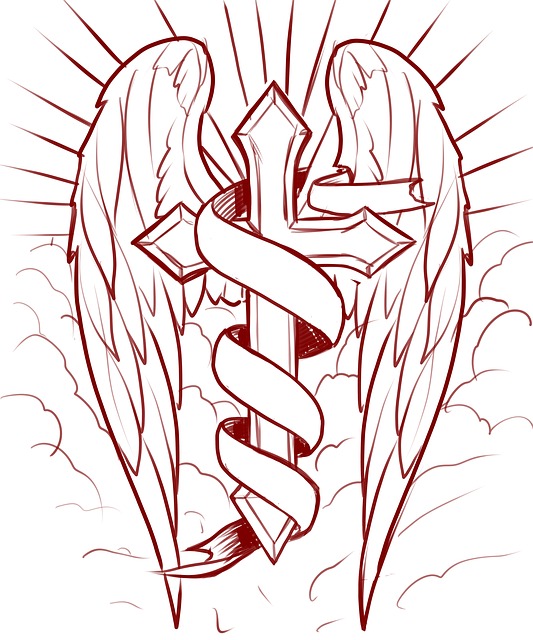
Believe it or not, this is a difficult question to answer, because there is no logical thought pattern behind the choice (with the exception of the choosing the cross symbol that identifies your religion). The design could be a traditional Christian cross, a tribal cross, a Celtic cross, a gothic cross (being “goth” doesn’t make you a bad person), or a Latin cross with either a rosary, wings or praying hands. The only thing that matters is that the cross tattoo design you select, speaks to you spiritually. This decision is between you and God.
How will you show your faith and love?
Copyright ©2005 Rhyan Scorpio Rhys


 MADD FICTIONAL