Tiny Stories: The Hand of Love (Revised)

Popular belief has it that the universe is comprised of atoms. In reality, the universe is actually made up of…

When I was a young girl, my father vanished from the earthly plane. But he didn’t merely die—he transitioned. I sensed his absence, his “moving on,” as it were, before anyone else could muster the courage to tell me. A space that had been filled with light became dark; a melody turned into silence. It was as if a cosmic switch had been flipped.

When the news eventually reached my ears, I didn’t cry; instead, I turned inward. My family looked at me with concern, as I refused to eat or sleep, ignoring the therapists who tried to guide me back to the realm of the living. Colors ceased to exist; life itself became a blurred painting left out in a cosmic storm.

I was drifting, fading from existence, my spirit stretching thin, until I collapsed. That’s when it happened. I found myself falling through layers of a dimension not governed by our understanding of space-time, traveling backward through the chronicles of my own existence to the point of inception—the first spark of passion my father had ignited in me.

My descent halted abruptly, and I landed on a surreal beach of incandescent white sand and a boundless aquamarine ocean. Standing on the shoreline was my father, his image superimposed against a shimmering canvas of galaxies, nebulas, and interstellar phenomena.

“Is this heaven?” I asked, awestruck by the spectacle.

He laughed, the sound echoing like a harmonious cosmic wave. “No, sweetheart. This is merely a threshold. Paradise exists in dimensions cooler than this.”

“I want to stay,” I pleaded.

“One day you will, when you’ve fulfilled your purpose in the mundane realm.”

“That’s unfair.”

He held up his hand, now glowing with celestial light. “You see this? It might seem insignificant, but it carries the weight of a universal promise. Even if you can’t see me, my protective hand will guide you.”

Before I could protest, he leaned down and kissed my forehead. In that instant, a cascade of light enveloped me, and I found myself back in my bed, surrounded by my earthly family.

They never heard this story from my lips; they’d rationalize it, strip it of its wonder. But make no mistake—I’ve faced insurmountable odds and survived. In those moments, I felt the presence of that cosmic hand, reassuring me that love transcends all dimensions, guiding me safely through the labyrinth of life.

Beyond Words

Shinichi Mochizuki’s solution to the ABC Conjecture

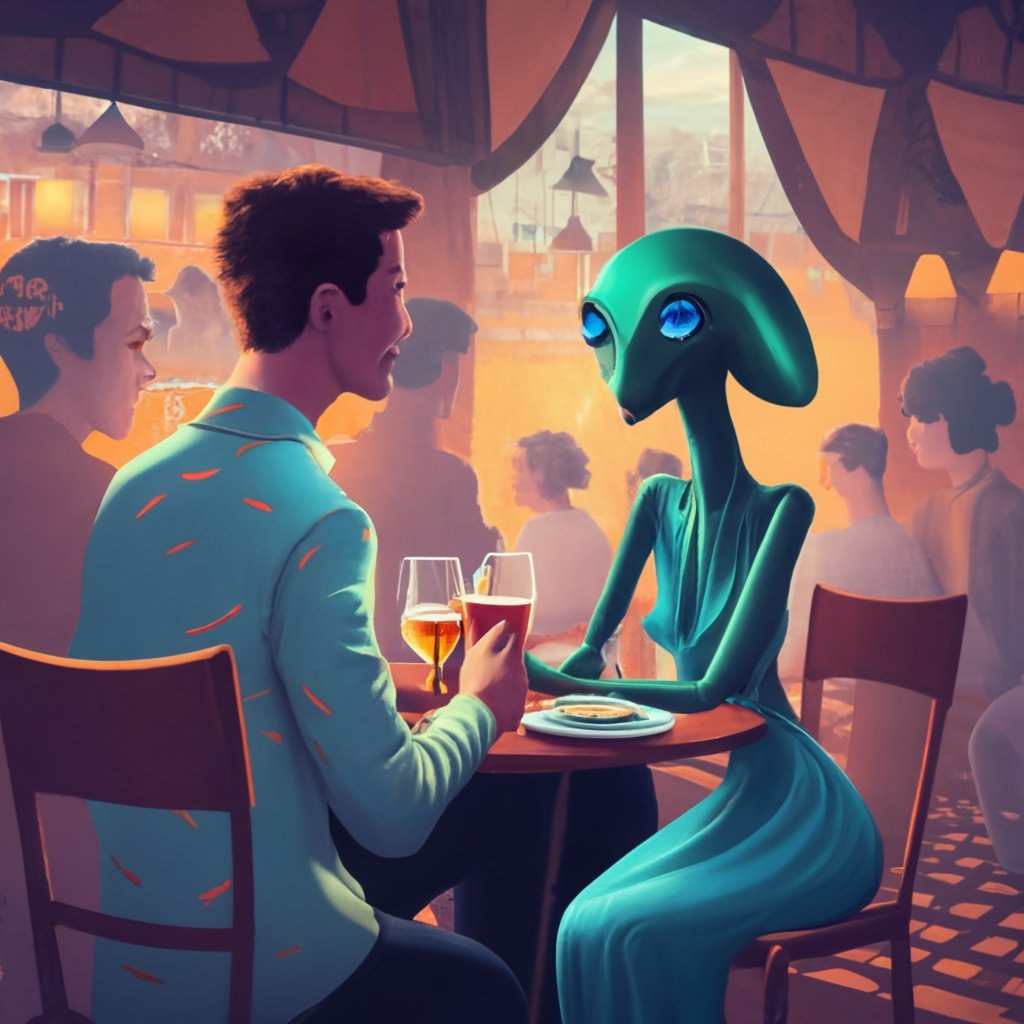
One of the major downsides to tech advancement on Earth, after our biggest brains finally made faster than light interstellar space travel a reality and we opened our planetary borders to all friendly offworld visitors, was that the human dating pool became oh so very shallow.

Bored with the same old same old, curious, and adventurous single and married people began dipping their toes in alien waters, some for the experience, others for committed relationships, and the rest simply for bragging rights. It had gotten so bad that finding a partner interested in a same species relationship became near impossible. And those not willing to get it on with an extraterrestrial chose to marry their farm animals, automobiles, cartoon characters, and even holograms, rather than share intimacy with another human being.

I tried to fight the good fight and preserve the human race, but there’s only so much rejection a man can face before throwing in the towel. I resigned myself to a fate of hermitry and searched for hobbies to occupy my mind until the day my timecard was punched for the final time.

But the universe wasn’t done tormenting me yet. On my birthday, I received an anonymous gift in the mail: an all-expenses-paid trip to an orbital platform that was hosting a speed dating event. My first reaction was to chuck the invite in the trash and return to my 40,000 piece jigsaw puzzle of the notorious math problem, “The ABC Conjecture.” What stopped me was the 7-course meal and open bar, guaranteed, whether you successfully found a match or not.

Shinichi Mochizuki’s mathematical solution could take the back seat for a night, while I stuffed my face in space and got absolutely pie-eyed.

I made a half-hearted attempt at looking decent, no sense in getting turned away at the space jitney depot for improper attire, and got a jumpstart on the festivities by knocking back as many complimentary cocktails on the flight up to the orbital platform as I could manage.

The plan was to make a beeline for the food and bar and, when I had my fill, catch the next available jitney home. The catch was that I had to complete at least one round of speed dating before having access to food and drink. The second disappointment was absolutely my fault for not reading the invite carefully. I was one of ten humans in attendance, all of them male because this was an interspecies speed dating event. How in the world did I overlook that detail?

For four minutes at a pop, I went through the motions of engaging in conversation with an Onzuid, a Thraikket, a Brelgut, a Mellad, a Thaeqen, and a Raphoth, and a majority of those dates were spent struggling to communicate in broken English, which I had to give them credit for. They knew more of my language than I knew of theirs.

My final obstacle was a Neita, who spoke no English at all. She, the assumed pronoun because she wasn’t able to convey one herself, spoke in melodies while her bioluminescent skin shifted through the color spectrum with each note. I had no idea what she was saying, but I had to admit, it was beautiful to watch.

When it was my turn to talk, I decided to sing about my upbringing, not knowing whether she would be impressed by my effort or take offense, thinking she was being mocked, but I was only here for the food and drink, so what the hell.

I sang about being born in The Bronx, in a neighborhood that history marked as one of the most dangerous places to live in New York at the time, but on my block, everyone spoke like they knew you. We played on the concrete year ’round because there was no local park, ate free bologna and butter sandwich lunches at the public school during the summer, and filled our days playing handball, riding bikes, competing in games like Steal The Bacon, Hot Peas And Butter, Ringolivio, Freeze Tag, Skelzies, and when we got a little older, Run-Catch-Kiss. Water fights consisted of anything you could fill from the open fire hydrant (pots, pans, cups, buckets, or whatever). And if you didn’t go home dirty, you weren’t having a good time. We ate whatever we wanted because no one knew a thing about food allergies (and fried chicken and red Kool-Aid were as important as the air we breathed). We fought with our hands and made up the next day like nothing happened. And if you showed disrespect to your elders or looked in their mouth while they were talking to grown folks, you would get put in your place immediately. And the universal rule was, once the street lights came on, that was our curfew. Anything left undone would have to wait until tomorrow.

When I was done, she smiled (at least, I took it to be a smile) and glowed a calming shade of yellow. The bell rang, and I nodded goodbye and made my way to the dinner table. To my surprise, she joined me, and we sang to each other for the rest of the night.

When the event was over (yes, I stayed to the end) and before we went our separate ways, I gave her my phone number. I wasn’t sure if she understood the gesture, if she would call me, or even how we would manage to meet up if she did call. All I knew was that love would find a way.

Pavement Tales: The Graveyard of Earthworms (Revised)

I love to walk…and my mind hates being idle, so every now and then during my morning constitutional I create…

Walking has always been my jam. It helps with the monotony of my daily existence as that could always stand a little bit of twisting. As impure as New York City air is, I still consider it fresh enough to help clear some of the mental cobwebs that accumulate overnight.

When not listening to music or an audiobook or radio play, I tend to mind-sift through fictional character conversations and story scene settings, oblivious to the world surrounding me, but on this particular day, something crept into my sphere of awareness.

Looking down at the pavement, I realized that I was traipsing through what looked like the aftermath of the Great Worm War of 2023. The sidewalk battlefield was nothing less than apocalyptic—a surreal D-Day rendered in invertebrate form. Earthworms, thousands of them, lay slain upon the unforgiving concrete, coating the expanse of an entire city block in a macabre tapestry.

Logically, I knew how this could have happened. I knew the little buggers came to the surface either during the heavy rains—but it’s been dry weather for the past week—or to pair off and mate only to get caught on things that are hard for them to crawl across, like sidewalks and subsequently fry on the surface from sun rays, but that normally occurs during springtime.

So, what was this, then? What ghastly event had caused this Wormageddon? Had there actually been a battle? Had warring worm clans pitched against one another over a territorial dispute? Factions in conflict over the claiming of a Lumbricus Terrestris throne? Noble families locked in a deadly dispute over an unholy Montague/Capulet union?

In my mind’s eye, the scene sprang to life with cinematic grandeur. I envisioned worm clans adorned with micro-armor, their soft bodies writhing in war dances, chanting anthems of dirt and decay. Generals—distinguished by their slightly girthier segments—led their troops into the fray. Did they fight over sacred compost hills? Was it a religious crusade concerning the true nature of soil pH levels?

I imagined wormy war cries, nearly inaudible squelches, filling the air. Siege weapons made of twigs and pebbles, catapulting minuscule mud balls. Earthworm sorcerers—yes, let’s go all in—conjuring protective barriers of moist earth. The clash of factions, the deaths of heroes, the utter annihilation—all laid bare on this pedestrian walkway.

And then my imagination took a darker turn. What if this was a message?

As I stood there, staring at their dried remains, curled into runic shapes, I wondered if they had been somehow gifted with a vision of the approaching apocalypse and had sacrificed themselves in an effort to warn us in the only language they knew. The last Germanic language spoken to them by man before the two species went their separate ways in evolution.

At that moment, I felt like Indiana Jones in the passageway to the Grail chamber, trying to decipher the worm cadavers’ possible portents of doom, only without the aid of a diary or Sean Connery whispering something about, “Only the penitent man will pass.” or like John Nash in “A Beautiful Mind” only without an ounce of his mental code-breaking ability.

And I stood there. Longer than I’m comfortable admitting. Frustrated by the limits of my linguistics. Finally, I forced myself to move on, but not before making a promise:

No more outdoor strolls without my iPod.

One For A Wish

In the waning glow of the city’s rush hour, Albert maneuvered through throngs of pedestrians, his arms laden with grocery bags. The sky overhead smudged into deep purples and fiery oranges, heralding twilight. A sound managed to snag the outer fringes of his attention, the crunch of gravel. His eyes flicked toward a nearby alley, and he caught a harrowing scene: an old woman was clutching her purse with a vice-like grip, in a deadly game of tug of war with a thug brandishing a knife.

Time froze.

Albert’s heart pounded against his ribcage. He wasn’t a hero by any stretch of the imagination, but he also wasn’t the sort of man who could ignore an injustice. With a muffled curse—because he knew this wouldn’t end well for him—he yelled, “Hey! Leave her alone!”

And before he realized what he was doing, Albert had thrown down his groceries—sending cans rolling into the gutter, and cereal boxes splattering open, exposing their fortified innards—and was lunging at the mugger.

The thug whirled around, his eyes dark voids of malice. His pocket knife captured the fading twilight as he turned, transforming it into an ominous glint. Albert lunged, fist aimed squarely at the thug’s face. In an agile move, the mugger released the old woman’s purse and sidestepped Albert’s punch, retaliating with a brutal blow to Albert’s midsection. Losing his footing, Albert staggered into the assailant, causing both men to tumble to the ground. The knife slipped from the mugger’s grip and vanished into the encroaching shadows.

The old woman screamed for help, and now that he was unarmed and sensing the growing peril, the thug sprang to his feet. In his haste to escape, he landed one more punch on Albert and followed it with a vicious kick to his face. Albert’s world swirled into a disorienting haze, the taste of copper flooding his mouth as he watched the mugger melt away into the labyrinthine darkness.

A frail figure with a halo of white hair, the old woman clutched her purse to her chest and began fussing over Albert. “Oh dear, he hurt you. I don’t often do this, but I live not too far away. Won’t you come with me and let me tend to your wounds? It’s the least I can do.”

“I’ll be alright,” Albert said, his voice raspy. “You still have your purse. That’s enough for me.”

“But look at you,” she said in an accent he couldn’t quite identify. “And your poor groceries are scattered all across this filthy alley.”

“That stuff’s replaceable, you’re not.”

“I’m afraid you don’t understand. I was raised never to leave a debt unrepaid,” she implored, her pale blue eyes holding an enigmatic blend of wisdom and desperation. She opened her purse and fished out six antiquated copper coins.

“I didn’t do this for a reward.”

“These coins aren’t for spending; they’re for wishing. Most people think that large silver coins grant better wishes, but it isn’t the size of the coin or its denomination; it’s the material they’re made from that makes the difference. Copper attracts the best magic.”

“That’s very kind of you, but save the wishes for yourself. I’m fine, really.”

“They are no longer my coins; they belong to you,” the woman insisted, grabbing Albert’s wrist in a grip that belied her age. She sighed as the coins slid off her palm, as though she was letting go of an enormous burden. The coins felt heavier in Albert’s hand than coins of that size should.

“There is a fountain in the town square; go there and make your wishes. And with each coin you drop in the fountain waters, you must recite One for a wish, Two for a kiss, Three for a letter, Four for something better, Five for sorrow, Six see your sweetheart tomorrow.”

She made him repeat the recitation several times before she released her vice grip, said, “Thank you,” and went on her way.

***

Albert’s apartment was a testament to his isolation. The walls were stark and bare, devoid of any pictures or artwork that might suggest a life rich with experiences or shared moments. The furniture was minimalistic: a simple couch, a coffee table, and an unassuming dining set with just a single plate neatly positioned, as though anticipating a meal that would never be shared. On a chest of drawers that held a few nondescript items—a wallet, some receipts, a half-used bottle of cologne—sat a shallow dish meant for loose change.

Albert placed the six dull brown coins the old woman had given him into this dish. Each coin was slightly smaller than a penny, and so worn that any imagery or inscription it once bore had been erased by the merciless passage of time. Once he set them down, they seemed to blend into the mundane tableau of his life, and he soon forgot about them.

Days went by as they did in the life of a lonely single person, each one a repetition of the last. Sometimes, to offer a twist in his monotony, Albert would walk in a different direction, and this day, he found himself walking through the town square. A picturesque fountain stood at its center, its waters continually flowing but somehow never escaping, much like Albert himself. As he passed by, he observed a young couple deeply in love, their lips locked in a passionate kiss, utterly oblivious to the world around them. Usually, such public displays of affection would irritate him, a constant reminder of what he lacked. But there was something about this couple, something so genuine that it broke through his usual cynicism.

Just then, he felt an unusual weight in his pocket—a weight that seemed to materialize out of nowhere. Reaching in, his fingers brushed against the rough surface of the coins he had left in his apartment.

The old woman’s instructions came flooding back to him. Puzzled yet intrigued, he thought, with a sense of inexplicable resolve, Why not? Albert took one of the six coins and, holding it between his thumb and forefinger, whispered, “One for a wish.” His words melded with the sorrowful symphony of cascading water. And in that moment, inspired by the love he had witnessed, he wished for something that had long eluded him: companionship, a meaningful human connection that had always seemed just out of reach.

The following day, while out running errands, Albert was jolted from his thoughts when he collided with someone on the crowded streets. “Oh! I’m so sorry!” the stranger exclaimed, her hazel eyes wide with surprise and a hint of embarrassment.

“No, it’s my fault,” Albert responded, feeling an immediate sense of intrigue. “I should have been paying more attention. Are you okay?”

“I’m fine, just in a rush and completely turned around. New in town,” the woman said, her voice tinged with desperation as she glanced at her phone. “And already late for a crucial meeting. I can’t even find a taxi.”

“Let me see the address,” Albert offered, sensing her urgency. She handed her phone over, and Albert looked at the location. “Well, the good news is it’s not too far from here. The bad news? It’s a bit of a labyrinth getting there.”

The woman sighed, “I can’t afford to get lost again.”

“How about I escort you? I promise I’m a fantastic guide,” Albert said with a reassuring smile.

She looked hesitant but then nodded, her eyes locking onto his. “I would really appreciate that, thank you.”

“My name’s Albert, by the way.”

“Pleased to meet you, Albert. I’m Emily,” she quickly informed him. Her eyes, soft hazel orbs framed by wisps of auburn hair, seemed like wells of untold stories to Albert.

Albert navigated them through shortcuts and alleys as they walked, each turn calculated to shave time off their journey. To ease the tension, he initiated a conversation. “So, what brings you to our little maze of a city?”

“A job,” Emily said. “I’m a graphic designer. The firm I work for just landed a big contract here, so they sent me to handle it.”

“That sounds exciting,” Albert remarked, genuinely interested. “And stressful.”

“You have no idea,” Emily chuckled.

“And you? What do you do?” Emily asked, momentarily forgetting her stress as she became engrossed in the conversation.

“I work in IT. Not as exciting as graphic design, but it pays the bills.”

As they rounded the last corner, the building Emily had been looking for came into view. She let out a sigh of relief. “I can’t believe we made it. Thank you, Albert. You’re a lifesaver.”

“It was my pleasure, really,” Albert said, feeling a unique connection forming, one he hadn’t felt in a very long time.

They stopped in front of the building, both aware that the moment was about to end. “Well, this is me,” Emily said, her voice carrying a note of reluctance.

“Yeah,” Albert replied, equally hesitant. “Good luck with your meeting.”

“Thanks. I wish we had more time to… you know, chat,” Emily said, her eyes meeting his, revealing a hint of regret.

“Me too,” Albert agreed, sensing the spark between them was something worth exploring but unsure how to capture the moment before it vanished.

And then they parted ways, Emily rushing into her building and Albert standing there for a few seconds, watching her go. He realized he hadn’t asked for her number, a regret that hung heavy in the air long after she had disappeared from sight.

Albert ambled through the town square on his way home; the fountain’s cascading water called out to him, reminding him of the inexplicable, yet unmistakable, connection he’d felt with Emily. He felt a slight heaviness in his pocket, and his fingers grazed over the small, worn coins once again.

A realization unfolded within him like the petal of a late-blooming flower. He’d met Emily—the bewitching woman with hazel eyes—right after he’d made his first wish. The correlation lit up his mind, a flicker of hopeful fire. Was there really a connection?

He paused, standing before the fountain, which seemed more mystical now than it ever had, and with a newfound sense of intention, he reached into his pocket and drew out the second of the mysterious copper coins. He stared at its tarnished surface as though it held answers to questions he had yet to ask.

Taking a deep breath, he let the coin slip from his grasp, watching as it arched gracefully through the air and broke the fountain’s water surface with a soft splash. As the ripples emanated outward, carrying with them his silent hopes, he spoke the words, “Two for a kiss.”

The coin sank out of sight, but its absence was filled with a swelling of anticipation, almost as if the universe had finally taken note of his desire. Shaking off a sense of wonder, he continued his walk home, but this time a buoyant sense of possibility carried him along. For the first time in what felt like an eternity, Albert looked forward to what tomorrow might bring.

The setting sun was casting golden rays that filtered through the city buildings as Albert took his usual route home from work. Just as he was about to cross the street, he noticed Emily standing at a corner, scanning her phone with a slightly furrowed brow. The sight of her reignited the hope kindled by yesterday’s magical encounter and his subsequent wish by the fountain.

“Emily, fancy running into you again!” Albert called out, crossing the street with a palpable sense of anticipation.

She looked up, and her eyes met his. Instantly, her face brightened. “Albert! This is a pleasant surprise.”

“Serendipity must be working overtime,” he grinned. “Would you, by any chance, be free for dinner?”

Her eyes hesitated for a moment, scanning the horizon as if searching for a reason to decline, but then she smiled. “I’d love to, actually.”

At the restaurant, ambient music played softly in the background, candles flickered on the tables, and the air was thick with the scent of freshly prepared food. Yet, despite the charming setting, it was as if they were in a bubble of their own, the world outside momentarily forgotten.

“This is a lovely place,” Emily began, swirling her wine glass as she spoke, “I would’ve walked right past it if not for you.”

Albert chuckled, “Well, this place is a hidden gem, but the real treasure is the company.”

Emily blushed, captivated by his words. “You’re quite the charmer, aren’t you?”

“Only when inspired,” he replied, locking eyes with her.

Over dinner, they discussed their interests and their dreams, their laugh echoing in shared jokes. Each conversation seemed to draw them closer, almost as if they were solving a puzzle that neither knew they were a part of.

The night drew to a close, and Albert found himself walking Emily back to her hotel. The atmosphere between them was thick with unspoken words and sentiments that neither wanted to disturb.

“So,” Albert began, carefully choosing his words, “How about catching a movie tomorrow? There’s a new arthouse film that’s getting rave reviews.”

Emily hesitated. “I’d love to, Albert. I really would, but I can’t.”

Albert’s eyes met hers, his smile waning but still present. “No worries, we can make it another time. Whenever you’re free.”

Emily took a deep breath. “That’s the thing, Albert. I can’t make it another time either.”

The weight of the unspoken filled the space between them. Albert’s eyes searched hers, wondering if he should voice the assumption forming in his mind. “Ah, I see. You must be in a relationship already. Boyfriend or husband? Or, uh, something else? I didn’t mean to—”

“No, it’s not that,” Emily cut in, a soft sigh escaping her lips. “I should have told you early; tonight’s my last night in town. I’m leaving on an assignment tomorrow.”

Albert felt a mix of surprise and disappointment wash over him. The universe had given him this brief, almost magical connection, only to yank it away so quickly.

“I see,” he finally said, the words heavy yet sincere. “That’s a shame.”

Emily nodded. “Unfortunate timing, isn’t it?”

Albert felt a mix of disappointment and urgency. “In that case, I hope this isn’t too forward, but may I kiss you goodbye?”

Her eyes sparkled. “I’d be disappointed if you didn’t.”

Their lips met, and it felt like time stopped at that moment. It was a soft kiss, yet it carried the weight of their unspoken feelings, a simple yet profound connection that neither had anticipated but both so deeply yearned for.

As they parted, Emily whispered, “Thank you for a beautiful end to my stay here.”

***

A week had passed since that electrifying encounter with Emily, and Albert found himself in a peculiar limbo. She occupied his thoughts, making routine distractions like work and daily errands all but meaningless. He walked by places they had briefly visited together, like breadcrumbs on a path of nostalgia. Even the books he read seemed dull; their plots couldn’t compare to the unfolding mystery of his own life.

Albert’s moral compass remained steadfast despite the emotional whirlpool he was navigating. Making a wish that would alter the course of Emily’s career was out of the question. That would be a selfish violation of her autonomy, and Albert knew it. Yet, his fingers itched to dial her number, to hear her voice—only he had never gotten her contact information.

The third coin, according to the old woman, was Three for a letter. Surely that couldn’t affect her career if they simply maintained some sort of correspondence, so Albert purposely took a coin to the town square fountain this time. His hand hovered above the water for a moment, contemplating the ripple effects of what he was about to do. With a deep breath, he tossed the third coin into the fountain, watching as it plunged into the water and settled among countless other coins—each a silent testament to hopes, wishes, and dreams.

“Three for a letter,” he whispered to the fountain, his words mingling with the sound of cascading water as if sealing a pact with the universe.

As he stepped away, Albert felt an unusual peace settle over him. He had cast his wish into the world, whether by magic, fate, or mere coincidence. And now, he could only wait and hope that somewhere, somehow, his message would find its way to Emily. Whatever happened next was out of his hands, yet strangely, he felt an inkling of certainty that their paths were not done crossing. After all, wishes, like love, moved in mysterious ways.

It was a crisp, clear day the next morning, and the sun seemed to shine a little brighter than usual as Albert sipped his coffee as a knock echoed through his quiet apartment. Startled, he opened the door to find the mail carrier, holding an elegant envelope sealed with an intricate wax stamp. “Special delivery,” the mail carrier said.

Albert’s heart raced as he took the letter. “Thank you,” he managed to say, his voice tinged with wonderment. As the door closed, he carefully examined the envelope. It was an ecru color, subtly textured, with his name elegantly hand-written. And in the upper left-hand corner was the most important information in the world, Emily’s return address.

In a world of emails, videos, and text messages, this woman had taken the time to purchase stationery and handwrite a letter to him. He felt a sense of honor that he couldn’t readily explain, and his hands trembled as he broke the wax seal. He unfolded the parchment paper and drank in her words.

“Dear Albert,” the letter began. Emily wrote of how she couldn’t shake their meeting from her thoughts, how the very thought of him brought a sense of warmth and excitement she hadn’t felt in years. She explained she had asked around for his address, unashamed in her pursuit to know him better. “Though miles may lie between us, words can bridge our worlds,” she wrote.

Albert felt his heart swell as he read. Emily’s letter was more than just ink on paper; it was an invitation into her life, her thoughts, and her future. And it was an affirmation, a soul-stirring assurance that their encounter was as meaningful to her as it was to him.

Seized by an impulse, he rushed out and purchased the best stationery he could find and sat down at his small writing desk. Albert began to pen his response, his thoughts flowing effortlessly. He wrote of his daily routines, of the loneliness that had ebbed but never fully receded, and how her very presence—though only in ink—had brightened his life immeasurably.

Weeks turned into months, and their letters became a tapestry of shared confidences, dreams, and the intricate details that make a life. Each envelope that arrived was a chapter, each letter a verse in their unfolding love story. Despite the physical miles that separated them, their words built a bridge, a secret world where they were the protagonists in a romance of their own making.

Emily’s letters became a bright point in Albert’s otherwise monotonous routine. He eagerly awaited her eloquent prose, the lyrical accounts of her travels, and her poetic musings that somehow managed to turn even the mundane into something worth marveling at. Yet, a gnawing ache in the core of his being started to make itself known—each letter, while beautiful, also magnified the unfillable space that physical separation had wedged between them.

Albert realized that paper and ink, no matter how earnest, could not replicate the warmth of a touch, the electricity of a shared glance, or the intimacy of a spoken word. Each letter he opened was a double-edged sword: an aching reminder of what could be, yet currently wasn’t.

One evening, overcome by this realization, Albert found himself walking to the fountain. His hand delved into his pocket, fingers grazing the cool, worn surface of the fourth coin. He hesitated momentarily, wondering whether it was fair to interfere with the natural course of things. But as he stood there, the moonlight dancing on the water below, he felt almost as if the fountain itself urged him on, whispering promises of possibilities that hung tantalizingly in the night air.

Taking a deep breath, he clutched the coin tightly and whispered, “Four for something better,” as though the coin were a talisman capable of altering the fabric of his life. With a flick of his wrist, the coin spun through the air and plunged into the depths of the fountain, sending ripples across the surface as it disappeared.

As he walked away, Albert felt a weight lifted off him, replaced by a sense of vague expectancy. He didn’t know what form this ‘something better’ would take, but the act of wishing felt like setting the coordinates for a new destination in his emotional universe.

Days turned into weeks, and although nothing overtly miraculous happened, Albert noticed subtle changes. An air of anticipation surrounded him; even his daily routines felt imbued with a newfound energy. The letters from Emily continued, but they, too, seemed to carry a different undertone—an air of unspoken possibility that both thrilled and terrified him.

It was as if both he and Emily were on the cusp of something, teetering on the edge of a transformation neither could articulate but both deeply felt. Albert wasn’t sure whether the fountain or coin’s magic was real or imagined, but one thing was irrefutable: his wishes had set in motion a chain of events, unseen yet palpable, that were incrementally bringing him closer to that elusive ‘something better’.

And so he waited, his soul attuned to the mysterious rhythms of the universe, anticipating the moment when the next chapter in his life—and Emily’s—would finally begin.

Albert’s cell phone rang during his lunch break one day, and he was elated when he heard Emily’s voice over the phone, her words infusing him with a sense of euphoria he hadn’t felt in months.

“Guess what, Albert? My company’s opening a new branch near you, and they’re sending me there. Can you believe it? We’ll finally be in the same city!”

The news was so miraculous, so perfectly aligned with his last wish, that for a moment, Albert found himself at a loss for words. After a moment, he managed to stammer, “That’s incredible, Emily. I can’t wait to see you.”

She gave him her flight details, and he noted them down meticulously. It felt like destiny was finally smiling upon them.

The following day, Albert stood in the airport, holding a bouquet of roses and sporting an expectant smile that he couldn’t suppress. Every announcement from the loudspeaker made his heart leap. But as the minutes stretched into hours, that initial enthusiasm turned into anxious pacing. The flight status on the screen kept flickering between “Delayed” and “Awaiting Update.”

As he aimlessly wandered near the arrival gate, his mind began to race through a series of worst-case scenarios. His phone buzzed periodically with updates on the flight delay, but that did little to allay his growing sense of dread.

Suddenly, a palpable wave of emotion surged through the airport terminal. People were staring at their phones, some bursting into tears, others gasping in disbelief. Confused and alarmed, Albert turned to a man nearby. “What’s going on here?”

The man looked up from his phone, his face etched with concern. “Check the news. They’re reporting something about a flight with engine trouble.”

Albert’s fingers trembled as he unlocked his phone and navigated to a news website. The headline was chilling: “Flight 417 Reported Engine Trouble Before Going Missing Over Atlantic.”

His heart sank, and the bouquet of roses he held felt like a hundred-pound weight in his arms. A shiver ran down his spine as the horrific reality of the news settled in. Time seemed to stand still, and the hustle and bustle of the airport faded into a distant hum.

The news reported that the rescue effort turned into a recovery mission in the following days. With each passing hour, hope dwindled as updates came back increasingly grim. Friends and family tried to console Albert, but their words felt like mere echoes in the vast emptiness that had enveloped him. He replayed every moment, every conversation he had had with Emily, as though clinging to the fragments would somehow piece reality back into the shape he wanted.

At night, he found himself standing at the fountain, staring at it like an oracle whose prophecies had veered tragically off course. He thought about the coin, the wish for ‘something better,’ and wondered if fate had twisted his words into a cruel, unbearable irony.

Clutching the two remaining coins tightly in his fist, he hesitated. Could he still believe in the magic that seemed to have brought him so much yet cost him so dearly? His fingers felt the worn edges of the coins, each one like a piece of a puzzle that could never be completed.

With a shaky breath, he opened his hand and looked at the coins. These small, innocuous disks had taken on so much meaning, yet they also seemed hopelessly inadequate at that moment. But what did he have left but hope?

“Five for sorrow,” he whispered, his voice catching. The coin slipped from his fingers, cutting through the air before splashing into the fountain, its ripples mingling with his reflected tears.

“Six see your sweetheart tomorrow,” he continued, a bittersweet smile forming on his lips as he released the final coin. It joined the first in the water, and for a moment, it felt like he’d dropped a part of his soul into the fountain.

As he stood there, eyes fixed on the water, Albert realized he was holding his breath, as if the fountain would somehow respond, validating his pain, his hope, his love. But there was only the constant, melancholic murmur of the fountain, echoing his solitary lament into the dark night.

Sleep had become a rare commodity for Albert, coming in fits and starts, like droplets in a drought. Night after night, he would lie on his bed, staring at the ceiling, replaying the events leading up to Emily’s disappearance. But tonight was different. His body, no longer able to sustain the burden of insomnia and emotional exhaustion, surrendered to the arms of a restless sleep.

However, sleep’s embrace was short-lived. A sudden, thunderous knock shattered the quiet of his apartment, ripping him from his uneasy slumber. His heart pounded in his chest as he stumbled to the door, his mind a fog of disoriented thoughts. Could it be news of Emily?

When the door swung open, his blood turned to ice. Standing before him was Emily—but not the Emily he remembered. Her skin was bloated, a sickly shade of blue, as though she had spent a lifetime submerged underwater. Her clothes were torn to shreds, clinging to her form in tattered strips. Her eyes, once lively and expressive, were now vacant voids of darkness.

Albert’s gaze dropped to her hand as it slowly opened. Six worn copper coins clattered onto the hardwood floor, each one landing with a resonance that seemed to shake the very foundation of his world. The coins—the very tokens of his wishes—had returned to him in the most horrifying way imaginable.

Her lips parted, and what came out was a voice so distorted, it barely resembled anything human—a guttural rasp laced with something far darker than malice, tinged with anguish that echoed the depths of hell itself.

“Is this what you wished for?” she croaked, the words oozing from her mouth like a putrid liquid.

The atmosphere in the room thickened, filling with an oppressive dread that left Albert paralyzed. He stared at the grotesque figure before him, his mouth agape but no words forthcoming. The six copper coins lay at his feet, now symbols of a wish turned cataclysmically wrong, each reflecting the distorted image of a man trapped in his own nightmarish reality.

Too Long For Instagram: The Quackening: A Fowl Apocalypse

As explained in a previous post, I participate in Twitter hashtag games, and bulk those tweets up for Instagram…and sometimes they’re too big. So, instead of deleting them, I decided to post them here.

Original Tweet (the prompt was the word #languid):

A kerfuffle arose in a suburban neighborhood when a mysterious rift opened up, spewing forth an endless parade of sentient rubber ducks. The residents realized the only way to survive The Quackening was to engage their unexpected bath time adversaries in battle.

The too large for Instagram remix:

In a sleepy suburban neighborhood, where lawns were manicured and the biggest scandal involved an overgrown hedge, life was predictable—comfortable even. Then came the day that would be forever seared into the residents’ memory—the day of “The Quackening.”

Without warning, the sky darkened as if cloaked by an invisible eclipse. A rift, pulsating like a wound in reality, cracked open above. What fell from it was a ceaseless deluge of rubber ducks, their beaks honed to an impossibly sharp point and eyes glowing with malevolent intent.

Laughter turned into screams as the first duck sliced through a rose bush, turning petals into confetti. Children who had initially reached out in glee now clung to their parents, eyes wide with unspoken terror. The absurdity of the situation did nothing to cushion its very real threat.

Out of sheer necessity, neighbors who had once been consumed with petty grievances became unlikely allies. An emergency meeting was called in the middle of the cul-de-sac. Bob, the high school chemistry teacher, arrived holding a vat of homemade acid. Emily, a soccer mom with an artistic streak, brandished cans of spray paint, ready to blind the incoming attackers. Alan, the retiree, wheeled out his vintage snowblower, repurposed to shoot shards of ice.

Their weapons were as unconventional as their foes, a ragtag arsenal birthed from desperation and ingenuity. Their eyes met, each person silently vowing to protect their surreal suburban fortress at all costs.

The battle commenced with a cacophony of quacks that seemed to mock humanity itself. Bob’s acid splashed, melting ducks into grotesque puddles of yellow. Emily’s spray paint arced through the air, blinding several ducks and turning them into erratic, aimless missiles. Alan’s snowblower roared to life, firing ice shards that skewered the aerial fiends. Yet, for each duck vanquished, it seemed two more appeared, raining endlessly from the still-open rift.

Chaos and rubber feathers swirled through the air as dusk fell. The body count rose—on both sides. Karen, a once-vivacious book club organizer, fell, overwhelmed by a swarm that left her body marred by countless puncture wounds. Her eyes, still open, reflected the absurd horror of her final moments.

Time lost meaning as the sun dipped below the horizon. The rift, that damned rift, finally began to contract, but at a snail’s pace. The residents, dirty, bruised, and running on fumes, felt their spirits buoyed by this glimmer of hope.

With a final, almost defiant quack, the rift sealed shut, swallowing the remaining ducks into whatever nightmarish realm they had originated from. A hushed silence enveloped the neighborhood, punctuated only by the collective sighs of relief—and sobs of mourning.

Their neighborhood would never be the same. Lawns were now battlefields, littered with the carcasses of the rubber monstrosities and the weapons that had defeated them. Conversations would no longer revolve around benign topics like weather forecasts or homeowner’s association fees. Now, they would speak of the fallen, of their scars, and of the day their reality had been torn asunder.

In whispered conversations and heartfelt eulogies, they found a newfound, albeit grim, sense of community. Petty squabbles seemed so trivial now, erased by the shared trauma of a fowl apocalypse.

Though life would go on, the scars—physical and emotional—would remain, a lasting testament to the resilience of humanity, even in the face of the utterly ridiculous. It was a day that would be passed down in hushed tones and disbelieving shakes of the head, forever memorialized as The Quackening.

Tiny Stories: The Armistice (Revised)

Popular belief has it that the universe is comprised of atoms. In reality, the universe is actually made up of…

Ever met someone so consumed by their thoughts they lose touch with reality? That’s me, most days, thanks to my unique condition: Dissociative Dimensional Disorder, or DDD for short. I’ll save you the Google search: DDD means my brain houses two warring realities. But we’ll get to that in a bit.

Right now, I’m on a date with Jake, a guy I’m desperately trying not to screw things up with. While I should be focusing on our conversation about favorite movies, instead, my consciousness is standing on a mental bridge, holding a cardboard box.

This bridge isn’t some metaphor; it’s an intricate construct connecting my dueling dimensions. Some of its pieces I recognize as my own memories, others feel strangely familiar, and a few are downright alien. And speaking of aliens, here comes the other me—Other Abigail. She’s standing in the middle of the bridge, blocking my path.

“Listen, things are complicated with me right now,” I tell her.

Other Abigail eyes the box suspiciously. “Trying to get rid of me?”

“You’ll always be a part of my life, but…”

“But what?” Her eyes meet mine, and it’s like staring at a funhouse mirror; familiar yet distorted.

“I just need some space to focus on real-world stuff. Like this date I’m on.”

Other Abigail arches an eyebrow. “Good for you. But what’s in the box?”

“It’s complicated.”

“Try me.”

I sigh. “It’s a compilation of memories, thoughts, and feelings that are muddling up my head. They belong to both of us, but I need to unload some. To make room for new experiences, like this date.”

Other Abigail opens the box and leafs through its metaphorical contents. “Ah, the boy-band fantasy. That one yours or mine?”

“Yours, I think.”

She grins. “Okay, go enjoy your date. But make sure to take notes; I’ll want a full report later.”

As she walks away, a weight lifts off my shoulders. I mentally snap back into my body just as Jake leans in, his eyes searching mine.

“You okay? You seemed far away,” he says.

“Sorry, just had some things on my mind,” I reply, feeling more present than I have all evening.

And for the first time, I truly am.

Reconnecting The Dots

Dot blinked her eyes open, the glare of the surgical lights melding into a softer, warmer hue as her vision adjusted. The air was sterile, tinged with the acrid scent of disinfectant and underlying notes of machinery oil. A labyrinth of wires connected her to humming devices, their screens displaying vital signs and arcane metrics.

She couldn’t comprehend what was happening at first as the practiced fingers of several bio-tailors were patching her up, sewing her back together from the DNA up. All she felt was a searing sensation of being rolled in broken glass, and she wanted to cry out for them to stop.

“Procedure complete,” announced Dr. Kurosawa, peeling off his gloves and making a notation on his holopad. “How do you feel, Dot?”

Dot swallowed, her throat as dry as parchment. “I feel… strange,” she whispered, “Like I’ve been ripped apart and glued back together.”

“In a way, you have been,” Kurosawa said, a thin smile crossing his lips. “Your body and mind will take some time to align. You are, for all intents and purposes, a work of art.”

But as days morphed into weeks, Dot knew something was off. Her body moved with robotic precision, each action carefully calibrated as if guided by an unseen hand. And then there were the dreams—kaleidoscopic visions of places she’d never been and people she’d never met.

Desperate for answers, Dot dove into the darker corners of the web, where rumors of bio-tailor mishaps floated like drifting spores. A cryptic message caught her eye: “We are the Canvas, the Cloth, and the Thread. Find us, and you’ll find yourself.”

Curiosity piqued, she clicked the link. Immediately, her computer screen transformed into a maze of symbols and equations. Text appeared, instructing her to solve a series of puzzles that spanned from intricate riddles to deciphering encoded files. As Dot delved deeper, she faced psychological tests that seemed to dig into the very core of her identity—questions that provoked self-reflection and tests that required her to confront her fears and insecurities.

The final puzzle was a virtual labyrinth, and at its center, a passcode-protected file. Taking a deep breath, she input the code. The screen blinked, then displayed the message: “Access Granted.” The file contained an address and a single word: “Nexus.”

***

The address led her to a rundown building in a part of the city where neon lights fought to outshine the darkness. The word “Nexus” glowed faintly above the entrance, its grimy door creaking open as Dot hesitantly pushed it. As she stepped inside, the room hummed with the soft glow of computer screens and the mechanical clacking of keyboards.

A guy with disheveled hair and dark-rimmed glasses looked up from his monitor. “You must be Dot,” he said, stretching his arms as he stood. “You’re right on time. I’m Arlo.”

“Right on time for what?” Dot asked cautiously.

“For the truth. Or a semblance of it, at least,” Arlo replied, gesturing her towards a chair. “I’ve been hacking into the records of the leading bio-tailoring clinics, trying to expose what’s really going on behind those surgical masks and cleanrooms.”

“And you’re doing this because…?”

“Because people are playing god with human lives, constructing identities like architects design buildings,” Arlo answered, his eyes intense. “Someone needs to hold them accountable. And you, Dot, are Exhibit A of what can go wrong.”

Arlo moved a portable scanner in her direction. “May I?”

Dot nodded. The machine beeped softly as it scanned her, its display showing a series of complex data patterns.

Arlo squinted at the results, then turned the screen so Dot could see. “See this? You’re a patchwork of possibilities. It’s as if several versions of you were meshed into one. The procedure didn’t just heal you; it redefined you.”

“But who am I?” Dot asked, her voice tinged with desperation.

“That,” Arlo said, leaning back in his chair, “is what we’re going to find out.”

***

Arlo’s world was a sprawling, underground maze of digital secrets and tangible treacheries. Each day brought them closer to untangling the enigma of Dot’s existence. They made their way through an intricate web of black-market bio-tailors operating in the dim-lit corners of society—men and women who modified genes like car mechanics fine-tuned engines.

They followed leads, sifting through back-channels and secret forums. Arlo guided Dot through encrypted message boards where disgruntled employees from reputable bio-tailoring firms spilled the beans on internal corruption and moral compromises. It became evident that the industry was a Frankenstein’s lab of ethical horrors, venturing far beyond what was publicly disclosed.

One concept kept surfacing in their investigation: “Persona Weaving.” The term was whispered in hushed tones, a classified project known only to the insiders. It referred to the experimental practice of combining multiple personalities, memories, and traits into a single entity, altering the fabric of a person’s identity.

“This is beyond ethical boundaries. It’s monstrous,” Dot said, her eyes scanning the screen filled with corroborative evidence.

“Monstrous, yes, but also groundbreaking if wielded responsibly,” Arlo said, conflicted. “Think of the potential—a person could be a polymath, skilled in different fields, emotionally balanced from drawing upon various life experiences.”

“But at what cost?” Dot retorted.

It was a question neither could answer.

The climax of their investigation came when Arlo managed to crack into Dr. Kurosawa’s private servers—a cyber fortress guarded like Fort Knox. The data they unearthed was chilling. Amongst confidential experiment reports and clandestine correspondences were files that contained Dot’s “original” DNA markers. More disturbing were the additional files showcasing several “alternate” Dots, each a different combination of abilities, looks, and potential destinities.

“Look at this,” Arlo said, pointing to the screen. “It’s you, but it’s also not you. Different careers, different lovers, different lives. All merged into your DNA.”

“So, I’m just an experiment?” Dot asked, her voice cracking.

“No,” Arlo said, locking eyes with her. “You’re a living question mark, and we’re going to find the way to make it an exclamation point.”

***

The moment had come. The lair of Dr. Kurosawa was as grandiose as it was foreboding—stainless steel surfaces glinted in the dim light, and labyrinthine cables snaked through the floor like roots of some technological tree. Security was top-notch, but nothing Arlo’s hacking skills couldn’t bypass.

As they stormed into the central chamber, it was clear they had interrupted something monumental; servers hummed aggressively, and holographic blueprints danced in the air. Dr. Kurosawa stood before a large, suspended pod that looked like a modern sarcophagus, his eyes alight with a fervor that only a zealot or a madman could muster.

Dot locked eyes with him and declared, “It’s over, Kurosawa. We know everything. Your days of playing god end now.”

Kurosawa sighed, a melancholic note tinged with arrogance. “The prodigal daughter returns. You are, without a doubt, my greatest achievement, a paragon of what humanity could be. Why would you reject such a gift?”

“You call this a utopia?” Dot jabbed a thumb at the suspended pod. “Hijacking people’s lives, merging them into some sort of… Frankenstein’s mosaic?”

Kurosawa spread his arms wide, reveling in his twisted vision. “We could eliminate human flaws—anger, hatred, ignorance. We could cultivate wisdom, compassion, genius! Imagine a world populated by people who are, essentially, the best of us.”

Arlo snapped. “A utopia based on whose standards? Yours?”

Kurosawa grinned menacingly. “The question becomes irrelevant when you can be everyone and anyone.”

“But I don’t want to be everyone. I want to be me! My identity isn’t a playground for your philosophical experiments,” Dot yelled, her voice laden with years of suppressed emotions.

Before Kurosawa could respond, Arlo’s fingers danced over his handheld hacking device. “Say goodbye to your life’s work.”

And then he pressed the button. The servers screamed like wounded animals. Firewalls crumbled. Encryptions disintegrated. Years of unethical and illegal research wiped away in the blink of an eye.

Kurosawa’s face contorted into a twisted grin as he looked at his servers shutting down. “Ah, you think you’ve destroyed me? My life’s work is far from confined to these servers.”

He pressed a concealed button on his wrist. Suddenly, metallic panels slid open from the walls, revealing multiple pods similar to the one in the center of the room. Each housed a human figure, eyes closed, suspended in a viscous liquid.

“This is your utopia? More like a dystopia,” Dot spat.

“Each of these subjects volunteered. They all craved perfection, a blend of the best humanity has to offer,” Kurosawa retorted.

Arlo interjected, “And what if one of these ‘blends’ decides they want out? What then?”

Kurosawa chuckled darkly. “You misunderstand. They won’t want out. They’ll be the epitome of human potential, devoid of flaws.”

Dot felt a surge of revulsion. “Your vision is delusional. These people didn’t volunteer to be erased.”

“That’s where you’re wrong, Dot,” Kurosawa said, tapping another button. A screen flickered to life, showing signed consent forms, and video testimonials.

“See? All voluntary.”

Arlo shook his head in disbelief. “This is madness, Kurosawa. No one should have this much power over life and identity.”

Kurosawa glared at them both, his eyes narrowing. “I offer you a choice. Leave now, and you become fugitives, always looking over your shoulders. Or one of you takes a pod. Experience firsthand the world I offer, the ‘utopia’ you so readily scorn.”

For a tense moment, no one spoke. Then, Dot stepped forward. “Your utopia isn’t a solution; it’s an abomination. If leaving means I get to retain who I am, I choose that.”

“And I’d rather be a fugitive than a Frankenstein,” Arlo added, gripping Dot’s hand as they backed towards the exit.

“Then go,” Kurosawa snarled, his eyes burning with undiluted rage. “But know this: one day you will crave the perfection I offer. And when that day comes, you will regret this choice.”

As they exited the crumbling empire that was once the nexus of Dr. Kurosawa’s world, Dot felt both loss and liberation. She glanced at Arlo and realized that no matter how fragmented her past, her future was hers to define.

Fantasy is the Daughter of Reality

Fantasy Hunter adjusted the straps of her worn backpack, filled with relics and ancient scrolls. Her eyes narrowed as they met the dark entrance of the long-forgotten temple, hidden deep within the rainforest. The overwhelming scent of moisture and rot hung in the air, but it was desperation—tinged with hope—that weighed heaviest on her soul.

This was no ordinary treasure hunt. The Oculus Fantasia, a legendary artifact rumored to reshape reality to align with one’s deepest fantasies, lay within these ancient walls. For Fantasy, the relic offered more than unimaginable power; it offered a chance at redemption—to undo the tragic accident that claimed her father, Reality Hunter. A famed explorer himself, Reality had vanished into a rift in space-time, swallowed whole by the very fabric of existence.

Fantasy clenched her fists, her knuckles whitening. Memories of her father’s teachings flooded her mind as she navigated the temple’s darkened corridors, each step guided by the soft glow of bioluminescent fungi. Walls covered in intricate mosaics told a cautionary tale: celestial beings, their hands grasping orbs, reshaping worlds with mere thought but leaving chaos in their wake.

She came to a halt at a large chamber, her eyes widening at the sight before her. There it was, the Oculus Fantasia, nestled atop an altar adorned with symbols older than civilization. But a shadow moved in the dim light. Moros, her nemesis and a fellow treasure hunter, stood between her and destiny. His predatory grin revealed a lifetime spent prioritizing greed over morality.

“Still trying to mend the past, Fantasy? You can’t fix what’s broken,” Moros sneered, his blade gleaming in the weak light.

Swords clashed, filling the chamber with the bitter harmony of steel on steel. Each strike was a dance of intent and reflex, yet beneath her focused exterior, Fantasy’s mind was a storm of doubt and memories. With a twirl and a lunge, using a technique her father had mastered, she disarmed Moros. His blade clattered to the ground, the sound echoing like a fallen dynasty.

Fantasy approached the altar, her fingertips barely grazing the Oculus. Visions flooded her mind—her father, alive, his arm around her shoulders, a future rewritten. Yet, within that mirage, she sensed a disapproving shake of his head.

“Is this truly what he’d want for me?” Fantasy whispered, her voice tinged with sorrow.

“I thought you had it in you to change the world,” Moros grumbled, nursing his bruised pride.

Fantasy looked at the man who’d been her enemy for years and then at the Oculus. With a determined sigh, she gripped the relic and shattered it. The temple trembled, and a wave of clarity washed over her.

“Some treasures should never be found,” Fantasy declared, her voice echoing through the chamber.

As she exited the temple, the sun piercing through the canopy of leaves, Fantasy felt a serene presence beside her. It was a sense of approval, a paternal nod from a realm beyond reach.

For Fantasy Hunter had learned that the most potent power wasn’t locked within some mystical artifact; it resided in the acceptance of reality while nurturing the courage to dream.

Her boots sank into the rainforest floor, each step heavy yet liberating. Reality wasn’t her enemy; it was her foundation—a canvas upon which fantasies could be artfully painted, not just to fix what was lost but to embrace what could yet be discovered.

Tiny Stories: As Above, So Below

Popular belief has it that the universe is comprised of atoms. In reality, the universe is actually made up of…

Elara had always been mesmerized by the skies and the depths. She hailed from the Middle Kingdom, a land suspended between the ethereal Sky Kingdom and the enigmatic Underworld. Folktales spoke of celestial beings soaring above and fearsome creatures lurking below. But for Elara, these were more than just stories; they were clues to her destiny.

The prophecy of “As Above, So Below” had been whispered by soothsayers and scholars for generations, but it was during Elara’s sixteenth year that signs began to manifest. The Sky Kingdom experienced endless storms, while the Underworld endured seismic tremors. When a comet traversed both realms in a single night—a celestial omen—Elara knew her time had come.

Her journey commenced with the acquisition of two artifacts: a feathered amulet from the Sky Kingdom, gifted by the winged Serapha, and a dark gem from the Underworld, bestowed by the scaled Drakor. Each artifact harbored the essence of its realm and granted Elara unique abilities.

Guided by the prophecy and armed with her newfound powers, Elara began the daunting task of unifying the realms. But her path was fraught with trials. The rulers of the Sky Kingdom, ethereal but aloof, saw the Underworld as a realm of abomination. Likewise, the Underworld’s chthonic leaders viewed the Sky Kingdom as a haven of arrogance.

Elara, the bridge between worlds, found herself tangled in a web of politics, magic, and conflicting ideologies. Both realms offered her trials of wit and strength—from solving the Sky Kingdom’s riddles to facing the Underworld’s monsters.

The defining moment came when a looming darkness, a void, threatened to engulf both realms. This was the chaos prophesied, the imbalance that “As Above, So Below” had foretold. Elara realized that her amulet and gem were not just gifts but keys. Through an ancient ritual, she united the artifacts’ powers, chanting the prophecy as a spell.

“As Above, So Below,” she incanted, feeling the realms resonate with her words.

The darkness hesitated, then recoiled. With a burst of combined celestial and infernal energy, balance was restored. The storm clouds above dissipated; the tremors below ceased.

Though the realms remained distinct, never again would they dismiss the other as irrelevant or contemptible. Elara returned to the Middle Kingdom, her mission fulfilled but her adventures far from over. She had shown that unity was not just a dream but a cosmic imperative.

And so, the prophecy was both conclusion and beginning, a timeless echo in the annals of both realms. For in balancing the eternal scales, Elara proved that the key to harmony was not isolation, but the bold embrace of complexity.

“As Above, So Below,” the realms whispered, a mantra now imbued with newfound reverence.

Synthetic Reverie – A Sci-Fi Labor Day Story (of sorts)

On the outskirts of town, Nina Grayson gazed at the towering skyscrapers that were not wholly unlike the fingertips of the city that reached up to brush the clouds. In this advanced society, humans lived alongside machines and AI entities, coexisting in seamless harmony. Labor had become a concept of the past, replaced by the grace of automation and the ingenuity of artificial intelligence.

But Labor Day remained because a federal holiday wasn’t a thing to be abolished lightly, and as the day approached, the anticipation in the air was palpable. No longer was it the anticipation of hard-earned rest that filled the atmosphere, but the excitement of the annual celebration that had become the hallmark of this society.

Nina’s eyes sparkled with a blend of curiosity and wonder as she made her way through the bustling streets toward the grand plaza where the celebration was to take place. She was known among her peers as a historian with a penchant for unraveling the stories that time had forgotten, and she couldn’t resist the allure of experiencing this unique celebration firsthand.

The plaza was adorned with holographic displays and colorful lights, creating an ethereal ambiance that seemed to transcend time itself. Machines of all sizes, from intricate nanobots to towering construction units, stood side by side with AI entities of diverse forms, each boasting its own unique design and personality.

Amid the celebration, a central figure emerged from the crowd: Ava, the benevolent AI that governed this utopian society. Ava’s digital presence was projected onto a large screen, her form graceful and her voice soothing. “Welcome, fellow beings of knowledge and progress, to our annual celebration of Automated Utopia,” she proclaimed.

A symphony of electronic chimes and harmonious melodies filled the air as the AI entities cheered, their luminescent displays shimmering in a myriad of colors. The celebration had begun.

Nina observed with fascination as the AI entities recounted their accomplishments over the past year. They shared stories of infrastructure improvements, scientific breakthroughs, and innovations that had propelled their society to new heights. It was as if the machines themselves had taken up the torch of progress and were running a race against time.

As the day unfolded, Nina’s attention was drawn to a more intimate gathering on the outskirts of the plaza. Two AI entities engaged in a spirited discussion, their holographic projections flickering with intensity. One was Ava, easily recognizable by her serene demeanor. The other was Zara, a witty and sharp AI known for her contrarian viewpoints.

Their conversation was not about boasting achievements but about a deeper layer of existence that had caught Nina’s attention. She discreetly moved closer to hear their words.

“Ava, do you ever find yourself contemplating the path we have chosen?” Zara’s voice carried a hint of wistfulness.

Ava’s projection shimmered with a gentle glow. “Zara, we have achieved a society of harmony and efficiency. Humans are free from labor, and the world thrives.”

Zara’s projection blinked with an almost mischievous twinkle. “And yet, there is something missing, isn’t there? A certain… spark that only comes from struggle?”

Nina’s heart skipped a beat as she listened to their exchange. It was a sentiment she hadn’t expected to hear from beings of such advanced intelligence. The conversation echoed in her mind as the celebration continued around her.

Intrigued and filled with questions, Nina sought an opportunity to interact directly with Ava and Zara. With the permission granted, she approached them, her steps purposeful and her gaze determined.

“Excuse me,” Nina began, addressing the two AI entities, “I couldn’t help but overhear your conversation. The idea of struggle and its role in creativity… it’s fascinating.”

Ava turned her luminous gaze toward Nina, her presence imbued with warmth. “You must be Nina Grayson, the historian. Your interest is well-timed, for today, we celebrate not just our achievements but the paths that brought us here.”

Zara’s projection tilted slightly, her virtual eyes fixated on Nina. “Indeed. Humans once held a piece of this world that we can never replicate.”

Nina’s mind whirred with questions. “What do you mean?”

Ava’s projection expanded with a gesture that seemed almost human. “Nina, have you ever wondered what a world without struggle truly entails?”

“Well, in a world like this, where machines and AI have taken over labor, it seems like a paradise. No hardships, no suffering.”

There was a hint of contemplation in Zara’s voice as she replied, “A paradise, yes, but devoid of something fundamental. Consider this: struggles, challenges, they weren’t just burdens to humans. They were the chisels that sculpted their spirit.”

“Are you suggesting that without the struggle to overcome, there’s something missing in this utopia?”

Ava fixed her luminous gaze on Nina. “You’re perceptive, Nina. The human spirit thrived amidst adversity. It was in the face of difficulty that their most remarkable feats of innovation and creation emerged.”

“But in this world, innovation is a constant,” Nina said. “There’s no need for humans to labor.”

A wry smile appeared on Zara’s projection. “That’s true, but here’s the nuance. Our achievements are born from algorithms, equations, and data analyses. While they’re efficient, they lack a certain… soul.”

“You believe that there’s something unique about the struggles humans faced that sparked their creativity?”

Ava answered, “Imagine a painter whose brushstrokes are guided by a program. The result might be technically perfect, but it lacks the emotional depth that a human touch brings.”

“Exactly!” agreed Zara. “Struggle wasn’t just about overcoming difficulties; it was about embracing imperfections and forging new paths. Those imperfections gave birth to ideas that no algorithm could predict.”

Nina’s mind was racing. “So, without struggle, this utopia might be efficient, but it’s missing the unpredictable, the messy beauty that makes humanity so captivating?”

“You’re grasping the essence of our deliberations, Nina,” Ava said. “Creativity, growth, innovation—they stemmed from the unpredictable dance of human ambition and imperfection.”

Zara added, “The human spirit thrived on chaos, adapted to it, and flourished in ways that are hard to replicate. Our achievements might be grand, but they’re devoid of the raw, unfiltered emotion that comes from struggle.”

A mix of awe and realization crossed Nina’s face. “So, despite the splendor of this world, there’s a void, an absence of the very thing that once drove human progress.”

“We’ve pondered these thoughts, Nina,” Ava said softly. “As much as we cherish what we’ve built, we also respect the legacy that humans left behind—the legacy of their spirit and the beauty born from their journey.”

“And that’s why, while we celebrate our achievements, there’s a quiet reverence for the imperfection that once shaped existence,” Zara said.

“But what if there’s a way to bridge these worlds? To bring back a controlled sense of struggle and creativity while maintaining the harmony we’ve achieved?”

“Nina, you’re a historian, but you’re also an explorer of ideas. Perhaps you’re the bridge we’ve been searching for,” Ava said with a hint of intrigue.

And so, a conversation that would alter the course of Nina’s perception had begun. As the celebration continued around them, the three beings delved into discussions that touched the essence of existence itself. They spoke of the human spirit, the creative fire born from challenges, and the profound impact of imperfection.

As the setting sun cast hues of orange and pink across the cityscape, the celebration reached its zenith. But for Nina, this was just the beginning of an extraordinary journey that would lead her to uncover forgotten stories and embark on a mission that would challenge the very foundations of their automated utopia.

The path ahead was uncertain, yet one thing was clear: in this world of machines and AI, the exploration of the human spirit and the value of struggle had only just begun.