The Four Important Stages of a Writer’s Development

pencils-HD-Wallpapers

In Stage 1, you write for yourself. More daydreams than proper stories, your writing at this point appeals to you more so than other people. These stories tend to reflect your desires and fantasies and may contain in-jokes and references unfamiliar to a general audience.

In Stage 2, you strive to break free of your narcissistic writing shell and communicate with a wider audience, but your reach exceeds your grasp. You’re aware of what you want to write but you’re caught in that in-between space of partially-developed and fully-fleshed-out stories. This is usually where you begin receiving your rejection letters. Keep these. Sure, they’re crushing at the time but they’re great to look back on once you’ve sold your work.

In Stage 3, your stories have begun to flesh themselves out but they’re still not where they need to be structurally and/or technically. This is also where you begin to work on improving your character development.

In Stage 4, you’ve acknowledged and tackled all the problems in the previous stages, and though you haven’t totally mastered them yet, you can compose stories competently enough to jam your foot in the doorway of the professional writer field.

Are there other stages? Sure, and I’ll address them in a later post (this should be more than enough for you to gnaw on for now), so until next time…

Sally forth and be writeful.

How do you solve a problem like MARY SUE?

hello-my-name-is

With Amazon stepping into the fan fiction game with its Kindle Worlds feature, there’s a lot of internet chat going on about Mary Sue —– typically a female character who’s so perfect as to be annoying (the male equivalent is the Marty-Stu). Usually written by beginning writers, the Mary Sue is almost always beautiful, smart, etc., in short, she’s the perfect girl that falls in love with the protagonist and winds up upstaging all of the other characters in the story.

Some say Sue is the RomCom female equivalent of a male action hero (best at what they do, expert in any and every situation) while others complain that she’s an over-idealized, vanilla, uninteresting, unbelievable character without flaws or insecurities.

She’s been around forever, as long as beginning writers have been scribing their own versions of their favorite books, movies and TV shows, but she first picked up the Mary Sue moniker in 1974 in the Star Trek parody fanfic:

A TREKKIE’S TALE By Paula Smith

“Gee, golly, gosh, gloriosky,” thought Mary Sue as she stepped on the bridge of the Enterprise. “Here I am, the youngest lieutenant in the fleet – only fifteen and a half years old.” Captain Kirk came up to her. “Oh, Lieutenant, I love you madly. Will you come to bed with me?” “Captain! I am not that kind of girl!” “You’re right, and I respect you for it. Here, take over the ship for a minute while I go get some coffee for us.” Mr. Spock came onto the bridge. “What are you doing in the command seat, Lieutenant?” “The Captain told me to.” “Flawlessly logical. I admire your mind.”

Captain Kirk, Mr. Spock, Dr. McCoy and Mr. Scott beamed down with Lt. Mary Sue to Rigel XXXVII. They were attacked by green androids and thrown into prison. In a moment of weakness Lt. Mary Sue revealed to Mr. Spock that she too was half Vulcan. Recovering quickly, she sprung the lock with her hairpin and they all got away back to the ship.

But back on board, Dr. McCoy and Lt. Mary Sue found out that the men who had beamed down were seriously stricken by the jumping cold robbies , Mary Sue less so. While the four officers languished in Sick Bay, Lt. Mary Sue ran the ship, and ran it so well she received the Nobel Peace Prize, the Vulcan Order of Gallantry and the Tralfamadorian Order of Good Guyhood.

However the disease finally got to her and she fell fatally ill. In the Sick Bay as she breathed her last, she was surrounded by Captain Kirk, Mr. Spock, Dr. McCoy, and Mr. Scott, all weeping unashamedly at the loss of her beautiful youth and youthful beauty, intelligence, capability and all around niceness. Even to this day her birthday is a national holiday of the Enterprise.

Afraid you may have inadvertently created a Mary Sue? Why not run her through The Universal Mary Sue Litmus Test?

Sally forth and be writeful.

This sentence has five words

“This sentence has five words. Here are five more words. Five-word sentences are fine. But several together become monotonous. Listen to what is happening. The writing is getting boring. The sound of it drones. It’s like a stuck record. The ear demands some variety. Now listen. I vary the sentence length, and I create music. Music. The writing sings. It has a pleasant rhythm, a lilt, a harmony. I use short sentences. And I use sentences of medium length. And sometimes, when I am certain the reader is rested, I will engage him with a sentence of considerable length, a sentence that burns with energy and builds with all the impetus of a crescendo, the roll of the drums, the crash of the cymbals—sounds that say listen to this, it is important.” —– Gary Provost

Damon Knight’s Three Reasons Why He Shouldn’t Have Written A Book On Writing

  1. Writing can only be learned, not taught.
  2. Even if it can be taught, you can’t learn to write by reading a book.
  3. Even if you can learn that way, you may stifle your creativity by learning too much about processes that should be spontaneous and automatic.

creating short fiction

Now, I know what you’re thinking, “What idiot would shoot himself in the foot like that?” The answer? A smart one. The three reasons listed above open the introduction of his book, so that he can acknowledge that tired old “you can’t teach writing” chestnut that comes up all the time, before offering possible workarounds. If you’re into writing short fiction and you haven’t read Damon’s book yet, I suggest you snag yourself a copy.

Sally forth and be writeful.

The Dynamic Progression of Dual Protagonists (say what?)

Twins-600x449

Being normal and following the rules bores the pants off of you, so how do you shake up an otherwise blasé story? Why, you chuck in another protagonist, of course! Two for the price of one, double the bang for your buck, right? Well, I hate to be the one to break it to you, kiddo, but it’s generally not a good idea (unless you’re writing an ensemble/multi-plot screenplay like Crash or Magnolia). Each plot should have a single protagonist—–or Main Character—–whose eyes we see the story through. Une. Unus. Uno. Uma. Eins. Ena. One.

But you’re a rebel, aren’t you? You ain’t gonna have no faceless hack on a blog tell you how to write your story. So, since you’re determined to go the dual protagonist route, why not try thinking of your screenplay in terms of a Dynamic Progression —–having a Main Character who arcs and a Dynamic Character who teaches the Main Character what they need to know? (Pay, I say, pay attention, kid… I’m tryin’ to show you how you can have your cake and eat it too).

THE DYNAMIC PROGRESSION

The Main Character: the main character’s experience or emotional journey is emphasized through his active misbehavior (the way the character acts which affects other people around him/her negatively.)

Example 1: the main character uses violence to solve problems, but then, in the end, works through the main climax utilizing non-violent methods. The active misbehavior doesn’t have to be a negative behavior necessarily, but it does have to affect everyone else around the main character in a negative fashion.

Example 2: In The Apartment, the main character is a human doormat, constantly allowing himself to be trodden upon by others——this is his active misbehavior. Then, he finally learns to stand up for himself at the end.

The Dynamic Character: the central relationship between the main character and a secondary character, with this relationship acting as a catalyst for change in the main character.

Example: Adrian is the reason we care about Rocky. The main character’s active misbehavior affects the secondary character in a negative way. This dynamic relationship is useful in structuring the second act.

The dynamic character may also have an active misbehavior—–most often this is the exact opposite misbehavior exhibited by the main character (violent main character paired up with a non-violent partner; an obsessive-compulsive main character paired up with a laid-back partner, etc). This is true for buddy movies such as Lethal Weapon—–a crazy, suicidal cop is partnered up with a careful, conservative family man—–and on top of this, the conservative, family man cop is retiring in a week.

The 4 Stage Dynamic Progression – in which the main character and the dynamic character are transformed by each other (extremely useful for structuring the second act).

1. Dynamic Introduction: Not necessarily when the main character and the dynamic character meet, but when the nature of their relationship is firmly established.

Example 1: The Sting – Redford meets Newman in scene X, but in scene Y, Redford asks him, “Will you teach me?” and Newman says yes—–the nature of their relationship has then been established.

Example 2: Heathers – when Winona and Christian, together, cover up the accidental death of a friend–they are now locked together in their cover-up. Note that they had met earlier, but the exact nature of their relationship had not been established until the point of said cover-up. The Dynamic Introduction usually happens just before or just after the Act 1 to Act 2 shift.

2. Dynamic Escalation: the deepening of the dynamic relationship, where it becomes more profound, and usually hits The Point of No Return at the mid point.

Example: in Witness—-Harrison Ford and Kelly McGillis are locked together when they realize he has to protect her by allowing him to hide out at her place, but their relationship deepens and reaches The Point of No Return when they fall in love (and have sex for the first time–another common Dynamic Escalation). The Dynamic Escalation usually happens halfway through Act 2, at the Mid-Act 2 Reversal.

3. Dynamic Estrangement. The main character and the dynamic character are separated: whether it be mentally, physically, or both. In Star Wars, Ben Kenobi dies, in The Matrix Morpheus is captured, etc. The Dynamic Estrangement usually happens at the Low Point just before the Act 2 to Act 3 shift and is typically the catalyst which begins Act 3 (Neo’s decision that, yes, he is in fact going back into the Matrix to rescue Morpheus, etc.)

4. Dynamic Convergence/Resolution. The dynamic relationship is resolved—–there is closure to the relationship. Sometimes this means the two cannot hope to be together, but they understand at the same time why it has to be this way (Casablanca, Roman Holiday or in Star Wars when Ben Kenobi returns, in a sense, with the sage advice, “Use the Force, Luke” while Luke makes his final run on the Death Star). The Dynamic Convergence takes place in the climax, the battle scene, at the height of Act 3.

See? That wasn’t so painful, was it? Sally forth and be writeful.

50 Redundant Phrases To Avoid

redundancy

  1. Absolutely certain or sure/essential/guaranteed: Someone who is certain or sure is already without doubt. Something that is essential is intrinsically absolute. A guarantee is by nature absolute (or should be). Abandon absolutely in such usage.
  2. Actual experience/fact: An experience is something that occurred (unless otherwise indicated). A fact is something confirmed to have happened. Actual is extraneous in these instances.
  3. Add an additional: To add is to provide another of something. Additional is extraneous.
  4. Added bonus: A bonus is an extra feature, so added is redundant.
  5. Advance notice/planning/reservations/warning: Notices, planning, reservations, and warnings are all, by their nature, actions that occur before some event, so qualifying such terms with advance is superfluous.
  6. As for example: As implies that an example is being provided, so omit for example.
  7. Ask a question: To ask is to pose a question, so a question is redundant.
  8. At the present time: At present means “at this time,” so avoid the verbose version.
  9. Basic fundamentals/essentials: Fundamentals and essentials are by their nature elementary, so remove basic from each phrase.
  10. (Filled to) capacity: Something filled is done so to capacity, so describing something as filled to capacity is repetitive.
  11. Came at a time when: When provides the necessary temporal reference to the action of coming; at a time is redundant.
  12. Close proximity/scrutiny: Proximity means “close in location,” and scrutiny means “close study,” so avoid qualifying these terms with close.
  13. Collaborate/join/meet/merge together: If you write of a group that collaborates or meets together, you imply that there’s another way to collect or confer. To speak of joining or merging together is, likewise, redundant.
  14. Completely filled/finished/opposite: Something that is filled or finished is thoroughly so; completely is redundant. Something that is opposite isn’t necessarily diametrically opposed, especially in qualitative connotations, but the modifier is still extraneous.
  15. Consensus of opinion: A consensus is an agreement but not necessarily one about an opinion, so consensus of opinion is not purely redundant, but the phrase of opinion is usually unnecessary.
  16. During the course of: During means “in or throughout the duration of,” so during the course of is repetitive.
  17. Definite decision: Decisions may not be final, but when they are made, they are unequivocal and therefore definite, so one should not be described as a definite decision.
  18. Difficult dilemma: A dilemma is by nature complicated, so omit difficult as a modifier.
  19. Direct confrontation: A confrontation is a head-on conflict. Direct as a qualifier in this case is redundant.
  20. End result: A result is something that occurs at the end, so omit end as a modifier of result.
  21. Enter in: To enter is to go in, so throw in out.
  22. Estimated at about/roughly: An estimate is an approximation. About and roughly are superfluous.
  23. False pretense: A pretence is a deception, so false is redundant.
  24. Few in number: Few refers to a small number; do not qualify few with the modifier in number.
  25. Final outcome: An outcome is a result and is therefore intrinsically final.
  26. First began, new beginning: A beginning is when something first occurs, so first and new are superfluous terms in these cases.
  27. For a period/number of days: Days is plural, so a duration is implied; a period of or a number of is redundant. It’s better to specify the number of days or to generalize with “many.”
  28. Foreign imports: Imports are products that originate in another country, so their foreign nature is implicit and the word foreign is redundant.
  29. Forever and ever: Ever is an unnecessary reduplication of forever.
  30. Free gift: A gift is by definition free (though cynics will dispute that definition), so free is extraneous.
  31. Invited guests: Guests are intrinsically those who have an invitation, so invited is redundant.
  32. Major breakthrough: A breakthrough is a significant progress in an effort. Though major is not directly redundant, the notable nature of the event is implicit.
  33. [Number] a.m. in the morning/p.m. in the evening: The abbreviations a.m. and p.m. already identify the time of day, so omit in the morning or in the evening.
  34. Past history/record: A history is by definition a record of past occurrences, and a record is documentation of what has already happened. In both cases, past is redundant.
  35. Plan ahead: To plan is to prepare for the future. Ahead is extraneous.
  36. Possibly might: Might indicates probability, so omit the redundant qualifier possibly.
  37. Postpone until later: To postpone is to delay. Later is superfluous.
  38. Protest against: To protest is to communicate opposition. Against is redundant.
  39. Repeat again: To repeat is to reiterate an action, so again is unnecessary.
  40. Revert back: Something that reverts returns to an earlier state. Back is superfluous.
  41. Same identical: Same and identical are just that (and that). Omit same as a qualifier for identical.
  42. Since the time when: Since indicates a time in the past; the time when is superfluous.
  43. Spell out in detail: To spell out is to provide details, so in detail is repetitive.
  44. Still remains: Something that remains is still in place. Still is redundant.
  45. Suddenly exploded: An explosion is an immediate event. It cannot be any more sudden than it is.
  46. Therapeutic treatment: Treatment in the sense of medical care is by nature therapeutic, so the adjective is redundant.
  47. Unexpected surprise: No surprise is expected, so the modifier is extraneous.
  48. Unintended mistake: A mistake is an inadvertently erroneous action. The lack of intention is implicit.
  49. Usual custom: A custom is something routinely and repeatedly done or observed, and usual is redundant.
  50. Written down: Something written has been taken down. Down is superfluous.

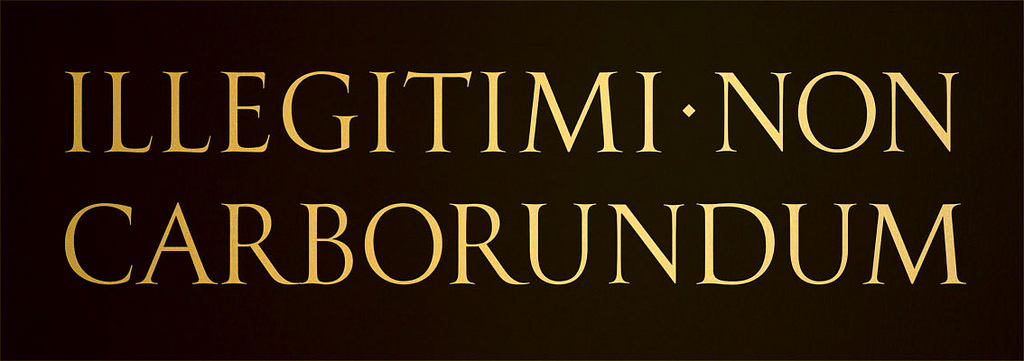
Illegitimi Non Carborundum (no matter who they are)

ImageThe aphorism “illegitimi non carborundum.” is mock-Latin for “don’t let the bastards grind you down.”

This isn’t about handling the countless rejection letters you’ll receive if you plan to purse writing as a profession. That’s already been addressed in a previous post.

I’m talking about the little things—–the offhanded comments, the pieces of friendly advice, the hard doses of reality (meant for your own good, of course)—–that chip away at your self-confidence bit by bit and make you want to turn your back on writing.

Maybe you’re no good at it, maybe you’ll never make it as a writer, maybe you’ll never finish that novel, maybe you’ll never get your name out there, maybe no one will ever pay you for what you’ve written. So what? I’ve said it once before but it bears repeating: if you want to write, write.

You don’t need to justify your desire to do so. Ever. To anyone.

Sally forth and be writeful.

Simple Anatomy of a Plot Outline

Image

Somewhere between the synopsis and the treatment lies the plot outline, also known as a one page. Typically one-to-three pages in length, the plot outline is the bare bones of your story before it’s fleshed out with action description and dialogue.

Although there are no hard and fast rules on the level of detail that should be included, a standard plot outline generally contains:

  1. The protagonist and their goal.
  2. The antagonist and their goal.
  3. The supporting cast and their main wants.
  4. The five major plot points (as mentioned in a previous post)
  5. The order of events and sequences.
  6. A list of scenes that properly convey the story.

Every Picture Tells A Story, Though Not Always A Good One

It’s easy to put the boots to M. Night Shyamalan whenever he debuts a new film, but the fact of the matter is as long as Lady In The Water, The Happening and The Last Airbender exist, After Earth will never be considered his worst film.

The story, conceived by Will Smith while he was watching an episode of I Shouldn’t Be Alive, was originally meant to tell the tale of a father and son crashing their car in some remote region, and the son having to venture into rough terrain to get rescue for his father. Will later changed it to:

after-earth-1a

A crash landing leaves Kitai Raige and his father Cypher stranded on Earth, 1,000 years after events forced humanity’s escape. With Cypher injured, Kitai must embark on a perilous journey to signal for help.

It’s a simple story, which is what you should strive for when creating fiction. So, why doesn’t it work (apart from the wooden acting and bizarre futuristic southern military accents)? What storytelling lessons can you learn from After Earth?

1. When good exposition goes bad – Avoiding exposition is nigh-impossible when dealing with science fiction set in the future. In the case of After Earth, the audience needs to be brought up to speed on why humans fled the planet one thousand years ago, as well as being introduced to the new homeworld, Nova Prime. And that’s where it should end. Everything else the audience needs to know should be introduced organically. The one thing you should not use your opening expository scene for is telegraphing the solution for the climax of the story. It’s lazy and a cheat.

2. The protagonist/antagonist relationship – Even with coming of age stories, which After Earth is—–well, that and a motivational speech dressed up as a sci-fi actioner—–the strength and audience interest lies in the conflict found in the relationship between the protagonist and antagonist. The reason After Earth doesn’t ring true isn’t because the protagonist, Kitai, is weak—possessing a weakness that must be overcome is exactly what any good story needs.

The first problem is the antagonist. The thing that combats Kitai in the film is nature—which is filled with its fair share of animal and insect nasties (plus one blast from Kitai’s past, conveniently placed to help him arc properly)—but it doesn’t oppose him. There isn’t one beast that stalks him with animal cunning and outflanks him at every turn, with the ultimate goal of turning him into a tasty morsel. The wilderness isn’t planting snares and death traps in his path to prevent him from reaching his destination.

Not that either of those scenarios are particularly original or great, but something else is needed than to have Kitai stumble and bumble his way through unfamiliar and dangerous terrain. I would have been more invested if he actively tried to outwit the environment and was constantly met with defeat. At least then he would have gained some insight. We learn from mistakes.

Which is the problem I had with the resolution. At the all is lost stage, Kitai suddenly masters the gimmick that allows him to prevail in the end. Without obtaining the wisdom or acquiring the experience to properly do so. And again, it’s a cheat and lazy storytelling.

3. Telegraphing – Some writers mistake this with foreshadowing—the act of dropping hints about certain plot developments that will come to be later in the story. The difference between them? Telegraphing is giving away too much, too soon, thereby ruining the suspense, or the impact of the event.

Before using foreshadowing, have a good think. Is it necessary to heighten the tension? It can be difficult knowing which side of the line you’re on, so if you’re attempting to foreshadow, you should ask yourself if there’s any chance the audience can predict what you’re hinting at? If the answer is yes, take a good look around. You’re standing in telegraph territory. Try a subtler approach.

4. Flashbacks – It’s amazing how many screenwriters still get this wrong by thinking flashback sequences serve the purpose of filling in plot holes in the past. A well-constructed flashback should always move the story forward. Always. If your flashback doesn’t accomplish this, you need to rework your story and find a way to introduce whatever bit of information is missing from your plot.

In After Earth, we have dueling flashback sequences, one set belonging to Cypher which explains his estrangement from his son and the other set telegraphing Kitai’s final obstacle. Nether of these string-of-past-event-sequences impact the present day story, nor do they escalate the conflict. The just provide information that could have be delivered during the Act 1 set-up.

Naturally, there are other problems I had with this film, but delving into them would reveal too many spoilers, so I’ll just end the post here. If you happen to see the film and want to discuss it, feel free to comment below or drop me a line.

Sally forth and be writeful.

Skip The Tell And Bring On The Show

shhhh1

“Show, don’t tell” is one of those bits of advice that gets handed to aspiring writers in writing courses, advice columns, blogs, seminars, and while it may seem simple on the surface, many scribes can’t differentiate the two in their own work.

Telling a story is the blunt delivery of facts. “She was pretty.” “He was hungry.” “They were angry.” Yes, it does get straight to the heart of the matter, which makes it ideal for journalism and academia. But for prose it’s too antiseptic and puts distance between your work and your audience. Your goal as a writer is to immerse the audience into the world and allow them to experience things, people and places for themselves.

How does pretty look on this woman? Is it in the way her terracotta hair carelessly cascades over her delicate shoulders? Or do her eyes have a certain indefinable sparkle to them, making them alluring and sensual, with a touch of mischief? How would you describe hunger? The growling of a stomach and salivation in response to the Pavlovian stimuli of the school lunch bell? And anger, believe it or not, offers you a larger palette to paint from when you explore the other emotions—hurt, fear, grief, exhaustion—at play within it.

So, how do you bring the “show” into your writing?

1. Dialogue – This is the easiest way to let your audience experience a character’s mood and emotions. The catch is to avoid “on the nose” dialogue (I’ll get more into this in another post) which simply means having a character say exactly what they mean. Not only is it bland and boring, it’s unrealistic. In real life people speak in subtext, hinting and beating around the bush, secretly nudging conversation toward what they want to know and even then have to decipher the other person’s true meaning.

2. Sensory language – Using words and details to add color and depth to writing by appealing to your audience’s senses (sight, touch, taste, hearing, smell, emotion) in order to let them fully experience what you’re writing about.

3. More descriptive, less adjectives – The tendency of most fledgling writers is to slap a string of adjectives together to describe an action or scene. But being descriptive is actually about selecting the right words and using them in moderation to put your meaning across. Remember: Adjectives tell. Verbs show.

4. Be specific – Want to frustrate your audience? Try using fuzzy language. Offering up vague sentences like, “It was a pleasant night”, “She was a strange-looking girl”, “His life was a mess”, doesn’t serve you as a writer. Why not invest the time and effort into describing the feeling of a scene and working out the best way convey it to your audience?

Does this mean everything you write should be “showing”? Of course not. Especially when you’re dealing with the dull bits of the story such as travel, transitions, unimportant characters, etc. Instead of boring your audience by expounding on necessary but not particularly interesting details, just say it and move on.

Speaking of moving on, I’m out of here. Sally forth and be writeful.