Famous Authors Reveal Their Writing Secrets (go on, you know you wanna look)

1. “The secret of getting ahead is getting started. The secret of getting started is breaking your complex overwhelming tasks into small manageable tasks, and then starting on the first one.” — Mark Twain

2. “People on the outside think there’s something magical about writing, that you go up in the attic at midnight and cast the bones and come down in the morning with a story, but it isn’t like that. You sit in back of the typewriter and you work, and that’s all there is to it.” — Harlan Ellison

3. “The secret is to start a story near the ending.” — Chris Offut

4. “The secret of successful fiction is a continual slight novelty.” — Edmund Gosse

5. “The big secret is the ability to stay in the room.” — Ron Carlson

6. “The secret to being a writer is that you have to write. It’s not enough to think about writing or to study literature or plan a future life as an author. You really have to lock yourself away, alone, and get to work.” — Augusten Burroughs

7. “It’s hard to explain how much one can love writing. If people knew how happy it can make you, we would all be writing all the time. It’s the greatest secret of the world.” — Andrea Barrett

8. “Composition is a discipline; it forces us to think. If you want to “get in touch with your feelings,” fine—talk to yourself; we all do. But, if you want to communicate with another thinking human being, get in touch with your thoughts. Put them in order; give them a purpose; use them to persuade, to instruct, to discover, to seduce. The secret way to do this is to write it down and then cut out the confusing parts.” — William Safire

9. “The secret of it all, is to write in the gush, the throb, the flood, of the moment – to put things down without deliberation – without worrying about their style – without waiting for a fit time or place. I always worked that way. I took the first scrap of paper, the first doorstep, the first desk, and wrote – wrote, wrote…By writing at the instant the very heartbeat of life is caught.” — Walt Whitman

10. “If there is a secret to writing, I haven’t found it yet. All I know is you need to sit down, clear your mind, and hang in there.” — Mary McGrory

Stop making that face. Did you really think you were going to uncover some magical shortcut to get you through the sometimes torturous process of writing? Ain’t I done learnt y’all better’n that? You go on now, here? And enjoy your weekend.

Sally forth and be secretly writeful.

— Rhyan Scorpio-Rhys

Writing Style Is the Dress of Thoughts

Parsing prose. Syntactical structure. Conceptual framework. Your writing style is the voice you use to speak to your audience and is more than just diction and the words you choose, as it offers a glimpse at your true personality. It takes the literal and transforms it into a subjective expression that evokes an emotional response from the reader.

As to how you develop a writing style… you write. Write what comes natural to you. Write without worrying about acceptance or being published. Write without concentrating on influences. But you’ve heard me bang on about this already, so I invited a few friends to help get you into the proper frame of mind:

1. “A good style must, first of all, be clear. It must not be mean or above the dignity of the subject. It must be appropriate.” — Aristotle

2. “Don’t say you were a bit confused and sort of tired and a little depressed and somewhat annoyed. Be tired. Be confused. Be depressed. Be annoyed. Don’t hedge your prose with little timidities. Good writing is lean and confident.” — William Zinsser

3. “Carefully examined, a good–an interesting–style will be found to consist in a constant succession of tiny, unobservable surprises.” — Ford Maddox Ford

4. “A good style should show no sign of effort. What is written should seem a happy accident.” — W. Somerset Maugham

5. “A strict and succinct style is that, where you can take away nothing with­out loss, and that loss to be manifest.” — Ben Jonson

6. “The hardest thing about writing, in a sense, is not writing. I mean, the sentence is not intended to show you off, you know. It is not supposed to be “look at me!” “Look, no hands!” It’s supposed to be a pipeline between the reader and you. Once condition of the sentence is to write so well that no one notices that you’re writing.” — James Baldwin

7. “The greatest possible mint of style is to make the words absolutely disappear into the thought.” — Nathaniel Hawthorne

8. “When you say something, make sure you have said it. The chances of your having said it are only fair.” — E.B. White

9. “I am well aware that an addiction to silk underwear does not necessarily imply that one’s feet are dirty. Nonetheless, style, like sheer silk, too often hides eczema.” — Albert Camus

10. “It was from Handel that I learned that style consists in force of assertion. If you can say a thing with one stroke, unanswerably you have style; if not, you are at best a marchande de plaisir, a decorative litterateur, or a musical confectioner, or a painter of fans with cupids and coquettes. Handel had power.” — George Bernard Shaw

11. “Who cares what a man’s style is, so it is intelligible, as intelligible as his thought. Literally and really, the style is no more than the stylus, the pen he writes with; and it is not worth scraping and polishing, and gilding, unless it will write his thoughts the better for it. It is something for use, and not to look at.” — Henry David Thoreau

12. “People think that I can teach them style. What stuff it all is! Have something to say, and say it as clearly as you can. That is the only secret of style.” — Matthew Arnold

13. “Style is the dress of thoughts; and let them be ever so just, if your style is homely, coarse, and vulgar, they will appear to as much disadvantage.” — Philip Dormer Stanhope, Earl of Chesterfield

14. “A man’s style should be like his dress. It should be as unobtrusive and should attract as little attention as possible.” — C. E. M. Joad

15. “The style is the man himself.” — George-Louis Leclerc de Buffon

16. “The old saying of Buffon’s that style is the man himself is as near the truth as we can get–but then most men mistake grammar for style, as they mistake correct spelling for words or schooling for education.” — Samuel Butler

17. “When we see a natural style, we are astonished and delighted; for we expected to see an author, and we find a man.” — Blaise Pascal

18. “Style is the hallmark of a temperament stamped upon the material at hand.” — Andre Maurois

19. “The essence of a sound style is that it cannot be reduced to rules–that it is a living and breathing thing with something of the devilish in it–that it fits its proprietor tightly yet ever so loosely, as his skin fits him. It is, in fact, quite as seriously an integral part of him as that skin is. . . . In brief, a style is always the outward and visible symbol of a man, and cannot be anything else.” — H.L. Mencken

20. “You do not create a style. You work, and develop yourself; your style is an emanation from your own being.” — Katherine Anne Porter

21. “Style is the perfection of a point of view.” — Richard Eberhart

22. “Where there is no style, there is in effect no point of view. There is, essentially, no anger, no conviction, no self. Style is opinion, hung washing, the caliber of a bullet, teething beads.” — Alexander Theroux

23. “Style is that which indicates how the writer takes himself and what he is saying. It is the mind skating circles around itself as it moves forward.” — Robert Frost

24. “What’s important is the way we say it. Art is all about craftsmanship. Others can interpret craftsmanship as style if they wish. Style is what unites memory or recollection, ideology, sentiment, nostalgia, presentiment, to the way we express all that. It’s not what we say but how we say it that matters.” — Federico Fellini

25. “Proper words in proper places, make the true definition of style.” — Jonathan Swift

26. “The web, then, or the pattern, a web at once sensuous and logical, an elegant and pregnant texture: that is style.” — Robert Louis Stevenson

27. “The most durable thing in writing is style, and style is the most valuable investment a writer can make with his time. It pays off slowly, your agent will sneer at it, your publisher will misunderstand it, and it will take people you have never heard of to convince them by slow degrees that the writer who puts his individual mark on the way he writes will always pay off.” — Raymond Chandler

28. “The style of an author should be the image of his mind, but the choice and command of language is the fruit of exercise.” — Edward Gibbon

29. “One arrives at style only with atrocious effort, with fanatical and devoted stubbornness.” — Gustave Flaubert

30. “To me style is just the outside of content, and content the inside of style, like the outside and the inside of the human body. Both go together, they can’t be separated.” — Jean-Luc Godard

31. “Thought and speech are inseparable from each other. Matter and expression are parts of one; style is a thinking out into language.” — Cardinal John Henry Newman

32. “In matters of grave importance, style, not sincerity, is the vital thing.” — Oscar Wilde

33. “Style, in its finest sense, is the last acquirement of the educated mind; it is also the most useful. It pervades the whole being.” — Alfred North Whitehead

34. “Style is not something applied. It is something that permeates. It is of the nature of that in which it is found, whether the poem, the manner of a god, the bearing of a man. It is not a dress.” — Wallace Stevens

35. “All my stories are webs of style and none seems at first blush to contain much kinetic matter. . . . For me ‘style’ is matter.” — Vladimir Nabokov

And if I may tack on a few extras pieces of advice: don’t forget to take risks, give voice to that quirkiness of thought that you possess, avoid clichés, if at all possible, be concise and precise, and develop a keen sense of word choice.

Oh, and be patient. Style is a thing that can’t be rushed and it might take a while for yours to become evident, but you’ll know when it finally arrives. Words will flow easier, you’ll feel more comfortable with the act of writing, and you’ll be able to recognize that identifiable cadence that belongs to only one person in the world… you.

Sally forth and be writeful… in style.

— Rhyan Scorpio-Rhys

To Save or Not to Save (the Cat): That is the Question

save-the-cat
“There’s this inherent screenplay structure that everyone seems to be stuck on, this three-act thing. It doesn’t really interest me. To me, it’s kind of like saying, ‘Well, when you do a painting, you always need to have sky here, the person here and the ground here.’ Well, you don’t.” — Charlie Kaufman

“Oyez, Oyez, Oyez!” That’s the town crier outside your window, all decked out in a red and gold robe, white breeches, black boots and a tricorne hat, clanging his handbell and making the public pronouncement that “Hollywood is broken!”

A statement which isn’t close to being accurate. Even if the industry fails to rake in the desired opening weekend profits from their current crop of mega-budget box office bombs, it will continue to churn out content even if it has to scale back production costs and cut salaries to do so. The real problem with Hollywood lies within its mindset, the outdated mode of thinking it still employs.

The simple fact is what used to work a few years ago no longer does and unless you’re Amish, a hermit, a bunkered-in end-of-the-world survivalist, or possess a serious dislike for 24-frame-per-second entertainment, you’ll have noticed a decline of late in the quality of Hollywood movies. And you’re not alone. Not only has theater attendance been dwindling and the grousing of movie critics and cinema snobs increased regarding the lack of originality springing from the loins of Tinseltown–particularly during this painful remake, reboot and prequel/sequel franchise phase—but even the average LCD movie-goer has begun to experience a touch of ennui in the midst of all the fast-paced, mind-baffling CGI and excessive explosions.

No big news if you’re a screenwriter, aspiring or otherwise, as this has been a source of debate and complaint for a couple of years now and it didn’t truly become headline worthy until Steven Spielberg and George Lucas spoke at USC, weighing in on the subject and predicting the inevitable “implosion” in the mega-budget film industry. Which, of course, led to a series of articles speculating, finger-pointing and assigning blame.

The latest target is American screenwriter Blake Snyder, who released a screenwriting manual in 2005, Save the Cat! The Last Book on Screenwriting You’ll Ever Need. His book provided a by-the-minute pattern for screenwriting, which included 15 essential plot points or beats that all scripted stories should contain (the example below is based on a screenplay 110 pages in length ):

1. Opening Image (Pg. 1) – Is a snapshot of the world before this story begins.

2. Theme Stated (Pg. 5) – Where you state what your movie is about before the adventure begins.

3. Set-Up (Pgs. 1-10) – The introduction to the world, the protagonist and the overall problem within the story.

4. Catalyst (Pg. 12) – Often referred to as the inciting incident, this is the point where something happens within your protagonist’s world that sets the story into motion.

5. Debate (Pgs. 12-25) – Though it’s obvious that your protagonist must accept the “call to adventure,” he/she doubts the journey they must take.

6. Break into Two (Pg. 25) – Your protagonist has faced the now-or-never choice and proactively steps into Act 2 where the story begins to ramp up.

7. B Story (Pg. 30) – Usually associated with the “love” story, this is where the protagonist encounters the person to whom they can confide what’s happening. But the role isn’t restricted to a love interest — it can be a Mentor, or a bunch of new characters that will help the protagonist understand this strange new place, assist him/her, and teach them the lesson of the journey.

8. Fun and Games (Pgs. 30-55) – This is where you find your “trailer moments.” The plot gets put on hold as your protagonist explores the new world (essentially it’s your pitch for the movie when it comes time to sell it).

9. Midpoint (Pg. 55) – Is the “no turning back” part of your movie, where your protagonist faces a whole new problem — even bigger than the one they started out with. This is where we get either a “false victory” (high) or a “false defeat” (low). It’s also where “time clocks” appear to pick up the pace of the story and rush to the end.

10. Bad Guys Close In (Pgs. 55-75) – From this point, both internal (problems inside the protagonist’s team) and external (the antagonists tighten their grip) pressure is applied that makes life tough for the hero.

11. All Is Lost (Pg. 75) – Something (an old belief system) or someone (the mentor) dies at this point in the story, forcing the protagonist to change in order to grow into the person they need to be to accomplish their goal(s).

12. Dark Night of the Soul (Pgs. 75-85) – The “Why hast thou forsaken me?” part where the protagonist is bereft and wondering, “Now what?” They have lost all hope.

13. Break into Three (Pg. 85)
– But thanks to a fresh idea, new inspiration, or last-minute advice or information from that person representing the B Story, the protagonist takes a proactive step into Act 3, devising a brand new plan of action and committing to going all the way!

14. Finale (Pgs. 85-110) – By adding what he’s learned to what he was before, the protagonist applies all that they are in a brand new way. Here is when your hero is at the doorstep of defeat yet “digs deep down” for that last ounce of strength — and faith — to triumph!

15. Final Image (Pg. 110) – Since all stories are about “transformation,” this is reverse of the Opening Image, a “snapshot of the world after,” proves that a change has occurred within the protagonist and their world.

Unfortunately, Mr. Snyder passed away in 2009 and is unable to defend himself, but is his book actually the reason that more and more people are becoming disenchanted with new releases? Screenwriters fall on both sides of this argument. There are those who see Save The Cat as a boon since the book instructs writers on producing unique, hot concepts, requires that they carry out the “promise of the premise” and beseeches them to “escalate the stakes” with full force in a bold new manner. While others think Mr. Snyder’s formula is best suited for high concept family comedies and has no business being applied to adult-themed stories that operate in black/grey moralities, as shoehorning them into the rigid 15 beat structure chokes the life out of the original work.

When it comes to the subject of creating beat sheets, not to sound like a fence-rider, but I find myself being both pro and con. On the plus side, hats off to Mr. Snyder for analyzing the composition of Hollywood films and further segmenting the 3 Act structure into smaller more manageable parts, much in the same way Gustav Freytag did in the nineteenth century with stage plays (see: Climbing The Freytag Pyramid). It really does help you gain a better understanding of the basic anatomy of an average studio-produced movie.

On the negative side, you have what I call the Nostradamus Effect, and if you’ve watched more than a handful of movies in your lifetime, you’ve experienced it to some degree. It occurs whilst viewing a film and suddenly you’re able to predict all the salient plot points, the futures of the supporting characters, and spot each and every twist and turn as if you’ve read them on signposts a mile off. That’s your brain recognizing the pattern, the formula. And I firmly believe that formulas cannot produce art, nor can they possess the spontaneity necessary to shock and surprise the modern day movie audience.

Having said that, I take a “Hey, man, whatever gets you writing” approach to Mr. Snyder’s methods when it applies to other writers. And that’s not to say that I don’t use the Save The Cat formula on occasion, but only when a stubborn story refuses to take shape. Once I get that bad boy locked down, I shake things up accordingly in the rewrite. Rules are meant to be broken, after all, and any writer worth their salt knows this. But guess who doesn’t? Yup, the rest of the industry.

Studios employ script readers who provide coverage–the analysis and grading of screenplays with Pass/Fail marks—which takes the whole beat system a bit too literally about hitting all the 15 marks on exact page counts. And if a script happens to be lucky enough to make it past these literary sentries, it will go through an additional series of rewrites by various screenwriters, adding studio-suggested bits stolen from other popular films “that worked previously”—whether the recycled bits fit the theme of the current script or not–often resulting in a frankenfilm. Sorry, you can’t hang that on Save The Cat.

I can’t tell you the number of early draft screenplays I’ve read that were far and away superior to the finished product. A few recent ones that come to mind are: Jon Spaihts’ “Alien Engineers” (Prometheus), Evan Daugherty’s “Snow White and the Huntsman,” and Kurt Wimmer’s “Edwin A. Salt” (Salt).

In closing I’d like to invite all the doomcasters to stop picking on a dead man whose system is quite possibly the victim of misuse and put their sandwich boards away. Hollywood is getting a much needed wake-up call–thanks in no small part to the internet and other modes of content distribution–and isn’t in danger of imploding, it’s just experiencing some growing pains. The first thing it needs to do, in the process of mitigating its risk in the creation of new product, is to focus a little more on forecasting what will sell tomorrow (#innovation) rather than duplicating what sold yesterday.

Sally forth and be structurally knowledgeable yet rule-breakingly writeful.

– Rhyan Scorpio-Rhys

Joyce Carol Oates’ Top 10 Tweet Tips on Writing

1) Write your heart out.

2) The first sentence can be written only after the last sentence has been written. FIRST DRAFTS ARE HELL. FINAL DRAFTS, PARADISE.

3) You are writing for your contemporaries–not for Posterity. If you are lucky, your contemporaries will become Posterity.

4) Keep in mind Oscar Wilde: “A little sincerity is a dangerous thing, and a great deal of it is absolutely fatal.”

5) When in doubt how to end a chapter, bring in a man with a gun. (This is Raymond Chandler’s advice, not mine. I would not try this.)

6) Unless you are experimenting with form–gnarled, snarled & obscure–be alert for possibilities of paragraphing.

7) Be your own editor/ critic. Sympathetic but merciless!

8) Don’t try to anticipate an ideal reader–or any reader. He/ she might exist–but is reading someone else.

9) Read, observe, listen intensely!–as if your life depended upon it.

10) Write your heart out.

Eleven Thoughts on Fiction

1. “Fiction reveals truths that reality obscures.” — Jessamyn West

2. “Truth may be stranger than fiction, but fiction is truer.” — Frederic Raphael

3. “Fiction’s about what it is to be a human being.” — David Foster Wallace

4. “First-rate fiction lays hands on the reader, to heal him or rough him up or, ideally, to do both.” — Ellen Currie

5. “The trouble with fiction is that it makes too much sense, whereas reality never makes sense.” — Aldous Huxley

6. “Details make stories human, and the more human a story can be, the better.” — V.S. Pritchett

7. “Character is the very life of fiction. Setting exists so that the character has someplace to stand. Plot exists so the character can discover what he is really like, forcing the character to choice and action. And theme exists only to make the character stand up and be somebody.” — John Gardner

8. “In writing fiction, the more fantastic the tale, the plainer the prose should be. Don’t ask your readers to admire your words when you want them to believe your story.” — Ben Bova

9. “Basically, fiction is people. You can’t write fiction about ideas.” — Theodore Sturgeon

10. “Structure is the key to narrative. These are the crucial questions any storyteller must answer: Where does it begin? Where does the beginning start to end and the middle begin? Where does the middle start to end and the end begin?” — Nora Ephron

11. “Fiction is a lie, and good fiction is the truth inside the lie.” — Stephen King

The Three Characteristics of Successful Fiction

Three characteristics a work of fiction must possess in order to be successful:

1. It must have a precise and suspenseful plot.

2. The author must feel a passionate urge to write it.

3. He must have the conviction, or at least the illusion, that he is the only one who can handle this particular theme.

— Isaac Bashevis Singer

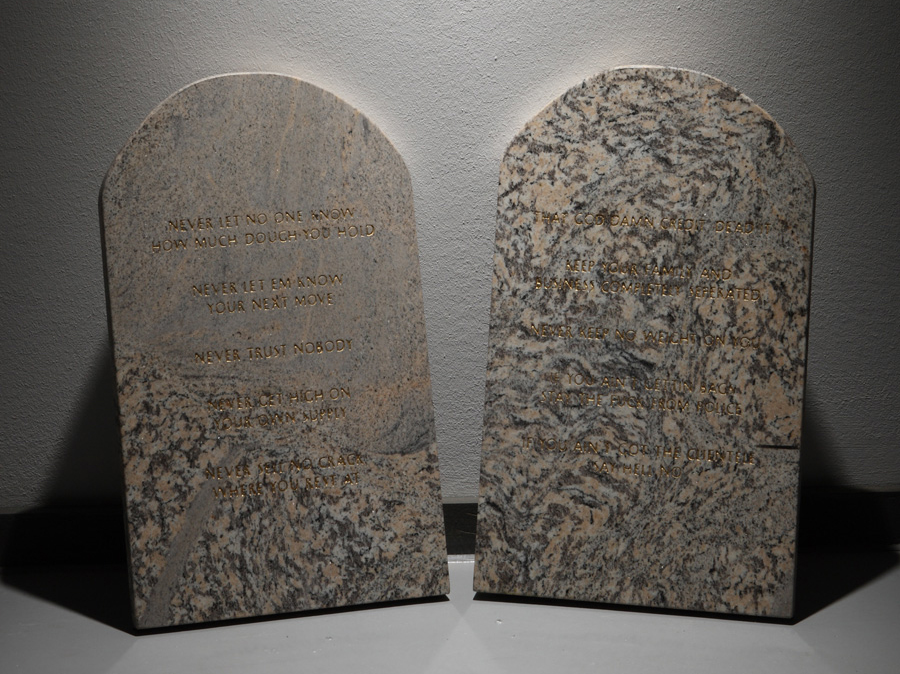
The Ten (Plus Four) Commandments (of Writing)

10crack-commandments

1. “The one great rule of composition is to speak the truth.” — Henry David Thoreau

2. “If you require a practical rule of me, I will present you with this: Whenever you feel an impulse to perpetrate a piece of exceptionally fine writing, obey it–wholeheartedly–and delete it before sending your manuscript to press. Murder your darlings.” — Arthur Quiller-Couch

3. “The best rule for writing–as well as for speaking—is to use always the simplest words that will accurately convey your thought.” — David Lambuth

4. “There are simple maxims . . . which I think might be commended to writers of expository prose. First: never use a long word if a short one will do. Second: if you want to make a statement with a great many qualifications, put some of the qualifications in separate sentences. Third: do not let the beginning of your sentence lead the readers to an expectation which is contradicted by the end.” — Bertrand Russell

5. “I have made three rules of writing for myself that are absolutes: Never take advice. Never show or discuss a work in progress. Never answer a critic.” — Raymond Chandler

6. “There are three rules for writing the novel. Unfortunately, no one knows what they are.” — W. Somerset Maugham

7. “Writing has laws of perspective, of light and shade, just as painting does, or music. If you are born knowing them, fine. If not, learn them. Then rearrange the rules to suit yourself.” — Truman Capote

8. “There is probably some long-standing “rule” among writers, journalists, and other word-mongers that says: “When you start stealing from your own work you’re in bad trouble.” And it may be true.” — Hunter S. Thompson

9. “If I were to advise new writers, if I were to advise the new writer in myself, going into the theater of the Absurd, the almost-Absurd, the theater of Ideas, the any-kind-of-theater-at-all, I would advise like this:

  • Tell me no pointless jokes. I will laugh at your refusal to allow me laughter.
  • Build me no tension toward tears and refuse me my lamentations. I will go find me better wailing walls.
  • Do not clench my fists for me and hide the target. I might strike you, instead.
  • Above all, sicken me not unless you show me the way to the ship’s rail.”

Ray Bradbury

10. “Breslin’s Rule: Don’t trust a brilliant idea unless it survives the hangover.” — Jimmy Breslin

11. “One of the great rules of art: Do not linger.” — Andre Gide

12. “Do not pay any attention to the rules other people make…. They make them for their own protection, and to Hell with them.” — William Saroyan

13. “Over the years, I’ve found one rule. It is the only one I give on those occasions when I talk about writing. A simple rule. If you tell yourself you are going to be at your desk tomorrow, you are by that declaration asking your unconscious to prepare the material. You are, in effect, contracting to pick up such valuables at a given time. Count on me, you are saying to a few forces below: I will be there to write.” — Norman Mailer

14. “I’ll give you the sole secret of short-story writing, and here it is: Rule 1. Write stories that please yourself. There is no rule 2. The technical points you can get from Bliss Perry. If you can’t write a story that pleases yourself, you will never please the public. But in writing the story forget the public.” — O. Henry

Of Inspiration and Imagination

Imagination_by_t1nus

1. “Imagination is the real and eternal world of which this vegetable universe is but a faint shadow.” — William Blake

2. “An idea, like a ghost, must be spoken to a little before it will explain itself.” — Charles Dickens

3. “If writers had to wait until their precious psyches were completely serene there wouldn’t be much writing done.” — William Styron

4. “I sit in the dark and wait for a little flame to appear at the end of my pencil.” — Billy Collins

5. “Use your imagination. Trust me, your lives are not interesting. Don’t write them down.” — W.P. Kinsella

6. “You get ideas from daydreaming. You get ideas from being bored. You get ideas all the time. The only difference between writers and other people is we notice when we’re doing it.” — Neil Gaiman

7. “You go to the attic of your mind and rummage around and find something.” — Mary Higgins Clark

8. “Thinking is the enemy of creativity. It’s self-conscious, and anything self-conscious is lousy. You can’t try to do things. You simply must do things.” — Ray Bradbury

The Best Judge of Character? Why, 10 Famous Authors, Naturally

quote-judge-of-your-natural-character-by-what-you-do-in-your-dreams-ralph-waldo-emerson-57859

1. “Creation of character is, like much of fiction writing, a mixture of subjective feel and objective control.” — Julian Barnes

2. “Characters are not created by writers. They pre-exist and have to be found.” — Elizabeth Bowen

3. “The characters that I create are parts of myself and I send them on little missions to find out what I don’t know yet.” — Gail Godwin

4. “I don’t have a very clear idea of who the characters are until they start talking.” — Joan Didion

5. “I visualize the characters completely; I have heard their dialogue. I know how they speak, what they want, who they are, nearly everything about them.” — Joyce Carol Oates

6. “When I write, I live with my characters. It’s like going to work. You see the people at the next desk in full regalia all the time, and you know where they came from and where they are going. The point is to define the nuances of everything that’s happening with them and to find the element of their lives that is fascinating enough to record. That takes a lot of doing.” — William Kennedy

7. “Don’t write about a character. Become that character, and then write your story.” — Ethan Canin

8. “The character that lasts is an ordinary guy with some extraordinary qualities.” — Raymond Chandler

9. “It doesn’t matter if your lead character is good or bad. He just has to be interesting, and he has to be good at what he does.” — David Chase

10. “Think of your main characters as dinner guests. Would your friends want to spend ten hours with the characters you’ve created? Your characters can be loveable, or they can be evil, but they’d better be compelling.” — Po Bronson

Elizabeth Bowen’s 7 Tips on Approaching Dialogue

1. Dialogue should be brief.

2. It should add to the reader’s present knowledge.

3. It should eliminate the routine exchanges of ordinary conversation.

4. It should convey a sense of spontaneity but eliminate the repetitiveness of real talk.

5. It should keep the story moving forward.

6. It should be revelatory of the speaker’s character, both directly and indirectly.

7. It should show the relationships among people.