
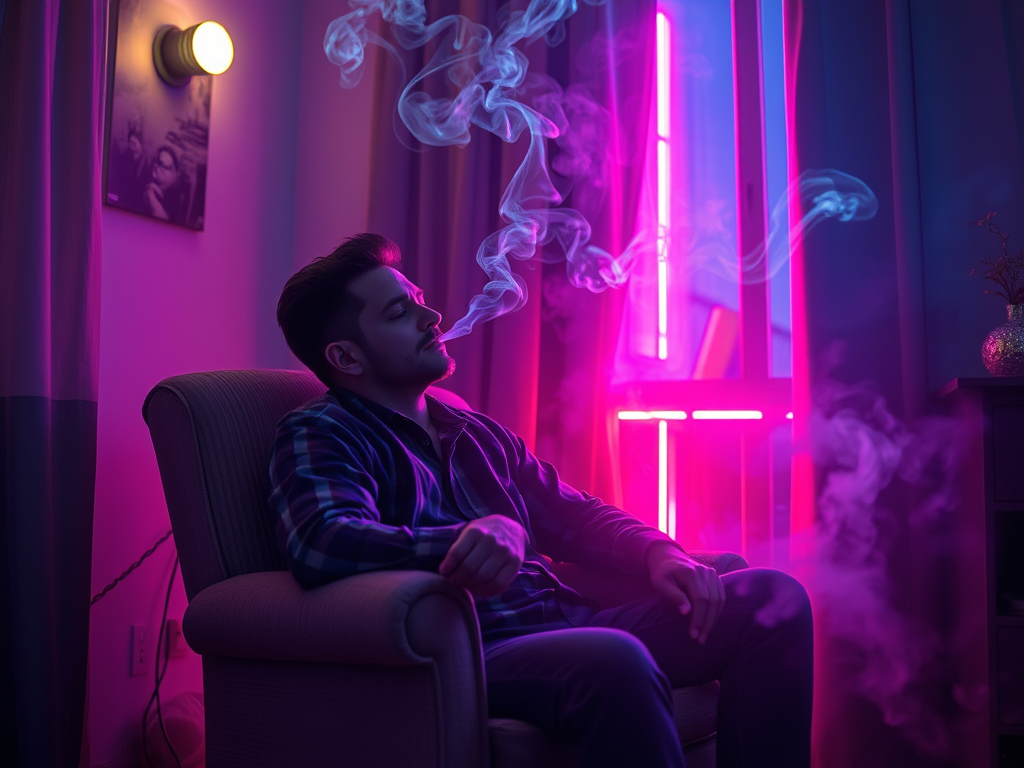
The world below, a sprawling constellation of indifferent lights, looked like a half-forgotten dream from Jacob’s perch. He wasn’t physically elevated, not in any conventional sense. His kingdom was a threadbare armchair, angled just so, in a third-floor apartment that smelled faintly of old takeout and the sweet, acrid tang of his chosen sacrament. The city’s neon blush, a vibrant, vulgar poetry, seeped through the cheap plastic blinds, striping the walls with fractured, greasy rainbows that writhed with the passing traffic. Smoke, a silver-grey exhalation, curled upward from the glowing tip nestled between his fingers, delicate and deliberate as a whispered prayer, before dissolving into the murky shadows clinging to the popcorn ceiling.
In this moment, suspended between the tick of the clock and the tock of his own weary heart, Jacob felt blessedly, terrifyingly weightless. The familiar leaden weight that usually sat squarely on his chest, a constant companion of dread and obligation, seemed to dissolve, molecule by molecule, into the smoky air. The insistent gnawing of unpaid bills, the spectral echo of his boss’s disappointed drone from the dead-end data entry job he barely tolerated, the heavy silence from friends he’d long since alienated with his increasingly erratic orbit – all of it melted away. What remained was a soft, pervasive hum, the thrum of existence stripped bare, a fundamental frequency.
Colors, those fractured rainbows on the wall, pulsed with an impossible vibrancy, the chipped paint on the windowsill glowing like an ancient manuscript. The edges of reality softened, grew pliable, as if the mundane world were merely a preliminary sketch for something far grander. And somewhere in that luminous haze, a presence nudged at the periphery of his consciousness. Not a voice, not in words he could parse, but an undeniable knowing, a pressure as gentle and insistent as a rising tide.
It’s okay, the presence seemed to murmur, not in his ears but directly into the core of his being. You’re okay. You are held.
This was not the usual narrator of his internal landscape. That voice, the one that accompanied him through the stark, unforgiving daylight hours of sobriety, was a cruel, meticulous accountant of his failings. It kept a running tally of overdue rent, missed calls from his worried mother, creative projects abandoned in fits of self-loathing, the ghostly outline of the artist he’d once dreamed of becoming. That voice was a taunt, a jeer, a constant, grating reminder of his inadequacy.
But this… this was different. This resonant hum, this gentle pressure, felt… holy. Like cool water on a parched throat.
He exhaled a long, slow plume of smoke, watching it twist and billow. One particular gyre, caught in a stray beam of crimson light from the liquor store sign across the street, momentarily coalesced into a shape that tugged at a distant memory: the vaulted ceiling of St. Michael’s, the church his grandmother, a woman of simple, unshakeable faith, had dragged him to every Sunday of his childhood. He remembered the place with a child’s sensory acuity: the cool, dusty smell of old wood and beeswax, the slightly intimidating grandeur of the altar, the way sunlight, filtered through stained glass, shattered into kaleidoscopic beams that danced on the polished pews, painting fleeting jewels on the bowed heads of the congregation. Back then, the sermons had been baffling riddles, the rituals a series of performative gestures devoid of meaning, the hymns a mournful drone. He’d fidgeted, counting the minutes until release.
But now, adrift in this smoky sanctuary, bathed in the profane glow of the city, he felt a flicker of understanding, or perhaps the illusion of it. The universe, vast and terrifyingly incomprehensible, indifferent to his small, sputtering existence, suddenly felt… intimate. Here he was, Jacob, a microscopic speck adrift in its endless, churning expanse, yet in this fleeting moment, he felt an undeniable, resonant connection to something utterly divine. He couldn’t name it – God, Brahman, the Tao, the Oversoul, the Universe Itself, or perhaps, as the sober part of his brain would later sneer, simply the neurotransmitters firing in a pattern induced by his chosen escape. Whatever its origin, the feeling was profoundly, viscerally real.
For the first time in months, maybe years, Jacob allowed himself to close his eyes, the neon light painting his eyelids a bruised purple, and pray. Not the rote, memorized phrases of his childhood, the lifeless “Our Fathers” and “Hail Marys” mumbled under duress. This was something raw, stripped-down, a desperate flare sent up from the sinking ship of his soul.
If you’re out there… The words formed in his mind, ragged and uncertain. If any of this is real… please… just show me. Let me feel this, just for tonight. Let it be enough.
The music playing softly from his cheap laptop – some ambient, ethereal electronica he’d found online – seemed to swell in response. The bass, usually a subtle undercurrent, resonated deep within his chest, a second, truer heartbeat. He could almost imagine it, the air thick with unseen presences, angels perhaps, their voices not in song, but in the harmonic convergence of the synthesized chords, their wings the shimmering patterns the smoke made against the darkness. Tears, hot and unexpected, pricked at the corners of his eyes, tracing clean paths through the day’s grime on his cheeks. A profound sense of peace, fragile but exquisite, settled over him. He was small, yes, but he was also part of everything. And for this brief, sacred interval, that was not a terrifying thought, but a comforting one.
But dawn, as it always did, arrived like a bailiff, unceremonious and cold.
The high dissipated like mist in the harsh morning light, and with it, the fragile architecture of his faith crumbled. The vibrant colors of the night before leached away, leaving behind the familiar, depressing palette of his reality. The numinous voice was silenced, the angels had taken flight, abandoning him to the stark, fluorescent glare of another day. The empty beer cans and the overflowing ashtray on the coffee table glinted dully, mundane monuments to his fleeting transcendence. His phone buzzed, an angry, insistent vibration against the scarred wood – another bill reminder, another demand from the world he couldn’t seem to navigate.
He rubbed his face, his skin feeling tight and papery, his eyes gritty. “It’s all just in my head,” he muttered, the words raspy, cracking under the returning weight of his own relentless skepticism. The magic was gone, leaving only the mundane mechanics of withdrawal and the bitter aftertaste of a joy he couldn’t sustain.
Yet, a tiny, stubborn ember of doubt remained. The feeling had been too profound, too encompassing, to be dismissed entirely as a chemical trick. Hadn’t mystics and saints throughout history spoken of similar states, of union with the divine, sometimes induced by fasting, or chanting, or solitude? Who was he to say his path, however unorthodox, was any less valid, even if it led through a haze of smoke?
Later that night, as the sun bled out below the horizon, smearing the western sky with bruised purples and oranges, Jacob found himself at his familiar station. The lighter flickered, a tiny, defiant star in the growing darkness. He touched it to the carefully prepared bowl, inhaled, and held the smoke, a familiar ritual of consecration. And as it rose once more, coiling and unfurling in the dim apartment, he felt it again – that subtle, irresistible tug. A pull toward something larger, something sacred, something that whispered solace in a language his sober mind couldn’t, or wouldn’t, comprehend.
Maybe it was real. Maybe it was a delusion, a comforting lie his mind spun to shield him from the sharp edges of his life. Maybe faith, for him, was a locked room, and this was the only key he possessed, however flawed, however temporary.
He didn’t care. Not really. Not in these moments.
In the intoxicating haze of the smoke, under the watchful, indifferent eyes of the city lights, Jacob found his church, his communion, his fleeting, precious glimpse of a higher faith. And for now, as the world outside receded and the inner landscape bloomed, that was more than enough. It had to be.
©2001 Rhyan Scorpio-Rhys, All Rights Reserved.
 MADD FICTIONAL