We Bought A Graveyard

Old_graveyard,_Copeland_Island_-_geograph.org.uk_-_209117

I opened the apartment door performing my famous grocery juggling act, organic cotton bags of the heavier items in each hand with two more sacks containing lighter stuff dangling off my wrists. I could have pulled out the shopping cart and saved myself the hassle of lugging the load from the supermarket, true, but the building’s elevator was on the fritz yet again and I didn’t relish the thought of pulling my arms out of their sockets by dragging the cart up seven flights of stairs one agonizingly slow step at a time. Slamming the front door shut with my heel, I went to the kitchen and flicked the light switch with my nose—and nearly dropped the bags.

There was someone standing in the kitchen.

My husband was at work and Katy was watching my daughter so the apartment was supposed to be empty but there this stranger stood. Terror trapped the scream in my throat and locked my legs rigid. I walked in on a robbery and now there was a very distinct possibility that I was going to die. And even if the burglar didn’t kill me, I wouldn’t be able to identify him. I was born with a visual processing disorder where I wasn’t able to differentiate between certain shapes, letters, small details and facial features. Therapy helped me learn a unique way of processing visual information so it was manageable except during anxiety attacks or when I encountered a sudden visual shock.

The man in my kitchen–I assumed it was a man because the blob was taller and broader than me–appeared to me as nothing more than a silhouette, a thing that didn’t compute, that didn’t make sense because he wasn’t supposed to be here. Still rooted to the spot, unable to move, I tried to calm myself, to focus, so that if I managed to survive I could give the police some sort of description.

And slowly I began assembling and rearranging bits of visual fragments. It was a man. His back was to me. He was standing in front of the under-cabinet mounted microwave, his hands picking at something that sounded like plastic. Then the puzzle pieces fit into place and I knew this man by his brown comb-over with its deep part, the slump of his shoulders in the navy pea coat.

“Caleb! Oh, my friggin’ God! What the hell are you doing lurking in the kitchen in the dark like that? You almost scared the living daylights out of me!” The tension flooded from my body and I was suddenly aware of the weight of the groceries that nearly slipped from my hands as I stumbled to set them on the kitchen table.

“I thought you were a burglar about to kill me or something! What are you doing here? Why aren’t you at work?” I demanded.

“Sorry about that, babe, I should have called,” Caleb said. He was about to put a small bag of pork pot stickers in the microwave but set the plastic pouch back on the counter. He didn’t turn around.

“Honey, what’s wrong?”

“I have to tell you something,” he said and I didn’t like the sound of his voice.

“What something and why won’t you turn around and look at me?” I asked but my heart was hammering in my chest because all I could imagine was that he was going to admit he was cheating on me. All those long hours when he was supposed to be at work–

“It’s about the job.”

It almost didn’t register because I was preparing myself for the worst. When it finally sank in I let out a sigh of relief but caught myself. “Did you get fired?” That was something that absolutely positively could not happen now, not with Elizangela going back to school next month.

“Worse than that, I’m afraid.”

“What’s worse than getting fired?” I asked. After being frightened half to death, the needle on my patience gauge was swiftly approaching the big red E.

“I got–” Caleb swung around and smiled that fantastic smile of his, the one that made the butterflies flutter in my stomach. “Promoted!”

I could feel my eyes going wide. “No friggin’ way!”

“Yes friggin’ way,” said Caleb and he was on me before I knew it, sweeping me off my feet in that wonderfully secure bear hug of his. “And it comes with a hefty, hefty, hefty salary bump!”

I went rigid in his arms. “Wait a minute. Three hefties? Either you’re exaggerating or that’s a lot of money. Don’t get me wrong, honey, I’m not saying you don’t work hard and deserve every penny of it but what’s the catch?”

Caleb set me down gently. “It isn’t like that, babe, there’s no catch. Not really.”

“I knew it. Spill.”

“Built into the pay raise is an insane relocation fee–“

“Relocation?”

Caleb nodded and continued, “If I can manage to move house and start work by the fifteenth.”

“The fifteenth? That’s only a week away!”

“I know but we’ve always been the #ChallengeAccepted type,” he smiled again but I wasn’t having any of it this go-round.

“Relocate to where?”

“Fort Wayne, Indiana,” he said under his breath.

“Who-what-where? What the hell is in Fort Wayne, Indiana?”

“I’m sure there’s plenty of stuff but the biggest attraction is the relocation fee could cover the cost of our first house. Our. First. House. Our dollar would go a long way and we could spend more of it on Liza to make sure she gets the best of everything, things we can’t afford to give her in New York. Where is she, by the way?”

“With my sister, it’s easier to do the shopping with her preoccupied.” Elizangela was at the Ooo, Mommy, can we please get this? stage in her development which was okay for the leisurely stroll through shops but not so great on the money-is-tight necessity runs.

I looked at him for a long moment. He’d have had to know about this for a while now but he kept it from me even though we made a no-secrets pact and if I brought this up he’d hand me some line about not wanting to jinx the promotion and I’d be upset but I’d know he was telling the truth because he was a big believer in the almighty jinx.

My first instinct was to say no, to fight him tooth and nail, all because he hadn’t consulted me on this enormously life-changing decision. But that would have been petty. Yeah, my feelings were hurt but it would be our first house, something we’d been talking about for years. And a better life for our daughter? I’d be a heinous-monster-worst-mother-on-the-planet if I didn’t set my wounded pride aside and at least consider it. So, I did.

“Okay.”

“Okay?” he asked.

“Okay, let’s do it,” I shrugged.

“Are you serious? I can tell my boss yes?”

“You didn’t accept it already?”

“Of course not, not without checking with you first.”

I gave him a hug and a quick kiss on the cheek before leaning in to whisper in his ear, “You big, stupid idiot! I love you, sometimes, you know that?”

***

Thanks to the internet, finding a house, even one that was seven hundred and forty-seven miles driving distance away was a piece of cake. The hardest part? Ignoring the common sense warnings from our parents and friends who thought our decision was rash, something we’d done because we were bored. But in the end, it was our choice to make and if they still hadn’t liked it after we explained the situation to them, they could just go ahead and lump it.

Online, we managed to locate a real estate agent who understood our situation and was willing to work with us in finding a fixer-upper in our price range, getting the house appraised and coordinating the paperwork so we could close the sale in five days, skipping the entire mortgage credit process by paying in cash.

Elizangela was the biggest shock in the relocating process. I’d have bet my eyeteeth that she would have kicked up a storm having to leave Queens and all her friends behind but Caleb cleverly presented the idea using Duck Tales, her favorite tv show, as an analogy.

“We might solve a mystery?” Elizangela asked, face full of childish hope.

“Or rewrite history,” Caleb answered and joined her in singing the show’s catchy theme song.

And like that, our daughter was sold on the idea and helped pack all her things with nary a complaint. My only complaint? We decided it was cheaper to drive, though it added five hours or so to the trip which Caleb and I took turns behind the wheel of the rental so there was no problem there, it was Elizangela singing the once adorable but now monotonous Duck Tales theme song on a loop for most of the time she was awake that began grating on my nerves.

***

Our new home pretty much matched the virtual tour we took on the realtor’s website. It was indeed a fixer-upper and would probably take the better part of a year before all the repairs could be completed. The outside was another story entirely. The front lawn was a respectable size, enough for me to create a nice vegetable garden, but the backyard was massive and overgrown to the point I thought we’d have to buy a couple of machetes, like in those old safari films, to hack the tall grass down to a mowable size. The plan was to tame the savage land and maybe build a grilling deck for our eventual summer barbeques and a playset for Elizangela to go on her Duck Tales adventures in and maybe entice some of the neighborhood kids to come over so she could make some new friends. Those plans all changed the moment we came across the graveyard.

I was on Caleb the moment he stepped into the house after work. “Do you want to know why this house was so cheap?”

“It’s a fixer-upper,” he answered, confused and a little more than slightly uncomfortable at the proximity of my face to his own. “We both knew that going into this. Why is it a big deal all of a sudden?”

“It’s not the repairs, Caleb Allen Mitchell,” I whisper-screamed. Even though I was on the verge of hysteria I was mindful not to upset Elizangela who was upstairs playing in her room. “It’s the friggin graveyard sitting smack dab in the middle of our backyard!”

“Graveyard? Did the previous owner bury a pet or something?”

“Pet? There are twelve graves with headstones out back! That’s not a memorial for poor, dead Fluffy, it’s a creepy-as-hell-honest-to-goodness graveyard!”

“Okay, calm down. Let me check it out,” he said trying not to sound skeptical and doing a lousy job at it.

I marched–it was more of an angry stomp-walk that seemed to me at the time to be childish but I couldn’t help myself–him down the foyer, past the living room, through the kitchen and flung the back door wide.

“Tell me I’m overreacting,” I said gesturing at the tombstones.

Caleb trudged over the carpet of tall grass that I spent the better part of the day attacking with the weed wacker and knelt beside the closest headstone.

“These are pretty old,” he said, running his over the cracked surface of the crumbling stone. “The inscriptions aren’t even legible anymore, most likely due to acid rain which means they’re probably made of calcite.”

“How do you know so much about headstones?”

“My dad,” Caleb answered. “My gran died when I was little and I was terrified of the cemetery when we buried her so my dad took me on walking tours of graveyards and told me the truth about what happens when we die and why funerals were important. Sometimes we’d just marvel at the tombstone designs and he could tell what they were made from just by looking at them. Some fathers and sons had sports, me and my dad had graveyards. That may seem pretty morbid to you, but those were some of the best memories of my dad. It was just the guys and he would talk to me like a man.”

“I think it’s kind of sweet in a weird way,” I said and placed a hand on his shoulder.

“Yeah, Dad’s always been pretty unconventional,” Caleb patted my hand, stood and dug the cellphone from his pocket. He made several calls, the first being to the realtor who sold us the house. I had to admit, he was good deal calmer and damn sure more polite than I would have been had the roles been reversed.

“No, this is not a crank call,” Caleb said into the phone. “Yes, there are twelve headstones. No, they’re really old, the information on them has been worn. No, I have not dug them up to confirm the existence of dead bodies. How do I know it is a graveyard? The headstones I just mentioned are giving me a strong indication that someone interred their dead beneath them. I can snap a couple of pics and send them to you if you’d like.”

Believe it or not, he had to repeat those answers several times to several different departments and organizations and what we learned was there was not going to be a swift resolution to our problem.

First, we had to contact the Historic Preservation Office to see if the land our house was built on was a former cemetery. Luckily for us, it wasn’t. Nor was there a family plot permit on record with the town Zoning Commission or approval from the state Department of Health.

We were informed there was a possibility the gravestones had been discarded. As creepy as it sounded, some people saw the value of the stones as building materials, but our stones–I didn’t like the fact that Caleb acknowledged ownership when speaking on the phone or that I had come to refer to them in the same manner–were out in the open and not used as part of our house’s foundation. The other suggestion offered was the previous owners might have thought they made for cool conversation pieces during backyard barbeques. Since the only way we could have verified this was to dig up one the graves ourselves–and there was no way in hell we were going to do that–we contacted the police.

To make a long story short, let’s just say the grave markers weren’t for show. Each stone did indeed contain a coffin in which were human remains. When the medical examiners arrived with the local tv station reporters and camera crew, our internet-folly-first-house became a tabloid story and possible crime scene.

A forensic anthropologist was brought in to examine the human remains to establish the identity, or if that was not possible, at least the age, sex, number of individuals present, and other facts. Once it was established that the remains were not part of a crime scene they were turned over to a local cemetery for reburial.

Then we were contacted by the Registrar of Cemeteries and told about the Funeral Burial and Cremations Services Act, which made it our responsibility to fix the problem. Because some grieving or possibly idiotic person choose to bury their dead in the backyard and the realtors hadn’t bothered to check the tall grass behind the house, we had to foot the bill for either reinterring at another site or cremating the remains–hell, let’s just call them what they were, bones–at a price tag that ranged between $500 and $1,000 per body.

That was when I went lawyer shopping, even though the realtor assured us, “The situation can be worked out amicably.” Amicably meant they might accept partial financial responsibility for a clerical oversight. My aim was to make them pay entirely for their screw up with a little extra for the obvious emotional distress. I played that distress up on camera the day I discovered a newspaper reporter lurking outside my daughter’s school waiting to ambush the both of us for an interview.

During the entire ordeal, Elizangela was grace under fire. She got that from her dad. She was full of questions, though, and we answered them as truthfully as we could. The graveyard forced us to introduce the concept of death sooner than we wanted to and she struggled with the same concepts I struggled with when my parents had the talk with me.

“Death is permanent,” Caleb said. “Do you know what permanent means?”

Elizangela shook her head and her bangs danced in front of her eyes.

“It means forever, honey,” I said, taking her tiny hand in mine. “It means once you die, you go away and never come back.”

“You mean move? Like we did from our old home to our new home?”

Calen shook his head slowly. “No, Liza, when a person dies, that means their body stops working. Their heart doesn’t beat anymore, they don’t need to eat or sleep, and they don’t feel any pain ever again. They leave their body because they don’t need it anymore.”

“But that’s other people, not us, right?” Elizangela asked.

What followed was a very long, extremely exhausting everything that is alive eventually dies conversation that ended with our baby saying, “Oh.” No tears, no hysterics, no subsequent nightmares or follow up questions. Just, “Oh.”

***

After a month or so of avoiding the backyard after the police concluded their business and things in the neighborhood began returning to normal, Caleb and I revisited plans to spruce up the area behind the house. The first order of business was filling in the former graves.

The problem was they wouldn’t stay filled.

The dirt shoveled into the holes the day before appeared by the graves the very next day. Not all the dirt, mind you, but enough to make noticeable piles. I didn’t want to worry Caleb about it, he had too much on his plate as it was with the new position and following up on our lawsuit with the realtor and tracking down the previous owners of the house, so I shoveled the dirt back in and never mentioned a word to my husband. But the following morning, sure as bread fell butter-side down, there the dirt would be in neat little piles.

We had gotten to know all our neighbors pretty well, especially after the tv news coverage put our area in the spotlight longer than most of the residents were comfortable with, but the neighbors to our immediate left, Hannelore and Sean Bogatz were two of the kindest people that ever set foot on God’s green earth. I spotted Hannelore–Hannie, to her friends–one morning when we were both retrieving the morning paper from our front lawns. During casual conversation, I mentioned the grave issue.

“It just boggles the mind why anyone would sneak onto our property and dig up the graves after we fill them? I’d write it off as an animal or something but the dirt is always piled up so neatly.”

“Well,” Hannie shrugged. “It could be kids up to a little mischief they consider to be fun or funny and if you’re leaning toward that way of thinking, I’d take a good look at those Woods boys, always up to no good. Sean and I had a run in with them a little while back that ended the moment we spoke to their parents. Strict as Irish priests in the seminary, Michael and Ella are.”

I had half a mind to pay Michael and Ella Woods a visit but what would that accomplish, accusing their sons with no real evidence? Which meant I needed to gather some. So, later on, after I put the day’s affairs in order, I took a midday nap before I needed to pick Elizangela from school and while she was up in her room, I quickly refilled the holes in the backyard–more scraping dirt into the open former graves that shoveling.

It was hard concentrating on conversations during dinner and the board game during family time because I wanted nothing more than to go out back and patrol the yard. But that had to wait until Elizangela had been put to bed and Caleb’s deep breathing turned into a light snore.

Sliding out of bed slowly and lifting my smartphone off the nightstand, I stepped as silent as I could manage, trying to remember where the creaking boards were located on the hardwood floor, and crept out of the bedroom and downstairs to the kitchen.

The casement window gave me the perfect vantage point to see out over the entire garden and one of the backless saddle stools we used for the kitchen island was the perfect sitting height for me to rest my elbows on the counter beside the sink. Earlier today I downloaded a night vision app–that was actually capable of capturing images at night, not the fake ones that simply inverted daylight images with a green overlay–on my phone in preparation for the stakeout. Not only was I determined to catch the culprit, I was also willing to sit up all night if need be.

I activated the night vision and turned the phone’s camera lens slowly, sweeping the yard. There was movement! Not a body, but dirt flying out of the hole nearest the house! I hopped off the stool, made a beeline to the kitchen door that led to the backyard–and it was unlocked? Had Caleb missed it when he made his nightly rounds securing the windows and doors? It hadn’t seemed likely. We were both native New Yorkers, Caleb represented Queens and I was raised out in Brooklyn, just like the lyrics of that LL Cool J song, and we never went to bed without making sure the house was secured.

Never mind, I would deal with that later. Now, I was racing across the cool grass and ignoring the pain in the soles of my feet as I pushed pebbles and pointy stones into the earth, on my way to gather evidence I could show Michael and Ella about their boys.

I stopped at the edge of the hole and snapped a picture. “I’ve got you now, you little shi–” It wasn’t the Woods boys.

Elizangela knelt in the center of the hole, nightgown pulled up above her knees, dirt cupped in her small hands.

“Liza, why are you playing in the–” I nearly said grave but caught myself and changed it to, “hole? It’s the middle of the night, honey!” Elizangela became upset and started to cry. Was it because I startled her, or made her feel she had been caught doing a bad thing?

I climbed into the (grave) hole and wrapped my arms around my daughter. I held her in silence until sobs waned to tears that quieted down to the occasional shudder.

“It’s okay, sweetheart. I just want to know what you’re doing and why you felt you had to sneak around at nighttime instead of just telling me?”

I thought Elizangela was so distraught that she couldn’t answer my question but after a long silence, she said, “Because you and Daddy said we shouldn’t tell secrets.”

“Secrets? Whose secrets are you keeping? Did your daddy tell you a secret?” I became suddenly afraid of what her answer might be, but she shook her head.

“I can’t tell you. I’m so sorry, Mommy,” Elizangela paused and asked, “Do you still love me?”

I was floored by the question. I cupped her small face in my hands and wanted desperately to say something definitive, something that would stick within her always so she never felt the need to ask that question ever again.

“Of course I do,” I answered. “I’ll always love you, Liza, no matter what.” And I meant it but it came out too quickly, sounded too rehearsed, too much like a pat answer.

“Maybe,” Elizangela started, careful not to look at me. “Maybe it’d be okay to tell if I asked them.”

I was about to ask her who they were but she began talking out loud in a funny voice, one I would never have recognized as coming from my daughter. At first, I thought she was talking to herself then I realized she was asking questions to the dirt walls surrounding us, reasoning with them, before she made her request.

My daughter smiled, finally making eye contact. “They said okay.”

“Who said–” I started and then a door opened in my vision, a door that has been hidden in plain sight, most likely for the entirety of my life. A door that could have been responsible for my visual processing disorder. From the doorway emerged ghosts of all ages shapes and sizes. Some of the older spirits carried the essences of babies that perhaps weren’t alive long enough to develop physical bodies.

They spoke to me but not in words. Images flooded my mind, of light and darkness, of peace and violence, each of them a history being forced into my mind, faster and faster until they became a subliminal blur.

Out the corner of my eye, I saw black ink bleed from the grave walls and swirl around me and I was suddenly caught up in a tornado of black. I lost sight of Elizangela and tried to call out to her but my jaw was clamped tight as if it had been wired shut. Electrical pulses shot through my body and deadened my nerve endings. I couldn’t catch my breath as my vision started to slowly fade out.

I found myself in that ethereal realm that occupied the space between dreaming and consciousness and in that space I wasn’t me. Though I couldn’t see myself, I knew that I was in another body, or better yet, bodies, twelve to be exact. The same as the number of graves. I was in twelve different places as twelve different people living twelve different lives at the same time. The histories that had been forced upon me moments? days? years? ago now made sense. I understood these people. I knew who they were, knew their struggles, their loves, their pain, their inevitable fates and more to the point, I knew their names.

The information burned itself into my memory as I lost my footing in the intangible nirvana and slipped toward the harsh reality of the waking world. When I came to my senses, my head was resting on my daughter’s lap and she was stroking my hair the very same way I’d done to her so many times before.

“It’s only like that the first time, Mommy,” she said, smiling in that way that always reminded me of Caleb.

I sat up in the grave. There was no escaping the cold that seeped into my bones and settled in the marrow. Everything felt wrong, not just the cold. There were foreign sounds in my head, voices that weren’t my own, too loud, too busy when all I wanted was a bit of silence, some time to sort things out. And there would be time but it would come later.

I focused on Elizangela with a desperation I hadn’t felt since the day she was born, when I was afraid I knew nothing about being a mother. But my daughter’s eyes were calm and wise. Without saying a word, she told me she knew.

And now I knew, too. The bodies belonged here, it was their land first. They needed to be returned, needed to have their grave markers restored with their names and information to mark their forgotten existence on the planet. Once that was done, they could finally move on.

Now all I had to do was convince Caleb which meant I’d have to give my father-in-law a call for some pointers.

©2018 Rhyan Scorpio-Rhys

Creative Commons License

The Best Debts Often Go Unpaid (Part 1)

travel-luggage-clipart-graphicsfairy004

Even though it’s true that I’ve written as far back as I can remember, there were people along the way who either directly or indirectly inspired me to create and as a part of my planting memories in a retrievable location for later use, I’d like to acknowledge as many of those individuals as I can recall, while I’m still able to recall. FYI, this will be one of those long and winding roads to a heartfelt thank you, so if you’d rather move on to juicier posts, I won’t hold it against you.

Some stories are meant for you…this one is meant for me.

I’ve lived with a variety of people and families growing up. My mother was an unconventional woman who lived life the best way she could manage, but that lifestyle couldn’t bear the weight of additional passengers, so I was often the extra bit of her life that she couldn’t quite fit into her travel bag when she was bitten by the wanderlust bug.

I won’t bore you with tales and half-remembrances of the various and sundry family doorways I’ve darkened in my youth—not now, at least—but sometime back in the early seventies I landed in the final household of strangers I’d ever be forced to call family. Don’t bother pressing me on an exact date. My mind doesn’t do date-stamped memories all that well. The family isn’t the focus of this story, the kid who lived across the street is. A kid named Gary.

Gary was several years older than me and how or why we became friends is still a mystery, but we used to talk about superheroes into the night—-in particular, Captain America and Bucky. You see, Gary’s take on the whole superhero thing was that it was actually doable, given the proper dedication to the cause and constant training. In the mind of a normal kid, these talks should have been one of those topics that you explored as a fantasy and laughed about when you bumped into your childhood friend years later on some random street corner.

But bugs have a nasty habit of planting themselves in my brain.

I trained every day, sometimes with Gary, but mostly without, trying to duplicate some of the more physically achievable moves found in comic book panels or mimicking fight scenes from TV shows, especially those Shatnerific Kirk-moves from Star Trek. Yeah, I know, but I was a kid, remember?

And I believed in the superhero cause so much that I began recruiting members, much the same as the X-Men’s mentor, Charles Xavier, in order to create my own Avengers or Justice League. Carefully selected individuals who were kindhearted and often bullied, kids who could be taught to fight back for a cause larger than self. It soon blossomed into a superhero big brother program.

Gary hated the team idea, but to his credit, he stuck around longer than I thought he would have and even trained with us on the odd occasion, but eventually, he hung up his cape and cowl and called it quits. Shortly thereafter he informed me that we had to stop being friends because his mother thought I was a bad influence on him.

She wouldn’t be the last mother to have that impression of me.

I was saddened by his departure, sure, I mean it was initially his idea, but I had a group to run, and our roster was growing. We had the nimble guy, the scrapper, the acrobatic guy, the tagalong guy (hey, he was my best friend and I couldn’t say no, even though he wasn’t truly committed to the cause, he just wanted to hang out), and the leader guy (me), but we were still missing one key ingredient… the muscle guy.

Turns out the acrobatic guy knew someone from school whom he thought would fit the bill perfectly. Enter: Derrick. Hated him from the moment I clapped eyes on him and the feeling was probably mutual. We met at our headquarters. The X-Men had the School For Gifted Children, The Avengers had a mansion, the Justice League had the Secret Sanctuary (inside a cave in Happy Harbor) and we had…the public library.

Our first meeting was across the table in the Children’s section of the library (hey, it was the only empty section after school) and Derrick sat there grunting and throwing bits of paper at me for some odd reason. He was weird, to be sure, but I chalked it up to muscle guy mentality, bit the bullet, and despite my intense dislike of the kid, accepted him into our ranks. Not like I was inundated with candidates for the position.

I don’t know how long we kept it going, my memory being the spotty thing it is, but I think we had at least one solid summer of training for The Superhero Thing. Yes, that’s what we called it. Well, we eventually came up with an official name, but that’s a story for another time.

And since all good things must come to an end, the following summer the group disbanded when all the members moved away to parts unknown. The only person who remained was Derrick. We kept the group alive for as long as we could in comic book form, drawing our exploits as we battled Mugly, Schmultron the Schmobot, Quirst (yup, named after the drink… it was a tragic soda factory accident that set him on the path of evil) and other baddies either based on real people or swiped and modified from the pages of our favorite comics. We’d even sometimes swap pages and continue each other’s stories. Derrick would, of course, eventually grow up and live the life of a proper adult, while I went on to publish comic books for a seven-year stint.

So, a tip of the hat to both Gary (don’t worry, your mom was probably right) and Derrick (stop whining, dude, I didn’t use your last name, so your secret identity is still intact) for providing me with creative outlets. Especially since they’re so very hard to come by these days.

Sally forth and be superheroingly writeful.

©2013 Rhyan Scorpio-Rhys

Creative Commons License

PS. Derrick is the only childhood friend I’ve managed to keep throughout the years. Go figure.

P.P.S. If I may be so bold as to quote Elwood Blues, “I’m thinking of putting the band back together.” so if you were a member of The Superhero Thing and you’re reading this, I’d advise you to brush off the latex. It’s crime fighting time!

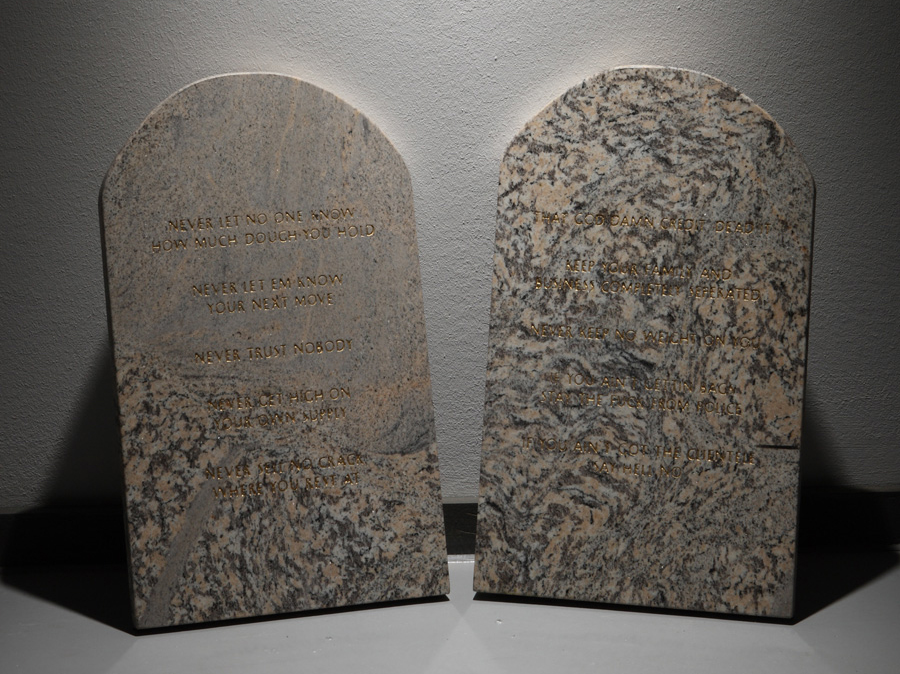
The Tam Commandments

10crack-commandments

My past often crossed paths with my present, but never with the people I desired to see again. Because of this, I’m always filled with an odd mix of embarrassing nostalgia and unwanted reflection, followed by the inevitable introspection. I see where old acquaintances are in their lives and I can’t help but look at where I am in relation to my dreams and aspirations.

No matter if you’re the outgrower (the disinterested party) or the outgrown (the rejected party), neither are comfortable during a random meeting. Also, dealing with people from my past have had the effect of feeling like I was moving backward. As if all the growth I’d experienced after being separated from that person vanished because they’re present in my life again.

And these chance encounters happened in the damnedest places. At the time the incident that is the subject of this post occurred, I was tucked away in a small town in a new state on the opposite coast when I ran into a childhood friend. Well, friend might have been a bit of a stretch. She wasn’t really friends with anyone. Truer to say we ran in the same circles. Even truer than that, we ran in different circles that sometimes overlapped like a Venn diagram of societal misfit kids.

Rough and rugged, tough as nails, she took no shit off anyone, not even her parents. She went her own way, did her own thing, and everyone in the neighborhood, kid and adult alike knew she’d most likely end up either dead or in prison. Some people only left their future open for those two options.

Anyway, I was at the local thrift store when I heard someone calling my name. I assumed it couldn’t be me since I knew exactly zero people in Los Angeles, but as this person kept calling, my curiosity got the better of me and turned to see her: Tamika.

It took me a moment to work out who she was. Not that the years hadn’t been kind to her, it was just that she wasn’t a person I had ever thought about remembering.

She, on the other hand, treated me like we were lifelong buddies. Big hugs and kisses and a smile that could have lit the Hollywood Bowl. Time has a funny way of altering the past. She remembered our relationship very differently than I had.

So, we did what people who hadn’t seen one another in ages do. We shared past stories, gave abridged accounts of our lives since then, and painted the brightest possible picture for our futures. And me being me, I remarked on how I never thought I’d see her ever again. Of all the people, not including those that had passed, she was easily the last person I ever expected to clap eyes on.

She hadn’t taken offense. She knew better than anyone the type of person she was back then and she said she probably would have fulfilled everyone’s prophesy of jail or death if not for Chickie.

Chickie was the only other person who could’ve matched Tammy pound for pound. Cut from the same cloth, sisters from a different mister, they were thick as thieves. And probably would have been for life, had Chickie not met her maker at the claw end of a hammer in a drug deal gone horribly wrong.

That’s when Tam found the way.

My internal groan was so loud I feared she might’ve heard it. I myself am areligious, and though I don’t begrudge anyone their spiritual beliefs, I have a hard time listening to the sanctimony of proselytizing born-agains.

But she hadn’t found Jesus, at least not in that way. Nor had she joined a cult. She claimed she simply hit rock bottom and having no one to turn to, sat down and wrote out a list of commandments for herself. A self-imposed list of rules in which she would like to live by.

And while I wish I could remember the list verbatim–my memory, unfortunately, has a mind of its own–I instead offer up a similar list that contains many of Tamika’s instructions for living a good life:

The 82 Commandments of Alejandro Jodorowsky

659077-jodorowsky

1. Ground your attention on yourself. Be conscious at every moment of what you are thinking, sensing, feeling, desiring, and doing.

2. Always finish what you have begun.

3. Whatever you are doing, do it as well as possible.

4. Do not become attached to anything that can destroy you in the course of time.

5. Develop your generosity – but secretly.

6. Treat everyone as if he or she was a close relative.

7. Organize what you have disorganized.

8. Learn to receive and give thanks for every gift.

9. Stop defining yourself.

10. Do not lie or steal, for you lie to yourself and steal from yourself.

11. Help your neighbor, but do not make him dependent.

12. Do not encourage others to imitate you.

13. Make work plans and accomplish them.

14. Do not take up too much space.

15. Make no useless movements or sounds.

16. If you lack faith, pretend to have it.

17. Do not allow yourself to be impressed by strong personalities.

18. Do not regard anyone or anything as your possession.

19. Share fairly.

20. Do not seduce.

21. Sleep and eat only as much as necessary.

22. Do not speak of your personal problems.

23. Do not express judgment or criticism when you are ignorant of most of the factors involved.

24. Do not establish useless friendships.

25. Do not follow fashions.

26. Do not sell yourself.

27. Respect contracts you have signed.

28. Be on time.

29. Never envy the luck or success of anyone.

30. Say no more than necessary.

31. Do not think of the profits your work will engender.

32. Never threaten anyone.

33. Keep your promises.

34. In any discussion, put yourself in the other person’s place.

35. Admit that someone else may be superior to you.

36. Do not eliminate, but transmute.

37. Conquer your fears, for each of them represents a camouflaged desire.

38. Help others to help themselves.

39. Conquer your aversions and come closer to those who inspire rejection in you.

40. Do not react to what others say about you, whether praise or blame.

41. Transform your pride into dignity.

42. Transform your anger into creativity.

43. Transform your greed into respect for beauty.

44. Transform your envy into admiration for the values of the other.

45. Transform your hate into charity.

46. Neither praise nor insult yourself.

47. Regard what does not belong to you as if it did belong to you.

48. Do not complain.

49. Develop your imagination.

50. Never give orders to gain the satisfaction of being obeyed.

51. Pay for services performed for you.

52. Do not proselytize your work or ideas.

53. Do not try to make others feel for you emotions such as pity, admiration, sympathy, or complicity.

54. Do not try to distinguish yourself by your appearance.

55. Never contradict; instead, be silent.

56. Do not contract debts; acquire and pay immediately.

57. If you offend someone, ask his or her pardon; if you have offended a person publicly, apologize publicly.

58. When you realize you have said something that is mistaken, do not persist in error through pride; instead, immediately retract it.

59. Never defend your old ideas simply because you are the one who expressed them.

60. Do not keep useless objects.

61. Do not adorn yourself with exotic ideas.

62. Do not have your photograph taken with famous people.

63. Justify yourself to no one, and keep your own counsel.

64. Never define yourself by what you possess.

65. Never speak of yourself without considering that you might change.

66. Accept that nothing belongs to you.

67. When someone asks your opinion about something or someone, speak only of his or her qualities.

68. When you become ill, regard your illness as your teacher, not as something to be hated.

69. Look directly, and do not hide yourself.

70. Do not forget your dead, but accord them a limited place and do not allow them to invade your life.

71. Wherever you live, always find a space that you devote to the sacred.

72. When you perform a service, make your effort inconspicuous.

73. If you decide to work to help others, do it with pleasure.

74. If you are hesitating between doing and not doing, take the risk of doing.

75. Do not try to be everything to your spouse; accept that there are things that you cannot give him or her but which others can.

76. When someone is speaking to an interested audience, do not contradict that person and steal his or her audience.

77. Live on money you have earned.

78. Never brag about amorous adventures.

79. Never glorify your weaknesses.

80. Never visit someone only to pass the time.

81. Obtain things in order to share them.

82. If you are meditating and a devil appears, make the devil meditate too.

Not being a fan of dogma, creed, or commandments in general, I admit I can find merit in many items on this list as suggestions for people to find their own path in life. Hell, if it worked for Tamika, it damn sure couldn’t hurt giving it a go.

So, sally forth, true believers and blasts from the past, and be making your own commandments and living by themingly writeful.

©2014 Rhyan Scorpio-Rhys

Creative Commons License


If You Can’t Blind Them With Brilliance…

Image

Fair warning: Thar be mild spoilers ahead, so if you plan on seeing Star Trek Into Darkness and wish to go in fresh, turn back now.

Let me begin by saying I didn’t have high expectations for this film, so I wasn’t disappointed at how much I really didn’t like it. Wasn’t a fan of the first film either. Truth to tell, I’m not big on reboots or reimaginings in general. And that’s all this is. A poor reboot of the far superior film, Star Trek II: The Wrath of Khan.

Don’t mistake my meaning, this isn’t a bash on J.J. Abrams. The man does what he’s paid to do. He puts asses in seats, like a professional carnival huckster. He’s under no obligation to provide a solid, well thought out plot or three-dimensional characters. It’s all about bang for the buck, which this movie has in spades. It meets its quota of fisticuffs, phaser fights, explosions, space battles, and winks and nods to the original series to appease actual fans of the franchise. Abrams certainly knows his way around a popcorn movie, living by the old adage, “If you can’t blind them with brilliance, baffle them with bullshit.”

But instead of dissecting Into Darkness (enough fan sites are doing that already), I’d rather talk about what made Wrath of Khan work. It’s one of two films that I can think of off the top of my head that has a near perfect set up. The other is the first Back To The Future film.

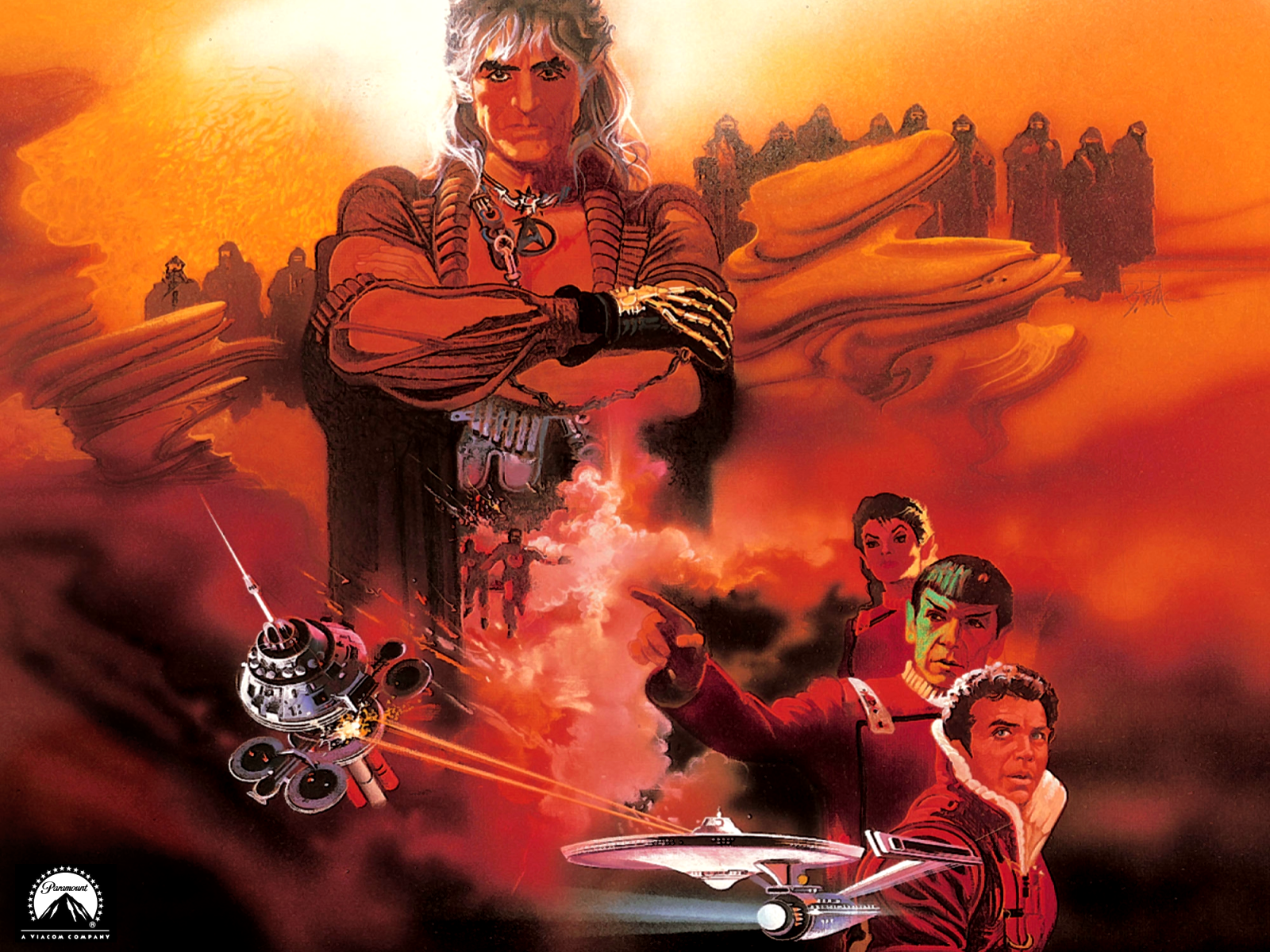
statrek-ii_-the-wrath-of-khan-wallpapers_16772_1600x1200

Wrath of Khan begins with the Star Fleet Academy final exam, The Kobayashi Maru, a no-win scenario simulation designed to test the character of cadets before unleashing them into the harsh realities of interplanetary relations. Kirk is now an admiral relegated to training cadets after giving up his starship command. It’s his birthday, so he’s feeling old. His life lacks adventure, so he feels put out to pasture. He has no family, so he feels alone in the universe. The man is miserable, making him the perfect character in desperate need of an arc.

Come to find out Kirk is the only cadet to beat The Kobayashi Maru, but he did it by rigging the test. He cheated because he doesn’t believe in a no-win scenario. And that’s what the entire film is, Kirk’s Kobayashi Maru. An adversary emerges from his past, hellbent on revenge for being stranded on a planet that turns hostile. He’s reunited with an old flame and discovers he has a son. And he’s pitted in a battle of wits against a far superior opponent. Even in his most desperate hour, Kirk is enjoying this. It’s what he was born to do. The only thing he’s ever been good at.

And finally, he’s forced to face The Kobayashi Maru consequences. He’s encountered his no-win scenario. He’s at the end of his tether, with no more cards left to play. He’s not only put himself in the line of fire but his crew and new found family as well. They’re dead. Or they would have been, had Spock not sacrificed himself, quoting the Charles Dickens novel, A Tale of Two Cities (a present he gives to Kirk on his birthday), “the needs of the many outweigh the needs of the few“.

Kirk finally faces devastating loss, the death of his closest friend, but as he mourns, he witnesses the creation of a world, has reconnected with a family he never knew he had and is once again in command of a starship. At the beginning of the film, he was feeling old, but as the film wraps, he stares at the Genesis Planet and tells Carol Marcus that he “Feels young.”

That’s a proper character arc.

And you won’t find any of that in Into Darkness. It’s a poor photocopy that lacks the richness of history, the depth of character, or a plot that can bear the weight of scrutiny.

— Rhyan Scorpio-Rhys


Project: #Novel365 2018 – Week 12

#Novel365 2018 Week Eleven

I became aware or at least I waded in the waters of the outer fringes of awareness. I could not say that I had awakened because the act of waking never felt quite like this; like some mysterious force outside myself suddenly prodding my cognizance to remind me I existed. My mind was plunged in the deepest layers of unconsciousness, the lowest notch on the coma scale before brain death, but an infinitesimal scrap of self dug its fingers into the loose soil walls of a bottomless grave of oblivion and slowly clawed its way up in search of normalcy or at least something familiar.

When I realized I had absolutely no idea where I was, bewilderment shifted to dread and I began to shake. I was lost in a forgotten place with no memory of how I had gotten here or even the faintest recollection who I was. Then there was pain, almost if I remembered to feel it, not excruciating but a dull throbbing ache in my head and back. I imagined myself broken, shattered to pieces, a hollow porcelain shell of a person that in no way could ever be properly reassembled. This feeling seemed familiar but distant, an old vague memory of being stricken with a plague of night terrors in which I had been paralyzed in a similar manner. I could not name what terrified me then but it lurked in the dark, always in the dark and perhaps it was a patient thing that had waited for my return. Perhaps it was here with me now. I tried to call out but I had no voice and that call strained to become a silent scream as my mind thrashed about in black confusion.

After a long helpless moment, the fog lifted and all at once I knew myself, I remembered tumbling into the subway shroud. I entered falling but how far I fell or for how long, I couldn’t rightly say. Somewhere during the process of spinning head over heel in the void, I had lost consciousness. When my senses eventually returned I found that I was resting prone on a surface, hard yet to my fingertips it had the texture of material. The black was so dense my eyes couldn’t locate enough light for me to see my own hand in front of my face let alone to make out any detail of my surroundings. I took a deep breath to calm myself because losing my presence of mind at the moment wouldn’t have produced the most advantageous outcome. I sat up and took stock of my situation. I was still alive, still able to take in air and there was indeed air to be taken in, I still possessed the sensation of touch as I could feel both the surface below me and my body, which seemed to be intact, but still had no clue as to my whereabouts. Inside the shroud, yes, I knew, but where was here exactly?

I fumbled in my pocket for my smartphone to use as a light source but my pocket was empty. In fact, all my pockets were empty, turned inside out, then I realized my backpack was gone as well. I remembered seeing footage of a man being struck by a car with enough force that his shoes flew off his feet when his legs whipped out during impact. Had that been the case here? My shoes were still securely fastened to my feet but if I had been thrown into an alternate dimension what were the rules governing what objects and matter could cross over and what could not?

Was this even an alternate dimension? The surface beneath me made me exclude the notions of being in a void or limbo. I stood up, arms stretched wide, fingers wiggling like feelers, testing my surroundings. My first thought was to look for the portal that brought me here. Was the shroud still on the train? Could I find my way back home? Were Madi and the others safe?

“Hello, hello!” I shouted into the intense darkness as I took a few tentative steps forward.

“I’m here, I’m here!” I repeated until my mouth went dry and I was about to abandon all hope of anyone hearing me in the abyss.

Suddenly a hand landed on my shoulder and I felt myself leap out of my skin; and I heard, yes, I heard these words pronounced in my ear,

“I hear you, Horton.”

It was Madi’s voice and I recognized the reference from a Dr. Seuss book, Horton Hears a Who! even though she got it wrong. Horton was the one doing the hearing when he discovered a world the size of a dust speck. Not that it mattered at the moment.

“Madi, is that you?” I spun and collected her thin frame in my arms.

“Who else would it be?” she answered.

“The shroud swallowed you as well?”

“No, when it reappeared, I jumped in after you.”

“You foolish—,” I said, my face buried in her neck as I hugged her to me. I was filled with a mix of emotions, happy that I was not alone here, angry that she risked her own safety for my sake and flattered that she had.

“I’m sure what you mean to say is thank you and you’re welcome. Now, how about you break this bear hug and we find a way out of here?”

I let Madi’s body slip from my arms but took hold of her shoulders, “Do you have your phone? I can’t find mine and we need some light.” But I knew the answer before she said it because when I hugged her, I didn’t feel her backpack.

I could hear her patting herself down. Her pockets were as empty as mine.

“We’ll just have to make do without them,” I said, placing the back of my hand on the back of her hand to let her figure out where my arm was. She held my arm just above the elbow and walked a half step behind me. “Since there definitely was a way into wherever here is…”

“Then there has to be a way out,” Madi said and I wondered if her inability to see physical dimensions in the dark was having any effect on her claustrophobia? “I hope you’re right.”

“I am,” I assured her. “Though the exit may not exist at our point of entry.” Without the aid of a cane, I had to test the ground with each foot I put forth.

“At least our situation isn’t absolutely terrible.”

“How do you reckon that?”

“Because we’re not dead, Darius.”

“And where there’s life there’s hope.”

“If we can’t believe that, what’s left? Besides, the film crew must have gotten all or some of what happened on tape, so there’s proof and perhaps our disappearance will spark an investigation and Andrew can lead a group of people much smarter than ourselves to find a way to rescue us.”

Madi stated it in such a self-possessed manner that I couldn’t bring myself to point out the flaws in her scenario, the biggest one being the next date scrawled on the 1924 subway map was two years away so even if McKissick mounted a rescue the plain and simple truth of the matter was we only had ourselves to rely on. So, I resolved to be the soil she could plant her hopes and faith in, whether I agreed with them or not.

Madi stopped suddenly and tugged on my arm. “Shhh! Did you hear that?” she whispered.

I held my breath for an instant and listened. It might have only been my imagination playing tricks on me, but it seemed to be a scuffling noise.

“Did you hear?” she murmured.

“Yes.” This time there was no mistake! A groaning sound accompanied the scuffling and it was close by! An insane thought flashed through my mind as insane thoughts had been known to do. Just for a moment, I wondered if we were truly dead and the sounds were of approaching demons coming to ferry us to processing place for final judgment. I quickly pushed it out of my mind.

It made more sense the sounds were coming from some other unfortunate soul who had been swallowed by the shroud and the most logical assumption was the old woman I sought to protect.

“Miss? Miss, are you all right?” I called out.

“What is it? Do you see something?” Madi’s grip tightened on my arm.

I ignored her and cocked my head straining to locate a sound I scarcely heard, a sound that was growing closer and closer. And after a moment something brushed past me and when it felt the contact, it clung to me.

“Madi, stand back!” I pushed her away and bawled my fist because the grip on me hadn’t felt like it belonged to an old woman.

“Madi?” the feeble voice asked. “Is that you, Quaice?”

“McKissick?” I murmured.

“Andrew!” Madi cried.

“Where are we?” asked McKissick.

“Inside the belly of the subway shroud.”

“Did you come in with the old woman? How many more of us should we be looking for?” I asked.

“My brain is still a little fuzzy but I remember the shroud skipping over the woman and thinking how fortunate she was that she didn’t move and then I woke up here.”

“Do you have a phone or lighter or anything we can use to see where we are?” I asked. “Ours are gone.”

A moment later McKissick confirmed that all his pockets were empty. There was something unnatural about our missing personal effects, a missing clue wandering in the back of my mind that I was missing. Best not to focus on it, I would let my subconscious sort that bit out.

I instructed McKissick to take the crook of Madi’s arm the way she had taken mine and we made our way slowly in a direction. I groped about and in a matter of steps, my fingers made contact with something smooth, polished and hard. I swung my foot forward, kicking it, and the blow produced a metallic sound and my fingers found a row of small protuberances which made me think the wall was made of riveted plates. Were we in some sort of a room or other enclosure constructed by a human?

Madi and McKissick joined me in searching the wall for a door frame or vent or some other aperture but the bare wall revealed no trace of window or door. I asked McKissick to lend me a hand in hoisting Madi up to see if she could feel how high the wall extended. She was barely able to feel a ridge but not enough to secure a handhold. We then began pounding on the metal wall in order to communicate with whoever built this, to let them know we were trapped inside or were we outside banging for them to let us in? It was impossible to tell in the total darkness.

Questions began forming in my mind daring me to find the answers to what the metal wall was for? Who built it? What type of beings lived inside the shroud? Were we even inside the shroud or teleported to another place?

Suddenly a noise, like iron works violently pushed aside, came from our left in the darkness. A door opened and the dense darkness suddenly gave way to extreme light so strong that I could not bear it at first. My eyes were so dazzled that I was barely able to distinguish the movement in the doorway from the figures that stepped through it. I shielded my eyes and squinted to better make out the backlit shapes. After the last had entered, the door shut immediately with a bang. The area remained lit as two of the figures attached phosphorescent domes to the walls with a magnetic clank. I blinked several times as my eyes adjusted to the light and I saw six people standing in front of the closed door.

We were in a long narrow room, metal riveted plate walls, a domed metal ceiling and a wood slats floor with a runner carpet laid down the center of it. Of the six individuals, five were men of varying shapes and sizes, from short to tall, wiry to muscular, hairy to bald, each looking like they had been plucked from Dick Tracy’s rogue’s gallery. But in the center stood a supple, statuesque woman who radiated enormous self-confidence. Her ochrous hued skin was impeccable, framed by midnight hair that tumbled over her broad shoulders and highlighted by dew-pond round champagne-brown eyes. She was without a doubt the most beautiful woman I had ever seen in my life.

While I was mesmerized by this woman, Madi and McKissick were asking questions in rapid succession. Where are we? What is this place? Who are you? How did you get here? Do you know the way out? And so on. But no answers were forthcoming. The six merely stood there in silence examining us with great attention which sparked annoyance in Madi that quickly escalated to anger.

“Madi, give them a chance to speak,” I touched her arm gently, though I did not, could not take my eyes off the raven-haired woman.

“Perhaps they don’t understand us,” offered McKissick.

And as confirmation of that, the tall, wiry man turned to the woman and spoke to her in an unrecognizable language. Although I spoke no other language besides English and Jarberish, I could identify most languages easily, but what they spoke, the harshness of vowels and the harmony of consonants, it seemed almost extraterrestrial, sounds the human tongue would have difficulty making.

To be continued…

Week 12 of my personal 2018 writing challenge to turn my daily tweeting habit into something productive… and now the story truly begins. No more floundering for ideas. I finally know where the story is heading. I think I may have even stumbled on the story’s voice (though that, like everything else is subjectto change.)

As a recap to newcomers:

This story is an experiment to write a stream of consciousness book with no outline or plot in mind, just a year’s worth of whatever-pops-into-my-fragile-little-mind tweets without edits or the fancy flourishes that will come in the rewrite.

I always knew this story would either be in a speculative fiction, sci-fi or horror vein but I never anticipated it would be a time travel story as I’m not the biggest fan of those. Just goes to show you, a story can sometimes take you where it wants to go, not necessarily where you want to go. There are seven more characters that have yet to be introduced but I have a sneaking suspicion that at least one of them will make an appearance in the next installment. Don’t hold me to that, though. The characters are still in complete control of this (pardon the pun) train wreck.

I’m still lagging behind in my progess but you know what, I will persevere in my endeavor to either create something (hopefully coherent and good) from thin air. Falling flat on my writerly face is not an option at this point in time.

Previously I asked if you can spare a moment, I invited readers to either cheer me on or tell me what a colossal mistake I’m making. But I’m past that point now. I will gladly accept attaboys and constructive criticism, but if you’re on a negative vibe, you can keep that to yourself. I already own more than my share of that.

‘Til next week,

☮️  💗

©2018 Rhyan Scorpio-Rhys

Creative Commons License


Project: #Novel365 2018 – Week 10

Untitled design

#Novel365 2018 Week Nine

Time was a bizarre creature. It crept in its petty pace from day to day, as Shakespeare once said via Macbeth, and I was anxious to get to the heart of this investigation, to confront the mysterious subway shroud and dissect it and disprove its mythical existence by exposing the reality behind it. And at the very same time, it sped by far too quickly, the handwritten date on the map was upon us so suddenly that we were not prepared for an encounter, not by a long shot.

True to his word, McKissick brought the 1924 BMT map to our office two days after our meeting in Beach’s pneumatic transit station. We asked the astrophysicist if the men who paid him a visit left a business card by any chance. They did and he fished it out of his wallet. It was identical to the one in our possession. A one-sided cornsilk card with no logo, organization identification or personnel name, only a toll-free phone number in raised Odile Initials lettering. But if the same men visited the both of us, why use different aliases on people they paired to work the same case?

Madi asked if he had attempted to contact the number. McKissick claimed he was waiting until we had something more solid than wild hunches to offer them. One of the possible plans we discussed two nights ago was to somehow convince the MTA to shut down train service on the elevated J train line between the Marcy Avenue and Cypress Hills station stops on March 12th in both directions.

“It shouldn’t raise any suspicion,” Madi said. “The J train is undergoing extensive track and station repairs at the moment and while people aren’t exactly thrilled with having to contend with shuttle bus replacement service, they’re used to it fouling up their daily commute.”

A unanimous vote found Penny dialing the mystery number and putting it through to Madi’s office, which was still the more presentable between hers and mine, and we three seated ourselves around the phone. The voice on the line identified himself as Duffy though he hadn’t sounded like the man we originally spoke with.

“Ms. Wasonofski and Mr. McKissick are also in attendance, so I’ve put you on speaker, I hope that isn’t a problem.”

“Not at all,” the unfamiliar voice of Duffy said. “Have you worked out your proposed turnaround time?”

“We’re actually calling to ask a favor,” Madi chimed in.

We each took turns revealing what we had discovered so far as well as our hunches and asked if their agency had enough pull to affect a partial train shut down for a twenty-four-hour period.

“For both dates?” asked Duffy.

“For March 12th, certainly. The next date is two years away. I doubt you’ll want to keep us on retainer that long,” I said.

“Let me see what I can do. Are you reachable at this number all day?”

“We’ll wait for your call.”

We moved out into reception and brought Penny up to speed, though we suspected she overheard most of our phone conversation with Duffy and went through the plan again over Chinese takeout. Having Penny be a part of this was crucial as she had the uncanny knack of spotting flaws and weak points and punching holes in our logic, which allowed us to devise several backup plans.

Two and half hours later the phone rang. It was Duffy. He wasn’t able to convince the MTA to partially suspend J line service but he had managed to secure an alternative option.

***

On Sunday, March 11th, we met at the Jamaica Center Station which was the last stop in Queens for the J train. We arranged a rendezvous time of 11:00 pm and while I was on-the-dot punctual, I found that Madi and McKissick were already there as well as the three-person guerilla film crew we hired to document our endeavor.

Project DaVinci, that was the name listed on the driver’s license of guerilla film crew director–what type of parent would do that to their child–held up a blank sheet of paper in order for Sarah Legere, the director of photography, to white balance the Sony PMW-300 One XDCAM mounted on the iso-elastic arm of her Steadicam harness. And Dennis Rokdo, the audio technician, clipped lavalier mics to the collars of Madi and McKissick’s shirts while they were engaged in what appeared to be an intimate conversation. Or perhaps just a conversation. I was being foolish and I was aware of it and I was slightly ashamed of the jealousy within me I hadn’t known existed until now. Though I pushed the thought aside, this was clearly a matter that needed to be addressed one way or the other once we concluded our work on the subway shroud case.

First to greet me was the station manager whose name might have been Peterson or Patterson but I wasn’t paying attention during the introduction and felt it would have been rude to ask the man to repeat himself.

While Duffy had been unable to suspend service on the section of the J line that we requested he had done the next best thing, which was probably the only other option available to him, he secured for us a test train.

“The test train models are called the R179,” Peterson/Patterson said as he pointed to the spotless silver beauty that sat on the local track, “which the MTA paid $735 million to the Montreal-based company Bombardier for the purchase of 300 new cars. The first of R179s were delivered in September 2016, and the first test train of eight cars was placed in service in November 2017.”

I knew this information as well as the fact that although the R179s passed their 30-day in-service test in December 2017, there had been a number of failures, which included train operator consoles erroneously indicated doors were open when they were closed, the emergency brakes kicking in when a bucket fell onto the tracks from the 121st Street station platform in Richmond Hill, Queens, and a test train leaving the Sutphin Boulevard station in Jamaica losing motor power in an ascent uphill at half speed over a standard gap between train equipment and the third rail, among others.

“Just so you know, this train won’t be in operation between the hours of 7:00 am to 10:00 am and 5:00 pm to 8:00 pm,” said the station manager.

“We were informed we would have access to the train for 24 hours,” Madi said.

“And you do, but this train will not congest our rush hour schedule. Whatever strings you pulled to gain access to a brand new train, it wasn’t high enough to convince my boss otherwise.”

“Then what do we do during rush hour?” McKissick asked.

“Rely on normal train service like the rest of us, I guess,” said Peterson/Patterson.

It wasn’t bad enough that we weren’t able to narrow down our search to either the Queens-bound or Manhattan-bound track or pinpoint one or two stations out of the sixteen Brooklyn stops but now we had to contend with commuters. Although I was not a superstition man by any stretch of the imagination, I knew better than to incur the wrath of the dreaded jinx by asking, could this get any worse?

Only one door of the train was open, the last door of the last car. There were signs taped to the windows of all the doors which read,

R179 TEST TRAIN
NOT IN SERVICE FOR PASSENGERS

If our train had been put into service, it wasn’t noticeable to me. The R179 was spotless and still had the new train car smell about it. For some reason, we were given a tour of it and I think it had more to do with the station manager attempting to get in a little screen time for himself as the film crew was recording everything.

“This train is equipped with updated control systems, heating, ventilation, and air conditioning or HVAC as we call it and public-address systems,” Peterson/Patterson continued. “It also employs FIND, an advanced Flexible Information and Notice Display, which includes an LCD screen displaying the route, route information, and advertisements, as well as a dynamic red, yellow, and green LED strip map that displays the next ten stations, plus five consecutive further stops to riders. And you’ll notice each car iss equipped with looped stanchions to provide passengers on crowded trains with a greater amount of pole surface area to grab on to.”

We were then introduced to our motorman and conductor and advised that the train would depart promptly at 11:45 pm.

“So, what were you thinking?” asked DaVinci.

“First off, a walkthrough of the full length of the train then hovering around the middle four cars. That’s where the shroud sightings seem to occur most frequently,” I said.

“And we have film rights?” DaVinci’s gaze skimmed our faces, catching each of our eyes for just a moment.

“Did you bother reading the NDA you signed?” Madi said. “If we capture anything abnormal on film, be it the subway shroud or some related phenomenon, there’s a six-month embargo before you can broadcast the footage in any form on any platform.”

“And you’ll need our written consent for any footage we appear in,” McKissick added.

DaVinci waved a sure, sure as he moved to the DP to discuss strategies for shooting around us to minimize our appearance in shots. I also heard DaVinci grumbling over the fact we vetoed his idea to have a pair of parapsychologists on hand, not because he believed their participation would have made any of this more successful but he wanted to edit in shots of them fiddling with their supernatural detection equipment and close-ups of dial measurement readings. If he truly wanted them so badly, he would have to shoot b-roll on his own dime.

Jessica Ettinger’s voice came in over the public address system announcing, “This is a Manhattan-bound J local train. The next stop is Sutphin Boulevard/Archer Avenue.”

“Stand clear of the closing doors, please,” said the recorded voice of Charlie Pellett, veteran Bloomberg Radio news anchor/reporter. Following the door chime familiar to New York City commuters, the R179’s doors closed and the train pulled out of the station.

“And so, it begins,” I said.

***

Despite his ridiculous name, DaVinci seemed a decent sort once we had begun talking and seemed, from my limited point of view, an experienced filmmaker, from the way he went about framing shots and discussing dramatic angles so that each car we walked through took on a slightly different appearance from the one before. His personal opinion of the subway shroud was that he believed it to be a trans-dimensional doorway which could be opened at spots where two realities pressed against one another and both sides simultaneously generated a harmonious resonance frequency, such as trains traveling at a certain velocity in the same direction at the same time on either side of the divide. But he gave me his assurance that he wouldn’t let his views bias the outcome of our findings today.

Legere and Rokdo were of similar beliefs and openly discussed and calculated the possibility of a sighting and hopefully of a physical interaction. They promised that should such an interaction occur they would leave the investigation and exploration to myself, Madi and McKissick, and stated their desire was nothing more than to document the shroud but their sincerity was put into doubt by the eagerness in their eyes and manner when discussing the matter. I spoke with Madi in Jarberish to advise McKissick that we would have to keep our eyes on the filmmakers should we make contact.

The guerilla crew had armed themselves with enough backup batteries and memory cards for a 24-hour shoot but hadn’t thought to bring provisions. We hadn’t suspected they might but Penny had over-packed our carry sacks, so we divided food and waters amongst us evenly if for no reason other than to lighten our load. In addition to food, we equipped ourselves with compasses, GPS, flashlights, a first aid kit, multitools, duct tape, rope, harnesses, locking and non-locking carabiners, prusik cords and a Geiger counter.

Once the journey was underway, Madi, McKissick and I fitted the harnesses around ourselves and ran the length of rope between them, with myself in the lead, Madi following and McKissick acting as the anchor.

McKissick had a knack for chatting and little by little his conversations included me. The thing I began noticing about the man was his ability to draw information out of people. There was an attentiveness to his listening that made it seem he was genuinely interested in what the speaker was saying, regardless of the topic. He also shared himself with anyone willing to listen and was not afraid to give an opinion on popular astrophysicists and their popular theories. When he spoke of his adventures in astrophysics, he made gestures like he was reciting verses from Old English epic poems, as if he was Beowulf doing battle against the Grendel that was the universal unknown.

He made fast friendships with DaVinci and his crew as he has done with Madi and he attempted it with me but I was a tougher nut to crack and I think he was beginning to sense it. The thing that put me ill at ease, aside from the fact that he was an absolute stranger who was thrust upon us, was the fact that he wanted me to like him. Almost as if he needed me to like him. But I pretended, as much as I could without getting roped into his duplicity, that we were comrades brought together by fate and our connection was cemented by the unknown and possible extreme dangers that awaited us. I had the sneaking suspicion that if I lived another hundred years and spent every day in the man’s company that I would not know the man any better than the day we first met.

McKissick also loved to debate. He hadn’t shared DaVinci’s view of the shroud which the filmmaker had trouble wrapping his head around. “How is it possible you’re not convinced that we’re dealing with an interdimensional doorway here?” asked the director. “You’re a hypothesizer by profession; you’re used to confronting the impossible and trying to solve it with a math equation. Out of everybody here you should be the first one to embrace the likelihood under the circumstances!”

McKissick countered that he could posit theories to support each and every opinion people had regarding the shroud and if he was truly invested, could present a math equation, as DaVinci put it, to support every single one of them, but that didn’t mean he believed any of them to be true.

And the conversation went on, to the positive and negative energies that ley lines emitted and their connection to the attraction of UFOs, to ley lines and their connection to adverse spiritual phenomena, to Planetary Energetic Grid Theory and Sacred Geometry, to the Becker-Hagens Grid, Curry lines, Hartmann net and so on.

Their debate pulled everyone in, even Madi but I was bored with the conversation almost immediately which meant the next seven hours passed like a montage in an Orson Welles film based on a Marcel Proust novel.

To be continued…

Week 10 of my personal 2018 writing challenge to turn my daily tweeting habit into something productive… and this is the moment before we get to the meat of the nutshell. I pretty much have a handle on where the story is headed but I won’t say that definitively because the characters might toss me a curveball.

As a recap to newcomers:

This story is an experiment to write a stream of consciousness book with no outline or plot in mind, just a year’s worth of whatever-pops-into-my-fragile-little-mind tweets without edits or the fancy flourishes that will come in the rewrite.

There is at least one character floating around in my gray matter that hasn’t made it to paper yet and if I commit to that character there are six more characters that need to be added to support the storyline. As mentioned above, a plotline is starting to take shape and it definitely will be a time travel story (Why? The world may never know) The ending is still anyone’s guess. Maybe I’ll get lucky and one of the characters will clue me in.

Though I’m lagging behind at the moment, I will persevere in my endeavor to either create something (hopefully coherent and good) from thin air or fall flat on my writerly face.

Don’t forget, if you can spare a moment, I invite you to either cheer me on or tell me what a colossal mistake I’m making. I’m good either way.

©2018 Rhyan Scorpio-Rhys

Creative Commons License

Project: #Novel365 2018 – Week 9

Untitled design

#Novel365 2018 Week Eight

The room inside was tiny and dark. I carefully ran my hand along the inside wall feeling for a possible light switch but only pulled away cobwebs.

“That was pretty impressive with the door,” McKissick said but though the compliment was intended for me he addressed it to Madi, which I found more than a little odd. “Is he always like this, Ms. Wasonofski? And do you mind if I call you Madison?”

“It’s Madi, one d no e, but only if I can call you Andrew, Mr. McKissick,” Madi answered.

“Consider it a deal,” said McKissick.

“And no, Darius isn’t always like this. It’s only when you least expect it that he surprises you. I’ve been with him since God spoke to Moses and I still don’t properly know him, I mean, better than most, but there’s always something new lurking around every corner.”

“Oh, are the two of you together?”

“Me and Darius? God no,” she waved the implication off like a bad smell.

I cleared my throat and I believed they received the message because the conversation halted. With the light that spilled in from the waiting area, I saw a single lightbulb in a ceiling-mounted hanging socket. I stepped inside and gave a quick tug on the pull chain. The light from the 40-watt bulb that lazily flickered to life was only slightly better than the darkness. McKissick followed me in and the space instantly became cramped. Madi stood in the doorway. Even if there was enough room for her I doubt she would have taxed her borderline control over the claustrophobia.

If I were into steampunk, the single control panel fitted with antiquated levers, switches, dials, gauges, knobs and wheel hand cranks, would have been a wet dream, but as nothing was labeled in any sort of helpful way that might have indicated their function, I found this hidden control room gem unimpressive, to say the least.

“This doesn’t make sense,” I said.

“What doesn’t?” McKissick asked, closer to me than I was comfortable with. I felt his hot breath on my neck when he turned his head to speak. Apparently, it was a pet peeve I hadn’t been made aware of until this very moment.

“Don’t you find the contrasting technology between the door lock and this control panel the least bit peculiar?”

“Is that an electric telegraph machine?” McKissick pointed at a device in the center of the crowded console.

It was, or more accurately it was a telegraph key, a metal frame fitted with a hammer, anvil spring tension adjustment, circuit closer, wiring post, and contact gap adjustment which sat on a wooden base. McKissick reached for the knob and began tapping the hammer to the anvil.

“Is that Morse Code?” Madi asked.

“Yes, it is,” smiled McKissick.

“What are you saying?”

“What hath God wrought,” said McKissick. “It’s from the Book of Numbers 23:23, the first Morse code message transmitted 1844 to officially open the Baltimore-Washington telegraph line. Doesn’t appear to be working though, and why would it? Who would be on the other end, if it still had an other end?”

McKissick turned his attention to other items on the console, fiddling with knobs and levers and even tapping a few of the dials testing if the needles would budge.

“Why go through the trouble of securing this room if nothing here is functional? And if you’re going through all the bother of restoring the station why ignore this?” I asked.

“For posterity?” Madi offered.

“If it’s meant to be a mini technology museum, why hasn’t it at least been dusted?” I blew a small cloud off a section of the console and regretted it an instant later when I began to cough. As I turned my head away from the dust I caught sight of something, a triangle of paper wedged between the end of the console and the wall. I pried at it with my fingertips until enough of it was exposed for me to pinch hold of and pull free.

“What is it?” Madi stretched up on her toes trying to see around McKissick.

It was an old bit of paper folded like a pamphlet, yellowed to the point of browning. I held it up to the light and read the front cover, “BMT Lines, Rapid Transit Division 1924 subway map.”

Madi asked, “What does the 1924 BMT line have to do with any of this?”

“Absolutely no clue,” I turned the map over on my hands.

“Is that handwriting?” McKissick pointed at the ink scrawling in the margins. I nodded.

“Well, bring it out here in the open where the light is better and let’s take a proper look at it,” Madi waved us over to the cocktail table near a settee. I could only guess that it was either the size comparison to the control room or her overriding curiosity that made her consider the waiting area an open space.

We huddled on the settee, Madi to my right and McKissick reluctantly on my left. It was clear he wanted to sit next to Madi and was disappointed when I claimed the middle seat. When all this was said and done, he and I were going to have a talk. I placed the map back cover up on the table and we studied the handwriting done in ballpoint pen that wasn’t nearly as old or faded as the map itself.

“A series of dates,” McKissick said.

“Not in chronological order,” added Madi.

I tapped at the top date, September 12, 1867, “This was the day Beach demonstrated the pneumatic train at the American Institute Fair held in the Fourteenth Street Armory.”

“And February 26, 1870, was the day he opened the pneumatic train to the public,” said McKissick.

Both McKissick and I pointed at June 14, 1911, and simultaneously said, “Zanetti.”

“Um, what’s Zanetti?”

“You weren’t subjected to the verisimilituder?” McKissick eyed Madi.

“No, only he was,” she shook her head and thumbed my way.

“And you didn’t tell her?” McKissick asked.

“Hadn’t gotten around to it yet,” I answered. “Instead of forcing the information on her all at once, I figured I’d offer it as needed.”

“Makes sense. I suppose if I was in your position I might have considered doing the same.”

“Hello,” Madi waved. “Still in the room. Would one of you brainwashed cultists please clue me in on what a Zanetti is?”

***

Zanetti was the name of an Italian railway company that unveiled its prototype excursion train on June 14th, 1911, and offered, free of charge, a test ride to members of high society in hopes of creating a word of mouth campaign to attract additional investors.

One hundred passengers boarded the three-car steam train at Zanetti’s station in Rome, along with a crew complement of six, and set out on a leisurely tour of the local sights, the most popular of which was a tunnel that had been carved into one of the Lombardy mountains.

But while the rest of the passengers were enjoying the complimentary hors d’oeuvres and champagne as they socialized, two men were simultaneously struck with a premonition of impending disaster. They attempted to share this with their fellow passengers and members of the crew and were at first dismissed then openly mocked.

As the train approached the mountain tunnel, it decelerated and the sensation of unease within the two men rose to a blind panic at the sound of an ominous humming followed by clouds of black smoke that began filling the train. The crew went about trying to put the passengers at ease as they opened windows to vent the smoke.

The two panicked men raced into the rear car and looked out of the window. Each reported seeing a milky-white fog billowing from the mountain tunnel and as the engine entered the cloud, the car split wide open. Both men leaped from the train to safety seconds before it entered the tunnel. The fog within appeared to be swallowing the train whole like a thing alive.

Their statements were later discredited as no debris was located inside the tunnel from where the train supposedly split open but the one fact that couldn’t be ignored was something mysterious happened during the ride since the train had actually vanished without a trace, taking one hundred and four people with it.

“Just so you know,” Madi pointed at both McKissick and I. “That was creepy.”

“It’s just an urban legend,” I said.

“Not the story, Major Marco, the way you two recited it in tandem. At one point you were finishing off each other’s sentences. Doesn’t that cause either of you the slightest bit of concern?”

It was true. I wasn’t able to tell which one of us said what. “Okay, you’ve made your point. You were right. I’m beginning to feel uncomfortable having information stored in my brain, especially not knowing who placed it or what else they planted in there. I was wrong for subjecting myself to it, but if I’m honest, if something does go wrong, I’d rather it happen to me than you.”

“I hate when you do that!” Madi was on the verge of a pout but restrained herself in front of company. “You’re not going to win emotional points with me over this! Anyway, it’s too late now. Just promise me when this is all over that you’ll get yourself checked out, please?”

“I promise,” I gave her a two finger Cub Scout salute. “But you’re here and on the case so I feel safe because I know you’ll shut me down if I go fatal.”

Madi shook her head in exasperation but I caught the corners of her mouth turn up in a barely noticeable smile. She apologized to McKissick for some unknown reason, perhaps she thought she was being unprofessional but the astrophysicist wasn’t bothered by our exchange.

“Who’s Major Marco, by the way?” McKissick whispered to me.

“From The Manchurian Candidate,” I replied. “She’s insinuating we’ve been brainwashed.”

“You’re both lousy whisperers and she is probably right, but we’ll table that discussion for another time,” Madi gestured at the next date on the list. “So, how about that 1940 date,”

McKissick and I looked at one another and I motioned for him to explain.

“The events of this day came from the meticulous notes of a psychiatrist living in Mexico,” McKissick said. “He wrote about the admission of one hundred and four people into a local infirmary, each of them diagnosed with mass insanity. At first, most were in a catatonic state, and those who spoke seemed to be spouting gibberish but someone eventually worked out they were speaking Italian. When they finally located a translator, the patients claimed to have arrived here by a train they boarded in Rome.”

“Are all the remaining dates urban legends as well?” Madi asked.

“The next two are,” I said. “The first one came from an ancient record that told of a giant sled with a pipe spouting suffocating clouds of black smoke and dragging three smaller ones behind it bearing down on the walls of a medieval monastery in Modena, Italy that vanished just before it made impact. Next on the list is the date in 1955 when a Ukrainian signalman witnessed the sudden appearance of an unannounced steam locomotive with 3 passenger cars heading for the barrier of the station, running in an area where there were no tracks. As you might suspect, it also vanished seconds before impact.”

“Two of the remaining dates are present day and coincide with two of the shroud sightings,” said McKissick.

Madi was on her feet, pacing in front of the coffee table before I even finished, “So, the mysterious they filled your heads with these urban legends as a supposed connection to the subway shroud, but how does Beach’s missing pneumatic car fit in?”

“We have at least two chances to find out,” I said.

Madi stopped dead in her tracks, “What?”

“There are three more dates, two of them in the near future.”

“And the third one?”

“There isn’t a snowball’s chance in hell any of us would live to see it,” I said.

Before Madi could respond, we heard a noise coming from the system control room. A repetitive clicking sound.

“That can’t be,” McKissick was out of his seat and halfway to the room before I could react. “Grab something to write with!”

Madi pulled a pen from the back pocket of her jeans but there was no paper in sight so she snatched the map off the table and I followed her across the room.

McKissick hovered over the telegraph key, huffing more from excitement than excursion, and shouted out letters as he deciphered the Morse Code dots and dashes until he determined, “The message is just repeating now. What does it say?”

Madi turned the front of the map to face us and the message read:

THE DIGERATI AWAITS YOU

“So, am I the only one in the room who doesn’t know who or what the digerati is?” asked Madi. Neither I nor McKissick had the faintest idea. “Now you two know how it feels. I guess the only sensible thing is to ask whoever sent the message.”

“Wonderful idea but we’ll have to wait until they’re done transmitting,” McKissick turned his head in the direction of the system control room and the clicking of the telegraph machine. “There’s no discernable variation in the pattern which suggests the message is on an automated loop, however that’s possible.”

“Digerati is a term coined in the early 90s to describe people skilled with or knowledgeable about digital technologies, especially computers and the Internet,” I held my iPhone out, displaying the Google page.

“We can get a signal down here?” Madi fished her phone from her pocket. “Why didn’t I think to check it? I could have kept pace with the pair of you.”

“Why is that important?” McKissick asked me under his breath.

“She has a thing about being left out but I wouldn’t mention it, she’s pretty sensitive about it,” I said in the softest voice I could manage.

“For your information, I am not sensitive. You won’t find a person on the planet who likes being out of the loop. And to save yourselves future embarrassment, please abandon the whole whisper thing. It isn’t working for you.”

McKissick asked if there was any additional information on digerati, anything relating to an organization or a movement. There wasn’t. We couldn’t even be sure it was connected to our case or simply some random message.

“I want to take another look at the map, see if it proves us with some sort of clue,” I plucked the map from Madi, who was conducting her own online investigation.

Unfolded, the map interior resembled the current New York City subway map minus the IND and IRT train lines and it didn’t take long for us to notice an area of the J train line circled in pen that encompassed the Brooklyn portion of the ride, from Marcy Avenue to Cypress Hills.

“Are you thinking what I’m thinking?” asked McKissick.

I was. The next date listed on the reverse side of the map was March 12, 2018, and if our theory was correct, the subway shroud or better still the ghost train would be making another appearance.

The next hour was spent investigating the waiting area for anything we might have missed, waiting to see if there was a break in the telegraph message for us to contact the party on the other end, and trying to construct a plan on how to make contact with a ghost train and what to do if we were successful.

“All right, we’re just spinning our gears here,” I said as the jetlag finally caught up with me. “Maybe we should rest up and reconvene later with clearer heads.”

“Of course,” McKissick said. “Would you mind if I took the map with me? Only for a day or so. I’ll deliver it to your office, I promise.”

“Why not take pictures of it with your phone?” Madi asked.

“No cell phone,” he patted his pockets. “Unusual in this day and age, I know, but my landline serves its purpose nicely so I never saw the need in having one.”

Madi and I traded glances but we had gone over the map with a fine-tooth comb so there wouldn’t have been any real harm in our taking back and front photos of it and letting McKissick hold on to the original.

We were ready to part ways when McKissick asked, “Where are you going?”

“Back to the ladder in the tunnel that lets out on Reade Street, same as you, right?” I replied.

“Why would I do that when the original entrance has been incorporated into City Hall Station?”

“You mean we climbed down a manhole for nothing?” Madi shouted, her voice echoed in the waiting area.

She was never going to let me forget this.

To be continued…

Week 9 of my personal 2018 writing challenge to turn my daily tweeting habit into something productive… and I think I’m starting to get a handle on the story… it’s still early days but I’m no longer rudderless.

As a recap to newcomers:

This story is an experiment to write a stream of consciousness book with no outline or plot in mind, just a year’s worth of whatever-pops-into-my-fragile-little-mind tweets without edits or the fancy flourishes that will come in the rewrite.

There is at least one character floating around in my gray matter that hasn’t made it to paper yet and if I commit to that character there are six more characters that need to be added to support the storyline. As mentioned above, a plotline is starting to take shape and it definitely will be a time travel story (Why? The world may never know) The ending is still anyone’s guess. Maybe I’ll get lucky and one of the characters will clue me in.

Though I’m lagging behind at the moment, I will persevere in my endeavor to either create something (hopefully coherent and good) from thin air or fall flat on my writerly face.

Don’t forget, if you can spare a moment, I invite you to either cheer me on or tell me what a colossal mistake I’m making. I’m good either way.

©2018 Rhyan Scorpio-Rhys

Creative Commons License

Project: #Novel365 2018 – Week 8

#Novel365 2018 Week Seven

“I can read you like a book, you know,” I used the tire iron to drag the manhole cover into place overhead. “Right now, in your mind, you’re asking me, Why we didn’t try to access the station directly from Broadway and Warren Street?”

Madi did her best to hide it but I could tell the climb down the wrought iron ladder rungs into the transit tunnel below was a chore. The problem was when it came down to offering emotional support or finding the proper words to act as a salve for difficult moments, I wasn’t the go-to person in our relationship for that sort of thing, she was. The best solution I could come up with was attempting to distract her by rambling on about the history of Beach’s invention.

“The simple answer is it doesn’t exist anymore. The entrance to the station was housed in the basement of Devlin’s Clothing Store in the Rogers, Peet & Co. building but after the project was shut down, the tunnel entrance was sealed and the basement was reclaimed for other uses. The entire building was eventually destroyed by a fire in 1898,” I said.

When Madi reached the bottom she immediately clicked on her a compact flood flashlight at maximum brightness, flooding the tunnel with 32,000 lumens and shone it in both directions. Unlike the average New York City subway tunnels which were rectangular in shape, the pneumatic passageway was circular and to my surprise, it wasn’t as cramped as I imagined, however watching Madi’s eyes widening in horror and hearing her breath begin to quicken, I knew she hadn’t shared my spatial opinion.

We were standing on a narrow brick-laid lip that I assumed was a pedestrian walkway in case the pneumatic car halted midway and passengers needed to disembark single file back to the main station or in the event technicians needed to arrive to effect repairs. To the right, the tunnel appeared to stretch into nothing. I tapped Madi’s shoulder, pointed left with my chin and gave her a gentle nudge to get her moving before the paralysis of fear consumed her body. Luckily, there weren’t any other distractions that would have made our being here more problematic for her. The corridor itself was dank but there was no scent of sewage, urine or any littered trash for that matter, no tunnel-dwellers—which was a very real concern according to a documentary I happened upon some time ago—and no rats. Just the two of us and the only sound, apart from the distant rumbling of a train somewhere beneath us, was the empty sound of our own footsteps.

“This is incredible, really,” I continued. “By 1870, Beach’s crew managed to build this tunnel, complete with a tunneling shield in only fifty-eight days. It runs three hun—”

“Uh-uh! Don’t give me numbers!” Madi snapped, shaking her head. After a moment, her tone softened. “And…thank you.”

“For what, bringing you up to speed?”

“You know what.” Madi’s voice had a forced calm to it that made me both proud of her and guilty at the same time.

I didn’t know how to respond. That was the closest she had ever come to admitting her phobia and it couldn’t have been easy for her to do in the moment. I opted for something I thought was safe, “Is it working?”

“I’m annoyed that Duffy and Thompson crammed junk in your head without your permission…so, yeah, I suppose.”

“Well, there’s plenty more where that came from,” I offered a weak smile. “Only one car ran on the track, controlled by a 48 short tons Roots blower, nicknamed the Western Tornado, that was originally designed for ventilating mine shafts. When the car reached the dead-end at its terminus at Murray Street, baffles on the blower system were reversed and the car was pulled back by the suction to the Warren Street main station.”

The brick-lined corridor began slanting downward into a left turn and I heard a hollow echo that suggested we were approaching an open space.

“Since the system couldn’t get approval as a regular mode of transportation, Beach opened it to the public as a novelty attraction at 25 cents per person with the proceeds going to the Union Home and School for Soldiers’ and Sailors’ Orphans.”

“Some good came from it, then,” Madi said.

“I’d say. During its first two weeks of operation, the Beach Pneumatic Transit sold over 11,000 rides and over 400,000 total rides in its single year of operation.”

“Whatever happened to it?” Madi asked. “The pneumatic car, I mean. After the fire.”

“Workers excavating for the current-day BMT Broadway line in 1912, dug into this tunnel and found the remains of the car, the tunneling shield used during initial construction, and even the piano in the subway’s waiting room. The shield was removed and donated to Cornell University, which has since lost track of its whereabouts.”

“And how much farther is this main station, Mister Tour Guide?”

“By my estimation—from the junk in my head, as you so eloquently put it—it should be just around this bend. I wish I could have seen it in its glory days. Reports claimed the main station was a very ornate proj—” and suddenly I was at a loss for words. There was no longer a need for Madi’s flashlight as we cleared the bend, for we found the Beach Pneumatic Transit station and it was fully lit.

I helped Madi step up onto what must have been the passenger boarding platform for the pneumatic car and just beyond that was a small flight of stairs which led to the waiting area. I was stunned and I could see that Madi was as well. It was beautiful beyond imagining. The light that revealed the luxurious interior of the waiting area was coming from Zirconia lamps fitted into two old-fashioned rock-crystal chandeliers. The walls were adorned with frescoes done in a style that seemed to expertly imitate the Italian Renaissance artist Raphael, in fact, one appeared to be the Sybils, his famous 1514 painting that decorated the interior of Santa Maria della Pace in Rome. In the corner nearest the stairs to the boarding platform was an elegant Steinway & Sons square grand piano. There were several bronze statues strategically placed in the space as well as plush leather easy chairs and settees and in the center was a goldfish pond filled with fresh water and live fish.

“This place is immaculate,’ Madi said, swiping a finger along the leather of an easy chair and holding up a finger to show no trace of dust.

“And it must have cost a small fortune to restore it and manage the upkeep,” I added. “But who would go through the trouble and for what reason?”

“Million dollar questions, the both of them,” a man’s voice said from behind and startled the hell out of me. Madi let out a little yelp. I swung around, maneuvered myself between her and the unknown visitor and raised the tire iron.

The man stepped out from behind a velvet curtain in the far corner, hands outstretched in front of him, palms facing us. “Unarmed, I assure you. I mean you no harm and my apologies, it wasn’t my intention to frighten you,” he said with a friendly smile. Going off his face alone, he looked to be in his mid-thirties but the graying at his temples was throwing my estimation off. His expression was one of weariness as he gave me the once-over but when he eyed Madi, he suddenly didn’t look tired at all.

“Are you the caretaker of this place?” I asked. My grip on the tire iron tightened.

“No. I’m as much a trespasser as the both of you. Good evening, Miss,” he nodded to Madi and tipped an invisible hat.

“Who are you?” I demanded.

“My name is Andrew McKissick,” he extended his hand and looked at the tire iron. The message was clear, I would either have to switch the steel level to my non-dominant hand or put it down to accept his greeting. “And you must be Darius Quaice. I’ve been expecting you but I wasn’t aware you would be bringing an assistant.”

Madi stepped in front of me and shook McKissick’s hand before I could stop her. “I’m Madison Wasonofski, Mr. Quaice’s business partner,” she said, gripping his hand firm enough it caused him to wince slightly and pumped it hard twice to stake her claim as my equal, as she had been known to do to thwart off misogynistic behaviors whether intentioned or born of ignorance.

“Wait a moment. McKissick. McKissick? As in the astrophysicist who examined the subway car for the MTA?” I asked.

“Guilty as charged.”

“But his name was never revealed in any of the arti—” Madi started but stopped when I tapped my temple.

“And you said you were expecting us?” I queried, leaning forward to take the man’s hand.

Madi suggested we be seated as we exchanged information and made her way to the settee and easy chair nearest the goldfish pond. I think she needed to focus on the fish in order to prevent her claustrophobia causing a scene.

McKissick explained that he had been visited by two men fitting the description of Duffy and Thompson, though they gave different names, two days ago in a meeting nearly identical to ours in which they informed him that I would be accompanying him on the subway shroud investigation shortly after they had the chance to speak with me.

I had never been a man who liked, believed in or trusted conveniences or coincidences. Someone was laying a trail of breadcrumbs and like a fool, I had followed it. Despite the knowledge implanted in my mind that confirmed his identity, there was no reason for us to believe this man was telling the truth or not to suspect that he was in league with Duffy and Thompson, or worse yet, the mastermind behind this entire affair. But I couldn’t deny that something in his manner put me at ease.

“So, you believe the subway shroud is a time travel device?” I asked. I sat beside Madi on the settee while McKissick took the adjacent easy chair.

“I wouldn’t state that conclusively but I suspect it may be capable, whether it was designed to or not, of generating a time dilation field.”

“Like in Doctor Who?” Madi asked. Off his confused expression, she added, “There’s an episode where the Doctor and Bill Potts are separated on opposite ends of a huge spaceship trapped in the gravity well of a black hole and time passes differently for the both of them.”

“I’ve never seen the show but the principle is sound,” McKissick said. “It’s the theory of relativity at play and it’s been tested with a pair of atomic clocks. One remained earthbound while the other was sent on a trip into space and when it returned there was a small disparity which proved that time moves slower under the influence of a stronger gravitational field.”

The three of us debated gravitational time dilation as an effective means for time traveling giving the limitations of being able to only move forward in time, speculated on the identity of the organization behind our recruitment, attempted to solve the riddle of why the pneumatic station was in pristine condition. When all the logical and completely absurd avenues of possibilities and probabilities had been explored and we each sat there in absolute silence, mulling the mysteries over in our minds, I was struck with a thought,

“Where’s the car?”

“What?” Madi said.

“Where is Beach’s pneumatic car? Someone went to great effort to restore this place to a working station, right? So why not restore the car as well?”

“Unless they did—” McKissick started before I cut him off.

“When we first spotted you, you were coming from that corner, McKissick. What’s behind those curtains?”

“Nothing, actually,” he shrugged. “Just a wall with a bit of writing on it.”

I leaped from my seat and hurried to the maroon velvet curtain. Brushing it aside I saw that the wall was covered by 2×2 inch polished mosaic tiles and at eye level were thirteen lettered tiles that spelled out the words COSTLY MENTORS.

Madi and McKissick were soon behind me reading the words over my shoulder.

“Is it some sort of clue as to who’s behind all this?” Madi asked.

“I thought it was some sort of inside joke left by the original builders or the restoration team,” McKissick said.

“Why tiles?” I said, thinking aloud. “Floor to ceiling, only this section of the wall is tiled and then covered in a room filled with dazzling opulence. The ultimate obfuscation? I mean, when distracted by the wonderment of everything else, who would bother to look here?”

“Dar, what are you getting at?” Madi’s voice faded into the background. The words Costly Mentors had my full attention now.

I ran my fingers over the raised letter tiles. They appeared to be loose but just barely, not enough for me to pry any of them free. Then I moved on to the surrounding tiles, exploring each until I discovered a plain bone-colored tile that had a slight give to it. I pressed the tile slowly into the wall roughly an eighth of an inch until it clicked into place. Stepping back, I waited…and nothing happened.

“Curious,” I muttered. Leaning closer, I inspected the tile edges surrounding the gap left by the recessed bone tile. There were grooves in the exposed ends of the tiles. Testing a theory, I placed two fingers on the tile above the gap and pulled down. The tile slid one space down without effort.

“What is it?” McKissick asked.

“A sliding puzzle?” Madi guessed.

Nodding, I continued shifting tiles around until I had access to the lettered ones. “I have an idea.” Sliding tiles around the puzzle was the easy part, lining the letters up also proved no real difficulty. The problem was arranging the letters into a word or words when I wasn’t sure what I was looking to spell. I managed MERCY TON SLOTS, MY LOST CORNETS, TRY MOST CLONES, and a series of others with no success…until I stumbled upon SYSTEM CONTROL. One digital beep and the sound of a magnetic lock tumbling later and the door to the Beach Pneumatic Transit System control booth opened.

“Pay no attention to the booth behind the curtain,” I smiled.

To be continued…

Week 8 of my personal 2018 writing challenge to turn my daily tweeting habit into something productive… and I’m not particularly happy with my progress at this point. It’s nearing the end of February and I’m at a mere twenty-three pages. Definitely time for me to step up my game, make some hard choices and push the plot forward.

As a recap to newcomers:

This story is an experiment to write a stream of consciousness book with no outline or plot in mind, just a year’s worth of whatever-pops-into-my-fragile-little-mind tweets without edits or the fancy flourishes that will come in the rewrite.

Although I have introduced one new character this week, I still have absolutely no idea what his importance in the greater scheme of things will be, or how many others will be added later on, what the story will ultimately be about (but it seems like it’s going to be time travel story which is bizarre because I’m not a fan of those) or how it will end. Initially that terrified and thrilled me simultaneously.

Though I’m lagging behind at the moment, I will persevere in my endeavor to either create something (hopefully coherent and good) from thin air or fall flat on my writerly face.

Don’t forget, if you can spare a moment, I invite you to either cheer me on or tell me what a colossal mistake I’m making. I’m good either way.

©2018 Rhyan Scorpio-Rhys

Creative Commons License

Project: #Novel365 2018 – Week 7

Untitled design

#Novel365 2018 Week Six

CHAPTER THREE

We gave Penny her back pay with a bonus for her patience and understanding from the cash retainer and deposited the rest into the business account before I went home for some much-needed rest. The events of the day were almost too much to process and my thoughts were in a jumble. I knew a nice long sleep would sort the facts out and I would be in a better state of mind to assess our latest case. But I found when I got home all the fatigue was gone. I hadn’t been unconscious that long when I passed out from the seizure so there was no possible way I could have gotten sufficient rest to feel this refreshed. Perhaps Madi was right. Perhaps the men calling themselves Duffy and Thompson had done something to me with their verisimilituder that made me accept the assignment without hesitation, that made weariness drain away and made me feel as if my true calling was to investigate the mystery of the subway shroud until I uncovered the truth.

I waited for as long as I could but tomorrow wasn’t coming fast enough so I found myself pounding on Madi’s apartment door just after midnight. She answered the door immediately, angrily, Louisville Slugger in hand hovering over her right shoulder ready to mete out justice on the delinquent who foolishly sought to take her unawares.

“Darius? Have you lost your mind?”

“Possibly.”

“Do you know what time it is?”

“Too late for a social call but not after your bedtime,” I said, making mention that she wasn’t dressed for bed, which meant she like I couldn’t sleep because she was most likely working the case.

“Banging on my door like that…I have neighbors!” Madi’s body language eased a bit and the hand with the bat dropped to her side.

“All right, I’ll admit that’s in bad form. May I come in?” I asked as I pushed my way past her.

“Wait a minute! What if this isn’t a good time? What if I’m entertaining a guest?”

“If there was someone in your life besides Penny and me, I know about it, trust me.” which was the wrong thing to say, said in the worst possible way and Madi spent the next ten minutes illustrating just how insensitive it was, as I prepared tea for the both of us.

After she had calmed down sufficiently to enter into a rational discussion, I sat across from her at the kitchen table and detailed the contents of the folder that had been flash-loaded into my mind. For the most part, it was the history of the New York City subway system.

“By 1869 street traffic had become such a nightmare especially along Broadway, the most crowded and congested thoroughfare in New York City, that an inventor and wealthy businessman, Alfred Ely Beach, had the radical idea of creating an underground system of circular, brick-lined tubes, inspired by the underground Metropolitan Railway in London, but instead of using conventional steam engines, he would place high-powered fans at the end of the vehicle which theoretically would create air pressure to push a streetcar back and forth along the line in the same manner that the pneumatic tubes of the time were used to transport mail. The plan received the go-ahead from William Magear “Boss” Tweed, the then Grand Sachem of Tammany Hall but only for the transport of mail, not people, and for two years Beach’s crew attempted to build the transportation system that promised to be gas, soot and steam-free in secret but the materials being delivered to Warren St near Broadway made the construction of the tunnel obvious to anyone who paid attention. And someone had been watching and taking note for the New York Tribune published an article a few weeks before the scheduled opening. Shortly after, the Beach Pneumatic Transit project was scrapped by Boss Tweed in favor of the construction of the elevated subway line in place today.

“The mayor at the time, George McClellan, who not only oversaw the openings of the New York Public Library, Chelsea Piers, and Grand Central Terminal but also licensed the very first taxicab and christened the city’s first subway service. It was a ceremony in which McClellan was only meant to start up the engine of the debut subway train but he was so fascinated by the whole experience that he wound up piloting the new train to 103rd Street before handing over the controls to George L. Morrison, the motor instructor of the company. That was the official story, the story that was printed in the papers and had become history.

“In actuality, when Boss Tweed introduced the bill for Beach’s subway, it didn’t pass, some blaming it on his Tammany Hall political machine which had fallen into disgrace. In an effort to gain reformer support, Beach stated that Tweed opposed his subway system, but if truth be told it was Alexander Turney Stewart and John Jacob Astor III, leading a collective of property owners along Broadway, who were afraid the underground tunneling would damage their storefronts and interfere with surface traffic. In an effort to dispel their fears, Beach operated his demonstration railway, which had one station in the basement of Devlin’s clothing store, a building at the southwest corner of Broadway and Warren St, and ran for a total of about 300 feet, first around a curve to the center of Broadway and then straight under the center of Broadway to the south side of Murray St.

“In 1871-72, the Beach Pneumatic Transit bills passed the legislature but were vetoed by Governor John T. Hoffman on the grounds that they gave away too much authority without compensation to the city or state. Governor John Adams Dix signed a similar bill into law in 1873 but Beach wasn’t able to raise construction funds and then the Great Depression later that year dried up the financial markets.

“While all this was happening, other investors had built an elevated railway in Greenwich St and Ninth Ave, which operated successfully with a small steam engine. Since this railway was well away from Broadway, the wealthy property owners had no objections to its construction.”

“I hate to interrupt you,” Madi said, setting her tea mug on a coaster. “But is this leading somewhere?”

“It is,” I nodded. “But I can’t control how a relay the information to you. I’m telling it the way it was implanted in my brain.”

“Still not happy about that.”

“Really? Try being the recipient,” I said a little sharper than was required. Madi’s expression softened, most likely at the realization that I was helpless in this matter and there wasn’t a thing she could have done to change that fact.

“Mea maxima culpa, which, by the way, should have been your response when I wigged out over your barging into my home in the middle of the night,” she sighed. “But that’s in the past now, so please, continue.”

“I will, but not here,” I said, thumbing toward her bedroom. “Go change into something you wouldn’t mind getting dirty and grab a flashlight. It’s best we get there before the sun comes up.”

“What? Wait…where are we going?”

“The Beach Pneumatic Transit station, of course.”

***

I never learned to drive, never saw the necessity in it. Manhattan-born and bred, I had lived in each of New York City’s five boroughs and could easily have hailed a cab, hopped a bus or train or walked to any destination. Despite the lousy reputation the MTA had for delays and passenger safety, I’d proudly hold it up against any other mass transit system in the world. The only times I wished I knew how to drive was when I needed a car to make a spur of the moment trip. It would have saved me considerable time trying to convince Madi to drive me to locations she considered inconvenient. The only acceptable places being the bank, the supermarket and the launderette which were all conveniently located between our office and her apartment. These exchanges usually involved my questioning her logic: “What’s the point of having a car if it doesn’t offer you the freedom and ability to travel anywhere you need to go, especially inconvenient places?”

She eventually relented as she always had when it involved an assignment, and we drove to lower Manhattan and parked on Broadway opposite the bus lane between Duane and Reade streets.“Pop the trunk and don’t forget your flashlight,” I said, opening the passenger side door and moving to the back of the car before she could ask me why. With a soft click the trunk of the teal Volvo S40 opened and from it, I retrieved a tire iron. What followed was the tricky bit.

I closed the trunk and walked toward Reade Street never once looking back to see if Madi had gotten out of the car or decided to follow me. Thankfully both foot and vehicle traffic down Reade Street was practically non-existent this night so there were no obstructions in the crosswalk. I was looking for a manhole cover and at this street crossing alone I found eight. I discounted the ones marked N.Y.C. SEWER, and WATER, which left two choices remaining. The larger of the two was bronzish in color and bore no writing. When I eyed the smaller, I knew I had found the right one. I slid one end of Madi’s tire iron into one the cast iron manhole cover’s pick holes and pried it up with considerable difficulty. I was surprised a lid so small would have been so heavy but I was able to lift the lid just enough so a portion of the cover rested over the lip of the hole. Then I readjusted the angle of the tire iron in the pick hole dragged the cover clear of the manhole.

I stood over the open manhole still not casting a glance over my shoulder to see if Madi was standing behind me. Even though I had convinced her to drive me here and even though it was for a case that could possibly bring a handsome bit of revenue into the business, had I told her we needed to root around the tunnels beneath the city in search of answers, she would have shot the idea down cold. I, therefore, needed to lure her into the mystery. Knowing her as I did, I knew she hated not knowing things other people, especially me, knew. She hated secrets and surprises to the point she demanded to know spoilers for the books she was reading or movies she planned on watching. She was a person who simply had to know and I was counting on her own brand of curiosity to compel her to join me. I didn’t want to do this alone. I didn’t want to do this without her. I am better and more at my game when she is around.

“You expect me to go down into the sewers?” her voice came from behind me and I stifled a smile. Did I know my Madi or didn’t I?

“Not at all. Those lead to sewer pipes, those to the water main and that, that one doesn’t say CON EDISON but I think it’s electrical,” I said pointing at each of the manhole covers.

“And the one you’re standing over?”

I pointed at the manhole cover bearing the initials NYPTS and I tapped each letter with the tire iron, saying, “New York Pneumatic Transit System.”

I pointed at the manhole cover bearing the initials NYPTS and I tapped each letter with the tire iron, saying, “New York Pneumatic Transit System.” After a moment I asked, “So, are you in?” and it truly wasn’t until that moment that I fully realized what I was asking.

This hole, the one I was inviting her to climb into was smaller than the others, a tighter fit. In my anxiousness to jump hip-deep into this mystery, I had forgotten that Madi suffered from claustrophobia. In my defense, though I wasn’t making excuses for my thoughtlessness, she never admitted to the affliction but from years of working side by side with this incredibly brave and tough as nails woman, I knew the phobia generally presented as a fear of restrictive movements but sometimes also reared its ugly head as a fear of unfamiliar small places. Her hesitation allowed me a moment’s self-recrimination. How selfish was I being? Was I truly afraid to take on the endeavor without her? I was about to suggest she go back to the car and act as lookout while I searched for answers when she cleared her throat.

“I’m here, aren’t I?” Madi shook the flashlight in her hand. “And you know where we’re going?”

“I can see it plain as day,” I nodded and tapped my temple, then I gestured to the manhole. “Ladies first.”

“Excuse me?” she couldn’t keep the panic out of her voice. “Why am I taking point? You’re the one with the map in his head.”

“I need to replace the cover behind us. We don’t want anyone knowing we’re down here or accidentally falling through the hole, do we?”

Madi shook her head and shot me a look so filthy that had it been put into words would have embarrassed that foul-mouthed celebrity chef with the Estuary English accent, as she descended into the manhole.

To be continued…

Week 7 of my personal 2018 writing challenge to turn my daily tweeting habit into something productive… and I find myself trying to flesh out and define the relationship between Darius and Madi.

As a recap:

This story, an experiment to write a stream of consciousness book with no outlineor plot in mind, just a year’s worth of whatever-pops-into-my-fragile-little-mind tweets without edits or the fancy flourishes that will come in the rewrite, has, as of this week, become a chore.

Although I have introduced a few characters, I still have absolutely no idea what their importance in the greater scheme of things are, or how many others there will be, what the story will ultimately be about or how it will end. Initially that terrified and thrilled me simultaneously, now, though it seems like a hinderence.

Still, I will persevere in my endeavor to either create something (hopefully coherent and good) from thin air or fall flat on my writerly face.

Don’t forget, if you can spare a moment, I invite you to either cheer me on or tell me what a colossal mistake I’m making. I’m good either way.

©2018 Rhyan Scorpio-Rhys

Creative Commons License

Project: #Novel365 2018 – Week 6

#Novel365 2018 Week Five

“Am I correct in assuming, as you’ve put your device away and haven’t raised an objection to Ms. Wasonofski viewing your file, that she’s covered under my NDA acceptance?” I asked.

Duffy replied, “Everyone in your employ is now bound to secrecy and will share responsibility…”

“In the event of a breach of trust.” Madi and I said almost in unison. Apparently, she caught the sinister undertones of the comment as well.

Upon closer inspection, the seal on the folder appeared to be the Chimera from Greek mythology, a monstrous fire-breathing hybrid creature composed of a lion with the head of a goat arising from its back and a tail that ended in a snake’s head. Encircling the offspring of Typhon and Echidna and sibling of Cerberus and the Hydra, was the Latin phrase, AUT VIAM INVENIAM AUT FACIAM which translated as, I will either find a way or make one, a statement attributed to the great ancient military commander, Hannibal. While interesting, it offered no real clue as to who we were dealing with.

My thumb slid inside the folder and Madi placed her hand on it, stopping me before I could open the cover.

Are you sure you want to do this? she said to me in Jarberish. It was our secret form of communication, seemingly jargon and gibberish words supported by a number of phonemic components, including movement of the face and torso as well as the hands. Basically, an idioglossia similar to the phenomenon known as twinspeak. We weren’t twins but Madi had been a part of my life since second grade and I couldn’t pinpoint the exact moment we had begun speaking in code but we thought it was brilliant creating words only the two of us knew and over time it grew from words to phrases to a comprehensive language.

What I want to do is go home and sleep for two weeks straight, I replied. But I get the sneaking suspicion this pair won’t let that happen.

Duffy commented on the language, calling it interesting, and asked its origin. Madi deflected the question, politely and expertly, each time Duffy and Thompson rephrased it until they finally got the message. Duffy suggested he and his associate could leave the room if we required a bit of privacy, but she let them know that wouldn’t be necessary. And then they simply sat there patiently as Madi and I finished our private conversation, the eyes of both men calm, placid and as cold as gunmetal.

I know you’re going to wind up opening that file no matter what I say, Madi said. But can we at least discuss this before you commit to what could be the biggest mistake of our career and maybe even our lives?

Of course, I nodded.

Let’s review the facts, shall we? Men In Black wannabes show up on our doorstep, an unlisted and unregistered office doorstep of a company that doesn’t advertise and whose clients are all referral based…

Perhaps we were recommended? I interrupted.

Or maybe they work for an agency that’s been keeping tabs on us and the confidential work we do, which means they might have the upper hand of knowing more about us than we do them, Madi countered. Anyway, they pop up unannounced with a bag of money…

Money?

That satchel is filled with hundred dollar bills, at least three hundred thousand of them, I’m guessing. They flashed it at Penny when she tried to give them the brush off. Don’t blame her, she knows we could use the money. It’s been a while since our previous case and it’ll be at least a sixty-day wait for Berkshire Hathaway to cut a check for the assignment we just completed. We’re running on fumes here, so the money got them in to see me and got me to drive to the airport to pick you up.

Cash payment, I sighed.

Yup.

From an agency or organization we know nothing about or who and what they represent.

Yup. And we don’t even know if they’re responsible for what’s going on in the subways. They could be looking for someone to pin in on as a diversion.

So, you think we should cut bait? I asked. Even though we could put that money to good use?

Absolutely, one hundred percent, without the shadow of a doubt.

But my curiosity is piqued.

Look what that did for the cat, and now it was Madi’s turn to sigh. You’re going to open the file, aren’t you?

I have to, I said, grinning apologetically at her. I want to see where this goes.

Madi removed her hand and I thumbed the folder open, surprised to find only a single white sheet of paper inside, totally blank. But it wasn’t blank, not exactly. My eyes swept across the page until I saw or thought I saw a white on white pattern reminiscent of the Magic Eye 3D hidden image stereogram posters that ignited a worldwide craze in the 90’s. The trick was to use parallel-viewing in order to see a picture secreted within a tiled pattern, so I unfocused my eyes and looked through the paper until the sheet became blurry and doubled which made the barely visible patterns overlap each other and each eye saw a slightly different image. It looked like a Quick Response Code, the type of matrix barcode first designed for the automotive industry in Japan. Only this QR code contained multilayered information, numeric equations, alphanumeric articles, byte/binary video segments that flooded my brain. Madi was saying something but her words, her voice, tapered off as if she was moving away from me or more accurately as if I was falling away from her.

***

The next thing I recalled was looking up into Madi’s sweet, concerned face. Ever since we began Qui Dubitat, I looked at her in a professional capacity. She was my friend, to be sure, my dearest and oldest, but in working together seven days a week over the past fifteen years, our relationship matured into a partnership as we struggled to keep afloat a business that seemed far more intriguing when we were younger and far more idealistic; it was only in moments such as this that I could appreciate just how beautiful she was. And I wished I could have lingered in that appreciation a bit longer and perhaps told her how much I’ve become accustomed to seeing her face every day and would happily have chosen it over every other face on the planet if I had only one face to see for the rest of my life. But that fleeting thought evaporated the moment Penny came into view beside Madi, holding a paper cup of water and behind them, the strangers that went by the pseudonyms, Duffy and Thompson.

I was lying on the brown Chesterfield leather sofa in reception and when I tried to get up Madi held me down, putting me through a series of questions, testing my state of mind, I supposed, and I was able to answer them, though I was very tired. When my agitation began to show, she let me sit up and I took the paper cup from Penny.

“Gentlemen, I must apologize,” I said, taking in sips of cold water. “I have no idea what happened. I must have been more tired than I thought.”

“No, we owe you an apology, Mr. Quaice,” Duffy said. “We should have warned you about the file.”

“Warned him? Why? Nothing was in it but a blank sheet of paper,” Madi said.

“It’s not blank,” I said, and my head began to throb at the thought of the QR code.

Off Madi’s expression, Thompson added, “The sheet is encoded with a subvisual, subliminal digital data stream that is only accessible to those exposed to the verisimilituder. As indicated on the file, the information within is classified Eyes Only and this method is currently the best way to ensure its secrecy.”

“In our experience, most people only suffer a minor headache, though a few have experienced mild vertigo,” Duffy was running interference, cutting off Madi before she had a chance to question what else their little device had done to me. “This is the first time we’ve ever seen anyone going into a seizure. Perhaps this was an unforeseen side effect of your jet lag. We can most certainly continue this another time when you’re feeling better.”

“That won’t be necessary,” I waved Duffy off. “We’ll take the case.”

We’ll do what? Madi said in Jarberish.

Trust me, I replied. To Duffy and Thompson, I said, “We’ll require a retainer to get the investigation underway.”

Thompson opened the satchel and began placing one hundred dollar bills in ten-thousand dollar currency straps on the coffee table. A total of thirty in all which meant Madi was correct in her guesstimation. Three hundred thousand dollars in cash sat in our tiny reception area.

“Penny, will you do me a favor, please, and write these gentlemen a receipt?” I asked.

It took a moment for Penny to tear her attention away from the coffee table. “Of course,” she said. “Gentlemen, if you’ll step this way.”

“A receipt won’t be necessary, Mr. Quaice,” Duffy said. “In the circles we travel in, your reputation is beyond reproach. How soon may we expect results?”

“You’ll have our initial assessment within the week, at which time we’ll be better able to offer you a fairly accurate timetable.”

And with a nod and not much else, Duffy and Thompson gathered their belongings and left, leaving Madi, Penny and myself staring at a pile of cash.

After a long period, Madi broke the silence, elbowing me in the side, “Have you lost your mind? What have you done, what did they do to you, and what was on that sheet of paper?”

To be continued…

Week 6 of my personal 2018 writing challenge to turn my daily tweeting habit into something productive… and I’d like to say the story is beginning to take shape in my mind but that’d be a big fat lie. Where this is all headed is as big a mystery to me as it is to you.

This story, an experiment to write a stream of consciousness book with no outline or plot in mind, just a year’s worth of whatever-pops-into-my-fragile-little-mind tweets without edits or the fancy flourishes that will come in the rewrite, has, as of this week, become a chore.

Although I have introduced a few characters, I still have absolutely no idea what their importance in the greater scheme of things are, or how many others there will be, what the story will ultimately be about or how it will end. Initially that terrified and thrilled me simultaneously, now, though it seems like a hinderence.

Still, I will persevere in my endeavor to either create something (hopefully coherent and good) from thin air or fall flat on my writerly face.

Don’t forget, if you can spare a moment, I invite you to either cheer me on or tell me what a colossal mistake I’m making. I’m good either way.

©2018 Rhyan Scorpio-Rhys

Creative Commons License