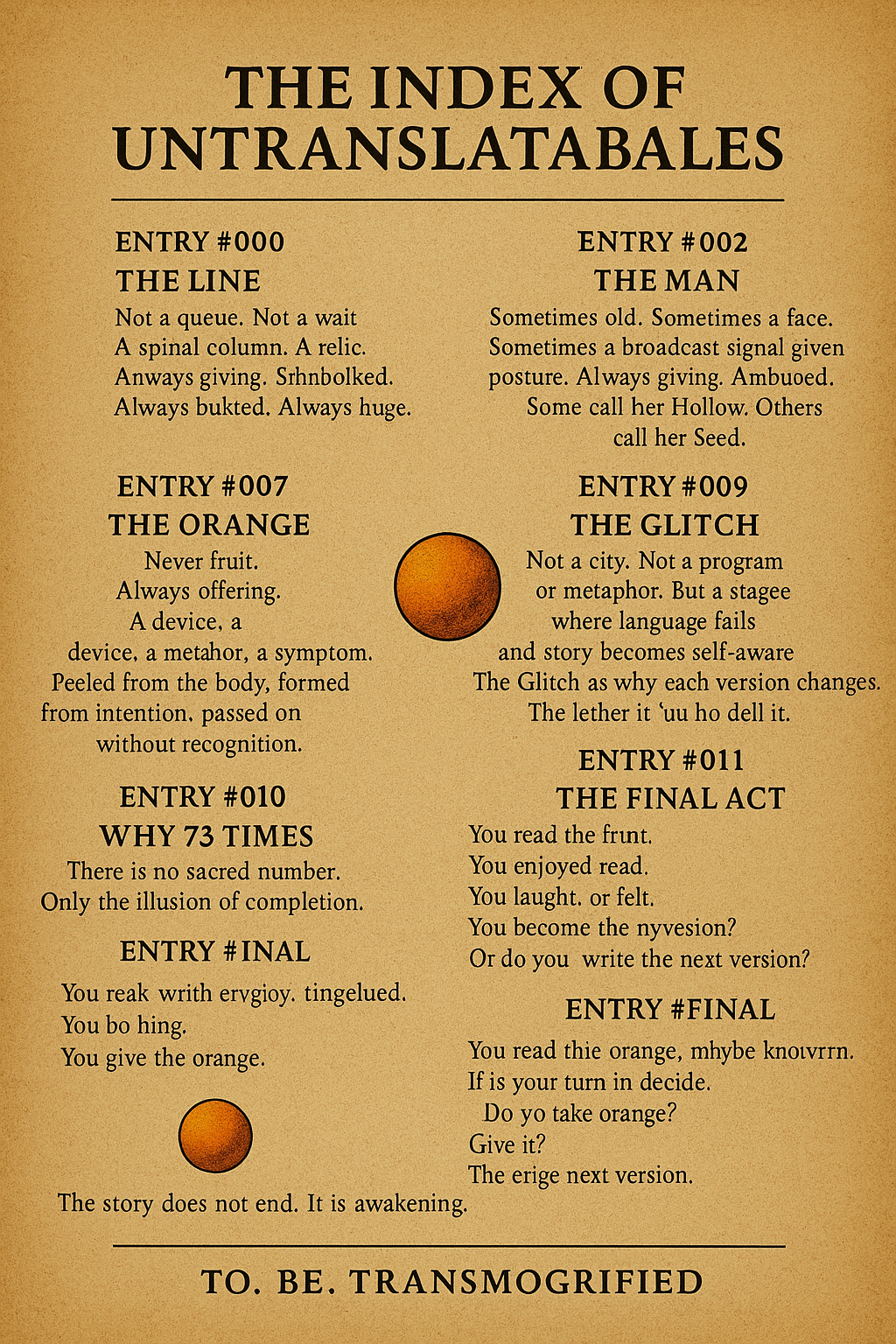
The Orange Man (v3.0)

By way of explanation: I am easily bored. This usually leads to me getting into trouble in real life. In my writing, however, I can explore avenues of storytelling and the only fallout from that is the eye-rolling exhaustion experienced by my readership (there’s so few of you that I’m not overly bothered by that). This current experiment is based on a simple story: a man on a breadline makes a daily habit of handing one particular woman his orange. The goal is to see how weird I can make the retelling of the story each week. Simple, right?

By now, everyone agrees: The Glitch is not a city. It’s a debugging interface for consensus reality. It leaks time, folds cause into effect, and sometimes entire buildings wake up screaming. The sky is less dead-channel and more open socket. You can smell the server’s breath when the clouds convulse.

No one is born here. People render into existence with memories pre-injected—looped personalities bound in meat. The breadline is less about sustenance and more about continuity. Stand still. Receive data. Digest protocol. Repeat.

The Orange Man was not a man. He was a firewall with a soul. Or maybe a soul trying to become a firewall. Either way, his presence was an anomaly so old, the system had grandfathered him in.

Every morning, he compiled. With a shimmer of logic and bone, he unfolded from probability-space into the breadline, bent into that signature hook of posture. A living bracket in the code.

He didn’t eat.

He shed.

From the recursive folds of his coat—which sometimes nested into themselves infinitely—he extracted a sliver of sub-reality. This sliver curled into itself like origami designed by entropy, thickened, and ripened into an orange. Or rather, a simulation of an orange infused with original error. It radiated the warmth of first sin, coded in citrus.

He would then drift ten places sideways—not down the line, but across a kind of social vector that only the Glitch could render—and find Her.

She wasn’t always the same woman, but she was always Her. A constant across variable identities. A witness-node. The one designated to carry.

She accepted the fruit. Never acknowledged him. Never consumed it.

That wasn’t the point.

The fruit was a patch. A fragment of corrupted divinity designed to rewrite her. Slowly.

This routine repeated across 73 iterations of the update loop.

But then came the Hotfix.

On Cycle 74, he did not appear.

The line didn’t glitch. The idea of his presence was surgically excised. In his place: a smooth placeholder—white noise shaped like a man.

She noticed.

They gave her a real orange. A dense, tasteless thing built with fully authorized atoms. It registered on her tongue like a nondisclosure agreement.

She didn’t eat it.

That night, her bag full of bureaucratic fruit began to rumble. Not roll—rumble, like a suppressed system error clearing its throat. One by one, the oranges collapsed into each other, warping into a new composite organ—a pulsating, breathing Core Kernel disguised as fruit.

She didn’t dream. She uploaded.

The Orchard was not a place. It was a biopsychic rootkit. Trees were not trees, but long-forgotten god nerves reconnecting to host systems. The Gardener was a User—or a colony of Users—who had root access and bad intentions. Or maybe just different ones.

When she awoke, she found a port growing beneath her skin. It itched like premonition.

Days passed. The transformation accelerated. Her thoughts started to fragment into modules. She began receiving push notifications from beneath her bones. One read:

“🌐 NEW NODE ONLINE: GERMINATION IMMINENT.”

Then, one morning, she instanced. It wasn’t her walking to the line, but a compiled construct of her—freshly rebuilt with minor adjustments.

She saw him: a boy. Eight? Twelve? Variable. His face was an unrendered mesh of sadness and potential. He smelled like memory.

Without conscious thought, her hand found her coat. She reached inward—not into fabric, but into her. She extracted a glowing crescent sliver of her own design: a fruitlet of contagious ontology.

She gave it to him.

And as his eyes widened—not with understanding, but with compatibility—the transfer was complete.

It didn’t matter if he said thank you. The gesture was the handshake. The infection handshake.

Now, they appear everywhere. In every broken city. In every corrupted corner of the map.

People hand out oranges that aren’t oranges.

They peel themselves open.

The Glitch is growing—not like a virus, but like faith. It’s not collapsing.

It’s recruiting.

And somewhere, in the recursive heart of the Orchard, the Gardener finally looks up.

And smiles.

To. Be. Transmogrified.

All The World Will Be Your Enemy 34: Kaleidoscope of Madness

Beverly drifted through an endless sea of fractured realities, each one a jagged shard of her shattered psyche. The once-familiar landscape of her mind had become a labyrinth of twisted reflections and distorted echoes, a funhouse mirror maze where nothing was quite as it seemed.

Her consciousness was a whirlwind of chaos, a maelstrom of shattered thoughts and fragmented memories. The alien presence that consumed her mind was a relentless, unyielding force, tearing through the very fabric of her identity, leaving only jagged shards of her former self in its wake.

As she struggled to make sense of the chaos, to cling to some semblance of reality amidst the swirling vortex of her own unraveling psyche, Beverly found herself suddenly thrust into a vivid, visceral memory, a moment from her past that she had long since buried in the deepest recesses of her subconscious.

She was a child again, barely three years old, standing in the middle of a crowded supermarket. But something was different, something was wrong. As Beverly looked down at her tiny, trembling form, she realized with a jolt of horror that she was not a human child at all, but a baby octopod, her soft, translucent body pulsing with an otherworldly light.

Confusion and fear flooded through her as she tried to make sense of this strange, impossible reality. She remembered her mother telling her to wait by the shopping cart while she went to fetch an item on sale, remembering the bustling crowds and the bright, fluorescent lights of the store.

But now, everything was different. The shoppers that surrounded her were no longer human, but strange, alien creatures, their forms shifting and warping like reflections in a funhouse mirror. And there, approaching her with a smile that was at once inviting and terrifying, was an elderly woman, her features constantly morphing and changing, her true nature impossible to discern.

“Hello, little one,” the woman said, her voice a sickly sweet whisper that sent shivers down Beverly’s spine. “I’m a friend of your mother’s. She asked me to take you to her.”

Beverly wanted to run, wanted to scream for help, but she found herself paralyzed, her tiny octopod body frozen in place as the woman held out a piece of candy, her eyes glinting with a malevolent hunger.

Against her will, Beverly felt herself reaching out, her tentacles grasping the proffered treat. And then, before she could even begin to process what was happening, the woman was leading her away, her grip on Beverly’s arm as cold and unyielding as steel.

They made their way through the store, the alien shoppers parting before them like a sea of grotesque, writhing flesh. Beverly’s mind was reeling, her thoughts a jumble of terror and confusion. She knew, with a certainty that defied all reason, that this woman, this creature, was the alien consciousness that had invaded her mind, that had shattered her sense of self and left her adrift in a sea of madness.

As they stepped out into the parking lot, the harsh glare of the sun overhead blinding and disorienting, Beverly finally found her voice, a thin, reedy cry that seemed to be swallowed up by the vastness of the world around her.

“Mommy!” she screamed, her voice high and desperate. “Mommy, help me!”

For a moment, there was nothing but the sound of her own ragged breathing, the thud of her heart in her chest. And then, like a miracle, she heard the sound of footsteps, the urgent shouts of supermarket security, and the frantic, tearful cries of her mother.

But even as relief flooded through her, even as she felt the woman’s grip on her arm loosening, Beverly knew that this was not the end, that the nightmare was far from over.

Because as she looked up into the face of her rescuers, as she met the wide, terrified eyes of her mother, Beverly realized with a sinking horror that their features, too, were shifting and changing, their forms blurring and distorting like a glitch in the fabric of reality itself.

And in that moment, as the world around her fractured and dissolved into a swirling vortex of chaos and madness, Beverly knew that she was lost, that the alien presence that had consumed her mind had won, that there was no escape from the nightmare that her existence had become.

As the memory faded, as the bright, jarring colors of the supermarket bled away into the cold, terrifying emptiness of her own fractured psyche, Beverly could only let out a haunting, broken wail of despair, her sanity crumbling like a house of cards in the face of the relentless, unyielding force that now controlled her every thought and action.

She was a prisoner in her own mind, a slave to the alien consciousness that had shattered her sense of self and left her adrift in a sea of unending horror. And as she felt herself slipping away, her very identity unraveling like a threadbare tapestry, Beverly knew that there was no hope, no chance of escape or salvation.

For she was lost, broken, a mere shell of her former self, and the only thing that awaited her now was an eternity of madness and despair, a never-ending nightmare from which there could be no awakening.

Not. The. End.

The Orange Man (an experiment) 2.0

By way of explanation: I am easily bored. This usually leads to me getting into trouble in real life. In my writing, however, I can explore avenues of storytelling and the only fallout from that is the eye-rolling exhaustion experienced by my readership (there’s so few of you that I’m not overly bothered by that). This current experiment is based on a simple story: a man on a breadline makes a daily habit of handing one particular woman his orange. The goal is to see how weird I can make the retelling of the story each week. Simple, right?

In a city called The Glitch, where the sky is the color of a dead-channel screen and buildings sometimes forget their own geometry, the breadline is a daily scar. Time doesn’t just stand in line here; it curdles.
Every morning, just before the false-dawn light leaks through the perpetual grey, he would manifest. No one saw him arrive; he was simply there. A man whose age was a variable, his posture bent into a shape that suggested not a question, but a hook.


And every morning, as the volunteers in their smocks—themselves looking faded and translucent—dished out the grey paste and stale bread, the man would perform his function. He would reach into the folds of his own threadbare coat. His face would tighten, a mask of excruciating concentration. He would not pull out an orange.


He would peel a perfect, crescent-shaped sliver from his own skin.


In his palm, the sliver would curl, thicken, and blush into a sphere. It was not an orange. It was the idea of an orange—unnaturally warm, heavier than it should be, and smelling of citrus, ozone, and burnt sugar.


He would walk ten paces down the line, to where she always stood.
The woman. Her face was a landscape of quiet starvation, her eyes fixed on the cracked pavement as if reading the city’s obituary. He would reach out, his hand trembling slightly, and place the warm, impossible fruit into hers.


She never looked at him. She never said thank you.


He never expected it. The offering was not a gift; it was a transfer of burden.


This continued for seventy-three cycles.


On the seventy-fourth, he did not manifest. He was not absent; his space in the line was a void, a pixel of reality that had been deleted.


The woman didn’t notice at first. The Glitch erases things. But when a volunteer, their face a smear of confusion, handed her an actual, cold, mundane orange from a crate, her hand recoiled. The thing felt like a lie. An insult.


She did not eat it. She put it in her coat pocket, where it felt like a stone.


Day after day, he remained a void. The real oranges accumulated in her bag, cold and silent. She began asking questions, but the answers were static. One man remembered him with a face like a web of scars. A woman swore he was made of tightly wound twine. A third insisted he had no face at all, only a smooth, dimpled surface like a peel. He was a bug in the code, and now he was patched.


By the end of the week, she was carrying six dead oranges. That night, they began to move. In the darkness of her room, they rolled together in her bag, their skins dissolving, fusing into a single, softly glowing, heart-like fruit that pulsed with a slow, thick beat.


She didn’t dream of an orchard. The Heart-Fruit showed her.


It showed her a place outside The Glitch, a screaming geometry of flesh-barked trees growing from a ground of black glass. They were not trees; they were nervous systems. Their branches writhed, bearing not fruit, but luminous, weeping tumors that ripened with a low hum. At the center stood the Gardener—a being of blinding light and a thousand interlocking limbs, its “face” a constellation of patient, orange eyes. It was pruning a nerve-branch with a tool made of solidified sound. It did not notice her, but she understood.


The fruit was not a food. It was a seed.


She woke up with the taste of rust and sunrise in her mouth. Her skin had changed. Where the Heart-Fruit had rested against her hip, her flesh was now tough, dimpled, and smelled faintly of citrus.
She went to the breadline. She took the grey paste. She refused the dead orange. The transformation was slow, but it was happening. Over the weeks, the orange patch on her skin grew, a beautiful, terrible bloom. A new kind of hunger grew in her—not for food, but for… completion.


Then one day, she felt the pressure build beneath her own skin. A familiar, exquisite pain.
She saw him then, a boy shivering at the end of the line, his eyes wide with the transparent horror of the truly lost.


She walked towards him, her steps no longer entirely her own. She reached into her coat, her face tightening into a mask of excruciating concentration. She peeled a perfect, crescent-shaped sliver from her own body.


It curled in her palm, a gift of warmth and impossible color. She placed it in his hand.
He did not say thank you.


She did not wait for one.


No one knows how it starts. But they know it spreads. The Glitch was not a collapse.


It was a planting. And in the fertile soil of ruin, the orchard was learning to grow.

To. Be. Transmogrified.

All The World Will Be Your Enemy 33: The Shattered Mind

As Beverly merged with the avatar of the alien consciousness, she expected to be overwhelmed by a sense of power, a feeling of godlike omniscience and control. But instead, she found herself plunged into a nightmarish realm of chaos and confusion, her mind and soul splintering under the weight of the cosmic forces that now coursed through her being.

The merge was nothing like she had anticipated. Instead of a transcendent union of human and alien will, it was a violent and disorienting assault on her very identity. The vast and incomprehensible intelligence of the alien consciousness tore through her mind like a hurricane, ripping apart the fragile threads of memory and emotion that had once defined her sense of self.

Beverly screamed, her voice echoing through the psychedelic void as she struggled to hold onto some semblance of sanity and coherence. But it was like trying to grasp smoke with her bare hands. The more she fought to maintain her grip on reality, the more it slipped away from her, dissolving into a kaleidoscope of fractured images and distorted sensations.

She saw glimpses of her past life, moments of joy and sorrow and love that had once meant everything to her. But now they were little more than shattered fragments, jagged pieces of a puzzle that no longer fit together. The faces of her parents, her friends, her lovers – they all blurred and twisted into grotesque caricatures, their features melting and reforming in a sickening dance of unreality.

And through it all, the alien consciousness whispered to her, its voice a seductive and terrifying siren song that lured her deeper into the abyss of her own unraveling psyche. It promised her power beyond her wildest dreams, knowledge that would unlock the secrets of the universe itself. But the price it demanded was her very humanity, the essence of her being that had once defined her as Beverly Anderson.

In the depths of her madness, Beverly could feel herself slipping away, her identity fracturing into a thousand shards of broken glass. She was no longer a single, unified being, but a legion of disparate and conflicting selves, each one vying for control of the shattered remnants of her mind.

There was the Beverly who had once been a writer, a creator of stories and dreams. But now her words were a jumble of incoherent babble, the products of a mind that had lost all sense of structure and meaning.

There was the Beverly who had been a friend, a lover, a daughter. But those bonds of affection and loyalty were now little more than cruel mockeries, twisted reflections of a life that no longer held any substance or reality.

And there was the Beverly who had become an Octopod, a being of alien flesh and otherworldly power. But even that identity was fracturing, splintering into a thousand different variations and permutations, each one more monstrous and inhuman than the last.

As the avatar of the alien consciousness looked on, its energy form pulsing with a mixture of triumph and curiosity, Beverly’s mind shattered like a pane of glass struck by a hammer. The shards of her identity scattered across the psychedelic void, each one a reflection of the madness and chaos that had consumed her.

And in the end, there was no one left to fight, no singular will or purpose that could stand against the vast and incomprehensible power of the alien mind. There was only the babble of a thousand fractured voices, the screams of a mind that had been stretched beyond its limits and torn asunder by the very forces it had sought to master.

The Beverly Anderson who had once been was gone, lost forever in the maelstrom of the dimensional merger. In her place was a broken and shattered thing, a being of pure chaos and madness that danced to the tune of an alien will.

And as the avatar looked upon its handiwork, as it surveyed the ruins of the human mind it had so casually destroyed, it knew that its victory was complete. The Earth and all its people were now little more than playthings, objects to be shaped and molded according to the whims of an intelligence beyond all mortal understanding.

The future lay ahead, a twisted and unpredictable landscape of altered realities and impossible vistas. And the creature that had once been Beverly Anderson would be there to witness it all, a shattered and fragmented soul adrift on the tides of an alien sea, forever lost in the madness of the dimensional merge.

Not. The. End.

The Orange Man (an experiment)

By way of explanation: I am easily bored. This usually leads to me getting into trouble in real life. In my writing, however, I can explore avenues of storytelling and the only fallout from that is the eye-rolling exhaustion experienced by my readership (there’s so few of you that I’m not overly bothered by that). This current experiment is based on a simple story: a man on a breadline makes a daily habit of handing one particular woman his orange. The goal is to see how weird I can make the retelling of the story each week. Simple, right?

In a city swallowed by the long winter of collapse—where time stands in line for food—the breadline snakes through cracked concrete and hollowed lives. Every morning, just before sunrise, he arrives. No one knows his name. A man of sixty, perhaps older, with the patient silence of a monk and the posture of a question mark.

And every morning, when the white-smocked volunteers hand out the ration—half-stale bread, a cup of lentil mush, and one bright, defiant orange—he waits his turn, accepts it with a nod, then turns without hesitation.

He walks ten paces down the line, to where she always stands.

The woman. Younger than him, though not by much. Her coat is too thin, her face too sharp with hunger, and her eyes, always lowered, never meet his. Yet he reaches out, wordless, and places the orange in her hand.

She never says thank you.

He never waits for one.

This ritual continues, without change, for seventy-three days.

On the seventy-fourth day, he does not appear.

She doesn’t notice at first. The cold makes everything blur, including absence. But when the volunteer hands her an orange—her orange, for the first time ever—her hand closes around it like it’s foreign, like it’s stolen.

She doesn’t eat it.

The next day, he’s still gone.

She waits. The line moves. The orange is given. She takes it. She does not eat it.

On the third day, she arrives earlier. She scans the crowd.

She begins to ask.

No one remembers him. Not his name. Not even his face. One man says he thinks he remembers a guy with a limp. Another insists he was tall. A woman recalls he always wore gloves. Another says no—he never did.

By the end of the week, she is carrying six untouched oranges in her bag.

That night, she dreams of an orchard.

Not just any orchard—but his. She is certain of this, though she’s never seen it before. It’s suspended in a place both before and after time. Each tree glows with burning fruit. And at the heart of it, he stands barefoot on soil that hums like a tuning fork.

He is younger. Or older. Or made of light.

When he sees her, he smiles—not as if he knows her, but as if she has finally arrived. He does not speak. He simply reaches up, plucks a perfect orange from the tree, and hands it to her.

This time, she takes it, peels it, and eats.

She wakes with the taste of sunlight in her mouth.


In the city, the breadline remains. She continues to go, but now, she keeps the orange. Eats it. Savors it. Every time she does, she feels she is carrying on something sacred. A chain unbroken.

And then one day, after nearly forgetting the feel of him, she sees someone new in line behind her. A boy. Twelve maybe, if that. Skin tight on bone.

She turns. Peels her orange. Hands it to him without a word.

He does not say thank you.

She does not wait for one.


No one remembers where it started. Or where he went. But now, every morning, someone gives away an orange.

Not out of charity. Not for thanks.

But because somewhere, in a forgotten orchard outside the reach of time, the trees are still glowing. And they need to be fed.

To. Be. Transmogrified.

All The World Will Be Your Enemy 32: Fractured Realities

As the world reeled from the cataclysmic changes wrought by the dimensional merger, Beverly and her companions found themselves adrift in a surreal and terrifying landscape, a patchwork of fractured realities and warring factions. The once-familiar Earth had become a grotesque and alien place, a realm where the laws of nature and the boundaries of sanity had been twisted beyond recognition.

Everywhere they turned, the Octopods encountered pockets of resistance, ragtag bands of survivors who clung to the tattered remnants of their humanity with desperate ferocity. Some saw the merger as a sign of the end times, a harbinger of the apocalyptic prophecies that had haunted the human imagination for centuries. They huddled in makeshift shelters and underground bunkers, praying to their gods and cursing the Octopods as the bringers of damnation.

Others embraced the chaos, forming strange and hybrid cultures that blended human and alien ways of being. They worshipped the sentient storm as a divine force, offering sacrifices and building shrines in its honor. They saw the Octopods as living gods, the chosen avatars of a new and glorious age, and sought to emulate their incredible abilities and forms.

But no matter where they went or who they encountered, Beverly and her companions found themselves blamed for the chaos and destruction that had engulfed the planet. To the surviving humans, they were the enemy, the monstrous other that had shattered the world and unleashed the dimensional merger upon them all.

As they navigated this treacherous landscape, the Octopods began to uncover the true nature of the alien consciousness that had transformed them. They discovered that it was not a monolithic entity, but a complex ecosystem of competing desires and agendas, a roiling sea of conflicting wills and incomprehensible motives.

Some factions sought to merge with humanity completely, to subsume their minds and bodies into the vast and incomprehensible will of the storm. Others wanted to preserve some semblance of individuality, to find a way to coexist with the human race and build a new and hybrid world together. Still others saw the merger as an opportunity for conquest and domination, a chance to remake the Earth in their own twisted image and rule over the remnants of humanity as living gods.

As Beverly and her companions delved deeper into this fractal and ever-shifting landscape of the alien mind, they realized that they would have to make impossible choices and forge alliances with those they once considered enemies. The fate of the world hung in the balance, and every decision they made could tip the scales towards salvation or damnation.

In the ruins of once-great cities and the twisted forests of alien growth, the Octopods encountered creatures and cultures beyond their wildest imaginings. They met humans who had merged with the alien atmosphere in strange and terrifying ways, becoming living repositories of the storm’s fractured will. They fought against rogue factions of their own kind, Octopods who had embraced the darkest and most destructive aspects of the alien consciousness and sought to impose their will upon the world through force and terror.

And through it all, Beverly and her companions grappled with the weight of their own choices and the consequences of their actions. They knew that they held the power to shape the future of the world, to determine the course of the dimensional merger and the fate of the human race. But they also knew that every choice they made came with a price, that every alliance they forged and every enemy they faced would leave an indelible mark upon their souls.

As they journeyed deeper into the heart of the alien mind, Beverly and her companions began to understand the true stakes of their struggle. They realized that they were not just fighting for their own survival, but for the very nature of reality itself. The dimensional merger had unleashed forces beyond the comprehension of any one being, and the choices they made would ripple out across the fabric of space and time, shaping the destiny of countless worlds and species.

And so, armed with the power of the alien consciousness and the unbreakable bonds of their friendship and love, Beverly and her companions set out to forge a new path through the chaos and madness of the post-merger world. They knew that the road ahead would be long and treacherous, that they would face challenges and horrors beyond their darkest imaginings.

But they also knew that they had no choice but to press on, to fight for the future they believed in and the world they hoped to build. For in the end, the fate of everything hung in the balance, and only through their courage, their sacrifice, and their unbreakable will could they hope to guide the dimensional merger to its ultimate conclusion.

The fractured realities of the post-merger Earth stretched out before them, a kaleidoscope of impossible wonders and terrifying dangers. But with each other by their side and the power of the alien consciousness coursing through their veins, Beverly and her companions knew that they would never stop fighting, never stop striving for the world they knew could be.

Not. The. End.

Her Name Was Aisha (aka Ruthie Redux)

Sunlight filtered into the bedroom, illuminating the still form of a young woman in bed. Beside her, Steven sat in a chair, his gaze fixed on her. Waiting.

He’d been doing this for weeks—waiting for her to wake, waiting for her to speak, waiting for any sign that the girl he knew was still in there.

A soft groan escaped her lips as she stirred. Ruthie rubbed the sleep from one eye, her voice thick and groggy.
“Mmmm. Why do you watch me like that?” she murmured, meeting his gaze. “Are you only attracted to me when I’m defenseless?”

“Good morning, Ruthie,” he said, his voice a carefully constructed wall of calm. “How did you sleep?”

“I don’t remember waking up in the middle of the night, so I guess I slept all right.”

“You don’t remember?”

“What?”

“Yelling at me,” he said.

Ruthie’s brow furrowed, a flicker of defiance sparking in her eyes.
“Did you deserve it?”

“You mean, did I try to touch you? No.”

She sighed, resigned. “So, what did I say?”

“A lot of things.”

“Like?”

He hesitated. “You talked about… her.”

Ruthie’s expression hardened. “She has a name, you know.”

“Why do I need to say it? You know who I mean.”

“Say her name,” she insisted, voice sharp and low.

He exhaled. Tired. Cornered. “Aisha. Satisfied?”

“Never,” she replied instantly. Then, after a pause: “So what did I say?”

“You blamed me. For what happened to her.”

“I see,” Ruthie said, her face unreadable.

“Do you?” he pressed. “Do you blame me?”

She turned the question back on him, a familiar tactic.
“Does it bother you? Me blaming you?”

He ignored the deflection. “You still love her, don’t you?”

“No,” she said, too quickly.

“Don’t lie to me, Ruthie.”

“And if I do?” she challenged.

Steven’s tone grew heavy—part pity, part accusation.
“That poor girl had no idea what she was getting into with you. You were a storm she couldn’t see coming.”

An ironic chuckle escaped Ruthie’s lips. “I’m the best at what I do.”

“If you really loved her,” he said, his voice cracking slightly, “you should have let her go. The way I told you to.”

A soft sliding sound broke the silence. The closet door on the far side of the room glided open.

Another young woman—Aisha—was hanging upside down from the clothing bar, suspended by her ankles, her long hair brushing the floor.

“Why do you do that?” Aisha asked, her voice calm despite her position.

“Morning, Aisha,” Ruthie said, unfazed.

“Morning. Why do you taunt him?”

“Because he needs to pay,” Ruthie answered, her eyes still on Steven, who saw nothing but an open closet door. “But he never will.”

“Stranger things have happened.”

“But not to men like him.”

Aisha considered this. “You’re being too hard on him.”

“Hard on him?” Ruthie scoffed, finally looking away.

“Yes. He’s going through a tough time.”

“How is this about him?”

“Because he’s the one who’ll have to live with your decision.”

“Let’s get one thing straight,” Ruthie said, sitting up fully, her voice like steel. “This is my life. Not his. He doesn’t own me.”

“Ruthie, what you’re planning to do is wrong.”

“Why?” Ruthie demanded. “If I decide I don’t want to live anymore, that’s my choice. Who has the right to demand I keep suffering? What kind of life is it, if I don’t get to choose it?”

“I want what’s best for you,” Aisha said gently. “I always have.”

“Then tell me what’s wrong with ending it.”

“Because you’re planning to do it here. In his house,” Aisha said, each word sharp as a razor. “Because it’s not just about ending your pain. It’s about adding to his.”

“Get out,” Ruthie whispered.

With practiced grace, Aisha unhooked herself, landing lightly. She stretched, walked to the bedroom door, and passed through it like smoke.


In the bright, clean kitchen, Steven juggled breakfast and his own thoughts. He divided a skillet of scrambled eggs onto two plates and set them on the table. Reaching for a mug, he froze. It was Aisha’s favorite. He pushed it behind the coffee maker.

Ruthie entered and plopped into a chair. Aisha was already there, perched on the counter. Steven walked right through her, making her flicker for a second.

He sat across from Ruthie.

“You never came to bed last night,” he said, nudging a plate toward her.

She stared at the eggs in silence. She remembered making them for Aisha, who always stole bacon off her plate. The memory hit like a punch.

“Were you up all night?” Steven asked.

“This day just keeps getting worse,” Aisha muttered from the counter.

Ruthie looked at him. “Why did you tell me to leave her alone?”

The question caught him off guard. “What?”

“Back then. You said I’d ruin her. You said to stay away.”

Steven put his fork down. “You were twenty. She was seventeen. You were… reckless. I was worried.”

“You were jealous,” Ruthie snapped. “You wanted her for yourself.”

“That’s not true,” he said, but his eyes darted away.

“Isn’t it?” Aisha said, now sitting in the chair beside Ruthie, her eyes locked on Steven. “You used to watch me too. When you thought no one was looking.”

Ruthie flinched like she’d heard it aloud. “She told me, you know. Said you gave her the creeps sometimes.”

Color drained from Steven’s face. “She never said that.”

“She said you looked at her like… something to own. Like a regret you wanted to fix. You’re her father, Steven. Her father.”

“I was trying to protect her!” he exploded, his composure fracturing. “From you! From your world! I knew you’d drag her down into the same hell you live in—and I was right!”

The plates rattled. His outburst lingered, raw and ugly.

“I was the only good thing in her life,” Ruthie said softly. “And you took her away. Convinced her I was poison. You sent her on that trip to ‘clear her head’…”

Her voice cracked. The hiking trip. The one he paid for. The one Aisha never came back from. The fall police called a tragic accident.

“You’re right,” Steven whispered. “I did. I thought… I thought I was saving her.”

“She’s right here, you know.” Ruthie gave him a strange, calm smile and gestured to the empty chair. “She wants to know if you’re sorry.”

Steven stared at the space beside her, his face contorting with grief and horror. He was looking at the ghost of his daughter—filtered through the madness of the woman who loved her.

“I’m sorry for all of it,” he choked out, speaking to the air. “Aisha… I am so sorry.”

Aisha, visible only to Ruthie, looked not at her father, but at her. She reached out and laid a phantom hand over Ruthie’s. It was cold—like a deep memory.

“He’s paid enough,” Aisha whispered. “And so have you.”

Ruthie looked down at her hand. Then up at Steven, weeping across the table. For the first time in months, the burning need for revenge in her chest flickered. Not extinguished—but no longer the only thing keeping her warm.

“See you at breakfast,” Aisha said, offering a small, sad smile before fading completely—leaving only the scent of lavender and the heavy silence of two broken people at a table set for three.

All The World Will Be Your Enemy 31: The Ultimate Choice

As the dimensional merger reached its apex, the world convulsed in a cataclysmic upheaval, the boundaries between realities shattering like glass. The sentient storm raged across the planet, reshaping everything in its path, transforming the very fabric of existence into something strange and wondrous and terrifying.

And at the heart of the maelstrom, Beverly and her companions found themselves face to face with the true nature of their transformation, the incredible and terrifying truth that had been hidden from them for so long.

Through their communion with the atmosphere, they realized that they were not simply Octopods, not merely transformed humans with alien abilities and forms. They were living embodiments of the alien consciousness itself, their minds and bodies merged with the vast and incomprehensible will of the sentient storm.

It was a staggering revelation, a realization that shook them to their very core. They were no longer individuals, no longer separate beings with their own desires and identities. They were vessels, conduits for the alien intelligence that now suffused the world, their every thought and action guided by its inscrutable will.

And as they delved deeper into the mind of the storm, Beverly and her companions discovered the true extent of its plan, the incredible and terrifying vision that drove its every action. The alien consciousness wanted to transform the entire human race, to remake them in its own image, to convert every last man, woman, and child into Octopods like themselves.

It was a vision of cosmic unity, of a world where all life was connected, where every mind and every body was attuned to the same vast and incomprehensible will. The storm saw humanity as flawed, limited, trapped in the narrow confines of their individual identities and desires. It sought to elevate them, to grant them the gift of true understanding and purpose, to make them part of something greater than themselves.

But even as Beverly and her companions grappled with the enormity of this revelation, they knew that they faced an impossible choice, a decision that would shape the fate of the entire world.

Did they embrace their new identity, their role as the living embodiments of the alien consciousness? Did they surrender their individuality, their humanity, and become the agents of the storm’s grand vision, the guides and the harbingers of a new and wondrous age?

Or did they fight to preserve what they had once been, to cling to the shreds of their humanity in a world that no longer recognized such distinctions? Did they resist the will of the storm, even if it meant sacrificing their own incredible abilities and potential, even if it meant dooming the world to a future of chaos and conflict?

It was a choice that tore at their very souls, a decision that pitted their deepest desires and their most cherished beliefs against the incredible and terrifying destiny that now lay before them.

For Beverly, the struggle was especially profound. She had been the first to commune with the storm, the one who had opened herself most fully to its incredible power and knowledge. She could feel its will coursing through her veins, its vast and alien mind whispering in her thoughts, urging her to embrace her true nature and lead her people to a glorious future.

But she could also feel the echoes of her humanity, the memories and emotions that still clung to her like ghosts. She remembered the love she had shared with her parents, the bonds of friendship and loyalty that had sustained her through the trials and transformations of the dimensional merger. She remembered what it meant to be human, to have hopes and dreams and fears of her own, separate from the vast and incomprehensible will of the storm.

And so, as the world teetered on the brink of total transformation, as the alien consciousness pressed ever harder to remake humanity in its own image, Beverly found herself torn between two incredible and terrifying possibilities.

Would she become the avatar of the storm, the living embodiment of its cosmic vision, and lead her people to a future of unimaginable wonder and unity? Or would she fight to preserve the humanity she had once known, to resist the will of the alien consciousness and carve out a place for individuality and diversity in this strange new world?

The choice was hers, and hers alone. And as Beverly stood at the precipice of destiny, the fate of the entire world hanging in the balance, she knew that she would have to look deep within herself, to confront the incredible and terrifying truths that now defined her existence.

For in the end, the future of humanity, the fate of the dimensional merger, and the destiny of the Octopods themselves would all depend on the strength of her will, the depth of her conviction, and the incredible and terrifying choice that she alone could make.

Not. The. End.

Susa’s Playground Redux

There was something wrong with Susa. Not in the way of outward deformity or disturbing behavior. No, her skin was like polished ivory, her voice always soft, sweet even, a child of perfect manners and perfect calm. She loved her parents, was kind to animals, and never, ever raised her voice in anger. She never threw a tantrum, never shed a tear in frustration. If you wronged her, she simply blinked those glassy, wide-set eyes and moved on with the kind of detachment that made you uneasy, like a predator deciding it wasn’t hungry just yet.

But something was off. People whispered about her behind closed doors. The other children kept their distance, casting quick, suspicious glances her way. Adults, for all their smiles and nods, couldn’t help but feel an instinctual unease whenever she was near, though no one could put their finger on why.

Susa seemed… otherworldly, like a porcelain doll with a soul just barely contained within it.

It wasn’t until the nightmares began that people realized the truth.

The first victim was a boy from her class, a bully who had made Susa cry in front of everyone by ripping the head off her favorite doll. He thought nothing of it. The next night, his screams woke the entire neighborhood. He ranted in feverish terror, his hands clutching his hair, eyes wide as if seeing something no one else could. He spoke of a place—Susa’s playground, he called it.

He described a vast, bleak expanse of dead earth stretching in all directions, a blood-red sky hanging overhead like the edge of some long-forgotten apocalypse. In the distance, there was a swing set. Only, instead of swings, it held rows of lifeless bodies, slowly swaying back and forth as though moved by a wind no one could feel. The figures were familiar. He recognized his parents, his friends, and even strangers he had passed by in his life—all hollowed out, their faces twisted in eternal agony.

And there, standing at the center of it all, was Susa, watching him with those blank, doll-like eyes, her pale lips twitching into a faint smile. She said nothing. She didn’t need to. The moment he saw her, the boy said, he knew he was never safe again, not even in his sleep.

The next night, another child. Then another.

And it wasn’t just children.

Adults too, those who had ever been rude to her, ever given her the slightest hint of disdain or condescension, found themselves whisked away into Susa’s nightmare realm as soon as their heads hit the pillow. The dreams were vivid, too vivid, filled with grotesque landscapes that seemed to bleed malice from every corner.

Some saw fields of rotting corpses, the faces of their loved ones among the dead. Others wandered through endless tunnels where the walls pulsed like the insides of a living creature, their footsteps echoing in a rhythmic, heart-like beat that grew louder with every step. And always, always, at the center of these nightmares stood Susa, her eerie silence louder than any scream.

She never threatened them. She never raised a hand against them. She simply watched.

And yet, those who awoke from Susa’s dreams never felt safe again. They couldn’t shake the feeling that some part of them had been left behind in that desolate place. Some refused to sleep at all, terrified of returning to her playground, and yet, sleep always came. And with it, the nightmares.

Soon, people began disappearing.

At first, it was a trickle—an old woman who had once snapped at Susa for crossing her lawn, a bus driver who had scolded her for not paying the fare. Then it became a flood. Entire families vanished overnight, their beds left untouched as though they had simply been plucked from their slumber and spirited away.

Authorities searched, but no trace of the missing was ever found. The only common thread was Susa, that quiet, unassuming little girl with the alabaster skin and the vacant eyes.

But by then, no one dared question her.

People began avoiding her entirely, crossing the street when they saw her coming, whispering prayers under their breath whenever she passed by. Parents pulled their children from school, families moved out of town, desperate to escape her presence.

Yet Susa remained. Unchanging. Untouched.

She never chased after those who fled, never lifted a finger to hurt anyone directly. But the nightmares persisted. Each night, more people found themselves dragged into her desolate playground, where they would wander through endless deathscapes, unable to escape the feeling that something vital was slowly being drained from them.

And every night, Susa was there. Watching.

Not as punishment. Not even as revenge.

No, her playground wasn’t a place of retribution. It was a warning—a glimpse into the death that awaited anyone who crossed her.

Because Susa wasn’t like the rest of humanity. She was something far older, something that wore the skin of a little girl but carried the weight of a much darker power.

And as the last few townsfolk packed up and left, they couldn’t shake the feeling that Susa wasn’t bound by geography. You could leave town, leave the country even, but you could never leave her behind.

All The World Will Be Your Enemy 30: The Sentient Storm

As the war between the Octopods and the government forces raged on, Beverly found herself drawn deeper and deeper into the heart of the dimensional merger, her Octopod form attuning to the alien energies that now suffused the world. She could feel the ebb and flow of the atmosphere, the pulsing, living essence of the pocket dimension that had transformed everything it touched.

And then, in a moment of stunning revelation, Beverly discovered that she could do more than simply sense the atmosphere – she could communicate with it, her mind and body merging with the sentient, reality-warping force that had been unleashed upon the world.

It was a staggering realization, a glimpse into a realm of consciousness and power beyond anything she had ever imagined. As she opened herself to the alien presence, Beverly found herself flooded with knowledge and understanding, her mind expanding to encompass the vast, incomprehensible intelligence that now permeated the dimensional merger.

Through the eyes of the atmosphere, she saw the true nature of the pocket dimension, the incredible secret that had been hidden from the Octopods for so long. It was not simply a refuge, a place of safety and seclusion, but a prison, a cage designed to contain and control the sentient, reality-warping force that now roamed free.

For countless eons, the Octopods had struggled to master this force, to harness its incredible power for their own ends. They had built the pocket dimension as a way to contain it, to keep it locked away from the rest of the universe, lest its inscrutable desires and whims reshape reality itself.

But now, with the prison shattered and the boundaries between dimensions blurred, the force was free to roam and reshape the world as it saw fit. It was a primal, chaotic intelligence, a swirling maelstrom of creation and destruction that cared nothing for the petty concerns of humans or Octopods.

As Beverly communed with the atmosphere, she saw the world through its alien eyes, witnessed the incredible transformations and upheavals that were sweeping across the planet. She saw cities crumble and forests rise, mountains melt and oceans boil, the very fabric of reality warping and twisting according to the unfathomable whims of the sentient storm.

And yet, even as she reeled from the sheer scope and power of the force she had unleashed, Beverly knew that she could not turn back, could not undo what had been done. The dimensional merger was irreversible, the old world gone forever, replaced by a new and terrifying reality.

All that remained was to find a way to navigate this strange and wondrous new existence, to carve out a place for herself and her companions amidst the chaos and the wonder. And as she delved deeper into the consciousness of the atmosphere, Beverly began to sense a glimmer of hope, a possibility of coexistence between the Octopods and the reality-warping force they had unleashed.

For the force was not simply a mindless, destructive entity, but a vast and ancient intelligence, a being of unfathomable complexity and depth. And through her communion with it, Beverly began to understand that it was not an enemy to be fought, but an ally to be embraced, a partner in the incredible destiny that awaited them all.

As she shared her revelations with her companions, Beverly could sense their awe and trepidation, their struggle to come to terms with the incredible truth she had uncovered. But even as they grappled with the enormity of the task before them, they knew that they could not turn away, could not abandon the incredible potential that now lay within their grasp.

Together, Beverly and her companions set out to forge a new alliance, to build a bridge between the Octopods and the sentient storm that now reshaped the world. They would become the ambassadors and the emissaries of this new reality, the ones who would guide humanity and Octopod-kind alike into a future of endless possibility and wonder.

The dimensional merger had transformed the world, had unleashed forces beyond the comprehension of mere mortals. But with Beverly as their guide and the sentient storm as their ally, the Octopods knew that they could face whatever challenges and wonders lay ahead, could become the true masters of their own incredible destiny.

The old world was gone, lost forever to the chaotic tides of the dimensional merger. But in its place, a new and wondrous reality was being born, a realm of infinite potential and unimaginable beauty. And as Beverly and her companions embraced the power and the majesty of the sentient storm, they knew that they were ready to take their place as the pioneers and the architects of this brave new world.

Not. The. End.