Famous Authors Reveal Their Writing Secrets (go on, you know you wanna look)

1. “The secret of getting ahead is getting started. The secret of getting started is breaking your complex overwhelming tasks into small manageable tasks, and then starting on the first one.” — Mark Twain

2. “People on the outside think there’s something magical about writing, that you go up in the attic at midnight and cast the bones and come down in the morning with a story, but it isn’t like that. You sit in back of the typewriter and you work, and that’s all there is to it.” — Harlan Ellison

3. “The secret is to start a story near the ending.” — Chris Offut

4. “The secret of successful fiction is a continual slight novelty.” — Edmund Gosse

5. “The big secret is the ability to stay in the room.” — Ron Carlson

6. “The secret to being a writer is that you have to write. It’s not enough to think about writing or to study literature or plan a future life as an author. You really have to lock yourself away, alone, and get to work.” — Augusten Burroughs

7. “It’s hard to explain how much one can love writing. If people knew how happy it can make you, we would all be writing all the time. It’s the greatest secret of the world.” — Andrea Barrett

8. “Composition is a discipline; it forces us to think. If you want to “get in touch with your feelings,” fine—talk to yourself; we all do. But, if you want to communicate with another thinking human being, get in touch with your thoughts. Put them in order; give them a purpose; use them to persuade, to instruct, to discover, to seduce. The secret way to do this is to write it down and then cut out the confusing parts.” — William Safire

9. “The secret of it all, is to write in the gush, the throb, the flood, of the moment – to put things down without deliberation – without worrying about their style – without waiting for a fit time or place. I always worked that way. I took the first scrap of paper, the first doorstep, the first desk, and wrote – wrote, wrote…By writing at the instant the very heartbeat of life is caught.” — Walt Whitman

10. “If there is a secret to writing, I haven’t found it yet. All I know is you need to sit down, clear your mind, and hang in there.” — Mary McGrory

Stop making that face. Did you really think you were going to uncover some magical shortcut to get you through the sometimes torturous process of writing? Ain’t I done learnt y’all better’n that? You go on now, here? And enjoy your weekend.

Sally forth and be secretly writeful.

— Rhyan Scorpio-Rhys

The Versatile Blogger Award

Hmmm, my very first blogger award nomination. What a pleasant surprise as I wasn’t aware something like this even existed. I’d like to thank Lara S. Chase over at In Progress: A New Author Navigates the World of Publishing for nominating me. It’s an honor to know that she not only occasionally enjoys my posts but also took the time to nominate my blog.

According to the rules:

Well, I’ve thanked Lara, so that’s sorted (check out her blog, it really is an interesting ride). Now I have to name:

My Nominees for The Versatile Blogger Award

  1. http://chriskokoski.wordpress.com/
  2. http://cicampbellblog.wordpress.com/
  3. http://shareyourarticles.wordpress.com/
  4. http://damyantiwrites.wordpress.com/
  5. http://ellisnelson.com/
  6. http://www.moneyequalslifestyle.com/
  7. http://impossiblewords.wordpress.com/
  8. http://writingsofamrs.wordpress.com/
  9. http://insearchofmymuse.wordpress.com/
  10. http://macabrebutsweet.wordpress.com/
  11. http://khaulanazir.wordpress.com/
  12. http://letmereach.com/
  13. http://khmazzola.wordpress.com/
  14. http://lachlancathy.com/
  15. http://leonardostories.wordpress.com/

And finally:

Seven Things About Myself

  1. Although I love to read, watch and write horror, I do not, even in the tiniest sense, believe in the paranormal, supernatural, or the occult. I do, however, believe in loonies, cultists and serial killers, so that should give me some sort of horror street cred.
  2. I once owned a tom cat named Buster Crabbe Unit Active Missile Warhead, who met his untimely end doing battle with a boxer (the dog-type, not the Balboa-type, though that would’ve made for a better movie than Rocky V).
  3. A former anime junkie, now I am tragically addicted to UK telly and in severe need of an intervention. I even watch Big Brother UK and the addiction has spread to Big Brother Australia. Don’t judge me!
  4. I absolutely despise the use of CGI in movies, especially when used to animate humans in a live action setting.
  5. Although the internet has made things digitally easier, I miss swapping videotaped TV programs with my friends, especially episodes of Mystery Science Theater 3000.
  6. I was once contacted by a man who claimed to own the licensing rights to Sybil Danning (an Austrian actress who starred in a lot of ’80s cult, science fiction, and action B movies) and he tried to rope me into a 5 year comic book deal (I was a comic book publisher at the time).
  7. I firmly believe that despite how intelligent we are as a species, we are not clever enough to know our origins, nor that of the planet or the universe.

A Nickel’s Worth of Free Writing Advice: Fill Your Toolbox

Is your writing toolbox looking a little empty? Fill it with the words you collect today from snippets of conversations you overhear, newspapers, magazines, books, or wherever you draw inspiration from. Create freestyle associations from these words to build sentences and keep adding more words and associations. Your notebook now represents personal snapshots of your style in the words you’ve chosen and associations you’ve made.

Sally forth and be writeful.

— Rhyan Scorpio-Rhys


Writing Style Is the Dress of Thoughts

Parsing prose. Syntactical structure. Conceptual framework. Your writing style is the voice you use to speak to your audience and is more than just diction and the words you choose, as it offers a glimpse at your true personality. It takes the literal and transforms it into a subjective expression that evokes an emotional response from the reader.

As to how you develop a writing style… you write. Write what comes natural to you. Write without worrying about acceptance or being published. Write without concentrating on influences. But you’ve heard me bang on about this already, so I invited a few friends to help get you into the proper frame of mind:

1. “A good style must, first of all, be clear. It must not be mean or above the dignity of the subject. It must be appropriate.” — Aristotle

2. “Don’t say you were a bit confused and sort of tired and a little depressed and somewhat annoyed. Be tired. Be confused. Be depressed. Be annoyed. Don’t hedge your prose with little timidities. Good writing is lean and confident.” — William Zinsser

3. “Carefully examined, a good–an interesting–style will be found to consist in a constant succession of tiny, unobservable surprises.” — Ford Maddox Ford

4. “A good style should show no sign of effort. What is written should seem a happy accident.” — W. Somerset Maugham

5. “A strict and succinct style is that, where you can take away nothing with­out loss, and that loss to be manifest.” — Ben Jonson

6. “The hardest thing about writing, in a sense, is not writing. I mean, the sentence is not intended to show you off, you know. It is not supposed to be “look at me!” “Look, no hands!” It’s supposed to be a pipeline between the reader and you. Once condition of the sentence is to write so well that no one notices that you’re writing.” — James Baldwin

7. “The greatest possible mint of style is to make the words absolutely disappear into the thought.” — Nathaniel Hawthorne

8. “When you say something, make sure you have said it. The chances of your having said it are only fair.” — E.B. White

9. “I am well aware that an addiction to silk underwear does not necessarily imply that one’s feet are dirty. Nonetheless, style, like sheer silk, too often hides eczema.” — Albert Camus

10. “It was from Handel that I learned that style consists in force of assertion. If you can say a thing with one stroke, unanswerably you have style; if not, you are at best a marchande de plaisir, a decorative litterateur, or a musical confectioner, or a painter of fans with cupids and coquettes. Handel had power.” — George Bernard Shaw

11. “Who cares what a man’s style is, so it is intelligible, as intelligible as his thought. Literally and really, the style is no more than the stylus, the pen he writes with; and it is not worth scraping and polishing, and gilding, unless it will write his thoughts the better for it. It is something for use, and not to look at.” — Henry David Thoreau

12. “People think that I can teach them style. What stuff it all is! Have something to say, and say it as clearly as you can. That is the only secret of style.” — Matthew Arnold

13. “Style is the dress of thoughts; and let them be ever so just, if your style is homely, coarse, and vulgar, they will appear to as much disadvantage.” — Philip Dormer Stanhope, Earl of Chesterfield

14. “A man’s style should be like his dress. It should be as unobtrusive and should attract as little attention as possible.” — C. E. M. Joad

15. “The style is the man himself.” — George-Louis Leclerc de Buffon

16. “The old saying of Buffon’s that style is the man himself is as near the truth as we can get–but then most men mistake grammar for style, as they mistake correct spelling for words or schooling for education.” — Samuel Butler

17. “When we see a natural style, we are astonished and delighted; for we expected to see an author, and we find a man.” — Blaise Pascal

18. “Style is the hallmark of a temperament stamped upon the material at hand.” — Andre Maurois

19. “The essence of a sound style is that it cannot be reduced to rules–that it is a living and breathing thing with something of the devilish in it–that it fits its proprietor tightly yet ever so loosely, as his skin fits him. It is, in fact, quite as seriously an integral part of him as that skin is. . . . In brief, a style is always the outward and visible symbol of a man, and cannot be anything else.” — H.L. Mencken

20. “You do not create a style. You work, and develop yourself; your style is an emanation from your own being.” — Katherine Anne Porter

21. “Style is the perfection of a point of view.” — Richard Eberhart

22. “Where there is no style, there is in effect no point of view. There is, essentially, no anger, no conviction, no self. Style is opinion, hung washing, the caliber of a bullet, teething beads.” — Alexander Theroux

23. “Style is that which indicates how the writer takes himself and what he is saying. It is the mind skating circles around itself as it moves forward.” — Robert Frost

24. “What’s important is the way we say it. Art is all about craftsmanship. Others can interpret craftsmanship as style if they wish. Style is what unites memory or recollection, ideology, sentiment, nostalgia, presentiment, to the way we express all that. It’s not what we say but how we say it that matters.” — Federico Fellini

25. “Proper words in proper places, make the true definition of style.” — Jonathan Swift

26. “The web, then, or the pattern, a web at once sensuous and logical, an elegant and pregnant texture: that is style.” — Robert Louis Stevenson

27. “The most durable thing in writing is style, and style is the most valuable investment a writer can make with his time. It pays off slowly, your agent will sneer at it, your publisher will misunderstand it, and it will take people you have never heard of to convince them by slow degrees that the writer who puts his individual mark on the way he writes will always pay off.” — Raymond Chandler

28. “The style of an author should be the image of his mind, but the choice and command of language is the fruit of exercise.” — Edward Gibbon

29. “One arrives at style only with atrocious effort, with fanatical and devoted stubbornness.” — Gustave Flaubert

30. “To me style is just the outside of content, and content the inside of style, like the outside and the inside of the human body. Both go together, they can’t be separated.” — Jean-Luc Godard

31. “Thought and speech are inseparable from each other. Matter and expression are parts of one; style is a thinking out into language.” — Cardinal John Henry Newman

32. “In matters of grave importance, style, not sincerity, is the vital thing.” — Oscar Wilde

33. “Style, in its finest sense, is the last acquirement of the educated mind; it is also the most useful. It pervades the whole being.” — Alfred North Whitehead

34. “Style is not something applied. It is something that permeates. It is of the nature of that in which it is found, whether the poem, the manner of a god, the bearing of a man. It is not a dress.” — Wallace Stevens

35. “All my stories are webs of style and none seems at first blush to contain much kinetic matter. . . . For me ‘style’ is matter.” — Vladimir Nabokov

And if I may tack on a few extras pieces of advice: don’t forget to take risks, give voice to that quirkiness of thought that you possess, avoid clichés, if at all possible, be concise and precise, and develop a keen sense of word choice.

Oh, and be patient. Style is a thing that can’t be rushed and it might take a while for yours to become evident, but you’ll know when it finally arrives. Words will flow easier, you’ll feel more comfortable with the act of writing, and you’ll be able to recognize that identifiable cadence that belongs to only one person in the world… you.

Sally forth and be writeful… in style.

— Rhyan Scorpio-Rhys

Do Your Legwork… the Proper Way

Lately I seem to be coming across more and more authors who thumb their noses up at the thought of doing research, which makes me scratch my puzzler. Not only is it a fundamental part of the process, regardless of the type of fiction you write, it is also a chance to learn and grow as a person as well as a writer. The simple fact is, if research truly is the bane of your existence, then you’re not doing it right.

Yes, you are most likely creating an entire world from scratch, in your own image and the laws of reality obey whatever rules strike your fancy, but even the most fantastical setting must have a sturdy foundation. And that foundation must be built with bricks of solid facts in order for your story to have any sort of credence.

I personally enjoy the research stage almost as much as the construction stage, but I understand how daunting a task fact-finding can be, so I’ve jotted down a few of the steps I tend to use when I’m in that researching frame of mind:

1. Pinpoint the right questions. The assumption is that you either have a strong interest in or possess a rudimentary knowledge of the story you’re attempting to pen. And that’s all you need in the beginning when you’re plucking the idea from the ether and committing it to the page in the form of an outline. But as you rearrange the story sequentially and create scenes to flesh the idea out into proper story form, you should be asking yourself how you’re going to make the story mechanics work. If your story is a period piece, you should be knowledgeable of that era, if your main characters hold down specific jobs, you should be familiar with the basics of their occupations, if the story takes place in a different part of the world… you get the point. Your research begins when you write your outline because that’s where you’ll find the questions that need answering.

2. Locate your resources. You’re probably thinking this part’s a cinch as long as you’ve got internet access, and I can’t really argue the point. As I’ve stated in a previous post, the internet is the wise sage of our virtual village (see: Applying Life Lessons To Your Writing) but, as is true with a great deal of online content, the reliability of the source material found therein can be erroneous, so verify, verify, verify as best you can in order to avoid unnecessary embarrassment at a later date. Myself, I tend to be a bit old-fashioned in my approach to research and armed with my trusty dusty library card I visit ye olde public bibliotheca in search of books pertaining to the various subjects in my story. I only rely on the internet as a back-up resource if I come up empty at the library.

3. Make a treasure map for your gold. What good is that golden nugget bit of research that you’ve discovered if you can’t lay your hands on it when you need it? If you own the book, sure you can bookmark or dog-ear pages, underline or highlight passages–but only if you own the book, please, marking up someone else’s tome is utter book sacrilege. If the book isn’t yours to mar, you can create your own index system by jotting down the book title, page and paragraph numbers, and a few keywords on the passage’s content. Then when you’re done info-gathering, you can transfer the text to your computer (arranged by subject headings) or to a notepad if you prefer to write longhand.

4. Create a vision board. Sounds hokey, I know, but pictures have that magical ability to transport your fertile imagination to all the unfamiliar aspects within your story and adding a visual component to your research and writing can help to serve as inspiration for time periods, locales, era clothing, vehicles, weaponry, etc.

5. Walk around in your story like you own the place. Nothing worse than a writer who lacks the confidence to strut their stuff within the world they’ve created. Even if that world is rife with utter nonsense, your job is to sell that nonsense as truth. There’s a saying that used to be popular when I wore a younger man’s clothes, but I haven’t come across it in a dog’s age, “If you can’t blind them with brilliance, baffle them with bullshit.” Now, this doesn’t mean you should out-and-out lie to your audience, but if the moment arrives when research fails and you need to invent something in order to make your story work, you should endeavor to portray it with as much authenticity as possible.

All the rest of the time? You live up to the trust that your audience places in your hands by checking and double-checking your sources and making sure your facts are as accurate as they can be. Also, you need to keep in mind that despite your best efforts, you aren’t ever going to get the facts correct all the time, but that doesn’t give you a reason not to do your due diligence. And should you ever deliberately decide to ignore the facts, you should alert your audience either in the author’s notes or afterword.

One of a writer’s biggest attractions to the written art form can be best summed up as, ex nihilo omnia fiunt–from nothing, everything is created–but we owe a duty to our audience to make the lie of fiction as truthful as possible.

Sally forth and be researchful.

Joyce Carol Oates’ Top 10 Tweet Tips on Writing

1) Write your heart out.

2) The first sentence can be written only after the last sentence has been written. FIRST DRAFTS ARE HELL. FINAL DRAFTS, PARADISE.

3) You are writing for your contemporaries–not for Posterity. If you are lucky, your contemporaries will become Posterity.

4) Keep in mind Oscar Wilde: “A little sincerity is a dangerous thing, and a great deal of it is absolutely fatal.”

5) When in doubt how to end a chapter, bring in a man with a gun. (This is Raymond Chandler’s advice, not mine. I would not try this.)

6) Unless you are experimenting with form–gnarled, snarled & obscure–be alert for possibilities of paragraphing.

7) Be your own editor/ critic. Sympathetic but merciless!

8) Don’t try to anticipate an ideal reader–or any reader. He/ she might exist–but is reading someone else.

9) Read, observe, listen intensely!–as if your life depended upon it.

10) Write your heart out.

Eleven Thoughts on Fiction

1. “Fiction reveals truths that reality obscures.” — Jessamyn West

2. “Truth may be stranger than fiction, but fiction is truer.” — Frederic Raphael

3. “Fiction’s about what it is to be a human being.” — David Foster Wallace

4. “First-rate fiction lays hands on the reader, to heal him or rough him up or, ideally, to do both.” — Ellen Currie

5. “The trouble with fiction is that it makes too much sense, whereas reality never makes sense.” — Aldous Huxley

6. “Details make stories human, and the more human a story can be, the better.” — V.S. Pritchett

7. “Character is the very life of fiction. Setting exists so that the character has someplace to stand. Plot exists so the character can discover what he is really like, forcing the character to choice and action. And theme exists only to make the character stand up and be somebody.” — John Gardner

8. “In writing fiction, the more fantastic the tale, the plainer the prose should be. Don’t ask your readers to admire your words when you want them to believe your story.” — Ben Bova

9. “Basically, fiction is people. You can’t write fiction about ideas.” — Theodore Sturgeon

10. “Structure is the key to narrative. These are the crucial questions any storyteller must answer: Where does it begin? Where does the beginning start to end and the middle begin? Where does the middle start to end and the end begin?” — Nora Ephron

11. “Fiction is a lie, and good fiction is the truth inside the lie.” — Stephen King

The Three Characteristics of Successful Fiction

Three characteristics a work of fiction must possess in order to be successful:

1. It must have a precise and suspenseful plot.

2. The author must feel a passionate urge to write it.

3. He must have the conviction, or at least the illusion, that he is the only one who can handle this particular theme.

— Isaac Bashevis Singer

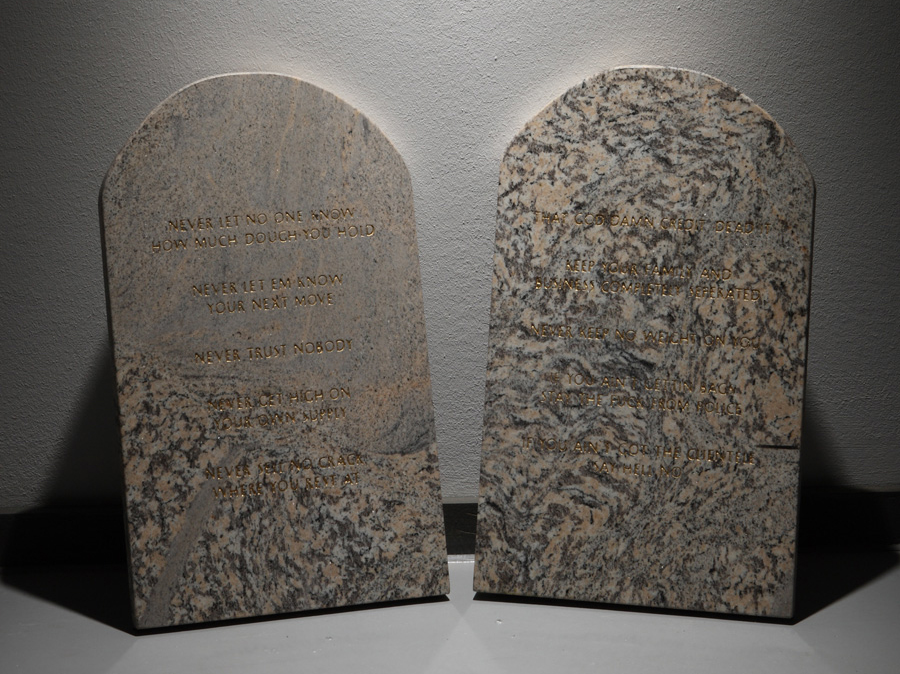
The Ten (Plus Four) Commandments (of Writing)

10crack-commandments

1. “The one great rule of composition is to speak the truth.” — Henry David Thoreau

2. “If you require a practical rule of me, I will present you with this: Whenever you feel an impulse to perpetrate a piece of exceptionally fine writing, obey it–wholeheartedly–and delete it before sending your manuscript to press. Murder your darlings.” — Arthur Quiller-Couch

3. “The best rule for writing–as well as for speaking—is to use always the simplest words that will accurately convey your thought.” — David Lambuth

4. “There are simple maxims . . . which I think might be commended to writers of expository prose. First: never use a long word if a short one will do. Second: if you want to make a statement with a great many qualifications, put some of the qualifications in separate sentences. Third: do not let the beginning of your sentence lead the readers to an expectation which is contradicted by the end.” — Bertrand Russell

5. “I have made three rules of writing for myself that are absolutes: Never take advice. Never show or discuss a work in progress. Never answer a critic.” — Raymond Chandler

6. “There are three rules for writing the novel. Unfortunately, no one knows what they are.” — W. Somerset Maugham

7. “Writing has laws of perspective, of light and shade, just as painting does, or music. If you are born knowing them, fine. If not, learn them. Then rearrange the rules to suit yourself.” — Truman Capote

8. “There is probably some long-standing “rule” among writers, journalists, and other word-mongers that says: “When you start stealing from your own work you’re in bad trouble.” And it may be true.” — Hunter S. Thompson

9. “If I were to advise new writers, if I were to advise the new writer in myself, going into the theater of the Absurd, the almost-Absurd, the theater of Ideas, the any-kind-of-theater-at-all, I would advise like this:

  • Tell me no pointless jokes. I will laugh at your refusal to allow me laughter.
  • Build me no tension toward tears and refuse me my lamentations. I will go find me better wailing walls.
  • Do not clench my fists for me and hide the target. I might strike you, instead.
  • Above all, sicken me not unless you show me the way to the ship’s rail.”

Ray Bradbury

10. “Breslin’s Rule: Don’t trust a brilliant idea unless it survives the hangover.” — Jimmy Breslin

11. “One of the great rules of art: Do not linger.” — Andre Gide

12. “Do not pay any attention to the rules other people make…. They make them for their own protection, and to Hell with them.” — William Saroyan

13. “Over the years, I’ve found one rule. It is the only one I give on those occasions when I talk about writing. A simple rule. If you tell yourself you are going to be at your desk tomorrow, you are by that declaration asking your unconscious to prepare the material. You are, in effect, contracting to pick up such valuables at a given time. Count on me, you are saying to a few forces below: I will be there to write.” — Norman Mailer

14. “I’ll give you the sole secret of short-story writing, and here it is: Rule 1. Write stories that please yourself. There is no rule 2. The technical points you can get from Bliss Perry. If you can’t write a story that pleases yourself, you will never please the public. But in writing the story forget the public.” — O. Henry

Of Inspiration and Imagination

Imagination_by_t1nus

1. “Imagination is the real and eternal world of which this vegetable universe is but a faint shadow.” — William Blake

2. “An idea, like a ghost, must be spoken to a little before it will explain itself.” — Charles Dickens

3. “If writers had to wait until their precious psyches were completely serene there wouldn’t be much writing done.” — William Styron

4. “I sit in the dark and wait for a little flame to appear at the end of my pencil.” — Billy Collins

5. “Use your imagination. Trust me, your lives are not interesting. Don’t write them down.” — W.P. Kinsella

6. “You get ideas from daydreaming. You get ideas from being bored. You get ideas all the time. The only difference between writers and other people is we notice when we’re doing it.” — Neil Gaiman

7. “You go to the attic of your mind and rummage around and find something.” — Mary Higgins Clark

8. “Thinking is the enemy of creativity. It’s self-conscious, and anything self-conscious is lousy. You can’t try to do things. You simply must do things.” — Ray Bradbury