12 Plays of Christmas: The Chronicles of Dr. Holly Jingle: The Christmas Time Twister

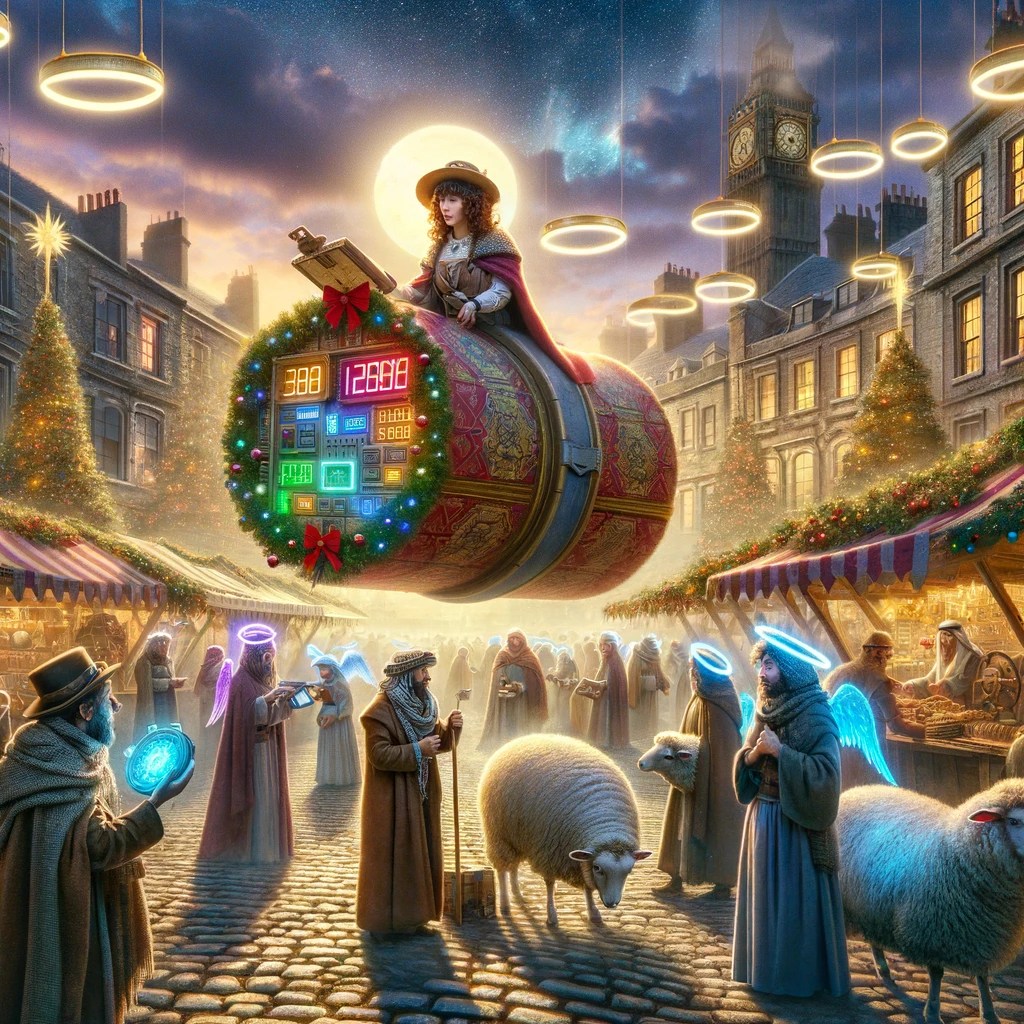
Dr. Holly Jingle wasn’t your ordinary inventor. With a lab filled with glittering gizmos, candy-cane tools, and an endless supply of Christmas spirit, she had always believed in making the impossible possible. But this time, she had truly outdone herself. Standing before her was the crown jewel of her career—a time machine whimsically named The Yuletide Voyager. Shaped like an enormous, ornamented Christmas cracker, it shimmered with silver tinsel and glowing lights.

For Dr. Jingle, this wasn’t just about science; it was about rediscovering the magic of Christmas. Since losing her father, the man who taught her the joy of the season, the holiday had never felt quite the same. With The Yuletide Voyager, she hoped to witness the origins of Christmas and reignite her spirit.

“To December 25, Year Zero!” she declared, donning her holly-patterned goggles. But as she flipped the switch on the festive flux capacitor, a loud POP echoed through the lab. The Voyager spun wildly, a kaleidoscope of candy-striped light swirling around her.

When the machine finally stilled, Dr. Jingle opened the hatch and stepped out—right into the bustling market square of Bethlehem. Well, almost. This wasn’t her Bethlehem. Snow blanketed the cobblestones, vendors hawked hot cider spiced with stardust, and an enormous mistletoe-shaped clock tower loomed overhead. A sign read: Welcome to Bethlehem-on-the-Parallel.

“Oh dear,” Dr. Jingle muttered, brushing glitter off her lab coat. “Wrong timeline.”


Dr. Jingle quickly realized that her arrival had caused a series of peculiar disruptions. The innkeeper, distracted by the sudden appearance of her oversized Christmas cracker, had offered Mary and Joseph a room at the inn instead of directing them to the stable. Meanwhile, three wise men wandered aimlessly, their star app glitching and leading them in circles. A choir of talking sheep bickered over the key for their avant-garde “baa-rmony” performance. And to top it all off, a troupe of angels struggled with flickering LED halos, threatening to turn the celestial announcement into a disco inferno.

“If this keeps up, there won’t be a Nativity at all,” Dr. Jingle sighed, her mind racing. “I’ll need to fix this mess before Christmas itself unravels!”


Dr. Jingle began with the wise men. She found them in a marketplace stall, frantically poking at their star app.

“It keeps recalibrating to ‘nearest manger’!” one lamented.

With a knowing smile, Dr. Jingle whipped out her portable cosmic compass, a prototype she’d invented for holiday stargazing.

“Try this,” she said, handing it over. “It’s powered by stardust and can’t be hacked.”

The wise men’s faces lit up as the compass pointed them in the right direction. “You’re a genius, Dr. Jingle!”

“I try,” she said with a wink.

Next, she turned her attention to the sheep. Their conductor, an elderly ewe named Eudora, fretted over the group’s lack of harmony.

“We can’t all baa in C major,” one lamb complained. “I’m more of a jazz lamb.”

“Perfect,” Dr. Jingle said. “Jazz it up! Mix traditional with modern. It’ll be unexpected, but unforgettable.”

With her encouragement, the sheep created a unique medley that blended classic carols with jazzy improvisation.

Finally, Dr. Jingle approached the angels. Their halos flickered wildly, casting erratic beams of light.

“These halos are running on outdated tech,” she noted. With a few adjustments and some spare parts from her toolkit, she synchronized their halos to glow in perfect unison, creating a dazzling light show that complemented the celestial choir.


As the stars aligned over the stable, Dr. Jingle marveled at the scene she had helped orchestrate. Mary and Joseph settled into the manger, the wise men arrived with their gifts, the sheep’s “baa-rmony” performance brought tears of joy, and the angels lit the night sky with their synchronized halos. It was a Nativity unlike any other, blending tradition with the whimsical magic of the Christmas dimension.

Quietly, Dr. Jingle slipped back to The Yuletide Voyager. Before she left, one of the wise men handed her a small, shimmering ornament.

“A token of gratitude,” he said. “You’ve shown us that Christmas is more than perfection. It’s about joy, creativity, and connection.”

As she returned to her own timeline, Dr. Jingle reflected on the journey. The true essence of Christmas, she realized, wasn’t in flawless execution but in the unexpected moments that brought people together. With the ornament glowing softly in her hand, she stepped out of her machine, ready to spread her newfound Christmas cheer to the world.


The ornament took its place on Dr. Jingle’s Christmas tree, its glow casting warm light over her workshop. Every time she looked at it, she remembered the adventure that rekindled her holiday spirit. And every Christmas after, she shared her tale—a story of a time-twisting inventor who learned that the magic of the season lives in the heart.

As for Bethlehem-on-the-Parallel, it continued to thrive in its quirky, festive glory, a universe forever touched by the eccentric genius of Dr. Holly Jingle.

12 Plays of Christmas: The Christmas Kaleidoscope

Belilah sat cross-legged on her bed, comic books spread out before her like constellations on a forgotten map. The air in her small apartment felt heavy, as if Christmas had taken a detour and left her world behind. Her dad, buried under a mountain of work, barely had time to glance at the advent calendar she’d taped to the fridge. Even the twinkling lights in the window seemed dimmer this year.

“Zephyra the Sky Wanderer wouldn’t just sit here,” Belilah whispered, clutching her makeshift cape—a fraying blue blanket she’d outgrown years ago. Zephyra, her favorite comic book hero, always leapt into action, no matter the odds. Belilah’s eyes landed on her dad’s luminescent wand, a relic from his days as a stage magician, now gathering dust on the bookshelf.

“Let’s make some magic,” she said, seizing the wand and venturing beneath the house into the dark, shadowy crawl space.

The narrow passage smelled of earth and rust, but Belilah pressed on, undeterred by the occasional skitter of unseen creatures. Her curiosity paid off when her hand brushed against something cool and metallic. She pulled it free to reveal an ancient, odd-looking prism viewer. As she raised it to her eyes, the world exploded into a whirlwind of kaleidoscopic colors. The device trembled in her hands, and before she could blink, Belilah was whisked away to a wondrously peculiar Yuletide realm.

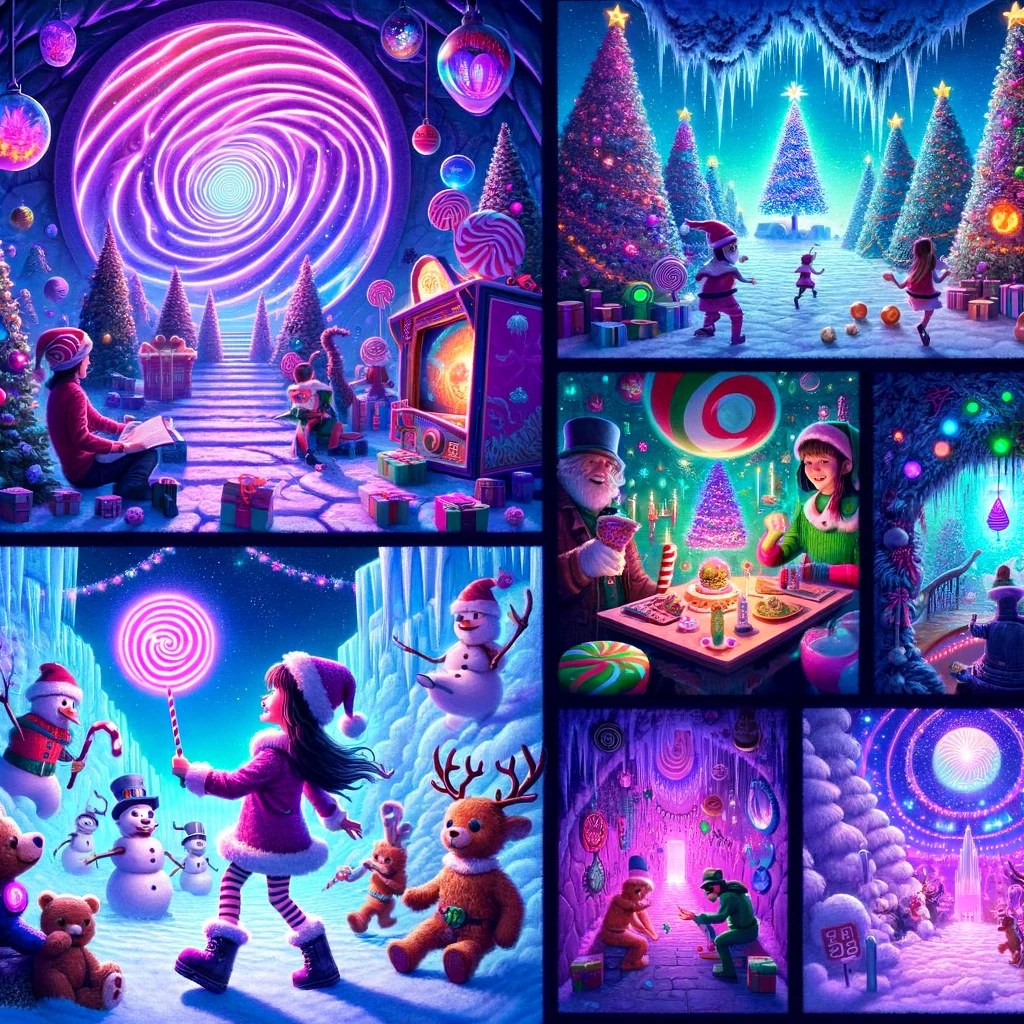
The sky above was a deep violet, dotted with stars that shimmered like Christmas lights. Trees adorned with neon baubles hummed familiar carols, their glow illuminating fields of marshmallow frost. Belilah landed softly and was immediately greeted by a band of confectionery elves wearing kaleidoscope goggles. They danced an elaborate waltz, their movements as mesmerizing as the patterns she’d seen through the prism.

“Welcome, Sky Wanderer,” one of them said with a bow. “The Yuletide realm awaits your imagination.”

Belilah couldn’t help but grin as she followed them through this dreamlike domain. Along the way, she befriended a trio of whimsical deer adorned with jingle bell antlers. They spoke in lilting limericks, inviting her to join their quest to find the mystical Yuletide orb.

Their journey was filled with wonders. Moonwalking frost figures greeted them with synchronized choreography, and harmonizing peppermint sticks serenaded their path. Yet, for all the whimsy, a shadow lingered in Belilah’s mind: why had she been brought here?

At last, they reached the levitating Yule tree, its branches aglow with swirling lights. Beneath it lay a portal to a hidden celebration underground. Inside, animated playthings and clockwork creatures danced to music conducted by a jack-in-the-box maestro. At the center of the revel stood the Yuletide orb, pulsing with light and melody.

As Belilah approached, the orb flickered, and a path of glowing candy canes spiraled downward. The elves cheered her on as she descended into the unknown, clutching the prism viewer tightly.

At the end of the spiral, she emerged into a celestial amphitheater. The terrain beneath her feet was soft as nougat, and the sky above sparkled with sugar frost. A grand pageant unfolded before her: elves on unicycles juggling ornaments, polar bears pirouetting on an iridescent ice rink, and above it all, the auroras danced in time with the music.

Belilah’s heart swelled with wonder, but the feeling deepened as a wise owl, perched on a golden pedestal, beckoned her toward an ice palace. The owl, wearing a tiny Santa cap, guided her through the palace’s shimmering halls to the Frost Monarch.

The Monarch, cloaked in a gown woven from whispers of snow, held a scepter that glittered with icy enchantment.

“Belilah, you have been chosen because your heart holds the spark we need,” the Monarch said, her voice as soft as falling snow. “The Christmas spirit in your world is fading, dulled by despair and forgetfulness. Only your boundless imagination can reignite it. The Yuletide orb is our beacon, but it needs your light to shine again.”

Belilah hesitated, the weight of the task settling over her. “But I’m just a kid. How can I do something so big?”

The Monarch knelt, placing a hand on Belilah’s shoulder. “Christmas magic is not about size or power. It’s about the courage to believe and the joy of sharing that belief with others.”

Together, they began a dance of renewal in the palace’s grand atrium. Belilah’s movements grew bolder as the Monarch guided her, and with each step, the orb’s light grew brighter. A wave of warmth filled the room, spreading outward, carrying love, hope, and joy across the cosmos.

When Belilah opened her eyes, she was back in her room. The prism viewer lay beside her, along with a luminous snowflake that pulsed gently in her hand. As she stared at it, she realized the truth: the magic wasn’t confined to the Yuletide realm. It was here, in the stories she told, the songs she sang, and the small acts of kindness she could share.

That morning, Belilah found her dad in the kitchen, still hunched over his laptop. She slid the snowflake into his hand. “Dad, let’s take a break. How about we hang some ornaments together?”

Her dad looked up, his tired eyes softening. “You know what? I’d like that.”

As they decorated the tree, Belilah felt the warmth of the Yuletide orb in her heart. The Christmas spirit, she realized, wasn’t just a fantastical adventure. It was in the connections she made, the laughter she shared, and the light she brought to others. And in her small corner of the world, the spirit of Christmas shone brighter than ever.

12 Plays of Christmas: The Sidewalk Santa

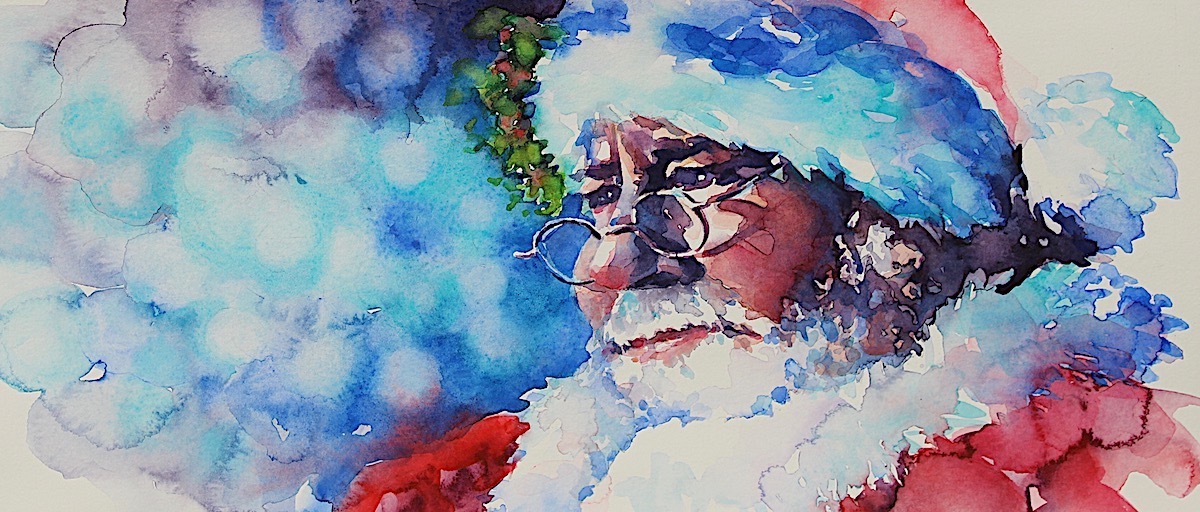
The frost-laden air of December bristled through the bustling streets, and on a corner like any other stood a sidewalk Santa unlike any other. In contrast to his bell-jingling counterparts, this peculiar Claus, cloaked in a suit more crimson than the richest wine, beckoned passersby with a velvet sack and a peculiar proposition. His eyes, hidden beneath the shadow of a fur-lined hat, glinted with a mysterious allure.

“Offer me a day of your purest joy,” he whispered, his voice a melody of forgotten Yuletides, “and in return, I shall gift it to a child whose laughter has been stifled by the harshness of life.”

To the unsuspecting, his request seemed a quaint holiday gesture, a novel twist to the season of giving. But if any had bothered to delve deeper, a haunting realization would have dawned. This counterfeit Kringle was no ordinary Santa; he was in fact a nefarious collector of happiness, a certified broker of joy so tangible that once given, it left a void in the donor’s heart.

Each day, a new soul approached, drawn by the irresistible charm of the Sidewalk Santa. A young woman, her laughter as infectious as the jingle of sleigh bells, offered a day she first fell in love. A grizzled old man, his eyes brimming with unshed tears, relinquished a Christmas morning from his childhood, resplendent with innocence and wonder.

As the days dwindled towards Christmas, a tapestry of stories unraveled, each thread a memory willingly surrendered. The Sidewalk Santa listened, his sack swelling not with coins or paper but with ephemeral joys, each a beacon of hope for a desolate child.

On the eve of Christmas, an unexpected visitor approached. A young boy, eyes wide with a curiosity unmarred by life’s trials, stood before Santa. Unlike the others, he had no joy to offer, his life a mosaic of hardships. Yet, in his presence, the air shimmered with a raw, unspoken magic.

“Sir,” the boy began, his voice barely above a whisper, “I have nothing to give but the day I met the real Santa Claus.”

In that moment, the Sidewalk Santa’s façade faltered, the enigma giving way to a profound, human empathy because the true essence of Christmas lay not in the joys he greedily collected for his own gain but in the unyielding spirit of those who had nothing yet gave everything.

With a gentle smile, the Sidewalk Santa reached into his sack, not to take, but to give back. He returned the memories, the laughter, and the love, understanding now that true joy could never be taken, only shared. As the boy walked away, a single snowflake descended, melting upon his cheek like a fleeting kiss.

The Sidewalk Santa vanished with the dawn, leaving behind a trail of wonder and a lesson etched in the hearts of all: that the greatest gift one could offer was not joy but compassion, not happiness but the willingness to understand another’s sorrow.

And thus, the legend of the Sidewalk Santa endured, a tale whispered in the hush of winter nights, a reminder that the most profound miracles often dwelled in the simplest of acts.

12 Plays of Christmas: One Last Thing Before I Go

Twelve days. That’s all the life she had left. One million, thirty-six thousand, eight hundred seconds. Perlie Hawthorne checked and double-checked her findings and if she played her cards right she could make it to Christmas day and not a moment further. Never a defeatist, she chose to make the most of her remaining time and certainly would have booked travel to one of the exotic destinations on her bucket list or treated herself to a luxurious night out on the town but the fact of the matter was she was dead broke. Not a penny to her name. The rent was paid and there was enough food in the pantry to last the twelve days, but that was it.

Going over her bucket list, Perlie discovered there was only one item that required no money:

  • Declare my feelings for Garnet Stainthorpe

Garnet Stainthorpe was a young man she had known since grade school, more of an acquaintance than a friend, whom she had been infatuated with since they bumped into one another in the school cafeteria. Cruel fate would not allow her to get over her crush as they remained in close proximity to one another ever since, he even lived in her building in the apartment directly below her own.

Her own apartment was a modest space filled with the echoes of solitary existence that had become her sanctuary and her prison. The walls, adorned with postcards from places never visited, whispered of dreams unfulfilled. A life that had slipped by in shades of grey, punctuated only by the vivid hues of her longing for one man.

The decision to confess her feelings to Garnet was fraught with the turbulence of unrequited love. Her heart raced with a mix of dread and anticipation as she rehearsed the words that had lived in the shadows of her thoughts for years.

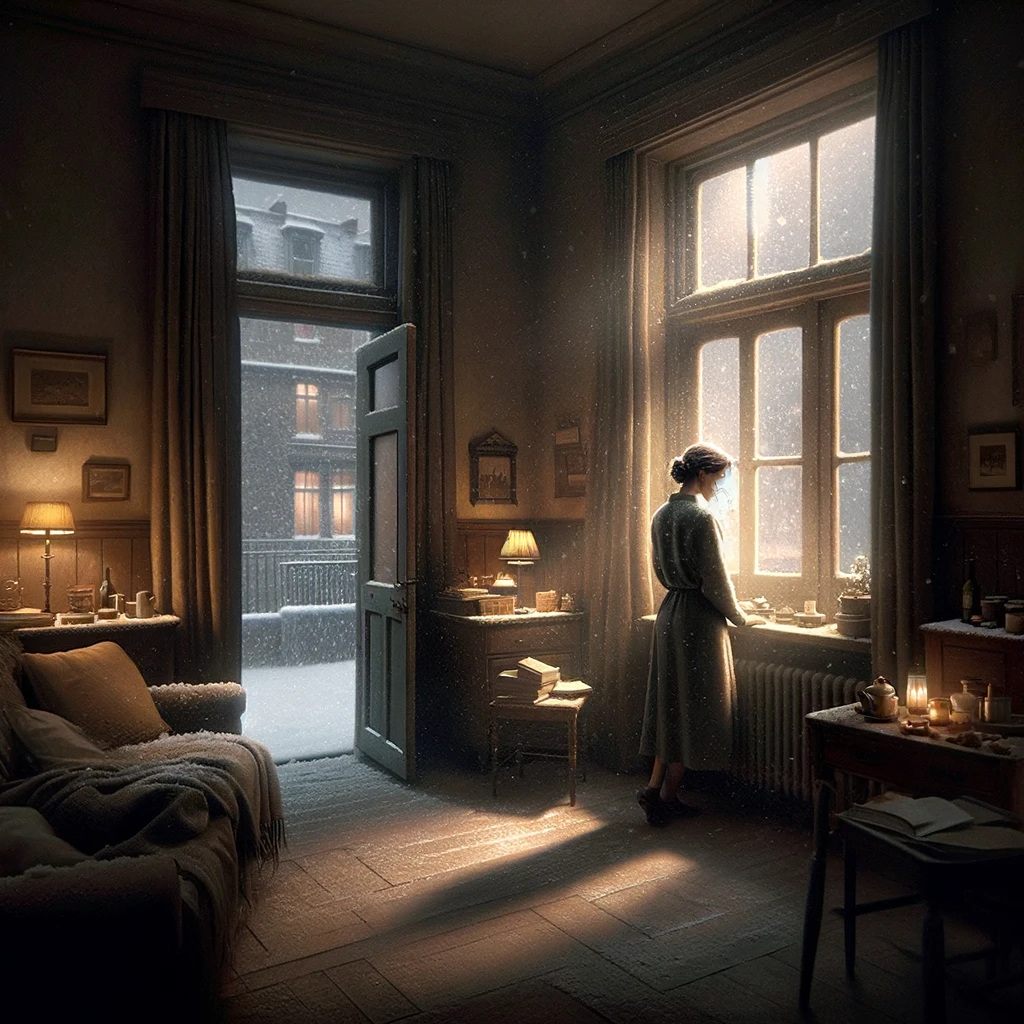
The day arrived, shrouded in the soft glow of winter’s embrace. Snowflakes, like delicate whispers from the heavens, fell gently outside her window, painting the world in a blanket of pristine white.

With a courage born of desperation, Perlie navigated the familiar path to Garnet’s door. The sound of her knock, a timid echo in the silent hallway, seemed to carry the weight of her entire existence.

The door opened, and there stood Garnet, his expression one of surprise that quickly melted into warm recognition. In that moment, time seemed to stand still, the world outside fading into insignificance.

Perlie’s words, when they came, were a cascade of honesty and vulnerability. She spoke of her feelings, a torrent of emotions that had been dammed for too long. Garnet listened, his eyes reflecting a myriad of emotions – surprise, empathy, and a gentle sadness.

The confession, though met with kindness, was not reciprocated in the way Perlie had hoped. Yet, in the honesty of that exchange, she found a bittersweet liberation. Her secret, once a burden, now released into the world, transformed into a poignant memory, a testament to her courage.

As she returned to her apartment, the world seemed a little less heavy. The finality of her days, though unchanged, now held a different meaning. She had faced her greatest fear, not death, but the regret of silence. In those remaining days, she found peace, not in grand gestures or unfulfilled dreams, but in the simple act of living each moment with an open heart.

And so, Perlie Hawthorne’s story concluded, not with grandeur, but with a quiet dignity. Her life, a tapestry of unspoken dreams and silent courage, was a reminder that sometimes the most profound journeys are those we take within ourselves.

12 Plays of Christmas: The Christmas Heart

‘Twas the night before the night before Christmas when a stranger entered a prewar building that in its heyday used to be a ballroom for the hoi polloi, a place where the common folk who couldn’t afford the ritzier establishments came to dance their cares away. The section of the city in which it was built was in a constant state of flux, so the ballroom eventually transformed into a department store warehouse, then a community center, and when funding and interest ran out and the neighborhood became a place police wouldn’t go after dark for fear of their safety, the abandoned and condemned property served as a makeshift shelter for homeless children.

Inside, it reeked of the stench of hopelessness and was packed to capacity with children covered in the grime of neglect, their young, despondent faces smudged with the soot of abandonment.

The stranger was a portly, bespectacled man wearing a red coat with white fur collar and cuffs, white-fur-cuffed red trousers, red hat with white fur, and black leather belt and boots. His nose and cheeks were red as roses and his white beard was full and seemed to roll in upon itself like a fluffy cloud. Despite his size, he maneuvered through the sea of children as quiet as the hush of evening.

Children who were up at the late hour woke those who were asleep but such was the aura of the man that none of them were alarmed or threatened by his sudden presence, and the sensations of starvation and being chilled to the bone were temporarily replaced with a sense of awe. It was akin to coming face to face with a real live unicorn or some other mythical creature.

Regardless of their ages, the children all gathered around and whispered his name, Santa! Kris Kringle! Papa Noël! Father Christmas! because it was apparent who the man was. Not an imposter from a mall or a bell-ringer from the street, this was the genuine article.

“Are you real?” asked a bedraggled boy in the middle of the crowd.

“Why, yes, Jude Herbert, I am as real as you are,” the one and only Claus answered to the boy’s delighted surprise.

“You know my name?”

“Of course, I know all your names,” the Keeper of the List nodded and began pointing to and naming every child in the room. “Alisha Moss, Finley Hopkins, Sienna Simmons,” and so forth and so on.

“Where’s your bag?”

“My what?”

“In all the pictures I’ve seen you always carry a bag full of presents,” said Dinesh Mehta. “That’s what you do, right? Give presents to kids?”

“The gift I have for you wouldn’t fit inside a sack.”

“He ain’t gonna give us no presents,” said Gabriel Ford. “When has he ever? I ain’t never got nothing from Santa Claus, have you?”

Glad and hopeful expressions dropped from the surrounding faces in rapid succession.

“It is true,” the Christmas Man, admitted. “I haven’t been able to get to all of you before today, but not because you are unloved or undeserving. I know this is a poor excuse but my resources are limited and I sincerely apologize for not making an appearance before today.”

“So, you’re gonna give us presents?” Hope Allison asked. “Really and truly?”

“Indeed I am, but first I want to ask you all a question: Where does all my magic come from?”

A multitude of hands shot into the air to a chorus of Ooo! Ooo! I know! I know! And those too impatient to wait to be called on, yelled, Magic food! Magic bell! Your magic hat! Pixie dust! Nicholas the Saint delighted in seeing them forget their worries for a moment and just be children.

He waited patiently until all the guessing had been exhausted before he cupped his red-mittened hands together and held them out.

“All good guesses but here is where all the magic stems from,” he said and opened his hands. Floating in midair just above his palms was the image of a heart, not a biological one but the type that people drew in pictures, but this heart was made of golden shimmering light.

“What’s that?” asked a young blond-haired girl.

“This, Shelina van der Schaaf, is a Christmas heart.”

“I want one!” exclaimed a small boy.

“You have one, Vasyl Vavera,” Sinterklaas said.

“I do?”

“Everyone has a Christmas heart.”

“I don’t have one,” young Yobanna Chukwumoge said, pulling all his filthy pockets inside out. “I don’t have anything, see?”

“That’s because you’re not looking in the right place,” Grandfather Frost said. From a pouch tucked in his belt, he produced a handful of dust and blew it into the air above the crowd. Instead of settling like normal dust, the shimmering particles hung in the air around the children. “What you need to do is open your hand, palm side up and place it in front of your chest. Now say to yourself, Show me my Christmas heart.”

The children all followed Pelznickel’s instructions and just above their palms shimmering hearts appeared. Some glowed brighter than others but they were all beautiful.

“This is the power source that keeps my workshops running, that helps my reindeers fly, that allows me to visit all the houses of children in the entire world in a single night, which is the problem. There are so many people in the world, new ones being born every second and the demand keeps getting bigger and bigger and it’s becoming more and more difficult to keep up, so I came to ask for your help.”

“But you’re Santa Claus and we’re just poor kids,” Kisanet Eyob pointed out. “How can we help you?”

“You may not be aware of this but all of you share the same wish. You all want a home, you want to be a part of a family, you want to be loved, and I have come here to give you that, with no strings attached.”

“But you also need our Christmas hearts, don’t you?” asked Zygfryd Zawadzki.

“I would like to borrow some of that energy, yes, and there are so many of you, I would only need a tiny bit from each heart. And you are free to say no, that will not affect my Christmas gift to you, you are all welcomed to share my home with me, and Mrs. Claus has hot baths and meals waiting for all of you.”

“Will it hurt?” asked Erick Santos Gomes. “When you take our hearts?”

“I’ll only be borrowing the smallest bit of energy. Your heart will be fine, Erick, you won’t feel a thing.”

The children began agreeing because they somehow knew Santa was telling the truth, but over the din of the excited children, Santa noticed the absence of one voice.

“Is something troubling you, Ruby Kirby?” Santa asked.

The children quieted down and stared at Father Christmas in befuddlement. They looked around to see whom he was talking to.

Over the heads of the throng he said, “If you said something, I couldn’t make it out. I’m far older than I look and my hearing isn’t what it used to be. Can you please come a bit closer?”

The crowd of children parted like the Red Sea and an emaciated little girl with dead eyes that held a thousand-yard stare, timidly made her way to the Christmas-Bringer.

“What seems to be the problem, my dear?” he asked.

“You need magic,” Ruby’s voice was as soft as pity. “I don’t have any.”

“Of course you do.”

“No, I don’t,” Ruby placed her open palm in front of her chest and said, “Show me my Christmas heart.”

The heart that floated above her hand looked more like the biological kind and it was not made of light but of rough metal with uneven edges, with scars all over it, and in places there were replacement pieces that didn’t fit perfectly, where it had been broken and improperly mended. There were also deep gouges where some pieces were missing.

The Christmas Kringle took a knee so that he was eye level with Ruby and said, “You may see a mess of scars, but I see a heart that has been battle-tested, a heart that has known love and loss, a heart resourceful enough to pick up the pieces of shattered affection and patch itself back together. And do you know how I know your heart is perfect?”

“How?” asked Ruby.

“Because that’s the exact same way my Christmas heart used to look. You may not know it to look at me now, but when I was your age I was a loner. Even in a crowded room, I was alone but it was mostly of my own doing because I did not seek out interactions with other people, in fact, I actively avoided it.”

“Why?”

“I guess because everyone in my life up to that point had let me down and abandoned me, so I made up my mind that I didn’t need anybody. But that wasn’t my destiny, you see. I met a couple who showed me that kindness towards others was such a fragile thing and it was never more than one generation away from extinction. Because it isn’t ingrained in our nature, it’s something that has to be taught and reinforced constantly by each generation, for once it dies, it is gone for good. Those who have known kindness have the propensity to show it to others, but where kindness was never known, only cruelty lurks.”

“So, you changed? But how did you do it?”

“By doing the hardest thing I ever had to do. I ignored all the negative voices in my head and I went out and made a friend, and that friend introduced me to his friends and before I knew it, I wasn’t by myself anymore.”

“But how did you do it?” Ruby asked again, not quite understanding his solution.

“You’re standing in a room full of people holding their hearts in their hands, what do you think you should do?”

Ruby hung her head, squeezed her eyes shut to stem the flow of tears, yet some sneaked past her eyelid defenses and rolled down her cheeks. She held her Christmas heart out in front of her and asked, “Will someone please be my friend and help me fix my Christmas heart?”

One by one the children took turns stepping up and touching their hearts to Ruby’s heart. With all that attention, she expected it to change but it remained metal and different from all the rest.

“It didn’t work,” a crestfallen Ruby said with tears welling once again.

“Didn’t it? Take a closer look,” the Holiday Sleigher suggested.

Ruby brought the heart up to her eye, “All I see is rusty metal.”

“But what about in the cracks? In the bits that are missing?”

And sure enough, Ruby detected a glow pulsing inside a metal cranny, keeping time with her own heartbeat. “Is that…?”

“It’s the birth of your new Christmas heart. Just like you, it requires time to grow but you need to take care of it, nurture and share it for it to reach its maximum potential. Can you do that?”

“I promise,” the little girl nodded and this time her tears were happy ones. “So, when are you taking us to your home?” she asked.

“Why, we’re already here,” said the jolly old saint. “If you don’t believe me, take a look for yourself.”

The children raced to the front doors and flung them open wide, and sure enough, the entire building had somehow crossed the magical Arctic Circle and was now sitting in the winter wonderland village in Rovaniemi in Lapland, Finland, the official hometown of Santa Claus.

“But how?” Ruby asked

“The magic of the Christmas hearts brought us here, even yours, Ruby.”

Ruby Kirby tucked her Christmas heart away and smiled ear to ear as Santa Claus lifted her in his arms and carried her across the field of soft powder snow to her new home.

And that just about does it for the 12 Plays of Christmas series. I want to thank all of you who followed me on this experimental journey. I know I run this phrase into the ground but, it’s very much appreciated. Oh, and…

MERRY CHRISTMAS! Wishing you all a happy holiday season (whether you celebrate or not) and may you receive the best gift of all: a wonderful life full of happiness, love, joy, laughter, tranquility and prosperity!

12 Plays of Christmas: A Treehouse on the Moon

How could Nathaniel Buchanan ever forget that book? The infamous leather-bound Do Not Touch book with the cracked spine that sat on the mantle above the fireplace of his childhood home. The only person allowed to touch it was his mother, which she did every night to read him the bedtime story adventures of The Christmas Treehouse on The Moon.

It was a collection of short stories, oddly enough without any pictures like most storybooks, involving the first mother and son astronaut team to travel to the moon. A problem with the ship’s engine forced them to land inside the deepest crater on the dark side of the moon and there they discovered a mysterious treehouse.

But this was no ordinary treehouse because the inside was big enough to hold an entire world, and the air was breathable, so they didn’t need their spacesuits, and every day was Christmas.

His mother never read the same story twice and the book contained so many adventures that Nathaniel never went to bed without listening to the exploits of Sarah and little Sammy Centauri as they explored strange lands, met different aliens, and celebrated new customs inside the fantastical, weird and sometimes dangerous lunar Christmas treehouse.

When Nathaniel finally became old enough to read for himself, the leather book mysteriously disappeared. It wasn’t until years later when nostalgia made him want to locate the book, which couldn’t be found in the public library, any rare bookstore, or even online, that he made two discoveries:

  1. The book didn’t exist; and
  2. His mother was illiterate.

To his mother’s credit, she managed to keep it a closely guarded secret, finding creative ways to hide the fact that she was unable to read. There was always some kind soul willing to help her read something because she had “forgotten her glasses” or a server suggesting recommendations when her eyes were too tired to read the menu.

And while Nathaniel wished she had told him the truth because he would have gladly helped her learn how to read, he appreciated the fact that she took the time to invent a new story every night, which unbeknownst to her, fueled his desire to become an astronaut.

Sadly, she passed away before he joined NASA and made the terraforming moon mission. On her deathbed, she whispered, “I’ll be waiting for you in the treehouse.”

The astronauts were allowed to bring a personal item with them on the mission, and while the others brought things like a musical instrument, favorite book, or family photos, Nathaniel brought a pine cone.

After all, you had to grow a Christmas tree before you could build a house on it.

12 Plays of Christmas: Home For The Holidays

Alan Mann was a family man. He came from a big family, all his brothers and sisters had big families and he was fortunate enough to marry a lovely woman, Mamie, who was an only child who always dreamed of starting a big family of her own. And when it came to the holidays, nobody celebrated Christmas like the Tribe of Mann.

Which was why it was such a disappointment that Alan’s job needed his help in closing a massive deal on Christmas Day on the opposite coast. Ordinarily, he would have refused but the fact of the matter was, his family needed the cash injection his commission from the deal would have provided. Mamie wasn’t thrilled about spending Christmas without her husband, but she backed his play.

Everything was going to plan in Los Angeles and Alan prepared for the deal to wrap early as he planned to make it home at least by Christmas evening. He had already shipped a load of gifts to his family and the backup plan, in case things went south, was to celebrate Christmas with them over webcam, but on Christmas Eve he received a call from his wife.

“Alan, you need to come home,” Mamie said.

“What’s wrong?”

“Your mother’s in the hospital and…it doesn’t look good.”

Alan booked a plane ticket online while Mamie explained his mother’s condition. The cheapest immediate flight he could find was severely overpriced, and on his way to the airport, he left messages on his business partners’ voicemails apprising them of the situation. His mother instilled in him the preference of asking forgiveness rather than permission when it came to family matters.

There was a layover at Detroit Metropolitan Airport that set Alan back five hours. He pleaded his case at the airport, tried to get them to bump a passenger off an earlier flight, which he would have gladly paid for, but it couldn’t be helped, weather conditions in New York caused the unavoidable delay.

When he finally landed at LaGuardia Airport, he jumped the cue at the taxi stand and called his wife to let her know he would be there soon. But when he arrived at the hospital, it was too late. His mother had passed.

“I shouldn’t have taken this stupid assignment in the first place,” Alan said as he paced the hospital corridor.

“You did it for the family, Alan, we needed the money. Who could have foreseen something like this happening?”

“I should have rented a car in Detroit and driven here instead of being stuck at that goddamned airport!”

“Detroit to New York? That’s what, a nine-hour drive at best? It wouldn’t have made a difference, honey.”

“But I should have been here!”

“You were, through us,” Mamie stood directly in his path and stopped him in his tracks. She gently held his face and made her husband look her in the eye. “Every time you called, me and your sisters and brothers kept your mother updated whenever she regained consciousness. We made sure she knew you were on your way, that you were doing your best like you always do. And I know you feel guilty about it, but you have to remember, she wasn’t alone. We were all here with her.”

Alan was taken to see his mother’s body where he unburdened his soul and begged for forgiveness, and after all the tears had been shed and it was time to leave, he coordinated with his siblings, divvying up responsibilities for the funeral arrangements.

On the way to the elevator, Alan heard a woman crying. There was an elderly woman lying on a gurney in the hallway, with no attendants or staff around so he wasn’t sure if she was waiting for a bed or being taken to a department for tests or treatment, but her cries tugged at his already tender heartstrings.

The woman’s eyes were watery, her stare distant, but she was aware of Alan’s presence and in a weak voice said, “I’m scared.”

Alan took her frail hand and said, “It’s okay to feel scared, but you’re not alone, I’m here with you. I love you and there isn’t a day that goes by that I don’t think of you. I can’t tell you how much better my life is for having you in it.”

The woman slipped into unconsciousness and Alan’s sisters located a male staffer and made him aware of the situation, berating the man in the process for leaving the old woman unattended. Such was the way of the Mann women.

“That was beautiful, Alan,” Mamie put her arm around her husband’s shoulder.

“I wish I could have said all those things to my mother.”

“Those were things your mother already knew, but you said them to a woman who might not have had an Alan in her life to hear it from. It was sweet and what your mother raised you to do.”

“I wouldn’t be surprised if Mom had that arranged,” said Doris, Alan’s oldest sister.

“You think Mom parked an old woman in the hallway for me to comfort?”

“Excuse me, have you ever met our mother? Tell me that isn’t something she would have done.”

It was farfetched and designed to lighten the mood a little, which it did, but Alan couldn’t totally discount the notion that his mother exerted the last of her energy setting those wheels in motion.

This was going to be a solemn Christmas with an empty place setting at the table but at least the family was all together.

12 Plays of Christmas: A Letter to Santa

Maurice Weichert never appreciated gifts given to him by strangers as most of them were usually old tat, but once at an office party many moons ago, a forgotten-named someone, as a Secret Santa, heard that he liked to write so she gave him a stationery set which he thought to be quite impressive. It went unused, of course, because he lived in an era where handwritten letters had gone the way of the dinosaur. And how fitting it was that a dinosaur was now on the hunt to retrieve it.

He exhumed the set from the bottom of a box shoved in the back of the bedroom closet, and to his surprise, it was still in pristine condition. Clearing a spot on the dining table, he paired the parchment with two other gifts from long-ago holidays, a Montblanc pen and a glass of Gonzalez Byass Apóstoles Sherry.

Maurice wasn’t much of a drinker, which explained why the sherry remained untouched all these years but he required a bit of liquid courage so he downed the glass in one, poured himself another, uncapped his pen and commenced to write his letter. Having not written for quite a long while, his penmanship wasn’t as crisp as it once was and added to that fact was the tremor in his hand brought on by age and nervousness.

Dear Santa,

It has been ages since I last wrote to you and I realize that I am far too old to start doing it again but I am not requesting anything from you, besides the loan of a moment of your time. As the winner of the unluckiest lottery, meaning that I have somehow managed to outlive my parents, siblings, wife and all my friends, I could not think of another living soul who would care to read this besides yourself.

I am a lonely man.

You have no idea how this desolation of companionship feels, having no one to inquire about what is going on in your life or inside your head, no one to challenge your philosophies in a deep conversation, no one to hold you during the silent hours of the night when the mind buzzes with nihilistic inevitabilities, no one to protect thereby giving your life a sense of purpose, no one to hand control over to on the days when you are not quite strong enough, no one to occupy the dead spots and the void inside of you that books, music, television and movies are not capable of filling.

And then there are the visitations from memory ghosts of loved ones and special people and people who could have been special if only you had not gotten in your own way and run them off, ghosts of better times and better days that you would gladly give anything, even your immortal soul, to step back into and relive just one more time, ghosts of conversations when you said the wrong things to people who did not deserve it and were too stubborn to apologize for.

You have no idea how much it hurts to be isolated from the world at large, to know that you still have love to give but not a single solitary soul to offer it to, still have jokes to tell but no one to laugh at them, experiences to share and knowledge to impart that no one cares to hear.

What is a man to do when his life no longer has direction, and his spark has been doused a decade ago? What happens when he can no longer compartmentalize all the sadness, anger, guilt, heartache, hopelessness, and worthlessness? How does he stop his mundane existence from draining and crippling his soul as it makes his world grow smaller by the day and it gets harder to breathe and he can’t clear the fog from his head—

The pen dropped from Maurice’s hand almost as if in protest. This wasn’t the letter he intended to write. The plan was to create a magnum opus, the letter to Santa to end all letters, a missive that succinctly encapsulated his existence, but this…this was soppy cringe-worthy drivel. He would have to start it all over again, perhaps creating an outline this time to better organize his thoughts.

Crumpling the letter into a ball, he tossed it absently in the direction of the wire mesh waste bin…when a hand snatched it out of the air.

Standing behind him in full regalia was Father Christmas himself, jolly old Saint Nicholas, who said, “I’ll take that. It was meant for me anyway, wasn’t it?”

“Santa?” Maurice felt like he was having a hypnagogic hallucination, the kind that occurred during the transition between REM sleep and wakefulness.

“In the flesh, Reese,” Santa said. “Do you mind if I call you Reese? I’ve watched you all your life and calling you Maurice just seems so formal. You can call me Nick if you like, or Kris. Either one is fine.”

 “What are you doing here?”

“You wrote me a letter.”

“And you personally visit everyone who writes to you?”

“Not usually, no, but I had a little downtime and thought, what the heck?”

“But how did you get here?”

“The usual way.”

“No, I mean how did you get here so fast? The letter isn’t even written yet.”

“The final version hasn’t been completed, but I know when someone is writing me a letter.”

“That’s impossible.”

Santa patted his belly and said, “I can fit this bulk through any chimney without getting stuck or catching fire, can levitate back up said chimney by touching my nose and nodding, I know the names of every person on the planet and if they’ve been naughty or nice, among other things…and my instantly knowing when someone writes a letter addressed to me is the thing you’re questioning?”

“I guess you’re right. Well, I think you wasted a trip because I wasn’t asking for anything, I just needed to air a few things out.”

Santa uncrumpled the letter and read it to himself. When he finished, he said, “Your feelings are valid and even though you think I don’t understand what you’re going through, believe me, I do. And you’re not alone in feeling this way, especially at this time of year. You’re also not dead yet, and what I mean by that is stop acting like you are. If you take good care of yourself, barring any accidents, you’ve got, at the bare minimum, twenty good years ahead of you. Years that you can make count for something instead of rotting away in a mausoleum of the past.”

Maurice was about to speak when Santa raised a hand to stop him. “Can we discuss what you didn’t get around to including in the letter, Reese? I’ve been at this a long time and have received millions of letters similar to this…”

There was a knock at the apartment door.

“I thought we’d have more time,” Santa said with a sigh. “You should get that, it’s for you.”

“Why did you sigh?” fear struck Maurice’s heart like a match. “I don’t like the way you said that. Who’s at the door?”

“Only one way to find out.”

Maurice approached his apartment door the way a hazardous devices technician approached a suspicious package. His hand hovered above the knob until he could muster the courage to open the door, and there he saw…

A frazzled woman, roughly his age, maybe a little younger, with shoulder-length silver hair, wearing a red and white Santa cap with the words Merry Christmas emblazoned on it.

“Hi, my name is Davina, and don’t worry, I’m not a crazy person, well, maybe a little, but fun-crazy not scary-crazy, I even wore the Santa hat to prove that I’m basically harmless, see?” Davina offered a toothy grin and pointed at the hat. “Anyway, I’m new to the building, your next-door neighbor, actually, and I hate to be a bother, especially so close to Christmas because you’re probably wrapping expensive presents or preparing some fantastic meal or binge-watching your favorite show on Netflix, or something important like that, but I really need to use your phone. It’s not a long-distance call or a phone scam to steal your identity or a call to some expensive sex chatline or anything weird like that, I just moved in today and I’ve got no electricity, gas or phone. It was all supposed to be on when I got here, but you know how these utility companies are, they get around to it when they get around to it because you’re always on their time and not vice-versa. So, would that be okay? Using your phone?”

Davina’s introduction was as rapid as machine-gun fire and Maurice stood in stunned silence for a long moment attempting to process it all. When his brain finally caught up, he said, “Um, sure. The phone’s just this way.”

He let her into the apartment and his brain began working overtime trying to invent a reason for Santa Claus to be sitting in his home, but when they entered the living room, Saint Nicholas was nowhere to be found.

“I’m so glad you’re home and you’re nice, you are nice, aren’t you? I think you’re nice and I’m usually a good judge of character, except when it comes to boyfriends, but why would you need to know that? I’m sorry, I tend to be a chatterbox when I’m nervous which is practically all the time, anyway, what was I saying, oh yeah, I’m so glad that you’re home and you’re letting me use your phone. I would have used my cell but the battery died while I was on hold with the electric company and I couldn’t recharge it because, you know, no electricity. Speaking of which, would it be okay if I charged my phone here?”

“Sure, the socket’s right by the phone.”

“You are a lifesaver, and I promise I’ll be out of your hair in no time.”

“It’s fine, take your time, no rush,” Maurice said still in a haze but he was present enough to remember his manners. “I’m not a coffee drinker but if you don’t mind tea, I can put the kettle on, or can I offer you a glass of water or juice, perhaps?”

“Oh, no, I don’t want to put you through any additional trouble.”

“If it was trouble, I wouldn’t have offered.”

“Are you sure?”

“Positive.”

“Then tea would be lovely, but nothing with caffeine, please. You wouldn’t want to see me all jittery, trust me.”

He had absolutely no doubt about that. “The phone’s all yours, pull up a chair and make yourself comfortable.”

In the kitchen, Maurice found a note taped to the tea kettle, written in perfect cursive on his stationery, which read:

Much like yourself, Davina has always remained on my nice list, but she’s gone through a bit of a rough patch recently and could use a friend who specializes in kid glove treatment. I know it’s a huge imposition and I wouldn’t dream of asking if I had any other options available to me, but I was wondering if you could help me out on this one as I simply don’t have the time or resources to handle this matter in the manner which it deserves. I would owe you big time and you never know when calling in a Santa favor could come in handy.

Oh, her utilities will be turned on in two hours, which should give you plenty of time to make her acquaintance.

Thanks for the assist, Reese, and Merry Christmas!

Love,

– Santa

PS. If you decide to write me a letter next year, please put out some cookies and milk. The Missus has me on a strict diet and the only time I get to snack is when I’m out on business.

12 Plays of Christmas: Mary Christmas

Luckily my favorite table was open at the bistro I frequented in Alphabet City, the one by the window where the midday sun filtered through shelves of antique colored milk bottles, mason jars, and assorted glassware.

I scanned through the menu feigning interest in all the food options available for some unknown reason though I knew what I was going to order because my order hadn’t changed in over three years. The food here wasn’t really great but it was one of the few places in the city that had a natural ambiance that suited my temperament.

I felt a presence looming over me that smelled of Christmas—actually, the smell was of apples and cinnamon, which always reminded me of Christmas—so I placed my order by rote without looking up from the menu, keeping up the pretense of struggling with the choices of so many delectable options which was silly but perhaps I wanted the staff to recognize how much I liked the place.

“Um, that sounds delicious,” a voice said in a register higher than I was accustomed to in the bistro, a woman’s voice. “But I don’t actually work here.”

I looked up and was nearly blinded by a rosy-cheeked, platinum blonde woman bundled in the whitest fur coat in existence—hopefully not a real fur coat because that would be cruel—topped with a fur hat.

“Is anyone sitting here?” she pointed at the empty chair across the table from me.

I answered, “No…” as I glanced around at all the vacant tables situated throughout the eatery and I was about to bring this to her attention when she daintily and skillfully seated herself.

“Hi, my name is Mary, Mary Christmas,” she beamed a smile and proffered her white-mittened hand to shake. “You have a kind face so you may call me Mary or Your Royal Majesty Queen-Empress of the Known Universe, absolutely your choice but under no circumstances are you to refer to me as Merry as in Merry Christmas. I grew up being teased by that and I’m not having anymore of it.”

I didn’t answer because I was too busy processing what was happening which she took an entirely different way, most likely because I hadn’t completed the handshake ritual.

“Oh, you’re one of those, are you?” she sighed, slipping the mitten off her hand and rummaging through a white handbag produced from a fold in her coat almost if by magic.

“One of those?”

“A non-believer. A person who has to be shown instead of accepting things at face value,” she said as she pulled something out of her purse and handed it to me. “Here, proof.” It was her driver’s license and I’ll be damned if it didn’t list her name as Mary Christmas.

“Look, miss…”

“Mary.”

“Mary, I wasn’t doubting your name, strange as it may be, no offense…”

“None taken.”

“It’s just that, you know…”

“Know what?”

“Come on, you have to admit it’s a bit unusual for an absolute stranger to sit at your table uninvited.”

“Oh, but you did invite me.”

“I did?”

“Well, not you verbally, but your loneliness called out to me. I’m sensitive to things of that nature, people’s loneliness and all that.”

“I appear lonely to you?”

“Most definitely. No offense.”

“None taken, I guess.”

“And well, it’s Christmas time and no one should feel lonely on Christmas.”

“Oh, I get it,” I blushed against my will and was suddenly unable to keep eye contact with her. “Um, I’m flattered, I guess but this really isn’t my sort of thing. I don’t pay for…”

“Wait a minute, you think I’m a…”

“You’re not?”

“Definitely not.”

“I-I am so sorry! It’s just beautiful women don’t make it a habit of approaching me and…”

“Let me stop you right there. I will allow the infraction because you called me beautiful and before you misread anything else into me sitting at your table, if you and I become anything it will simply be friends, not friends with benefits or any of this other modern-day nonsense. I’m far too old-fashioned for that. And yes, even as a friend I still expect you to be gentleman enough to open doors for me as well as pull out my chair when we dine, thank you very much.”

“Um, okay?”

“And quit acting like this is weird,” Mary said. “Tis the season and I have no gift to bring other than to say, I see you. This has grown to be an unintentional world where people are acknowledged more on the internet than in real life, so I intend to change that, right here, right now, starting with you by asking you a simple question.”

“And what question would that be?”

“How are you doing?” Mary asked, looking me in the eye and giving me her full attention and I was about to respond with the automatic faux “Fine,” but there was something in her expression that made me feel that she was interested in hearing my honest response, so I told her.

I told her how I thought I was at the end of my rope. As an older gentleman who was closer to the end of the race than the beginning, I felt absolutely lost. My life was empty. I had felt this way before but then I wore a younger man’s clothes and was far more resilient, able to pick myself up by the bootstraps and rebuild my life but the change was always temporary and things crumbled and I had to begin again. The problem was I didn’t think I had the strength or wherewithal to start over again. I had lost all interest in the things I was once passionate about and all motivation to find something new was gone.

“Sometimes,” Mary reached her hand across the table and held mine. “We just need to focus on things beyond our circumstances to maintain our sense of peace and allow our senses to lead us to our true path.”

“Like you did by sitting at my table?”

Mary smiled and nodded. “Something like that.”

Now, I wasn’t one to believe in Christmas miracles but this bizarre woman, bless her heart, offered to be a knot at the end of my rope, transforming her from a random stranger to a catalyst of joy. And as the conversation continued, we discussed making a greater impact on society by acknowledging strangers and becoming a source of compassion for those in need and in turn challenging them to make the world a better place, filled with upturned smiling faces, happy to make contact with a living being instead of blue-lit zombies scouring their phones for acceptance and approval.

I never gave much credence to the idea of living a life of service as I equated it to religion and I was not a spiritual man by any stretch of the imagination but there was no denying how constantly amazed I was that a spontaneous conversation or a meaningful smile were so rare that they could literally be the highlight of someone’s day. Now, my newfound purpose in life had become making these rare moments of love between complete strangers the norm.

Thank you, Mary Christmas, for starting a revolution.

12 Plays of Christmas: A Gift For Teacher

Some people were destined for a particular profession since birth, such was the case with Margaret Magnussen, never to be addressed as Maggie because it brought back the traumatizing years of elementary school teasing. Maggie Magnussen became MagMag the old hag which was later abbreviated to MagHag. The sole nickname she allowed was Magpie and the only people allowed to call her that were her parents and her best friend, Jane Campbell.

Out of respect, she will be referred to as Miss Magnussen for the duration of this tale.

Miss Magnussen only ever wanted to be one thing, a teacher, so she made it her profession, and she excelled at it. Even during her off hours, after preparing lesson plans and grading test papers and essays, she would spend time in teachers’ groups and forums on Facebook and WhatsApp and other platforms where the topic of conversation generally steered in the direction of the disadvantages of being a teacher:

  • It’s not being a profession where a person would become rich
  • Limited promotion options
  • Repetitive lessons
  • Difficult kids uninterested in what was being taught
  • Parents complaining about the style of teaching,

and the list went on. They rarely spoke of the benefits like job stability, the improvement of salary and benefits, the joy of getting to teach subjects that you loved, and influencing the next generation, among others.

But there was one thing on Miss Magnussen’s list that straddled the line between disadvantage and perk: the day before Christmas vacation. That was the day when each of her students presented her with a Christmas gift. To be clear, she appreciated the acknowledgment of being in someone’s thoughts enough for them to give her a present and the term bad gift didn’t apply, especially when it came from an elementary school student.

It was the parent-bought gifts, the expensive items that made her feel as if she was perhaps being bribed to hand out better grades to students who offered the more expensive gifts, that put her in an awkward position. If she rejected the gift, she risked insulting the parent, and if she accepted it, she stood to be reprimanded by the school board. To date, the only gift she absolutely refused was a sheer negligée from a fourth-grade student’s single father.

And here it was, the final day before Christmas break and Miss Magnussen was staring at a desk covered with numerous World’s Greatest Teacher mugs, scented candles, perfumes, lotions, bath products, and things shaped like apples or with apple motifs. Of the thirty-two items, only one stood out from the rest:

A handmade sculpture.

It was placed on her desk by Jan Nichols. The other students snickered at it and mocked the ten-year-old for being too poor to buy a proper gift, but our Miss Magnussen saw something in that sculpture, something which defied any description other than to say it was breathtaking.

Its shape was fluid geometry that somehow folded and twisted in upon itself like a design pulled from a section of arcane biological mathematics that would have made Fibonacci’s mouth water in its simple complexity.

Luckily the day’s lesson plan consisted of a quick review of the lessons covered so far followed by an open discussion of student plans for the holidays because Miss Magnussen’s attention kept being drawn back to Jan’s sculpture.

When the end of day school bell rang and the students hurriedly packed their belongings and raced for vacation freedom, Miss Magnussen asked Jan to remain behind. The young girl approached the teacher’s desk with apprehension, her eyes pointed down at her scuffed polyurethane leather shoes.

To the casual observer, Jan Nichols might have seemed a plain Jane mousy chameleon who blended into the background to remain unnoticed thereby avoiding the unwanted attention which led to endless insults and teasing. Miss Magnussen, however, spotted her beauty. It was as if the universe planted a seed of perfect caring in her soul.

“Yes, Miss Magnussen?” Jan said in a voice barely above a whisper.

“I wanted to talk to you about your gift.”

“I’m sorry.”

“Sorry?”

“That I couldn’t afford to buy you a gift like the other kids,” Jan said and struggled with the following bit. “We don’t have a lot of money.”

“You thought I was going to berate you because of your gift?”

Jan shrugged. “I don’t know. Maybe.”

Miss Magnussen took Jan gently by the chin and lifted her head until they were eye to eye. “Oh, honey, you couldn’t be further from the truth. I think your gift is beautiful.”

“Really and truly?”

“Really and truly,” Miss Magnussen nodded. “I think the best gifts are handmade gifts. In fact, of all the gifts I’ve ever received, the handwritten letters, homemade cards and crafts are the most valued and remembered ones and I have a special shelf for them in my home.”

“Are you putting my gift on that shelf?” Jan asked, eyes wide with hope.

“I’m going to find a special place where it can sit on its own. But before I do that, I wanted to ask you about the statue. Can you tell me what it is?”

Jan thought long and hard before answering. “My mom suggested that I make you something, since we couldn’t afford to…you know…”

Miss Magnussen waved off Jan’s need to finish that thought. “Go on.”

“Well, she told me to think long and hard about what I wanted to make and since I love to sculpt and my dad had some extra clay laying around that he said I could use—he helped me bake and glaze it, by the way—I just closed my eyes and sculpted you.”

Miss Magnussen picked up the sculpture and turned it end over end in her hands. “This is me?”

“This is love,” Jan corrected. “It’s what I feel when I think about you. I don’t like school much, the kids are really mean when you’re not around, but when I’m here in your class and I see your face, you make me smile and make me feel safe. You’re so smart and funny and you teach us in a way that makes learning fun, so this is how I see you, only not with my eyes but with my heart.”

Oh, the tears. It was hardly professional to cry in front of a student but Miss Magnussen found it impossible to hold them back.

“I’m so sorry,” Jan said, looking like a skittish fawn prepared to bolt.

“Never apologize for your talent. These are good tears, Jan, happy tears,” Miss Magnussen said. She placed the sculpture back on the desk and fished a tissue from one of her drawers to dab her eyes with.

When she composed herself, Miss Magnussen said, “I had no idea you were having such a tough time with your fellow classmates. Why didn’t you say something?”

“Because it’s not good to tattle.”

“Jan, there’s a difference between being a tattletale and letting an adult know when something is wrong and bullying is wrong and I won’t stand for it and neither should you. Over the break I’m going to work on some solutions so we can nip this problem in the bud, okay?”

“Yes, Miss Magnussen.”

“In the meantime, we need to get you suited up in some mental armor.”

“Mental armor, what’s that?”

“It’s a trick that successful people use that makes all the difference in the world. The first part is learning the ability to turn obstacles around. You’ve heard the saying every dark cloud has a silver lining, haven’t you?”

“My mom says it all the time,” Jan nodded.

“That’s great, and you should always try to find the silver lining in any bad situation. It won’t be easy a lot of the time but just like with everything else, the more you practice it, the better you’ll get and the best part is that it turns you into a problem solver, someone that’s good in a crisis.”

“The second part,” Miss Magnussen continued. “Is to focus on being positive. You said I make learning fun. Do you know why I do that? Because putting people in a positive mood while teaching them something new helps them absorb the knowledge better and when you make them happy before a test they get better grades. Our brains are these amazing machines designed to perform at their best when they experience positivity.”

“That makes sense,” said Jan.

“And you’re good at sculpting, I mean really good, so I want you to think about creating something for the school art fair so we can show off your talent, and maybe I’ll even let you borrow my beautiful sculpture to display, but only if you promise to take really good care of it.”

“I would, I promise,” Jan crossed her heart with her index finger.

“All right, Miss Nichols, I shan’t keep you from your precious holiday vacation one second longer, so wish your parents Merry Christmas for me, and have a happy, healthy and hearty holiday season!”

A smile spread so wide across Jan’s face that it nearly split her head in half. “Thank you, Miss Magnussen, for everything…and same to you!” she said and skip-sprinted out of the classroom in that special way known only to young girls.

What Miss Magnussen hadn’t told Jan, as not to get her hopes up, was that she intended to look into funding for some art programs for the young sculptress to enroll in, because talent like hers deserved to be acknowledged and cultivated.

This was going to be a busy Christmas break, but absolutely worth it.