“I’m not a liar. I just have a good memory for things that never happened.” ― J.T. Bock
There’s a story I’m fond of telling, about a girl I met in a park during a blizzard. Sad fact of the matter is I don’t remember what she looked like. Not exactly. In my fading memory’s defense, I only saw the bit of her frosty red face that was nestled within the furry ring of her hooded parka. And I’ll admit that my recollection of events might be slightly dramatized and infused with more schmaltzy innocence and devil may care fun, as we built a snow fort to defend ourselves from the invading snow army, but it happened, the girl was real and not some imaginary snow playmate—I’ve had plenty of those, so I know the difference—and a good time was had by all, or at least by me.
The memory gets more Michael Bay-ish with each retelling. It takes on mass and bulks up and challenges me to become a better liar in order to bear its additional weight. But am I actually a liar? If the current version records over the initial memory on the VHS tape in my mind and all I have left is the most recent telling, then I am relaying events as I recall them, no? And why shouldn’t I drape this memory with grace so that it might straighten its back and hold its head higher as it strolls amongst my other remembrances? I am one of only two people who possess this memory and since I cannot verify that the other party is holding up their end, it’s my sworn duty to keep it alive, embellishments and all.
It started out as one of my favorite kind of schooldays, you know, where you wake up and the world outside is completely white and Alice Cooper’s voice is on a continuous loop in your head as you do your victory dance in front of the window, “School’s out forever…“
What was that? Just me, then? All right. Good to know.
Anyhoo, after lying about leaving my books at school–thereby avoiding studying to get ahead of the class (perish the thought)–and breezing through my chores, I ventured forth into snowmageddon and discovered… no one else was outside. Oh, sure, people were attempting to dig their cars out, but none of my friends, hell, no one my age was visible in the dense thundersnow.
Cowards, the lot of them!
Undaunted–I wasn’t going back inside, not on a day like this–I trekked to the local park and that was when I saw The Girl. Out on her lonesome, rolling the lower portion of a snowman-to-be with all the intensity of a Winterland Victoria Frankenstein.
When she eventually caught sight of me, she stopped and glared, trying to suss me out. Was I friend or foe? We stood there for ages, still as statues, locked in a silent Mexican Stare Off. She was determined, this one, to wait me out. She had staked claim to this park and I was the trespasser. If we were ever going to come to an accord, I’d have to make the first move. So, I did the only thing I could do in that situation…
I began rolling the middle portion for her snowman. That seemed to be good enough for her.
You ask me what her name was? Well, there are only two words that come to mind when I think about her: amber and hazel. So, either her name was Amber and she had hazel eyes, or she was an amber-eyed Hazel. Perhaps even something in between like Hazamberel or Amhazelber? I can’t rule any options out at this point.
The park was ours and ours alone, we two intrepid children of The Bronx. We laughed in the face of the snowpocalypse and frolicked–as much as our starfish overlayering would allow–and built an ominous snow army that we waged snow war against, plowed through the snow soldiers and beat them down to the ground, before turning on each other in the snowball fight to end all snowball fights, tried to sled downhill on a ratty piece of cardboard, discovered how truly fast squirrels are when we tried to catch one, marveled at how far trees could bend under the weight of snow and made a pact to be friends forever.
I learned that day that pacts are not unbreakable–I never saw Hazamberel again–and just how like a snowflake a memory is.
Not a terribly exciting story to hear, I realize, but I’m not telling it for your enjoyment. I tell it so that I don’t lose it, so that it doesn’t fade any more than it already has from the weathers of time, or become trapped and freezes to death in the hedge maze like Jack Nicholson in The Shining.
That’s part of the duty we owe to our past, to not only remember it but become the architects and build up the bits of the foundation that have crumbled away due to neglect.
So, please stop me if I’ve told you this one before, but once, when I was younger, I met a girl in a blizzard, at least I think it was snowing, maybe it was rain, and her name was some sort of color, Vermillion or Fuchsia, maybe…
Yeah, yeah, I know what you’re thinking, “A top ten 2013 list is so… December 2013,” but I didn’t realize I had this great idea until I swiped it from Lani-Lani-bo-Bani-Bonana-fanna-fo-Fani-Fee-fy-mo-Mani, sole proprietor of Life the Universe and Lani.
Why roll out this blog post version of a best of clip show? Is it some clever ruse to get you to follow me til your dying day? To shower me with much deserved (and ever elusive) praise? To send in donations so that I might begin construction on my pet project: The Everlasting Dream Church of Rhyan (my genius must be preserved!)?
Yes, yes, and yes.
So take a gander, and enjoy… or not. Totally your call, mate.
Clips from a disastrous horror film I attempted to shoot with absolutely no money and with the kind assistance of local talent, until locations became increasingly difficult to obtain and actors booked paying jobs. Still, ya gotta try to find out what’s doable and what ain’t, am I right? Rhetorical question. Of course I’m right.
You most likely won’t like this one. No one does but yours truly. It originated from a dream and while I might have bungled it a bit bringing it into reality, I loved the internal exploration. It breaks the blog post rules of being too damned long and meandering, but it’s my baby, and I love it just the way it is. So, deal.
Writing this actually prompted me to dust off some of my more prehistorically published short speculative fiction stories and repurpose them as a collection (available on Amazon, in case you’re interested)
A true story I had forgotten about until an idle comment in some random conversation with absolute strangers triggered the memory. I love when that happens, but I fear how many memories I’ve already forgotten that will never find their triggers.
Although a writing advice post, I really like the wraparound bits in this one and I realize that it’s a bit gauche to fall in love with your own cleverness, but the quote from which the title was extracted is inspired.
And there you have it. My personal best bits of 2013. Let’s see what gems this year brings.
Sally forth and be whipping out your credit card and dialing because operators are standing byingly writeful.
“Of course it hurt that we could never love each other in a physical way. We would have been far more happy if we had. But that was like the tides, the change of seasons–something immutable, an immovable destiny we could never alter. No matter how cleverly we might shelter it, our delicate friendship wasn’t going to last forever. We were bound to reach a dead end. That was painfully clear.” ― Haruki Murakami, Sputnik Sweetheart
They say you find friends in the damnedest places. Once I found a friend in the reflection of a mirror. No, not my reflection, this person, this girl, this Alice, stood beside the mirror version of myself, to the left. Always left of center. I should have taken that as a sign, but you never see the glaringly obvious without the benefit of hindsight.
Before you mistake Alice for an imaginary friend, know that were I in a mirrorless room, I wouldn’t be able to communicate with her because she simply wouldn’t be there.
How she came to be trapped within mirrors is anyone’s guess and I doubt she truly knew herself, though whenever asked, she would always blame her fractured memory, splintered like shards of glass that held incomplete images of her past.
She was fascinating in her way, Alice was. A brain filled with dark matter. Insecure to a fault. A high maintenance friend if ever there was one. Not only was she needy, self-absorbed to the exclusion of all else, devoid of a funny bone (despite the fact she claimed to have an excellent sense of humor), but she was also passive aggressive and more than slightly obtuse when it came to rules of the world that existed outside her own head. But as I said, fascinating in her own right.
It’s a shame that fascination wasn’t enough. I was determined in the beginning to plant our relationship in the soil of time, water it with patience and let it bask in the rays of understanding.
What sprang from the dirt wasn’t the flower of friendship, but the weeds of unwanted advice. It’s what broken people do, you see, they have an undying need to give others advice on how to fix themselves. I am by no stretch of the imagination a Bible scholar, but I am familiar with the passage:
“And why beholdest thou the mote that is in thy brother’s eye, but considerest not the beam that is in thine own eye?”
But I endured it. Ask me why? I couldn’t tell you. That’s what friends are for, I reckon. But then I started to notice that her reflection was dwarfing my own. She began taking up the majority space in the mirror, and I, trying to keep the peace had ignored the signs and allowed it to happen. My own fault, I plainly admit it.
But no more.
As a brand new year rolls around and I reevaluate my life choices and take stock of my friends, I see with regard to the Alice matter that I will never get a decent return on my investment. Some people are a bad fit within their own skin as well as with other people.
Not long after I noticed she wasn’t simply trapped in a mirror. Alice was actually trapped in a glass box of her own construction, caught within a mirror pocket dimension. And to add insult to injury, she was attempting to trap my reflection, and thereby me, inside one as well.
In the end, I did the only thing I could do, for she gave me no other choice. I placed her reflection in the only fitting place I could think of — my rear view mirror. The very last time I ever laid eyes on Alice, she was shrinking in the distance until she was little more than a dot on the horizon.
My sincerest wishes for her are to find her way out of her glass cage and strive to be more than a visual echo in the reflectors of others. But that first step begins with her. She has to want to be a real person, and I’m not sure she knows how.
In any event, adieu, Looking Glass Girl. Here’s not looking at you, kiddo.
The rest of you, sally forth and be reflectively writeful (and be mindful of mirror-lurkers).
“May your coming year be filled with magic and dreams and good madness. I hope you read some fine books and kiss someone who thinks you’re wonderful, and don’t forget to make some art — write or draw or build or sing or live as only you can. And I hope, somewhere in the next year, you surprise yourself.” — Neil Gaiman
I can’t say it any better than Neil, so I won’t.
Thanks to all the people who bothered to traipse through my musings and who shared their interesting content with me.
Tins were a wonderful thing to me. They were a depository where the things a boy kept precious could be secreted away and tucked into the backs of closets or under loose floorboards. Mostly the contents of tins included stamps, coins, marbles, smooth and colorful stones and the bits of refuse that could viewed as treasure to the furtive imagination of a young mind.
I collected snow.
Not just any snow, mind you—-I wasn’t some type of frozen vapor hoarding lunatic—-I collected the flakes from the first snow fall and packed little rectangular bricks in the back of the freezer. Why? Because of Frosty the Snowman who came to life after being imbued with the magical properties of first fall snow. But I wasn’t going to build some ratty old snowman, no sir, not me. My goals were slightly loftier than that.
I was going to build a griffin. Agrippa the Griffin.
I’d be the envy of my neighborhood when Agrippa and I went for a walk, and since I read somewhere how griffins have the ability to sense and dig gold up from the earth, I knew we’d be financially sorted for life. And we would totally rule the airways. That went without saying.
Yup. I saw it all clear as day and my plan was foolproof. I traced pictures from books in the New York Public Library so I’d know how to sculpt Agrippa accurately, and knowing he’d be curious about his heritage, I constructed a fascinating family history that would have made any newly birthed mythological creature proud.
As I collected tins of first snow and carefully hid them in the freezer, I knew the world was finally mine and I was destined to live the most incredibly awesome life ever imagined, and nothing could have prevented it…
Until I discovered the hard way that refrigerators came equipped with a thaw feature. All my carefully stacked magically imbued briquettes had been reduced to not-so-magical freezer run-off that dripped impotently into a catch tray.
Needless to say, I have yet to bring Agrippa into existence. And life, well, it hasn’t quite reached that most incredibly awesome high water mark yet.
But where there’s hope…
In the meantime, sally forth and be Merry Griffinmasly writeful.
Even though it’s true that I’ve written as far back as I can remember, there were people along the way who either directly or indirectly inspired me to create and as a part of my planting memories in a retrievable location for later use, I’d like to acknowledge as many of those individuals as I can recall, while I’m still able to recall. FYI, this’ll be one of those long and winding roads to a heartfelt thank you, so if you’d rather move on to juicier posts, I won’t hold it against you.
Some stories are meant for you… this one’s meant for me.
I’ve lived with a variety of people and families growing up. My mother was an unconventional woman who lived life the best way she could manage, but that lifestyle couldn’t bear the weight of additional passengers, so I was often the extra bit of her life that she couldn’t quite fit into her travel bag when she was bitten by the wanderlust bug.
I won’t bore you with tales and half-remembrances of the various and sundry family doorways I’ve darkened in my youth—not now, at least—but sometime back in the early seventies I landed in the final household of strangers I’d ever be forced to call family. Don’t bother pressing me on an exact date. My mind doesn’t do date-stamped memories all that well. The family isn’t the focus of this story, the kid who lived across the street is. A kid named Gary.
Gary was several years older than me and how or why we became friends is still a mystery, but we used to talk about superheroes into the night—-in particular, Captain America and Bucky. You see, Gary’s take on the whole superhero thing was that it was actually doable, given the proper dedication to the cause and constant training. In the mind of a normal kid, these talks should have been one of those topics that you explored as a fantasy and laughed about when you bumped into your childhood friend years later on some random street corner.
But bugs have a nasty habit of planting themselves in my brain.
I trained everyday, sometimes with Gary, but mostly without, trying to duplicate some of the more physically achievable moves found in comic panels or mimicking fight scenes from TV shows, especially those Shatnerific Kirk-moves from Star Trek. Yeah, I know, but I was a kid, remember?
And I believed in the superhero cause so much that I began recruiting members, much the same as Charles Xavier, in order to create my own Avengers or Justice League. Carefully selected individuals who were kindhearted and often bullied, kids who could be taught to fight back for a cause larger than self. It soon blossomed into a superhero big brother program.
Gary hated the team idea, but to his credit, he stuck around longer than I thought he would have and even trained with us on the odd occasion, but eventually he hung up his cape and cowl and called it quits. Shortly thereafter he informed me that we had to stop being friends because his mother thought I was a bad influence on him.
She wouldn’t be the last mother to have that impression of me.
I was saddened by his departure, sure, I mean it was initially his idea, but I had a group to run, and our roster was growing. We had the nimble guy, the scrapper, the acrobatic guy, the tagalong guy (hey, he was my best friend and I couldn’t say no, even though he wasn’t truly committed to the cause, he just wanted to hang out), and the leader guy (me), but we were still missing one key ingredient… the muscle guy.
Turns out the acrobatic guy knew someone from school whom he thought would fit the bill perfectly. Enter: Derrick. Hated him from the moment I clapped eyes on him and the feeling was probably mutual. We met at our headquarters. The X-Men had the School For Gifted Mutants, The Avengers had a mansion, the Justice League had the Secret Sanctuary (inside a cave in Happy Harbor) and we had… the public library.
Our first meeting was across the table in the Children’s section of the library (hey, it was the only empty section after school) and Derrick sat there grunting and throwing bits of paper at me for some odd reason. He was weird, to be sure, but I chalked it up to muscle guy mentality, bit the bullet, and despite my intense dislike of the kid, accepted him into our ranks. Not like I was inundated with candidates for the position.
I don’t know how long we kept it going, my memory being the spotty thing it is, but I think we had at least one solid summer of training for The Superhero Thing. Yes, that’s what we called it. Well, we eventually came up with an official name, but that’s a story for another time.
And since all good things must come to an end, the following summer the group disbanded when all the members moved away to parts unknown. The only person who remained was Derrick. We kept the group alive for as long as we could in comic book form, drawing our exploits as we battled Mugly, Schmultron the Schmobot, Quirst (yup, named after the drink… it was a tragic soda factory accident that set him on the path of evil) and other baddies either based on real people or swiped and modified from the pages of our favorite comics. We’d even sometimes swap pages and continue each others stories. Derrick would, of course, eventually grow up and live the life of a proper adult, while I went on to publish comic books for a seven-year stint.
So, a tip of the hat to both Gary (don’t worry, your mom was probably right) and Derrick (stop whining, dude, I didn’t use your last name, so your secret identity is still intact) for providing me with creative outlets. Especially since they’re so very hard to come by these days.
PS. Derrick is the only childhood friend I’ve managed to keep throughout the years. Go figure.
P.P.S. If I may be so bold as to quote Elwood Blues, “I’m thinking of putting the band back together.” so if you were a member of The Superhero Thing and you’re reading this, I’d advise you to brush off the latex. It’s crime fighting time!
I’ve been out of sorts for the past week or so. Not physically under the weather, but artistically less than okay. As if my creativity somehow caught a head cold.
Replete with out-of-sortsosity, my inspiration receptors have become clogged and in the wee hours of the night I’m no longer able to decipher the Aramaic Morse code of the house creaks that whisper my dreams back to me as it settles.
My fear is that The Order Of Things has finally caught up with me and placed a lien on my Adulting Account, something I’ve been attempting to stave off for most of my life. There’s no way in hell I could withstand a grown-up audit, they’d revoke my maturity license for sure.
Hell, I still watch cartoons—-but to make myself sound more posh I refer to them as animation, or anime, depending on the crowd I’m addressing, I still read the occasional comic book—-that’s graphic novel to you, pal!, and I’m that waaaaay-too-old guy you sometimes spot out the corner of your eye in the supermarket, waving my arms like a lunatic while trying to maintain my balance on the back of the shopping cart I’m riding like a Honda Kick N Go Scooter down the candy/soda aisle, singing Blur’s “Woo Hoo.”
And here’s where Out-of-sortstein rears its monstery head and blocks my attempt at crafting a pithy wrap-up that brings everything all together and ties it in a neat little bloggy bow.
Instead, I gots nothing.
So just this once, I’m asking you in Peter Pan fashion to use your imagination and pretend I wrote something clever and clap your hands. Petey asked his audience to do it when it looked like Tinker Bell was dying so she could get well again. I’m asking mine to help bring my creativity back to life.
“I give you this to take with you: Nothing remains as it was. If you know this, you can begin again, with pure joy in the uprooting.” ― Judith Minty, Letters to My Daughters
Uprooting my life, trading the familiarity of the devil I had a close and personal relationship with for the devil who was a complete and utter stranger was a bit daunting to say the least, but when my life had reached the point where it felt as if it was slowly being dragged down into the quagmire of stagnation… well, as The Brady Kids aptly sang, “When it’s time to change, then it’s time to change.”
Like most people, I spent my life acquiring the necessary knowledge and subset skills that helped me assimilate, adapt and maneuver through all the various and sundry obstacles and alterations sprinkled—sometimes hurled with vehemence—in my path and after a while I deluded myself into thinking I had become a dab hand at it. My arrogance allowed me to believe that I pretty much sussed out the true schematics of existence—at least as it applied to surviving in the city of which I was born and bred.
My arrogance was my folly. Over the past year and a half I slowly discovered none of it worked any longer. All the tips and trade secrets I had tucked away in my rucksack of tricks failed to net even the minutest result and all the rules I had mastered no longer applied. That was when I came to the sad realization that New York had fallen out of love with me. She even wrote me a Dear John letter that only took me eighteen months to read.
So here I am in El Pueblo de Nuestra Señora la Reina de los Ángeles del Río de Porciúncula, a stranger in a strange land, not quite settled in and having to shake the memory of the former city that broke his heart, while getting used to the sight of the shifting colorful mountains in the backdrop of an unfamiliar skyline.
Raise a glass with me, won’t you, as we toast to new beginnings.
Cheers.
Sally forth and be Sha na na na, na na na na na, sha na na na naingly writeful.
“You have a messiah complex, got to save the world.” — Dean Koontz, Odd Thomas
I’ve never been much for crowds, not even as a child. People huddled en masse tended to embrace a hive mind of boorishness, which was why I tended to do all my necessities shopping early on Tuesday mornings. Fewer people and less hassle as I collected my weekly provisions, zipped through the express lane, out of the market and on to the next chore on my list that required social navigation. But something wasn’t quite right today. Tuesday? Of course. Early morning? Naturally. Empty supermarket? Not by a long shot.
The aisles were crawling with miscreants of every possible variety. Attention deficit disordered shoppers who treated their shopping cart like cars out of a Fast and Furious film, crashed into other carts and shoppers with reckless abandon in search of the ever elusive sale of nearing-their-sell-by-date items they probably had no practical use for; forsaken carts parked in the middle of aisles blocking throughways and creating bumper to bumper trolley traffic; and coupon carrying cretins stalling checkout lines because they hadn’t quite mastered the simple art of having payment in hand for their items and beating a hasty retreat out into the open plains of the parking lot.
I contemplated pivoting on my heels and leaving the shopping for another morning or possibly next Tuesday—surely I could have survived a week on basic rations. But had I left, I wouldn’t have run into Tatum.
It was seventeen years since I laid eyes on her last. She was still attractive, more so now, a slender Honduran with mocha skin, shoulder-length dreadlocks, and a disarming smile that tended to pull a bit to the right side of her face. Unlike previous times when I randomly encountered someone from my past on the street and immediately began flipping through my mental card catalog for any excuse to walk away, I was actually pleased to see her. In that moment of reciting the usual social pleasantries by rote, all the negative history hadn’t existed. We waded in a pool of heart-warming nostalgia.
Her smile never wavered as she told me how her life hadn’t turned out quite the way she planned. When we were together, she studied to be a lawyer. Now, she worked as a marketing senior manager for a cosmetics firm, was the mother of two, a girl and a boy, seven and nine years old respectively, who were fathered by a deadbeat boyfriend who ditched both the wedding and his kids in one fell swoop.
I had no idea how long we stood there blocking the aisle much to the ire of the other shoppers nor did I care. For the first time in quite a while, I honestly enjoyed exchanging words with a person who wasn’t trapped within the confines of a television set. But all good things, as they say—so, we exchanged numbers, promised each other we’d call and went our separate ways.
And on the way home, the strangest nagging notion crept up from the back of my mind: had we been able to work things out all those many years ago, her life might have turned out differently. Better. Then came the guilt as if my absence was somehow responsible for the direction her life took. And on the tail end of that guilt came the shame for not being a better boyfriend to her and a better person in general.
I promptly crumpled up her number and kicked it down a storm drain. Neither she nor I needed to be reminded of what might have been.
Less than a week later, once I had time to regret trashing her phone number, she called me out of the blue with an invitation to have lunch and meet her children. I wasn’t particularly keen on the latter, but I definitely wanted to see her again.
We met at a faux Italian restaurant, a fast food chain done up in dime store décor to give the eatery a stereotypical taste of Italy, and I had to admit that I didn’t mind her kids all that much. They were a bit unruly, but what children weren’t at those ages? Although I felt a little awkward being interrogated by her brood, it was nice being in Tatum’s company. I experienced a level of comfort in her presence that oddly felt like home.
That was, until her daughter, Tracie, asked, “Did you and Mommy have S-E-X?” as if spelling the word somehow made the question safe to ask.
Confirmed bachelor that I was, I wasn’t comfortable chatting with a nine-year-old about sex. I had no idea what the proper protocol was, so I turned to Tatum and with a look, asked, Did we have S-E-X, Mommy?
Without batting an eye, Tatum answered, “Yes. We had sex.”
Was that how it’s done nowadays? Was it the norm for ex-boyfriends to be brought to lunch with the kiddies to openly discuss their sexual history? I was still reeling from that exchange when her son, Lee, chimed in, “You could be our Dad!”
The old one-two punch. These kids worked me over like a speed bag. They laughed at my embarrassment and I tried to play it off, but it unnerved me on a deep level. The rest of the conversation was downhill after that in terms of my personal discomfort. We got on well enough, the four of us, better than expected and when we said our goodbyes after lunch, I was hit with another weird sensation—jealousy. Because her children weren’t our children and in her family, there was no place setting for me at the table. It only lasted an instant but long enough to have registered.
I tried to put things into perspective, tried to remember why our relationship ended in the first place, it wasn’t a build up of all the minor things, the petty annoyances that masked the underlying truth that people simply grew apart. If I was honest, it was the Santería, the Afro-Cuban ritualistic and ceremonial worship of saints her family practiced religiously that rubbed me the wrong way. She asked how I felt about it and I told her I didn’t believe in things like that and it was the truth, but the other truth, the deeper truth, was that it scared a part of me that I didn’t want to acknowledge.
To be clear, it wasn’t Tatum practicing rituals so much as her mother. That woman hated me from the moment she clapped eyes on me, no rhyme, no reason, just pure unadulterated hatred. For some reason, I hadn’t measured up to her exacting standards of what constituted a proper boyfriend for her daughter and she never bothered hiding that fact. She visited our apartment constantly and after she left, I would find things hidden around the house, under the bed, in the refrigerator. Little Santería objects tucked away everywhere.
One day when I arrived home early with the intention of whipping up a surprise dinner for Tatum when she got off from work, I walked in on Tatum’s mother and sisters in the middle of a Santeria ritual. There were others with them, perhaps family members I hadn’t met or just fellow practitioners, all clad in white. Drummers talked to the saints, playing their specific beat, eyes closed in a trance while robed dancers chanted in ancient Yoruba as they spun and shook off the evil eye.
And in the center of the living room, Tatum’s mother stared at me like I was a burglar, like I was the thing that didn’t belong in my own home. Before I knew it, the last of my resolve evaporated and I began yelling for her and everyone else to get the hell out of my apartment, jabbing my finger in the air at her for emphasis. The old woman ignored me and she walked in ever-expanding circles while smoking a cigar that smelled of things I’d never smelled before and blew smoke in my face as she spoke in tongues. It made me gag and start to cough. I clutched at my throat and lost consciousness to the sight of Tatum’s mother and sisters laughing at me.
When I came to, Tatum was home. I told her what happened and she called her mother on the phone. After a lengthy conversation, she said she understood how things must have seemed and apologized for not telling me she allowed them to use the apartment while we were out but ultimately she sided with her family over me.
That was all it took. I moved out of the apartment that night and never looked back. Depending on how you looked at it, if her mother was casting a spell to get rid of me, it actually worked because I was out of her daughter’s life.
I kept this firmly in mind when Tatum phoned and invited me around hers for dinner. I accepted the invitation, mind you, but I kept the incident with her mother firmly in mind. It had been a month of Sundays since I had a proper home-cooked meal because no one in their right mind would have called what I did cooking.
Tatum greeted me at the door, apron on, dusted with flour and seasonings, happy homemaking in full effect. The kids were in the kitchen and to my astonishment were finishing up washing the dishes. They dried their hands before they ran up and hugged me. I looked into their faces and something seemed off. Their smiles were too wide, teeth too white and there was something unnatural about the intensity in their eyes. And their faces looked different. They still possessed features that were reminiscent of Tatum but the rest was somehow different, incomplete, like faces in transition. I chalked it up to being overly tired and thought no more of it.
Dinner went well. Who knew Tatum could have been such a gracious hostess? The kids made the meal a pleasant experience, as well. They stopped bickering and playing with their food when I asked them to, laughed at my jokes and listened with rapt attention as I talked about the time I met their mother.
When dinner was over we sat in the living room. The apartment was too small for two growing kids but Tatum arranged everything in a way that made it feel roomy, as though it was a real house.
We sat on the sofa, all of us, Tatum paging through a family photo album on her lap. Pictures of vacations with the deadbeat boyfriend, of her during various stages of her pregnancy, of her and deadbeat holding a newborn Lee and later with Tatum holding a newborn Tracie while deadbeat lurked somewhere in the background. A life well documented.
Tatum told me how difficult things had been. Deadbeat had developed a drug habit and came around under the guise of seeing his children only to beg off some money to score and if that hadn’t worked, he stole things to sell or threatened to take the kids.
One time when Tatum refused to give him any more money, he made good on his threat and Stacie and Lee were taken from her by Child Services because of alleged abuse charges. She described the hell she had to go through to get her family back.
As if on cue, there was a knock at the door. It was deadbeat, whose Christian name was Oscar, most likely coming around again to score. She spoke with him in hushed tones through the space in the door allowed by the security chain. When his shouts turned to raged kicks on the door, I stepped up behind Tatum so that he could see me. “Everything all right, Tate?”
It was like trying to put out a fire with gasoline. Oscar lost his mind and no manner of reasoning calmed him. I showed him my cell phone, made sure he had seen me dial 911 and only then as he weighed the options in his mind did he leave, but not before he made his threats. He would be back, to kill me, get his kids and make Tatum pay.
Tatum convinced me not to involve the police but only after she agreed to let me stay the night in case Oscar decided to return. We tried to salvage the rest of the evening for the sake of Tracie and Lee but deadbeat’s presence lingered in the air.
The sofa was made up for me as comfortable as she could manage, but sleep was the furthest thing from my mind. I was afraid that Oscar would return, afraid that I wouldn’t be much use since I wasn’t a violent man. All I could have done was to block his attack while Tatum grabbed the kids and made their way to safety. And if that was what it took, then so be it.
When the tension of the evening finally loosened its grip and I began drifting off, Tatum came to me. Without uttering a word, she slid her nightgown off her shoulders and let it fall to her ankles. Why hadn’t I ever noticed just how perfect she was before? She stood there, naked and beautiful in the moonlight that poured in from the living room window, and I knew then and there that I would have done anything for her. Smiling, she climbed on top of me and it was paradise.
After we were done, after all the love I was capable of making had been made, after the pillow talk in which things were said that were sweet and emotional and ultimately meaningless, Tatum gathered her nightgown and went back to her bed. I understood her not wanting the children to find her in my arms in the morning, but a small piece of me was gutted.
My head swam with a million thoughts, my heart filled with far too many emotions, and that, combined with the feeling that something still wasn’t quite right, meant there was no sleep for me this night. And so preoccupied was I that I hadn’t heard it at first. The sound. The jingling of keys.
I strained my ears, trying to locate the noise again. After a few moments of silence, I wondered if it had just been my overactive imagination. It couldn’t have been him with a set of keys, surely Tatum would have changed the locks. Then it happened again. The sound of a key sliding into a lock. I sat bolt upright on the sofa, eyes scanning the darkness for a weapon. Remote controls, game console controllers, DVDs—the candy dish! It was no gun, but the glass was solid enough to crack a skull.
I stared into the dark hallway from the living room entranceway and heard the front doorknob turning. The door opened a crack and light spilled in from the apartment building’s hallway. An arm slipped in through the crack holding a hooked wire, perhaps a piece of a clothes hanger, that scratched at the door until it found purchase in the handle of the security chain which it then dragged along the track slowly until the chain fell away.
I should have acted then. I should have rushed the door, slammed his arm in it, put my full weight against the door, held him there and called the police for them to cart him away. But I was held in place by a tension that locked inside of me. Instinct had taken over. So had the fear.
The intruder’s silhouette appeared in the doorway before the door clicked shut behind him, plunging the hall back into darkness. Footsteps, slow and deliberate. The floorboards creaked as if they were screaming a warning. I threw the candy dish with all my might into the darkness and knew that I missed my target completely when I heard it crash off the front door and glass rained down on the floor.
Then I heard a rustling come from the kids’ room, obviously awakened by the noise. Were they coming to investigate? Something snapped inside me. This bastard wasn’t going to harm those kids!
I charged into the darkness until I collided with the intruder. But as angry and determined as I was, I was no match for his explosive violence. He heaved me into the air and threw me onto the floor, unleashing a hail of punches and kicks that knocked me senseless. I put my arms up to protect my face and instinctively curled into a ball but my defensive position blocked none of his attacks.
He must have sensed how weak I was, what a uselessly pathetic man he was dealing with because he stopped hitting me and chose instead to wrap his hands around my throat. I flailed spastically to get him off as I gasped for air but the intruder was having none of it. He slammed my head against the floor in a violent demonstration of his control over me as I gasped my last remaining breaths.
Then light flooded the room. Tatum and the children stood at the end of the hall, staring at me. My emotions were mixed. I wanted them to go away, I didn’t want them to see me like this. I wanted them to get to safety, but on the other hand, I wanted them to help me. I didn’t want to die.
But there was something in the way they looked at me, something that told me things weren’t right. And I looked up at the intruder—
Who was no longer there. And now I understood why they were staring at me. Here I was lying on the floor with my own hands wrapped around my neck. It took some effort for me to loosen my own grip. I staggered to my feet and tried to explain how Oscar had come back, how he had a key and he broke in and was going to do something terrible to them, but they didn’t understand.
“Who’s Oscar?” the kids asked and, “What’s wrong with Daddy?”
“Stop that! It isn’t funny anymore!” I tried to yell through a raw throat. “I’m not your father!”
A genuine look of pain danced across Tracie and Lee’s faces as they turned to Tatum, asking, “Why is he saying this, Mommy? Why is he acting so strange?”
And I was feeling strange like my entire world had suddenly shifted on its axis.
“I can prove it,” I said as I ran past them into the living room and grabbed the photo album for proof and flipped through the pages of—
Tatum and I on vacation. Me posing with her during various stages of both her pregnancies. The pair of us cradling a newborn Lee and later with us holding a newborn Tracie while Lee lurked in the background pulling a silly face.
These weren’t the pictures I had seen earlier and I had no recollection of having taken these photos, yet they existed.
And I looked at Tracie and Lee and they were different again, now a mixture of Tatum and I thought I actually saw bits of myself in their faces. The kids asked Tatum what was wrong and she explained that I, Daddy, just had a nightmare, that’s all. She told them that everything would be all right in the morning, everything back to normal.
After Tatum swept up the shattered candy dish, she began to usher me to the bedroom, grabbing the pillow off the sofa when something fell to the floor, something that had been resting under the pillow. It looked like a figure made of red-tinged folded palm leaves, bound together by hair but I couldn’t see it properly because she quickly brushed it under the sofa with her foot. I asked her what it was and she said it was just one of the kids’ toys and she would talk to them about picking up their things, or she suggested maybe I should do it, after I got back from Tuesday morning shopping, because she wouldn’t have time since she was staring at a monster of a day down at the law firm tomorrow.
I was toiling away at a short story for the longest time—-it was an elusive bastard of a thing that simply refused to cooperate—-but there I was knee-deep in the rising action stage and the words were flowing at a pretty decent clip and some of it was even good if i do say so myself—-
And then I hit the Duh Moment.
It’s that precise instant when a puzzle piece your subconscious has been working on without your knowledge slips into place and your entire universe makes absolute sense. What’s the matter with me? The solution is so simple! How did I not see this before? It was staring me right in the face, plain as day!
One of the single best experiences when writing. That magical moment of crystal clarity. And it lasts for just a moment.
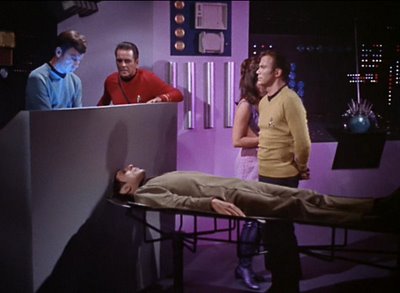
Just like the episode of Star Trek where the Eymorgs steal Spock’s brain and McCoy has to put on the Teacher in order to perform a reverse brain transplant within the three-hour time limit that the implanted knowledge lasts—-phew! that’s a mouthful—-you’re in a race against time to commit as much of that new-found genius to the page as possible before it slips away like a dream upon waking.
You’re also trying to beat the crash.
Coming down off the adrenaline rush when your story came together, your mind will lock onto something and detour on a tangent and you’ll miss a vital piece of information and the structure will topple like a Jenga tower.
In the end, your mind winds up bone weary and you’ll need to step away from the inspiration carnage in order to rebuild your depleted creativity reserve. No worries, though. It’s all part of the process.
As for the aforementioned short story? Still working on it. The first draft is still in the construction phase, but thanks to a bulletted list as long as your arm, I was able to jot down all the important bits.










 Gary was several years older than me and how or why we became friends is still a mystery, but we used to talk about superheroes into the night—-in particular, Captain America and Bucky. You see, Gary’s take on the whole superhero thing was that it was actually doable, given the proper dedication to the cause and constant training. In the mind of a normal kid, these talks should have been one of those topics that you explored as a fantasy and laughed about when you bumped into your childhood friend years later on some random street corner.



 MADD FICTIONAL