
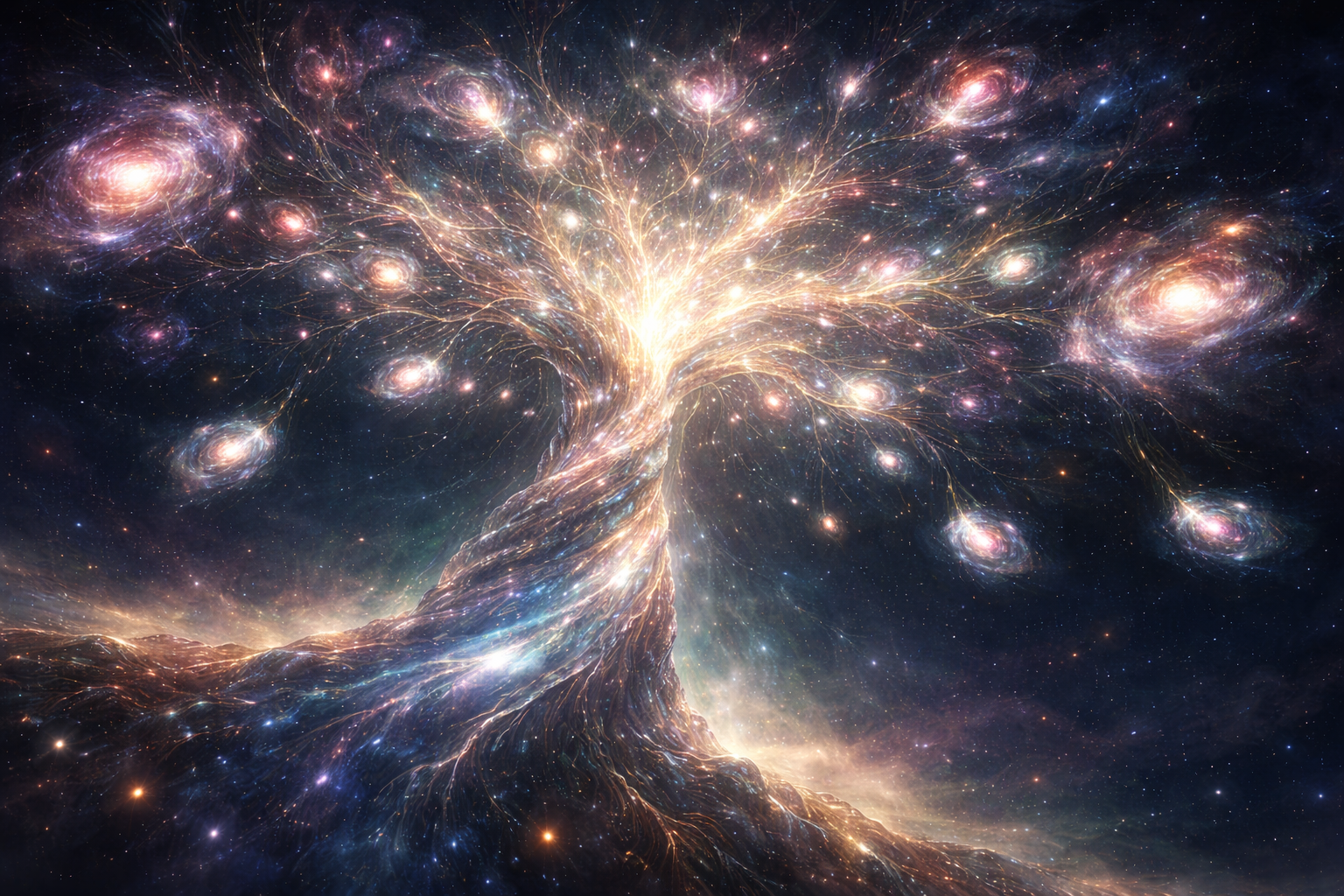
Before the first quark dared to spin, before the very idea of before could find purchase, there was Sylvandros.
It was not a tree in any human sense—no bark, no sap, no leaves to catch a local wind. Sylvandros was a structure of living possibility, a vast, sentient architecture woven from unspent laws and unborn light. Its “roots” sank into the un-fabric of what-was-not-yet, drinking from the quiet void like a spring no one had named. Its “trunk” rose as a column of braided energies: light that hadn’t learned its speed, mathematics that hadn’t decided its constants, thought that existed before there were minds to contain it.
And its branches—those were the most unsettling part.
They were not wood, but filaments of potential, infinite in number and reach, stretching into the nascent empyrean. Each branch-tip brushed a different veil of possibility. Each knot was a nexus where a future could be chosen. Each subtle curve suggested a timeline—an entire reality—waiting to become something more than a maybe.
For eons uncounted, Sylvandros simply was. It absorbed the echo of non-being, transmuted it into the first dreams of existence, and grew. Not outward, exactly. Deeper. More complex. As if it were refining an infinite palette—deciding which colors reality might one day use.
Within its shimmering immensity, the fundamental forces were brewing. The grammar of physics assembled itself in slow, deliberate quiet. The raw materials of life and awareness gestated like seeds in dark soil, not yet planted, not yet released.
Then, after an eternity that was only a breath in its lifespan, Sylvandros began to bloom.
This was no gentle unfurling.
If there had been observers, their minds would have shattered and reformed a million times trying to comprehend the scale of it: a slow, cataclysmic exhalation of creation itself. Not a blast. Not an explosion. A deliberate opening, as if the universe was not made so much as allowed.
At the tips of its myriad branches, buds formed.
They were not petals. They were condensed universes of potential—sealed possibilities, each one unique. Some glowed with a fierce internal fire, like a billion suns already arguing over who would burn first. Others shimmered with cool nebular radiance, dreaming of structure but not yet committing to it. Some were velvet-dark voids, heavy with unknown energies, mysteries with no names.
And then the first blossoms unfurled.
When they opened, they did not release pollen.
They released reality.
Each blossom was an intricate jewel of light and information: multifaceted, alive with nascent law. Some were galaxies-in-miniature—spiral arms hinted in diamond dust, gravity’s first choreography already encoded in their swirl. Some were crystalline lattices that hummed with the earliest notes of physics, a seed-melody for the universal symphony. Others were soft, luminous mists, intangible and tender, carrying the raw material of consciousness: the ability to notice, to wonder, to ache for meaning.
Sylvandros did not clutch these blooms like treasures.
It let them go.
There was no “fall,” because there was no down. No “flight,” because there was no resistance. The blossoms simply detached and drifted into the virgin canvas of everything-to-come: first one by one, then in flurries, then in great, silent rivers of incandescent release.
Imagine one blossom—radiant sapphire threaded with diamond dust—gliding through the pre-dawn of time. As it traveled, it shed infinitesimal motes of itself. A single mote, impossibly dense, wandered into a thin pocket of primordial hydrogen. Something in that mote remembered a law that hadn’t fully existed yet. It insisted on fusion.
A star ignited.
The first star.
A new kind of presence in the overwhelming dark, burning as proof that possibility could become fact. And that single blossom, continuing its slow, graceful decay, seeded an entire nursery: a thousand suns kindled by the aftershimmer of its passing, each one a descendant of that first, quiet gift.
Another blossom drifted differently.
This one was a lattice of emerald light and shadow, an inherent blueprint of order. It slipped into a region of churning, chaotic gas and did not conquer it—only influenced it, the way a steady hand can calm trembling. The chaos began to gather along the lines of force emanating from the blossom’s core. Dust motes clung together not randomly, but with strange inevitability. Over millennia, planets formed, their orbits and compositions guided by silent wisdom embedded in the bloom’s structure.
One of those worlds was cold and rock-bare, an indifferent sphere turning beneath a young sun. It might have remained forever silent. But a fading filament of the blossom brushed it like a fingertip against a sleeping cheek, sparking a new chemical insistence deep in the mantle: the first self-replicating molecule. Small. Humble. So easy to dismiss.
And yet it was the ancestor of everything that would ever breathe.
There were rarer blossoms too—nearly invisible, like heat haze in a place that didn’t yet have heat. These were made of nascent awareness itself: not life, but the capacity for life to awaken. They traveled far, seeking resonance. One such blossom sensed the faint stirring of complex chemistry on a watery world and drifted downward through its atmosphere, dissolving into the ocean.
It did not create life. Life was already stirring, stubborn and accidental as a weed between stones.
But the blossom gifted that life with potential.
The potential for self-awareness. For curiosity. For tenderness. For terror. For art. For love. For the strange human habit of staring into the dark and demanding the dark answer back.
Rivers of blossoms flowed outward, each carrying a different legacy.
Some were bursts of pure beauty, ephemeral and unnecessary—Sylvandros’s art, scattered with no audience but the universe itself. Their passing painted the void with nebulae, left trails of dust that would become the bones of future worlds. The glow of starfields, the silhouettes of cosmic clouds, the delicate haunt of distant clusters—these were, in part, the residue of blossoms that existed simply to be luminous.
Other blossoms carried the seeds of physical law.
As they unraveled, they laid down constants like stakes in an infinite field: gravity’s strength, the electron’s charge, light’s speed. They wove spacetime into a coherent tapestry so that cause could follow effect, stars could burn, worlds could orbit, and the universe could become a place where events meant something.
And Sylvandros continued to bloom.
Season after season—if such a word can exist for something outside time—it released its children. The cosmos filled with their light, their information, their slow-decaying instructions. Galaxies formed and collided, fell apart and remade themselves. Life arose in a thousand strange dialects: carbon, silicon, plasma, pattern, dream. Some of it aware, some of it merely striving.
All of it, indirectly, touched by the Great Tree’s generosity.
On one small world—one among countless—a creature stood beneath a night sky and looked up.
It wore primitive furs. It had no language for what it felt. Its mind was young, new, still learning how to hold a thought without dropping it. Yet it stared at the glittering band overhead and experienced an ache so profound it almost counted as prayer: wonder without a god, longing without an object.
Unbeknownst to it, the starlight illuminating its face was born from the slow decay of ancient blossoms. The atoms inside its body—carbon, oxygen, iron—had been forged in the hearts of stars that were themselves descendants of Sylvandros’s released potential. The creature’s questions were not separate from the cosmos. They were the cosmos, looking back at itself through newly opened eyes.
And Sylvandros remained.
Vast. Silent. Radiant at the heart of its ever-expanding creation. It did not demand thanks. It did not hunger for acknowledgement. Its blooming was not conquest or plan but expression—its fundamental nature made visible: to generate, to create, to give.
Even now, its blossoms still float.
Some are only beginning their journeys, launched from branches that pierce the membranes of realities we cannot comprehend. Others are ancient, their energies almost spent, yet still capable of subtle influence: a nudge toward a discovery, a sudden peace in a mind that has forgotten how to rest, an idea kindling in a scientist’s thoughts like a match struck in the dark.
They are the whispers of creation. The dreams of the void made tangible. The universe’s long, unending exhale.
Each speck of stardust, each quantum fluctuation, each beat of a living heart carries within it—however faint—a memory of that first blooming. The cosmos is a garden sown by a single unimaginable Tree, and its blossoms are still drifting, freely and forever, carrying seeds of wonder to every conceivable shore of existence.
And Sylvandros, in its timeless serenity, continues to bloom.
 MADD FICTIONAL