
Bzou smelled her before he heard her.
Blood—cold, human, female—threaded through the damp air outside his den like a slow confession. Not fresh injury. Not panic. Something older and deeper, a stain that didn’t rinse out. It clung to her the way smoke clung to clothes after a long night near a dying fire.
He opened his eyes as the emberlight behind him guttered low. The cave held the kind of darkness that belonged to the world before lanterns, before roads, before people decided shadows were a problem to be solved. His breath steamed in the cold, a pale ribbon curling toward the ceiling, and he listened.
Footsteps, careful.
Not the stumbling, drunk courage of a villager. Not the hurried, frantic rush of someone lost in the woods. These were measured. Intentional. The sound of someone who had made a choice and was prepared to live with it.
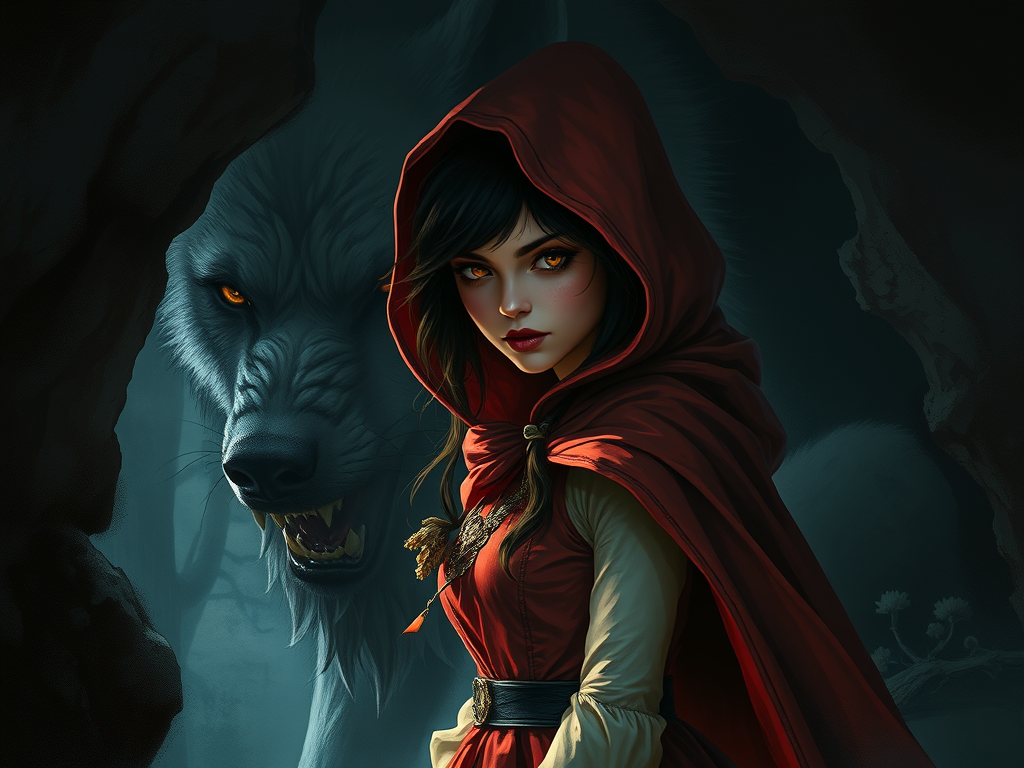
She appeared at the mouth of the cave with the fog behind her like a curtain. Hood up, shoulders squared. The cloak was red, but not bright. Not storybook scarlet. Darker. A red that had been slept in, rained on, dragged through thorns and older regrets. The kind of red that didn’t beg attention, but demanded it.
Bzou didn’t rise. He didn’t have to. The den was his kingdom. Anyone who entered it had already crossed a line.
“You shouldn’t be here,” he said.
His voice was the voice of stone rubbed raw. It pressed against the damp air and made the fog feel heavier.
She didn’t flinch.
“I know.”
That alone was wrong. Most humans heard his voice and remembered they were made of soft things. Most humans took a step back even if they didn’t mean to. Fear was automatic. A reflex. A truth.
This woman stood still as a nail.
Bzou watched her for a long moment. The firelight crawled over his fur and over the ridges of his back, catching on the old scars that never fully faded. In the village they called him wolf. Monster. Pact-keeper. Curse. They said a lot of things when they were trying to keep their hands clean.
He shifted, slow and deliberate, and his bones cracked quietly as he unfolded himself from the hollow where he’d been curled.
“What do you want?” he asked.
The woman reached up and pushed back her hood.
Her hair was dark as wet bark, her cheekbones sharp enough to cut glass, her eyes too steady for someone standing at the edge of a predator’s home. Her lips were painted deep red—not for vanity, not for seduction, but like punctuation. A period at the end of a sentence she’d been repeating to herself for days.
She wanted to be seen.
“A missing person,” she said.
Bzou almost laughed, but it would have sounded like a growl. “Not my world.”
He turned away from her, toward the dwindling embers, toward the quiet he’d earned. The village’s problems belonged to the village. The village had chosen its rules. He had chosen exile. That was the pact: he stayed on the edge, and they left him alone. A boundary drawn in old blood and older fear.
Her voice came again, closer than it should have been.
“My grandmother is gone.”
Bzou didn’t turn, but the words tightened something inside him. Missing people were common. People disappeared into woods, into drink, into other people’s cruelty. The world took what it wanted. Sometimes it didn’t even bother to leave a reason behind.
But she didn’t say it like someone repeating the village’s comforting lie. She said it like someone naming a crime.
“They said she wandered off,” the woman continued. “But she didn’t. She was taken.”
Now Bzou turned.
Not quickly. Not with alarm. With the slow attention of something that had learned not to waste energy on false alarms.
“What’s your name?” he asked.
She hesitated. Just long enough to betray a private argument she’d already lost.
“Redalhia.”
It sounded like a name from somewhere else. Somewhere old. Somewhere that didn’t belong to Gildengrove’s neat little square and its tidy sermons and its polite lies.
Bzou studied her. “If your grandmother was taken, why come to me?”
Redalhia didn’t look away. “Because the village doesn’t hunt its own sins.”
Bzou felt a low rumble gather in his chest, not quite a growl. Not quite a laugh. The kind of sound that meant you’re closer to the truth than you should be.
“You’re not from there,” he said.
“I was,” she replied. “Then I wasn’t.”
That was all she offered, and it was enough. The people who left Gildengrove didn’t come back. Not unless they were dragged. Not unless they were desperate. Not unless they were carrying something the village wanted.
Bzou stepped closer. Not to threaten. To measure. The air around her was dense with layers: soap, rain, a trace of cheap tobacco, iron from old blood, and beneath it a faint sweetness like crushed berries that had begun to rot. He could smell nights without sleep. He could smell decisions made in the dark.
“You want me to walk into the village,” he said.
“Yes.”
“You know what that means.”
Redalhia’s jaw tightened. “I know what it means for you.”
Bzou’s eyes narrowed. “And what does it mean for you?”
For the first time something flickered across her face—not fear, not regret, but something like a tired acceptance.
“It means I stop pretending the story they told me makes sense,” she said. “And I stop acting like I’ll survive by keeping my head down.”
Bzou watched her. A long, quiet assessment. He had seen women like her before—women who had been forced into sharpness by dull men. Women who had learned the cost of being small.
“You came alone,” he said. “That’s either brave or stupid.”
Redalhia’s lips curved slightly, but there was no warmth in it. “I didn’t come unarmed.”
Bzou’s nostrils flared. He could smell steel under her cloak. A knife. Maybe more.
“That’s not what I mean.”
“I know.”
The silence between them thickened. The cave’s mouth framed her like an omen.
Bzou’s gaze dropped to her cloak again. The red wasn’t simply red. It had a history. A texture. A depth. It wasn’t a costume.
“How long has she been missing?” he asked.
“Three nights,” Redalhia said. “They told me she wandered into the woods during a fog and didn’t come back. They said she’s old, forgetful, that she probably fell. They asked me to be sensible.”
Bzou’s throat tightened with the old familiar disgust. Sensible. The word people used when they wanted you to agree to something monstrous.
“And you weren’t.”
“I was,” Redalhia said quietly. “For one night. And then I went to her house.”
Bzou stilled. “Her house is sealed.”
Redalhia nodded once. “Yes.”
“You shouldn’t be able to get in.”
“I didn’t get in.” Her eyes hardened. “But I smelled something through the cracks. Not her. Not death. Something else.”
Bzou felt his fur lift along his spine. “What did you smell?”
Redalhia’s gaze didn’t waver. “Tallow.”
Bzou’s jaw clenched.
Tallow meant torches. It meant huntsmen. It meant old rites with clean names. It meant the village doing something it didn’t want seen in daylight.
Redalhia took a slow breath, as if she’d been holding this in for days.
“They nailed her shutters shut from the outside,” she said. “Iron nails. Like she was a thing to be contained.”
Bzou turned his head slightly, listening past her words to the world outside. The fog was thick tonight. The kind of fog that made distances lie. The kind of fog his kind moved through easily.
He looked back at her.
“There was a pact,” Bzou said.
Redalhia’s eyes sharpened. “So you admit it.”
He didn’t answer. The pact wasn’t a story for outsiders. It was an arrangement carved out of survival. The village kept its hearths and its children; Bzou kept the things that crawled at the edges. Sometimes, when the forest spit up something wrong, he put it back down. Sometimes he dragged it into the dark and broke it there.
He did not interfere with human business. Not anymore.
“You ask me to break it,” he said.
Redalhia stepped closer, too close, the red of her cloak absorbing the firelight. “I ask you to look me in the eye and tell me you don’t already want to.”
Bzou’s breath steamed between them. He could hear her heart. Not racing. Not pleading. Steady. Determined. Like a drum.
“You think you know what I want,” he said.
“I know the village is rotting,” Redalhia replied. “I know they’re hiding something under their clean faces. And I know you smell it too, whether you admit it or not.”
Bzou stared at her for a long time. In the old stories, the girl in red wandered into the woods because she was naive. Because she didn’t understand the rules. That story was a lie. Girls in red wandered into the woods because no one else would go. Because someone had to. Because the world didn’t protect the soft.
Redalhia wasn’t soft. Not anymore.
“What’s your grandmother’s name?” Bzou asked.
Redalhia’s voice tightened. “Mireille.”
The name landed heavy. Not because Bzou knew the woman—he didn’t. Not because the name had power in itself. But because naming a missing person was a form of refusal. Refusal to let them become rumor. Refusal to let them become a lesson.
Bzou turned away from the fire. He moved deeper into the cave for a moment, into the shadows where Redalhia couldn’t see his face. He reached into a crevice in the stone and drew out something wrapped in old cloth.
A token. A reminder.
He returned to the firelight and unwrapped it.
A strip of leather, cracked with age, threaded with beads that had once been white and were now the color of old teeth. At its center, a small metal medallion stamped with a symbol the village pretended not to recognize: a wolf’s head inside a ring of thorns.
Redalhia’s eyes flicked to it, then to him.
“What is that?” she asked.
Bzou held it between two fingers. “Proof.”
“Of what?”
He didn’t answer directly. He looked at her and asked, “When you were a child, did they tell you the woods were dangerous?”
Redalhia’s mouth tightened. “They told me the woods were punishment.”
Bzou nodded once. “Then you learned their favorite lie.”
He let the medallion fall back into his palm and wrapped it again, slow, as if each motion was a decision.
“I don’t walk into Gildengrove,” he said.
Redalhia didn’t move. “Then Mireille dies.”
“That’s not a certainty.”
Redalhia’s voice turned razor-thin. “It’s a pattern.”
The fire popped. The sound snapped through the cave like a breaking bone.
Bzou met her eyes. In them he saw something he hadn’t expected. Not just anger. Not just fear. A quiet, brutal certainty that she would go alone if he refused. That she would step into the village, into its teeth, because no one else would.
And that she might not come back.
Bzou exhaled, slow.
“You have one more thing you’re not telling me,” he said.
Redalhia’s lashes fluttered once. A tell. A crack.
He stepped closer until he could smell the faintest trace of something beneath everything else. Not scent exactly. More like residue. Like a touch left behind.
Something old.
Something that didn’t belong to a human body.
“You’ve been marked,” Bzou said quietly.
Redalhia’s throat worked. “I don’t know what you mean.”
Bzou lifted his hand and stopped just short of touching her face. He didn’t need to. He could feel it in the air around her—the faint pull like gravity slightly wrong.
“She’s not only missing,” he said. “She left you something. Or something left her through you.”
Redalhia held his gaze, and for the first time the calm in her expression wavered.
“I started dreaming,” she admitted. “After the second night. Same dream, every time.”
Bzou’s voice dropped. “Tell me.”
Redalhia swallowed. “A well.”
The word fell into the cave like a stone into deep water.
Bzou went still.
Redalhia continued, her voice quieter now, as if speaking too loudly would wake something. “It’s boarded up. Nailed shut. There are symbols carved into the wood. I’m standing at the edge, and I can hear breathing from below.”
Bzou’s jaw tightened. The old boundary inside him—the pact, the rules, the careful distance—shifted like a rotten fence post giving way.
“Do you know where the well is?” he asked.
Redalhia nodded once. “Near the oldest houses. Off the square.”
Bzou stared at her. He didn’t like coincidences. He didn’t trust them. Dreams came from somewhere, even if people pretended otherwise.
He looked toward the cave mouth, where fog rolled like a living thing.
“The village didn’t let you in because they wanted you safe,” he said.
Redalhia’s lips pressed together. “No.”
“They let you in because they wanted you close.”
Redalhia didn’t ask who they were. She didn’t have to. Something in her already knew.
Bzou reached for his cloak—dark, heavy, old. Not a garment, a second skin. He swung it around his shoulders.
Redalhia’s breath caught, just once. Not relief. Not victory. Something more complicated. Like she hadn’t believed he would say yes until the moment he moved.
“You’re coming,” she said.
Bzou’s eyes narrowed. “We’re going.”
Redalhia’s fingers curled under her cloak around the knife she carried, as if it steadied her.
Bzou stepped past her into the fog. It swallowed the cave and the fire behind him immediately, taking the warmth away like it had never existed.
He paused at the threshold and looked back once.
“If you lie to me,” he said, “I will leave you there.”
Redalhia met his gaze. “If I lie to you,” she said, “I deserve to be left.”
Bzou turned forward again and started walking.
The fog thickened as they moved through the trees, making the world feel like a half-remembered story. The forest accepted him the way it always had, bending around his presence, quieting its small animals, swallowing its own sounds. Redalhia followed close behind, steady-footed, more capable than most humans. She didn’t speak. Neither did he.
Words weren’t the point anymore. The point was the border they were crossing.
When the first rooftops of Gildengrove emerged out of the fog, Bzou stopped.
The village sat low and neat between the trees, lights glowing warm in windows, smoke curling from chimneys—an image of comfort practiced so often it had become a weapon. The cobblestone road into town was damp, black with rain, and the air smelled too clean. Too scrubbed. Too much sage burned to hide the wrongness beneath.
Bzou inhaled.
There it was—tallow, old iron, lamb fat, and something else threaded underneath, thin but unmistakable. Burned hair. Metal. And the faintest trace of wolf.
Bzou’s eyes narrowed as he stared into the fog-shrouded streets. “They know,” he said.
Redalhia’s voice came quiet beside him. “Know what?”
Bzou didn’t look at her. His gaze stayed locked on the village.
“That you came to my den,” he replied. “And that I said yes.”
They stood at the edge of Gildengrove, just outside its first fence line, while the fog curled around them like the breath of something large and waiting.
From somewhere deeper in town—a sound, distant but clear enough to tighten the skin.
A crackle. A flare. Fire being fed.
Bzou exhaled once, slow and grim. “Stay close,” he said.
Redalhia’s hand slid fully onto the knife under her cloak. “I wasn’t planning on wandering,” she replied.
Bzou stepped forward.
And the village, smelling of clean lies and old smoke, opened its mouth.
 MADD FICTIONAL