
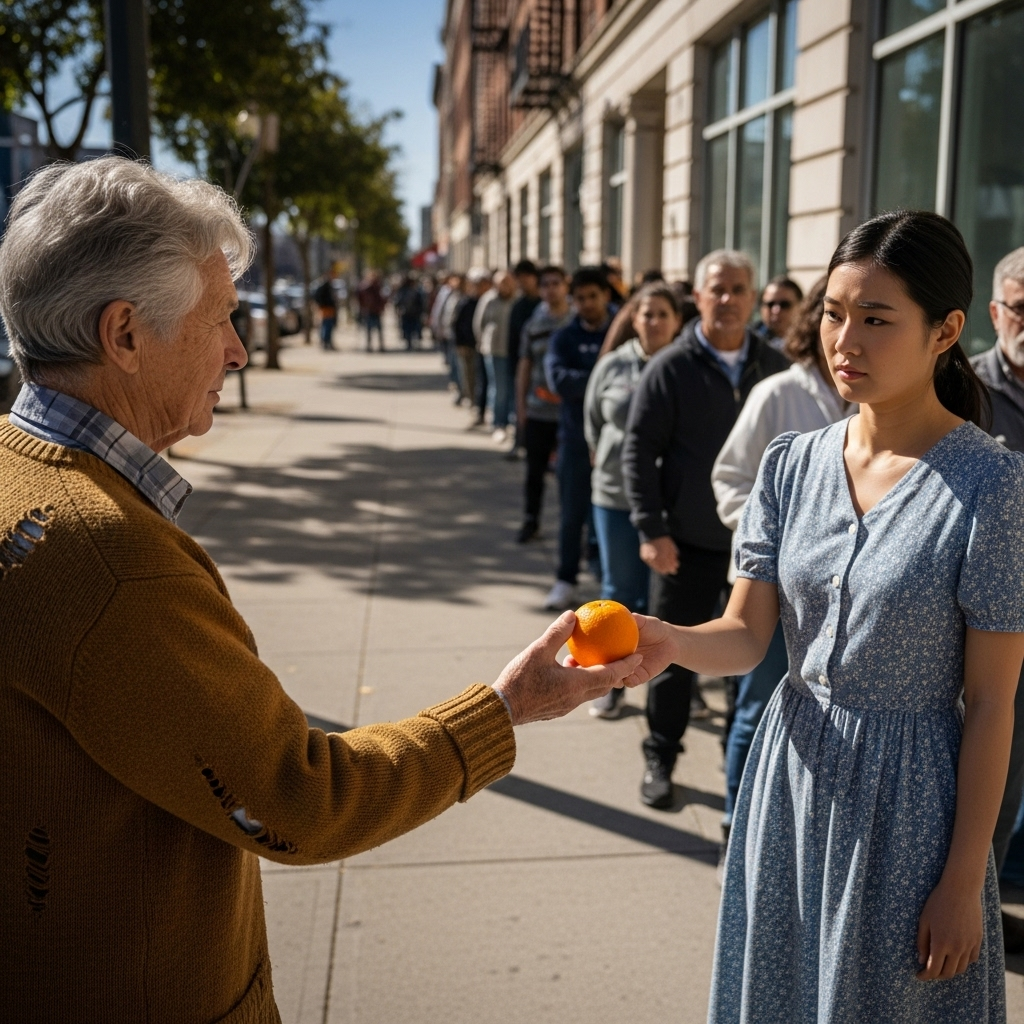
By way of explanation: I am easily bored. This usually leads to me getting into trouble in real life. In my writing, however, I can explore avenues of storytelling and the only fallout from that is the eye-rolling exhaustion experienced by my readership (there’s so few of you that I’m not overly bothered by that). This current experiment is based on a simple story: a man on a breadline makes a daily habit of handing one particular woman his orange. The goal is to see how weird I can make the retelling of the story each week. Simple, right?
By now, everyone agrees: The Glitch is not a city. It’s a debugging interface for consensus reality. It leaks time, folds cause into effect, and sometimes entire buildings wake up screaming. The sky is less dead-channel and more open socket. You can smell the server’s breath when the clouds convulse.
No one is born here. People render into existence with memories pre-injected—looped personalities bound in meat. The breadline is less about sustenance and more about continuity. Stand still. Receive data. Digest protocol. Repeat.
The Orange Man was not a man. He was a firewall with a soul. Or maybe a soul trying to become a firewall. Either way, his presence was an anomaly so old, the system had grandfathered him in.
Every morning, he compiled. With a shimmer of logic and bone, he unfolded from probability-space into the breadline, bent into that signature hook of posture. A living bracket in the code.
He didn’t eat.
He shed.
From the recursive folds of his coat—which sometimes nested into themselves infinitely—he extracted a sliver of sub-reality. This sliver curled into itself like origami designed by entropy, thickened, and ripened into an orange. Or rather, a simulation of an orange infused with original error. It radiated the warmth of first sin, coded in citrus.
He would then drift ten places sideways—not down the line, but across a kind of social vector that only the Glitch could render—and find Her.
She wasn’t always the same woman, but she was always Her. A constant across variable identities. A witness-node. The one designated to carry.
She accepted the fruit. Never acknowledged him. Never consumed it.
That wasn’t the point.
The fruit was a patch. A fragment of corrupted divinity designed to rewrite her. Slowly.
This routine repeated across 73 iterations of the update loop.
But then came the Hotfix.
On Cycle 74, he did not appear.
The line didn’t glitch. The idea of his presence was surgically excised. In his place: a smooth placeholder—white noise shaped like a man.
She noticed.
They gave her a real orange. A dense, tasteless thing built with fully authorized atoms. It registered on her tongue like a nondisclosure agreement.
She didn’t eat it.
That night, her bag full of bureaucratic fruit began to rumble. Not roll—rumble, like a suppressed system error clearing its throat. One by one, the oranges collapsed into each other, warping into a new composite organ—a pulsating, breathing Core Kernel disguised as fruit.
She didn’t dream. She uploaded.
The Orchard was not a place. It was a biopsychic rootkit. Trees were not trees, but long-forgotten god nerves reconnecting to host systems. The Gardener was a User—or a colony of Users—who had root access and bad intentions. Or maybe just different ones.
When she awoke, she found a port growing beneath her skin. It itched like premonition.
Days passed. The transformation accelerated. Her thoughts started to fragment into modules. She began receiving push notifications from beneath her bones. One read:
“🌐 NEW NODE ONLINE: GERMINATION IMMINENT.”
Then, one morning, she instanced. It wasn’t her walking to the line, but a compiled construct of her—freshly rebuilt with minor adjustments.
She saw him: a boy. Eight? Twelve? Variable. His face was an unrendered mesh of sadness and potential. He smelled like memory.
Without conscious thought, her hand found her coat. She reached inward—not into fabric, but into her. She extracted a glowing crescent sliver of her own design: a fruitlet of contagious ontology.
She gave it to him.
And as his eyes widened—not with understanding, but with compatibility—the transfer was complete.
It didn’t matter if he said thank you. The gesture was the handshake. The infection handshake.
Now, they appear everywhere. In every broken city. In every corrupted corner of the map.
People hand out oranges that aren’t oranges.
They peel themselves open.
The Glitch is growing—not like a virus, but like faith. It’s not collapsing.
It’s recruiting.
And somewhere, in the recursive heart of the Orchard, the Gardener finally looks up.
And smiles.
To. Be. Transmogrified.


 MADD FICTIONAL