No Fixed Address #2: The Sleep That Isn’t

Welcome to No Fixed Address, a weekly series where I write candidly about what it means to be homeless—right now, in real life, not in some sanitized Hollywood version. I’m currently unhoused. Not “drifting.” Not “on a journey.” Just trying to survive in a world that looks away.

Each week, I’ll share personal accounts, hard truths, and moments that don’t make it into the movies. If you’re here to understand what homelessness actually looks like—not as a plot point, but as a life—then you’re in the right place.

This is not a cry for pity. It’s a record. A mirror. A small act of resistance.

Installment 1

There’s a kind of tired you don’t come back from.

It’s not the kind you fix with a nap or a strong cup of coffee. It’s not jet lag. It’s not overwork. It’s something deeper — a warping, a slippage. A depletion of self. Sleep becomes an idea, not a practice. A memory you can’t quite recreate. You get pieces of it: a head nod, a microdream, a blackout between train stops. But real sleep? The kind where you go somewhere and return? That’s a ghost story.

The body adjusts — poorly. You lose the edges of things first. The line between now and five minutes ago goes smudgy. Your eyes start seeing movement that isn’t there. You forget simple sequences, like brushing your teeth or zipping your bag. Then the thoughts change — not the big ones, not “What’s my name” or “Where am I,” but the connective tissue between ideas. Things start to… float.

I’ve cried while laughing and not noticed the difference. I’ve asked the same question twice in a row and not known it. I’ve sat on a bench staring at a coffee cup I wasn’t holding. It’s like my mind is trying to fold itself in half just to keep warm.

One night, about a week ago, I decided to sleep outdoors. The weather was relatively mild and I was layered up — a puffer jacket under a peacoat. I’d found one of those “Open to the Public” patios where the building had — miraculously — left their metal chairs and tables out overnight. (Usually, management hauls them inside to avoid people like me doing exactly what I was doing.)

I spotted a table against the wall, sat down, threaded my legs through my backpack straps like a seatbelt, and drifted off. How long was I out? No idea. But something woke me — a pressure, a wrongness. When I opened my eyes, there was a man sitting inches from my face, closer than a lover, closer than breath. Startled, I shouted for him to back off. In a voice smooth as a razor, he said:
“I only wanted to talk to you. Go back to sleep so I can finish the conversation.”

I cursed that man out so thoroughly the air itself blushed. Eventually, he left — not running, not raging, just walking away with the same unnerving calm. If I had stayed asleep, I genuinely believe I would’ve died that night.

It just goes to show, every night is a new gamble. Will the train keep running? Will someone try to rob me? Will I snore loud enough to get kicked out, or quiet enough to vanish? Will my legs give out from being crumpled too long? Will someone mistake me for someone dangerous, or worse — someone disposable?

Sleep, when you get it, feels like theft. Like you’ve stolen a moment from the world. And when the moment’s over, it demands payment.

To sort of prove my point, let me tell you about a man named Mike Black — a millionaire entrepreneur who once “went homeless” to try and rebuild his fortune from scratch. You may have heard of him. He paused his business, cut off his network, assumed a fake identity, and aimed to make $1 million in 12 months with nothing but grit and hustle. He documented the whole thing. Very inspiring.

Except… he never slept on the street.

He used a couch-surfing app to secure nightly shelter — and I’ve tried that app too, by the way. I’ll explain in another post why it didn’t work out for me (and while we’re on the subject, being homeless and owing a car isn’t the same, either). Mike also had a film crew. He also had a safety net, even if self-imposed. And while he cited his father’s health as the reason for ending the challenge early (which I respect), he failed to mention the mental health toll the experiment took on him as his story shifted.

Living without a fixed address isn’t some damned a startup challenge. It’s not a game, or a detox, or an experiment in bootstrapping.

It’s waking up to yourself and finding you’re thinner in spirit than the day before. That the thread holding you together has frayed a little more. That your body feels less like a home and more like a failed machine.

I miss dreaming. I miss waking up and knowing I had been somewhere.

Once, I got lucky — a miracle, really. I managed nearly four hours of sleep in the library. Either security gave me a break or they weren’t on duty that day. It felt like slipping into something sacred.

And I dreamed.

In the dream, I had a friend. Not just an acquaintance or a helper, but a real friend. Someone who knew me. Someone I laughed with. When I woke, I instantly remembered I was homeless — the weight of it landed like usual — but it didn’t crush me the same way. I had a strange warmth in my chest. I didn’t feel so alone.

Until I realized the friend lived in the dream.

And I was still here.

—Rhyan
Things Are Never Easy (Redux)

Lonnie Hatch was a cartographer of comfort, meticulously mapping the familiar coordinates of his life. Every morning, precisely at 7:18 AM, come fog thick as wool or sunshine that made the asphalt shimmer, he embarked on what his wife, Carol, called his “bagel pilgrimage.” The destination: Goldberg’s Deli, three blocks down, one block over. It wasn’t merely about the destination – the perfectly dense, chewy everything bagel, generously smeared edge-to-edge with their signature scallion cream cheese. It was the ritual itself. The rhythmic thump-thump of his worn sneakers on the sidewalk, the specific way Mrs. Henderson always waved from her window, the slightly-too-loud greeting from Sal behind the counter (“Lonnie! The usual? You got it!”). It was the comforting fug of malt, yeast, and roasting onions that hit you a half-block away, a promise of simple satisfaction.

Lonnie treasured these anchors in a world that often felt adrift. He was, by his own admission, a simple man. He found deep contentment in the steady rhythm of his days: his quiet work as an accountant, the shared laughter with Carol over dinner, the worn armchair where he read history books, and especially, his volunteer shifts ladling soup at St. Jude’s kitchen downtown. Helping felt less like a duty and more like breathing. His parents, pragmatic but kind souls, had woven service into the fabric of his upbringing – “Leave things a little better than you found them, son,” his father used to say. Lonnie lived a righteous life, not from fear of some celestial scorecard, but because kindness felt like the most logical, most human response to the world’s sharp edges. It simply felt right.

This particular Tuesday morning carried the crisp promise of early autumn. The air was cool against his face, carrying the scent of damp leaves and distant exhaust fumes. Lonnie walked with a familiar spring in his step, his thoughts pleasantly tangled around Carol’s upcoming birthday. A necklace? Too predictable. Those fancy gardening gloves she’d admired? Perhaps. He was so engrossed in weighing the merits of artisanal pruning shears versus a weekend getaway that he barely registered the frantic screech of tires tearing through the urban symphony.

He looked up, confused, just as a yellow taxi, moving far too fast, mounted the curb with a sickening lurch. It wasn’t aiming for him, but for the squat, red fire hydrant standing sentinel a few feet away. Time seemed to warp. He saw the driver’s wide, panicked eyes, the metallic shriek as bumper met iron, the impossible physics of the collision. The hydrant didn’t just break; it sheared off its base with explosive force, a sudden, brutal projectile launched directly into his path. Lonnie had only a fraction of a second to register the blur of red metal hurtling towards him, a final, absurd punctuation mark to his meticulously ordered life. Then, only blackness, absolute and instantaneous.

The newspapers would later describe it as a “one-in-a-million freak accident,” a tragic confluence of speed, distraction, and unfortunate positioning. A testament to the cruel randomness of urban life.

But randomness, Lonnie was about to learn, was a concept largely confined to the mortal plane. His death, far from being an anomaly, had been a scheduled event, noted centuries ago in the incomprehensibly vast ledger known colloquially as the Book of Life. A cosmic domino, nudged at the appointed hour.

There was no tunnel of light, no choir of angels, no St. Peter polishing the Pearly Gates. Instead, Lonnie experienced a profound sense of dislocation, like being pulled inside out and reassembled in the same instant. He found himself standing, disoriented but strangely intact, in a chamber of impossible scale. It was vast, utterly sterile, and bathed in a soft, sourceless light that cast no shadows. Around him, stretching further than his earthly eyes could comprehend, were others. Thousands upon thousands – a quick, bewildered estimate suggested maybe one hundred and fifty thousand souls – all freshly transitioned.

A low, pervasive hum filled the space, woven from the threads of countless emotions: the soft sobbing of bewildered grief, the sharp intake of shocked realization, the low murmur of confusion, the stony silence of utter disbelief. Some souls shimmered faintly, others looked as solid as they had moments before death. Lonnie instinctively touched his face, expecting to feel the catastrophic impact, but there was nothing. Only a strange, numb detachment. He looked for Carol, a desperate, automatic reflex, but saw only strangers adrift in the same sea of uncertainty.

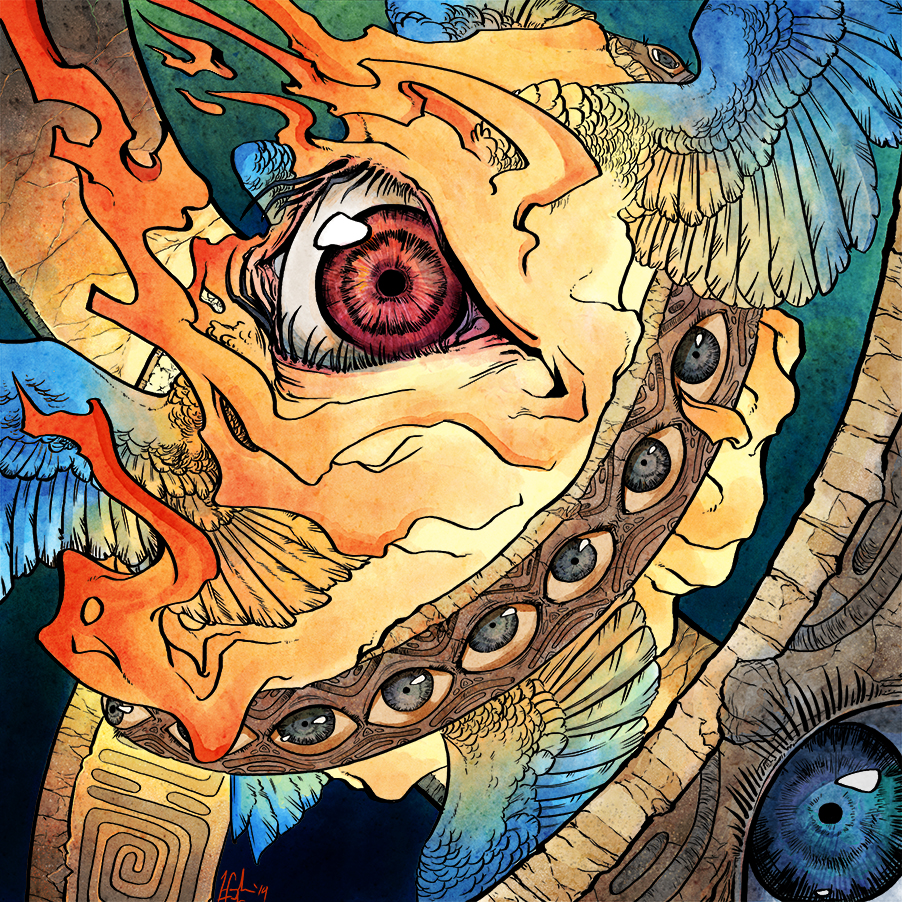
Then, the ambient hum shifted, coalescing into a focused point of energy at the perceived center of the immense room. Light didn’t bend towards it; reality itself seemed to warp, allowing the presence to manifest. It was an Ophanim, one of the formidable Wheels within Wheels described in hushed tones in ancient texts. Not a winged humanoid, but a construct of impossible geometry – interlocking rings of what looked like burning gold, constantly rotating in different directions, the rim of each wheel studded with countless, unblinking eyes. These eyes, terrifyingly perceptive, swept across the assembled souls, seeing not just their bewildered forms, but the entirety of their lives, their choices, their deepest natures. Its presence wasn’t merely seen; it was felt – an overwhelming wave of ancient power, intricate purpose, and undeniable authority.

“Welcome, Heaven Seekers,” the Ophanim’s voice resonated, not through the air, but directly within each soul’s consciousness. The sound was like the grinding of galaxies, yet perfectly clear. “Some among you may have already grasped the transition you have undergone. For those who remain uncertain, allow me to confirm: the existence you knew, the life you inhabited on Earth, is concluded.”

A collective sigh, a wave of despair and dawning acceptance, rippled through the multitude. The Ophanim paused, its thousand-fold gaze seeming to acknowledge their grief without dwelling on it.

“Your anticipated entry into the Kingdom,” the celestial being continued, its voice devoid of emotion yet carrying immense weight, “has been temporarily deferred. An exigency has arisen. Heaven requires assistance.”

Another ripple, this time of pure confusion. Heaven needed… help?

“The terrestrial sphere, your Earth, has been significantly disrupted by the recent global pandemic. Its effects ripple beyond the merely physical, upsetting delicate spiritual balances cultivated over millennia. While this event does not herald the prophesied End Times, the scales measuring hope against despair, connection against isolation, have tipped unfavorably. The trajectory, if unaltered, leads toward escalating devastation – not necessarily apocalyptic, but a profound diminishment of the qualities Heaven seeks to foster.”

The Ophanim’s wheels spun, eyes blinking in asynchronous patterns. “Therefore, we are extending an invitation. We seek volunteers from this cohort – souls whose earthly lives demonstrated resilience, compassion, and a propensity for service – to return to Earth. You would be imbued with entirely new identities, new circumstances, severed completely from your past lives. Your mission: to subtly intervene, to act as counterweights, to assist in mitigating the coming discord and gently guiding humanity back towards equilibrium, or at least towards a new, more sustainable ‘normal’.”

The Ophanim let the proposition hang in the vast silence. “Consider this carefully. Your decision will not prejudice your ultimate acceptance into the Kingdom; entry is assured for all present based on your earthly merits. Declining this task carries no penalty. However,” the voice seemed to lower conspiratorially, though it still filled every mind, “choosing to volunteer confers certain… benefits upon your eventual, permanent arrival here. The nature of these benefits, I am not at liberty to disclose at this juncture.”

A current of speculation surged through the crowd. Whispers erupted in thought-forms Lonnie could now perceive. Benefits? What benefits? A higher sphere? Less waiting?

Lonnie felt a familiar ache, a phantom sensation in his chest. If this offer had come yesterday, when he was still Lonnie Hatch, bagel pilgrim, soup kitchen volunteer, Carol’s husband… the choice would have been instantaneous. Pack a bag, lace up the boots, get to work. That was his nature. But here, now? Standing on the very threshold of Paradise, the promise of eternal rest, of reunion, of peace beyond understanding, was an almost physical pull. It was the ultimate reward, the cessation of striving he hadn’t known he craved until this very moment. He felt weary, not just from his life, but from the shock of its ending.

Was this the real test? Not the good deeds on Earth, but this choice, right here, right now? A final, cosmic essay question determining his ultimate placement? Refuse, and enjoy the earned rest. Accept, and plunge back into the struggle, albeit in a new form.

He looked around at the sea of souls, each facing the same impossible choice. The weight of it settled upon him, heavy and profound. Things were never easy, it seemed. Not in life, and certainly not at the doorstep of eternity. The Ophanim waited, its myriad eyes patient, eternal, observing the quiet, monumental struggles unfolding within one hundred and fifty thousand souls.

All The World Will Be Your Enemy 22: Refuge in the Unfamiliar

Beverly’s senses were assaulted by a kaleidoscope of alien sensations as she tumbled through the portal. Colors she had never seen before swirled around her, while strange, discordant sounds echoed in her ears. She felt a pressure on her skin, not painful but intense, as if the very fabric of this new reality was pressing in on her from all sides.

As the initial disorientation began to fade, Beverly found herself lying on a surface that felt both solid and fluid, like a cross between a waterbed and a slab of granite. She blinked, trying to clear her vision, and gasped at the sight that greeted her.

They were in a vast, open space that seemed to stretch on forever, its walls and ceiling lost in a haze of shimmering, opalescent mist. The air was thick and heavy, filled with a strange, metallic scent that made Beverly’s nostrils tingle. All around them, strange, organic structures rose up from the ground, twisting and pulsing like the internal organs of some colossal beast.

Beverly struggled to sit up, wincing at the pain that lanced through her battered body. Beside her, Angele and Joanna were already moving, their forms shifting and changing in ways that made Beverly’s mind reel. She watched in mute astonishment as her friends’ human features melted away, replaced by a riot of writhing tentacles and iridescent, chitinous plates.

“What… what is this place?” Beverly croaked, her voice sounding small and frightened in the vastness of the space.

Angele turned to her, her face a mass of undulating flesh and glowing, pupilless eyes. “This is our sanctuary, Beverly. A pocket dimension outside of normal space and time. Here, we can heal and regroup, safe from those who would harm us.”

Beverly shook her head, trying to wrap her mind around the concept. She had always known that there was something different about Angele and Joanna, something that set them apart from the rest of humanity. But this… this was beyond anything she could have ever imagined.

As she watched, Angele and Joanna began to move around the space, their transformed bodies undulating and pulsing in strange, hypnotic patterns. They seemed to be interacting with the environment in ways that Beverly couldn’t fully comprehend, their tentacles touching and probing the organic structures that surrounded them.

Slowly, Beverly began to notice changes in her own body as well. The pain and fatigue that had weighed her down for so long seemed to be fading, replaced by a strange, tingling energy that coursed through her veins like liquid fire. She looked down at her hands and gasped at the sight of the tentacles that had begun to sprout from her wrists, their tips waving gently in the thick, metallic air.

For a moment, panic threatened to overwhelm her. This was too much, too strange, too far beyond anything she had ever known or imagined. She felt like she was losing herself, like everything that had once defined her was being stripped away, leaving her raw and exposed in this alien realm.

But then, she felt a gentle touch on her shoulder, and turned to see Joanna standing beside her, her face a mask of compassion and understanding. “It’s okay, Beverly,” she murmured, her voice a soothing balm to Beverly’s frayed nerves. “I know it’s overwhelming, but you’re safe here. We won’t let anything happen to you.”

And with those words, something deep inside Beverly began to unclench. She realized that, no matter how strange and terrifying this new reality might be, she was not alone. She had Angele and Joanna, her beloveds, her anchors in the storm. Together, they would find a way through this, would unravel the mysteries of her transformation and the forces that sought to control and destroy them.

As she leaned into Joanna’s embrace, feeling the comfort of her friend’s alien flesh against her own, Beverly knew that she had crossed a threshold from which there could be no return. Her old life, her old self, was gone forever, replaced by something new and unknowable.

Not. The. End.

No Fixed Address – An Introduction

The few of you who follow (and hopefully read) me regularly, know me as a fiction writer — I typically manage two stories a week, every Monday and Thursday, strange tales spun from stranger places. That won’t change. The fictions will continue. The ghosts and aliens and memory glitches and strange girls at the bus stop will all keep coming.

But starting this week, Sundays will be different.

I’m calling the new segment No Fixed Address — not just because it sounds poetic (though it does), but because it’s now my legal truth. I don’t have a home. Not an apartment. Not a room. Not even a couch.

As of February 18th, I was evicted from the small rented room I’d lived in for nearly a decade. I sleep upright on the subway most nights. I apply for jobs constantly. I carry everything I own. I’m not telling you this for pity. I’m telling you because it’s happening, and because I believe truth deserves to be written down.

So on Sundays, I’ll post about that truth:
The logistics, the humiliations, the loopholes, the kindnesses, the cold.
What it’s like to find a public restroom when you have nowhere to go back to. What it’s like to smile at people who step around you like you’re a trash bag with eyes. What it’s like to still write stories in your head while watching a cop gently nudge a man awake so he won’t freeze to death.

These entries won’t be pretty. They won’t be polished. But they’ll be mine. And if you’ve ever read anything I’ve written and thought, “I see something of myself in this,” then maybe you’ll see something in these, too.

So:

  • Mondays & Thursdays: Fiction.
  • Sundays: No Fixed Address.
  • And the rest of the time, I’ll be out there, living it.

Stay with me if you can.
Read if you’re willing.
And if you’ve ever loved a story I told — now might be the time to send some positivity my way to help me live long enough to write more.

Ciao til next now.

—Rhyan