All The World Will Be Your Enemy 17: The Price of Hope

As news of Beverly’s condition spread through the medical world, it was only a matter of time before the pharmaceutical industry caught wind of her case. Within days, representatives from some of the world’s largest drug companies were descending on the government facility where she was being held, each one eager to stake their claim on what they saw as the discovery of the century.

To them, Beverly was more than just a patient or a research subject – she was a potential goldmine, a key to unlocking new treatments and therapies that could revolutionize medicine as we know it. Her unique biology, they argued, held the secrets to curing everything from cancer to Alzheimer’s to aging itself.

The bidding war that ensued was fierce and ruthless, with companies offering vast sums of money and resources in exchange for exclusive access to Beverly’s case. They promised state-of-the-art research facilities, teams of world-renowned scientists, and cutting-edge technologies that could unlock the mysteries of her condition in record time.

But even as the pharmaceutical giants battled for control of Beverly’s future, her family found themselves caught in the crosshairs. They were approached by armies of lawyers and executives, each one promising a different vision of what Beverly’s legacy could be.

Some offered money, vast sums that could set the family up for life and ensure that Beverly received the best possible care. Others promised fame and recognition, the chance to turn Beverly’s story into a symbol of hope and inspiration for millions around the world.

But through it all, Beverly’s loved ones remained wary and skeptical. They had seen firsthand the toll that her condition had taken on her, the way it had ravaged her body and mind and left her a shell of the person she once was. They knew that any decision they made would have profound consequences, not just for Beverly, but for the entire world.

As the pressure mounted and the offers grew more and more extravagant, Beverly’s family found themselves torn between their desire to protect her and their desperate need for answers. They knew that the pharmaceutical companies’ motives were not entirely altruistic, that they saw Beverly as a means to an end, a tool to be exploited for profit and power.

But at the same time, they couldn’t help but be tempted by the promise of hope, the chance to find a cure for Beverly’s condition and to spare others the same fate. They spent long, agonizing hours debating their options, weighing the risks and rewards of each path before them.

In the end, it was Beverly herself who made the decision. In a rare moment of lucidity, she called her family to her bedside and spoke to them in a voice that was barely above a whisper. She told them that she wanted her suffering to mean something, that she wanted her story to be one of progress and discovery, not just pain and tragedy.

And so, with heavy hearts and a sense of trepidation, Beverly’s loved ones signed the papers that would grant one of the pharmaceutical companies exclusive rights to her case. They watched as teams of researchers and scientists descended on the facility, their faces alight with excitement and ambition.

For Beverly, the days that followed were a blur of tests and procedures, of endless rounds of questioning and experimentation. She was poked and prodded, subjected to every cutting-edge technology and technique the company’s vast resources could provide.

Not. The. End.

Black Forest Bianca

Kevin McClure matched with Bianca Forester three days ago. Her profile had been strangely compelling—a chef specializing in heritage Black Forest cuisine, with photos of her meticulously layering dark chocolate sponge, kirsch-soaked cherries, and thick cream into elaborate cakes.

Her bio mentioned she’d recently moved from Germany’s Black Forest region, and her messages had been oddly formal yet playful. A mix of old-world charm and something he couldn’t quite place.

When she invited him to her restaurant, Schwarzwald, for a private after-hours tasting, he jumped at the chance. The reviews were stellar—but something about the place was elusive. The website had no menu, no listed hours. When he searched for photos, they all seemed… wrong—as though the restaurant itself didn’t want to be seen.


Kevin arrived at 9 PM sharp. The street was empty. Schwarzwald stood in the dim glow of a single lantern, its heavy wood-and-iron door cracked open, inviting him inside.

The restaurant was dark except for a single table, bathed in candlelight. The walls were lined with twisted wooden beams that looked almost organic, as though the building had grown from the ground itself.

Bianca greeted him in a crisp white chef’s coat, her dark hair pinned back, except for a few loose strands curling around her pale face.

“I hope you’re hungry,” she said, leading him to the table. Her accent was soft, but deliberate, like someone who had spoken English for centuries but never quite let go of their mother tongue.

She brought out the first course—thin slices of Black Forest ham, deep red with marbled white veins.

“Cured in-house,” she explained. “Traditional methods. The smoking process takes months. But the preparation?” She smiled. “That begins with the first bite.”

Kevin picked up a slice and placed it on his tongue.

The taste was indescribable.

At first, it was rich, velvety, almost intoxicating. Then—something shifted. A creeping feral musk. The deep, loamy taste of soil after rain. The lingering bitterness of pine resin. Something ancient. Something alive.

Bianca watched him intently.

“What’s your secret ingredient?” he asked, the question half a joke, half a plea.

Her smile widened. “We preserve more than just meat in the Black Forest.”

She disappeared into the kitchen.


Kevin’s vision swam. The candle flames flickered strangely, their shadows elongating, twisting, moving when nothing else did.

The walls seemed… closer. The beams had shifted, hadn’t they? The wood looked like bones now—not carved, but grown that way, shaped by centuries of wind, time, and hunger.

Bianca returned, setting down a slice of Black Forest cake before him. The cherries glistened wetly in the candlelight, dark as coagulated blood.

Kevin blinked. His fingers felt numb. He tried to stand, but his legs wouldn’t move.

“What… what’s happening?” he slurred. His fork clattered against the plate.

Bianca tilted her head. Her pupils were too large now, swallowing the color of her irises, and her shadow on the wall was… wrong.

Too tall. Too jagged.

Branches. Not arms.

“The Black Forest is old, Kevin,” she murmured, voice deepening, growing rough, raw, and layered—like a chorus of voices speaking through her. “The trees, the roots, the soil—we learned long ago how to preserve more than just flesh. Time. Memory. Life itself.”

The walls creaked. No—breathed.

Kevin’s body felt heavy, sinking into the chair as if the wood had begun to absorb him.

Bianca stepped closer. Her shadow branched outward, dark tendrils splitting and stretching across the walls like reaching roots.

“You ate the ham.”

Her fingers brushed his face, and Kevin saw.

A flash of dark trees stretching skyward. Something vast and watching beneath the canopy. A hunger older than the bones of the world.

The restaurant wasn’t a place—it was a threshold. A piece of the Black Forest, still alive, still feeding, still growing.

And now, so was he.

Bianca leaned in, whispering in his ear.

“The smoking process takes months.”

She pressed a hand to his chest.

“But the preparation… that begins with the first bite.”


Three days later, Schwarzwald unveiled a new special.

A house-cured Black Forest ham, unlike anything diners had ever tasted.

“The depth of flavor is incredible,” a patron murmured over candlelight, slicing into the delicate meat. “What’s the secret?”

Bianca smiled from the kitchen doorway, watching, waiting.

“Family tradition,” she said.

She turned back inside, where the restaurant sighed, exhaling softly, the wood of the beams shifting, growing.

On the dating app, a new profile appeared.

Someone seeking adventurous diners interested in sampling authentic Black Forest cuisine.

After hours.

©2025 Rhyan Scorpio-Rhys

All The World Will Be Your Enemy 16: Under Government Scrutiny

As the media frenzy surrounding Beverly’s case reached a fever pitch, it was only a matter of time before the government took notice. The first to arrive were the CDC, a team of top epidemiologists and infectious disease experts dispatched to investigate the possible public health implications of Beverly’s condition.

They descended on the hospital like a swarm of locusts, commandeering entire floors and setting up a makeshift command center. They pored over every scrap of medical data, interviewed every doctor and nurse who had come into contact with Beverly, and collected samples of everything from the air in her room to the lint in her bedsheets.

But even as the CDC conducted its investigation, other branches of the government were taking an interest in Beverly’s case. The NIH began its own parallel research effort, assembling teams of geneticists and molecular biologists to study the fundamental mechanisms of her transformation.

And then there were the whispers, the rumors that began to circulate in the halls of power. Some suggested that Beverly’s condition was the result of a deliberate attack, a new form of bioterrorism unleashed by a foreign power or a rogue non-state actor. Others speculated that she was the product of a secret government experiment, a classified military program that had gone horribly wrong.

As these rumors gained traction, the Department of Homeland Security was put on high alert. Teams of agents were dispatched to the hospital, their presence a constant reminder of the growing sense of unease and paranoia that had taken hold.

For Beverly, the arrival of the government only added to the surreal nightmare that her life had become. She was questioned relentlessly, subjected to endless rounds of interrogation by stone-faced agents who seemed more interested in her potential as a threat than in her well-being.

And then, one day, everything changed. Beverly was awakened in the middle of the night by a team of heavily armed soldiers, their faces obscured by gas masks and their weapons trained on her. They bundled her onto a stretcher, strapped her down with heavy restraints, and loaded her into the back of an unmarked van.

She was being moved, they told her, to a secure government facility where she could be studied and contained more effectively. Beverly’s mind reeled with terror and confusion as the van sped through the empty streets, the city lights flickering past the tinted windows.

When they arrived at the facility, Beverly was struck by the sheer scale of it – a vast, sprawling complex of buildings and fences that seemed to stretch on forever. She was wheeled inside, past checkpoints and guard stations and endless corridors of sterile white tile.

Her new home was a stark, featureless room, its walls lined with monitoring equipment and its air thick with the hum of machinery. A team of doctors and scientists in hazmat suits hovered over her, their faces obscured behind layers of plastic and rubber.

And so began a new chapter in Beverly’s ordeal, one marked by even greater isolation and uncertainty. She was poked and prodded, subjected to endless tests and experiments, all in the name of unlocking the secrets of her condition.

But even as the government’s top minds worked tirelessly to unravel the mystery of her transformation, Beverly could sense a growing unease among her captors. They seemed almost afraid of her at times, as if they knew something she didn’t, as if they had glimpsed some dark truth that they dared not share.

Not. The. End.

The Mime of Hickory Glen

The sky over Hickory Glen shimmered a bright, cloudless blue on the day of the Autumn Harvest Festival. Banners of orange and gold fluttered in the breeze as townsfolk bustled around the main street, a charming stretch lined with century-old shops and pumpkin-laden wagons. A faint smell of hay and caramel apples wafted through the air. Laughter and conversation filled every corner, while the clucking of prized chickens and the lowing of well-groomed cattle filled the gaps.

On one end of the festival grounds stood long tables groaning beneath the weight of homemade jams, pies, and preserves. Beyond that, an impromptu stage had been set up, where local kids in scarecrow outfits performed folk dances to the beat of a fiddler. Everywhere, people admired massive gourds and towering stalks of corn, hoping to win ribbons for the largest or most unusual produce.

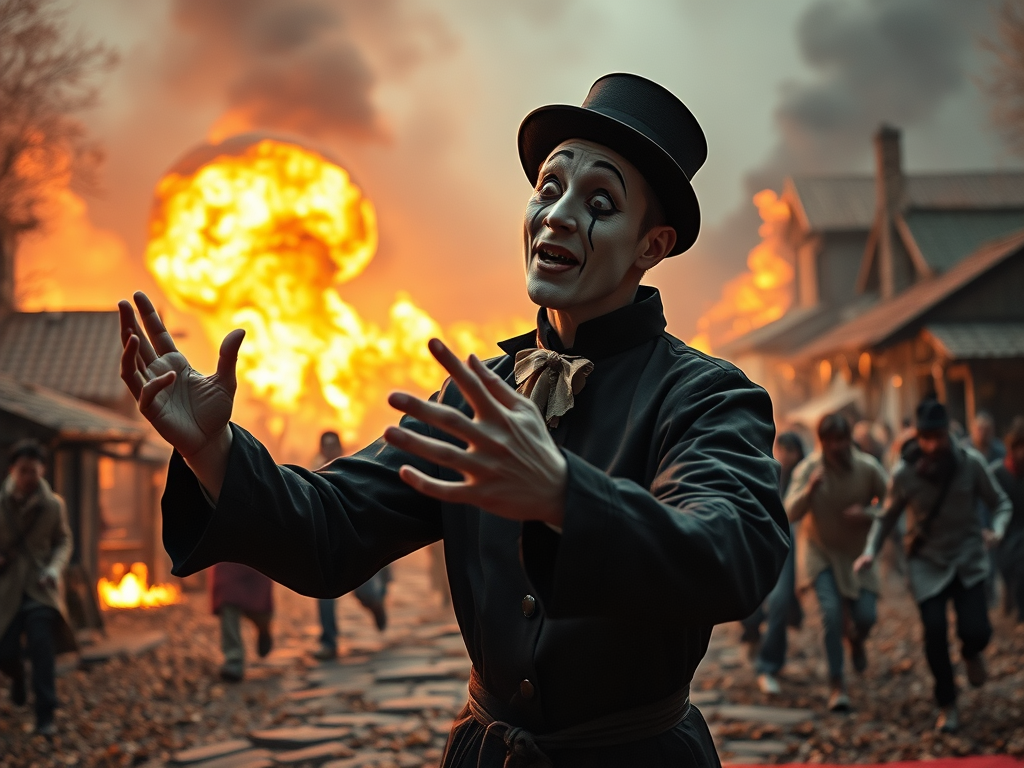
Around mid-morning, a stranger arrived unnoticed. He wore white face makeup, dark eyeliner exaggerated his eyes, and he was dressed in black from head to toe—a mime. He began to stroll through the crowds, weaving silently between booths, gesturing at onlookers with animated movements.

Some of the festival-goers found him delightful, clapping at his pantomimed pretend walls and invisible ropes. He plucked an imaginary flower and offered it to a giggling child. But others felt something…off about him. Perhaps it was the way he never broke character, not even to smile or to nod. Or maybe it was the shifting shadow at his feet that seemed a touch too dark, as though the sun couldn’t touch it.

By afternoon, the mime had set up an impromptu performance circle near the center of town. Families paused on hay bales to watch. The mime mimed the act of juggling, yet no one could see what he might be tossing in the air. Children clapped anyway, cheering him on. Then he tipped an imaginary hat and started “pulling” something out of it.

That was when the first strange thing happened.

The light in the square seemed to flicker, as if clouds had suddenly drifted across the sun—yet the sky remained free of any. The wind stilled; no more pleasant breeze teased the flags and ribbons. A hush spread across the festival as the mime continued to pull and pull from his invisible hat. Slowly, a shimmer appeared in the air, like heat waves rising off asphalt. People pressed closer, uncertain if it was some clever trick.

Then, with a silent snap, a shape formed in midair—a grotesque, quivering thing covered in ropy, black tendrils. It hovered before the mime as though he were holding it by a leash. A collective gasp rippled through the crowd. The mime stared at his conjuration, moving his gloved hands with expert precision, guiding it. The shape pulsed once, twice, and then slithered across the dusty pavement before vanishing into the shadows beneath a booth.

Parents snatched their children away, hugging them close. The festival’s host, Mayor Rosalee Hightower, rushed to the scene, demanding an explanation. But the mime said nothing. His chalk-white face remained impassive, eyes flitting from person to person as though searching for his next target.

Almost at once, the feeling in Hickory Glen curdled. The sweet smell of caramel apples turned sour in the nose. Far across the green, a bleat of terror rose from the livestock pen. People ran to investigate, only to find the animals huddled and shaking. One of the prized goats was missing—just gone without a trace. A thick patch of black ichor stained the ground where it had stood.

Meanwhile, the mime pressed on. He performed a silent routine of “feeding” an invisible something in front of him. Though no one could see the shape, they sensed its presence—a malignant energy that made their skin crawl. The shadows around him lengthened in impossible ways. A second later, a thunderous crack echoed overhead, though the sky remained rainless.

Panic seeped through the crowd. The once-bustling festival grew quieter as people backed away. Some tried to run for their cars, only to find the road barricaded by twisted illusions: towering figures that flickered into existence, shifting between solid and spectral. They loomed over the escaping townsfolk, forcing them back.

A desperate hush fell. Mayor Hightower ordered the local deputies to intervene. They approached the mime cautiously, guns drawn. He stared them down with a look of eerie calm. With one graceful gesture—hands miming the shape of a box—he trapped them behind invisible walls. Their frantic cries were muted, as though they stood behind thick, soundproof glass.

By now, the most elderly residents were whispering old folktales about a creeping evil that once haunted Hickory Glen long before it was settled. They spoke of a traveling performer who had, according to legend, bargained with dark entities in forgotten woods. Though none had believed the stories for generations, it all felt too real now.

As sunset approached, the festival lights flickered on. The swirl of color and warmth did nothing to dispel the suffocating fear. The mime took center stage once more, his gloved hands raised to the bruised-purple sky. With each measured movement, the rifts of shimmering air tore open around the square. Something like diseased roots or ancient tentacles pressed against the edges of reality, threatening to break through in multiple places at once.

Children screamed and clung to their parents. Strong farmers who’d once wrestled livestock into pens turned pale and helpless. The top prize for the largest pumpkin sat, still unclaimed, next to a half-finished pie contest. In the distance, a church bell began tolling on its own, each peal more ominous than the last.

And the mime was smiling now—barely, but definitely smiling. A faint curve of the lips painted in stark white. In that moment, the townsfolk realized this wasn’t an act. Something unfathomable had chosen their celebration as a gateway.

An unspoken question gnawed at every survivor watching: could this horror be stopped, or was Hickory Glen doomed to become a silent, abandoned ruin beneath an ancient darkness?

No one dared breathe too loudly as the mime continued his performance, weaving illusions into life, each one more terrifying than the last. What had begun as a day of pride and joy—bounty from the land—had become a nightmare beyond mortal comprehension. The mime’s white face caught the glow of lanterns, and in his eyes, there was a silent promise that the worst was yet to come.

©2025 Rhyan Scorpio-Rhys

All The World Will Be Your Enemy 15: Viral Sensation

It started with a single post on social media, a blurry photo taken by a hospital worker who had caught a glimpse of Beverly through the window of her quarantine room. Within hours, the image had spread like wildfire, shared and reposted across every platform and news outlet.

At first, many people dismissed it as a hoax, a cleverly photoshopped prank designed to go viral. But as more details began to emerge, as leaked medical reports and eyewitness accounts hit the web, it became clear that something extraordinary was happening at the hospital.

Soon, the media descended en masse, setting up camp outside the hospital’s doors and clamoring for access. Reporters from every major news network and publication jockeyed for position, each one desperate to be the first to break the story of the century.

Inside the hospital, the atmosphere was one of barely controlled chaos. Security was immediately stepped up, with armed guards posted at every entrance and checkpoint. Doctors and nurses were given strict gag orders, threatened with termination and legal action if they spoke to the press.

But even the tightest security measures couldn’t stop the flow of information. Grainy photos and shaky video clips of Beverly continued to leak out, each one more shocking and disturbing than the last. Social media exploded with speculation and debate, with millions of people around the world obsessing over every new detail and development.

Some claimed that Beverly was the victim of a rare genetic disorder, a one-in-a-billion mutation that had caused her body to transform in ways never before seen. Others insisted that she was the result of a top-secret government experiment, a bio-engineered weapon or a test subject for alien technology.

Conspiracy theories ran rampant, with online forums and chat rooms buzzing with wild speculation and outlandish claims. Some even suggested that Beverly was a hoax after all, a masterful publicity stunt orchestrated by the hospital or some shadowy organization.

Through it all, Beverly remained locked away in her quarantine room, oblivious to the media circus that had erupted around her. She drifted in and out of consciousness, her mind and body ravaged by the relentless progression of her condition.

But even in her isolation, she could sense the growing frenzy outside, the weight of a million eyes and voices all fixated on her. It was a pressure that threatened to crush her, a fame that she had never sought and never wanted.

As the days wore on and the media’s appetite for her story only grew, the hospital was forced to take even more drastic measures. A wall of silence descended around Beverly’s case, with all information tightly controlled and rationed.

Press conferences were held, but they were brief and carefully choreographed, with doctors and officials reading from prepared statements and deflecting all questions. Interviews were granted, but only to a handpicked few, and always under the strictest conditions of secrecy and security.

But even as the hospital tried to maintain control, the speculation and rumors only intensified. Beverly’s name became a household word, her face a symbol of the strange and the unknown. She was the subject of countless memes and hashtags, the inspiration for art and music and endless online debate.

And through it all, Beverly could only watch from the sidelines, a helpless spectator to her own media circus. She knew that her story had taken on a life of its own, that she had become something more than human in the eyes of the world.

Not. The. End.

The Return of Philly Fuego

Miles Modesto stepped into the old warehouse at the edge of town, the scent of motor oil and damp wood clinging to the air. He adjusted his Italian suit, exuding the effortless confidence of a man who had left his past behind.

A past that stood waiting for him in the dim light.

Philly Fuego emerged from the shadows, his expression unreadable. “Been a while, partner.”

Miles stopped short, his breath hitching for just a second before he regained his composure. “I thought you were gonna die in that cell.”

Fuego chuckled, but there was no warmth in it. “Guess I was too stubborn for that. Got out early—turns out, good behavior has its perks.”

Miles forced a smile. “You always were good at playing the angles.”

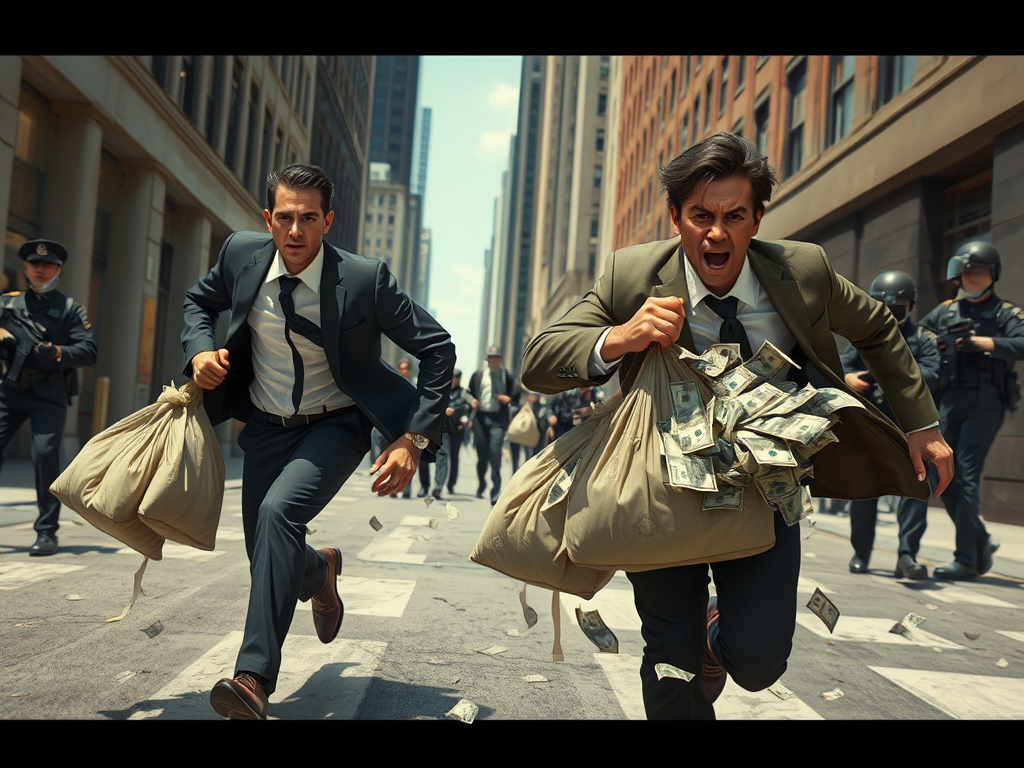
“Not as good as you,” Fuego said, stepping closer. “Five years, Miles. Five years inside, while you were out here getting rich off what we stole. Now, I’m here for my share.”

Miles exhaled slowly. “The money’s gone.”

Fuego’s eyes darkened. “Try again.”

“It’s not a lie,” Miles said. “I had to move fast—cops were sniffing around, the heat was on me. I funneled it all into the business. There’s no stash, no hidden vault.”

Fuego clenched his jaw, his fingers curling into fists. “And yet, you’re standing here in a ten-thousand-dollar suit, living in a villa outside the city while I was eating slop off a metal tray.”

“You think it was easy for me?” Miles snapped. “I spent five years waiting for the knock on my door. Every time I saw a cop in my rearview, I thought it was over. I didn’t abandon you, Fuego—I survived.”

“Yeah?” Fuego’s voice was razor-sharp. “Well, now it’s my turn.”

Miles studied him for a long moment. “I don’t have cash to give you. But I do have a job.”

Fuego scoffed. “A job?”

“Modesto Import & Export,” Miles said. “You start in the warehouse. Work your way up. You’ll make money. Legitimately. No more running, no more hiding.”

Fuego stared at him, trying to gauge whether this was an insult or an olive branch.

“You owe me,” he said finally.

“This is how I pay you back,” Miles replied.

Fuego’s lips pressed into a thin line. “I’ll think about it.”

But he already knew his answer. He wasn’t here for redemption. He was here to take back what was his.


Miles’s villa was nothing like the life they had once dreamed of. Behind wrought-iron gates and walls of climbing bougainvillea, he had built something untouchable.

It should have enraged Fuego. It should have fueled his hunger for revenge.

But then he saw her.

Piña Modesto wasn’t a child anymore. The last time Fuego had seen her, she’d been a shy teenager, tucked behind Miles’s protective arm. Now, she was twenty-two, with dark, expressive eyes and a sharp wit that cut through any pretense. She carried herself with the quiet confidence of someone who had always been underestimated.

And she noticed Fuego long before he ever spoke to her.

The first time was at the warehouse. She was sorting paperwork in the office when she looked up and caught him staring.

“You’re Philly Fuego,” she said. Not a question.

Fuego leaned on the doorframe. “And you’re Miles’s stepdaughter.”

She smirked. “He told me you were dead.”

“Sometimes, I think I was,” he admitted.

She studied him. “Why are you here?”

Fuego hesitated. For revenge? For money? Or for something else?

“Still trying to decide that,” he said instead.


At first, it was small things—glances held a second too long, conversations that dipped into dangerous territory. Piña was clever, sharp, and relentless. She wanted to know everything about him.

“Did you really rob a bank?” she asked one night, leaning on a stack of shipping crates.

“Yeah.”

“And Miles just…got away?”

Fuego gave a humorless laugh. “That’s about the size of it.”

“Did you ever think he set you up?”

Fuego froze.

Because the thought had gnawed at him for years. But hearing it from Piña, spoken so casually, sent a shiver down his spine.

And then there was the night she touched his hand—just a brief, fleeting thing—but enough to make Fuego feel like the world had tilted beneath his feet.

“This isn’t a smart thing to do,” he muttered. “You play with fire, you’re bound to get burned.”

“Maybe,” Piña whispered. “But what if I don’t care?”


Miles noticed. Of course, he did.

The moment he saw Piña looking at Fuego the way she used to look at him for approval, he knew.

“He’s using you,” Miles told her, voice tight with barely contained rage. “to get back at me.”

“Like you used him,” she shot back. “to get rich?”

Miles went still.

And that was the moment he knew he had lost her.


Fuego was waiting in the courtyard, his worldly possessions stuffed into the rucksack slung over his shoulder, when he heard the footsteps.

But it wasn’t Piña.

Miles Modesto stepped out of the shadows, his Wilson Combat SFX9 drawn.

“You think you can just waltz back into my life, steal my stepdaughter like some petty crook, and I’m going to let you get away Scot-free?” Miles’s voice was thick with fury.

Fuego didn’t flinch. “It ain’t stealing ’cause you don’t own her…and she wants to come with me.”

Miles exhaled slowly. “And you expect me to believe that you want her?”

Fuego hesitated.

“I do. More that anything I’ve ever wanted.”

Miles nodded. “Well, here’s where you earn it.”

Fuego barely had time to react before Miles raised the 9mm Luger.

Crack.

The first shot rang out across the courtyard.

A heartbeat later—the second.

Neither hit their mark.

Blood bloomed.

Across Piña’s dress.

She hadn’t meant to step between them. Just as she hadn’t meant to come between her stepfather and his former partner.

Miles’s gun trembled in his grip, his face drained of color. “Piña—”

She collapsed.

Fuego caught her, lowering her gently, hands pressing against the wound.

“Why?” he whispered.

Piña’s breath came in shallow gasps. She tried to smile.

“Because I love you.”

Miles staggered back. His daughter—his one remaining connection to something pure—was slipping away.

Fuego lifted her, his voice breaking. “Get help!”

Miles didn’t move. He just watched. Because, for the first time, he understood: for him, this wasn’t about revenge. It wasn’t even about the money. It was about being chosen, about who was more important.

And Piña had made her choice.

The sirens wailed in the distance.

Fuego didn’t know if she would make it. But as he looked into her eyes, filled with pain but still burning with fire, he knew one thing. For the first time in his life, he had something worth running toward. And he wasn’t going to lose her.

Not now. Not ever.

©2025 Rhyan Scorpio-Rhys

Author’s Note: Yeah, okay, it’s corny, I know. But sometimes you just have to get a little corniness out of your system.

All The World Will Be Your Enemy 14: Uncharted Territory

Beverly drifted in and out of consciousness as the ambulance raced through the city streets, sirens blaring. The EMTs hovered over her, their faces obscured by masks and protective gear, their voices muffled and distant. She caught snippets of their conversation, words like “unknown pathogen” and “biosafety level 4” that sent chills down her spine.

When they arrived at the hospital, Beverly was immediately whisked away to a secure wing, far from the bustle of the main floors. She was placed in a sealed room, its walls lined with plastic sheeting and its air filled with the hum of negative pressure ventilation.

For hours, she lay there, barely aware of her surroundings, as a parade of doctors and specialists filed in and out. They took endless samples – blood, skin, saliva, even spinal fluid – and subjected her to a battery of tests and scans. All the while, they spoke in hushed, urgent tones, their expressions ranging from fascination to outright fear.

Beverly caught glimpses of herself in the reflections of their face shields, and each time, she had to stifle a scream. Her body was almost unrecognizable now, a twisted mass of writhing tentacles and mottled, pulsating flesh. The sight filled her with a horror so profound it bordered on madness.

As the days stretched into weeks, Beverly became a fixture of the hospital’s research wing. Teams of specialists from around the world were brought in to study her case, each one more baffled than the last. Geneticists sequenced her DNA, looking for mutations or anomalies that could explain her transformation. Dermatologists examined her skin, marveling at its strange texture and properties. Infectious disease experts tested her for every known pathogen, but found nothing.

Through it all, Beverly remained in a state of numb detachment, her mind retreating deeper and deeper into itself. She spoke little, ate only when prompted, and spent most of her time staring blankly at the ceiling, lost in a haze of drugs and despair.

The doctors tried everything they could think of to halt or reverse her condition. They pumped her full of antibiotics, antivirals, and experimental drugs. They subjected her to radiation and chemotherapy, hoping to kill off the aberrant cells that were taking over her body. But nothing seemed to make a difference.

As the weeks turned into months, the initial fervor surrounding Beverly’s case began to fade. The specialists drifted away, moving on to other projects and priorities. The hospital staff grew accustomed to her presence, no longer whispering or staring when they entered her room.

But for Beverly, the nightmare never ended. Each day brought new horrors, new reminders of the creature she had become. She watched in mute anguish as her body continued to change and warp, her humanity slipping away piece by piece.

And through it all, one thought haunted her, circling endlessly in her mind. What if this was only the beginning? What if her transformation was not an end, but a prelude to something even more terrifying and unknown?

In her darkest moments, Beverly found herself longing for death, for an end to the suffering and the fear. But even that seemed like a distant dream now, an escape that was forever beyond her reach.

For she knew, with a certainty that chilled her to the bone, that whatever she was becoming, it would not let her go so easily. She was being remade, forged in the crucible of her own flesh, for a purpose she could not yet comprehend.

And as the doctors and researchers continued to pore over her case, searching in vain for answers, Beverly could only lie there, a prisoner in her own body, and wait for the next phase of her transformation to begin.

Not. The. End.

Two Blokes Named Noakes

This piece started out as a casual, one-off blog post—like so many of my bite-sized stories—but it refused to stay small. I thought we could compromise on a short story, while it insisted on becoming a novel. After hours of spirited negotiation, we struck a deal and settled on a novella. If you’re curious, you can find it here: https://amzn.to/40o2hJv. This draft was the seed; the final version in the novella is this scene cranked up to eleven.

The pub didn’t have a name. Its sign was blank, the wooden board swinging creakily above the cobblestone street as though it had forgotten what it was supposed to say. Noakes—the first one—paused in front of the door, hesitating. He checked his watch.

“3:03 p.m.” He muttered. A lucky time.

The second Noakes bumped into him from behind. “Well, are we going in or not? I’m parched.”

Noakes—the first—turned, raising an eyebrow at the uncanny resemblance. The man behind him looked exactly like him, down to the scratch on his chin and the threadbare scarf around his neck.

“I… sorry, but who are you?”

“Isn’t it obvious? I’m Noakes,” the second man said casually. “Same as you, mate.” He stepped past and pushed open the door, the scent of old wood and stale beer wafting out. “Coming or not?”

Noakes—the first—followed, his curiosity outweighing his unease.

Inside, the barroom stretched impossibly far. Rows of tables lined with flickering candles seemed to fade into the distance, disappearing into a haze of smoke and dim light. The air buzzed faintly, a low hum that seemed to resonate in the bones.

“Two pints,” Noakes—the second—said to the barkeep, who had already turned around and started pouring before the words were fully out.

The barkeep was a wiry, ageless man with one eye larger than the other, giving him a permanently surprised expression. He slid the pints over without a word.

“Cheers,” Noakes—the first—muttered, raising his glass. They clinked, the sound strangely hollow, as though the pint glasses were made of something other than glass.

The first sip hit like a hammer. Noakes—the first—gasped as his vision blurred. The bar around him expanded outward in a kaleidoscope of colors, the tables multiplying into endless rows, the hum rising to a deafening crescendo before settling back into its low buzz.

“What the hell?” he croaked.

Noakes—the second—grinned. “Yeah, it does that.” He leaned in, lowering his voice. “You notice anything… different yet?”

Noakes—the first—looked down. His hands were trembling slightly, but that wasn’t unusual after a strong drink. The barroom, however, had changed. Where before there had been a handful of patrons—a hunched man in a flat cap, a woman nursing a martini in the corner—there were now dozens of figures, all identical to himself. Each sat at their own table, some deep in conversation, others staring blankly at the flickering candles.

“What the…”

“They’re all Noakes,” the second Noakes said. “Just like you. Just like me.”

“How?”

The second Noakes shrugged. “You’ll figure it out. Or maybe you won’t. Either way, have another drink.”

The barkeep set another pint in front of him without being asked.

“I don’t want another drink,” Noakes—the first—said, his voice shaking.

The second Noakes laughed, a hollow, echoing sound. “Yeah, that’s what we all say at first. But you will. You always do.”

He drained his glass and stood. “See you around, mate. Or maybe I won’t.” And with that, he vanished into the endless rows of tables, leaving Noakes—the first—alone with the hum, the candlelight, and the reflection of his own face staring back at him from every corner of the bar.

The barkeep smiled. “Another?”

Where does Noakes’s story go from here? The expanded version is available here.