
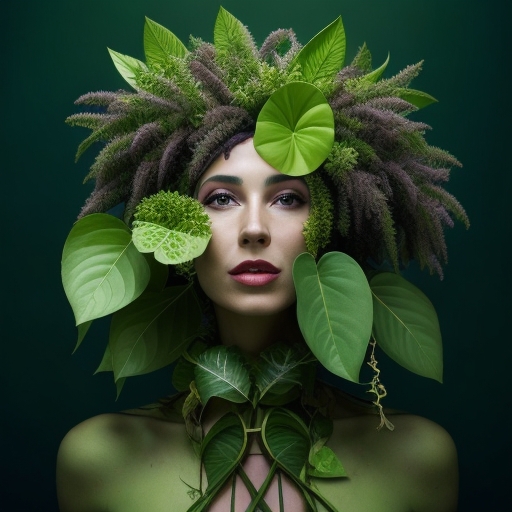
Azalea Vale was a sleepy town where magic was considered nothing more than children’s tales, which made Hortensia an enigma. Gifted—or perhaps cursed—with the ability to manifest emotions as flowers sprouting from her chest, she was a living, breathing spectacle. This gift was a legacy from her grandmother, a mysterious figure whispered to have been a sorceress.
One fateful morning, a bud, tender and green, burst forth from Hortensia’s chest. As the sun spilled its golden rays into her room, the bud unfurled into a vibrant, multi-hued flower. It was as if her very soul had blossomed.
News of this marvel rippled through Azalea Vale and beyond, turning Hortensia’s secluded home into a sanctuary for the emotionally bereft, the spiritually curious, and even the skeptically intrigued. Scientists, scholars, and common folk alike were captivated by the fiery roses of love, tranquil bluebells of peace, and radiant sunflowers of joy that adorned her.
Yet, this newfound attention wasn’t without its perils. A charismatic but unscrupulous academic, Dr. Alistair, saw potential for exploitation. “Imagine harnessing this emotional energy for scientific breakthroughs,” he whispered into the ears of the town council.
Hortensia found herself at a crossroads. “To share or not to share, that’s the question,” she mused, recalling a line from a play she had once loved.
Guided by an inner symphony of empathy, Hortensia made her decision. She would open her doors to the world, turning her home into an empathic haven. “Welcome to my emotional garden,” she announced, her words a harmonious melody that invited one and all.
For a while, it was a dreamscape. Visitors were bathed in the intoxicating aroma of blossoms, each petal a tangible whisper of shared human emotions. But soon, the garden began to wither. The once distinct and vibrant petals blurred into a murky mess, suffocated by the overwhelming emotional cacophony brought in by the throng of visitors.
Realizing the impending catastrophe, Hortensia sought wisdom from ancient scrolls her grandmother had left her and consulted wise hermits who lived on the outskirts of Azalea Vale. Through her relentless search, she discovered an ancient technique to balance the emotional energies within her.
Armed with newfound wisdom, Hortensia returned home. With utmost care, she plucked each flower, whispering words of acknowledgment to the emotion it represented. She then rearranged them into thematic alcoves in her home, where each emotion could sing its own tune without overwhelming the others.
When Dr. Alistair attempted to seize this moment for his own gain, he found himself thwarted by the town council, who had been moved by the new harmony in Hortensia’s garden. “This is a sanctuary, not a laboratory,” they declared.
Visitors now experienced a carefully orchestrated symphony of emotions. Each alcove became a pilgrimage point, encouraging contemplation and emotional growth. People left the sanctuary with seeds of empathy planted within them, their lives forever enriched.
Hortensia’s garden transformed from a mere spectacle to a guiding light in the quest for emotional understanding. It stood as a living testament to the resilient power of compassion and the captivating beauty of human emotions.
In Azalea Vale and far beyond, the tale of “Harmony’s Bloom” resonated as a timeless parable. It was a testament to our shared emotional landscape, a gentle reminder of the wondrous gardens that could grow within us when watered with empathy and love.
 MADD FICTIONAL
Great story.
LikeLiked by 1 person
Thank you. Much appreciated.
LikeLiked by 1 person
Pingback: The Week in Review – Iris Carden, Author