Every Villain is a Hero

“Every villain is a hero in his or her own mind.” – Allison Brennan

What suits a hero best? That which opposes them. Despite the fact your protagonist is an expert in whatever field applies to your story, the very best at what they do, they’re only really as strong as their antagonist.  And how do you create a strong antagonist? By not treating them like a mustache-twirling villain.

While your shouldn’t limit yourself to the suggestions below, here are the most common antagonist archetypes writers tend to use for ideas and inspiration:

The Immoral Antagonist

Easily the most popular form of antagonist–the person your audience will have no trouble hating. They’re usually set in clear contrast against the hero. The lines are drawn in varying shades of black and white, and readers have no problem choosing whom to root for.

1. The Hypocrite is an antagonist who feigns goodness. They may be guilty of all sorts of treachery and evil, but on the surface they’re all sweetness and light. They put a righteous face on their misdeeds–perhaps even accusing the protagonist of hypocrisy to disguise their own–but the audience knows the truth: this person isn’t just bad, they’re a fraud, which makes them all the more hateable.

2. The Psycho is simply evil through and through. No excuses, no thread of goodness leading them back to redemption. They’re rotten to the core… and crazy to boot. Serial killers, genocidal world leaders, and sadists fit the bill and if you do your job properly, your audience will not only hate the psycho, but fear them as well.

3. The Regular Person Forced to Do Bad Things for an Illegitimate Reason who has let their weaknesses get the better of them. Lust, greed, and hatred can drive even ordinary people to do extraordinary evil.

The Moral Antagonist

In the moral antagonist we find a more complicated—and often more compelling—character, since they presents more parallels than contrasts with the protagonist. This is a person who is doing the right thing—as they see it—and usually for the right reasons, but who has nonetheless been forced to do battle with the hero, thanks to the requirements of your story’s overall conflict.

1. The Good Guy on the Opposing Side is usually present in stories where the conflict is between good people with opposing views who appear on both sides of the battle lines. Lawyers fighting each other for causes in which they each believe passionately, football teams competing for a championship, two love interests trying to win the same girl—none of them have to be inherently bad. Stories of this nature can provide all kinds of interesting possibilities for exploring the grey areas of life, relationships, and morality.

2. The Crusader can be insanely scary in their own right, someone who fiercely believes they’re doing the right thing, and indeed may well be fighting for a good cause. They may be someone who believes they’ve to choose between the lesser of two evils in their decisions. Or they may be someone driven to fanaticism—and thus dangerous decisions—by their passion for the cause. In fact, they may be just plain out right, while the protagonist is the one who’s wrong.

3. The Regular Person Forced to Do Bad Things for a Legitimate Reason because they feel they have no choice. A character who robs a bank to pay for their family member’s operation or to save themselves from the Mafia’s threats may be a hero in their own right—or they may be a compelling and relatable antagonist to the detective protagonist who has to go after them.

So, what are you waiting for? Walk a mile in your antagonist’s shoes, see the world from their point of view, empathize with their plight, understand the justifications for their actions. In other words, treat them with the same love and respect you do your hero for they’re equally as important to the overall success of your story.

Sally forth and be writeful.

It Ain’t Impossible Once Somebody Gets It Done


“To believe a thing impossible is to make it so.” – French Proverb

Everyone talks about the writer’s toolkit and all the utensils it should contain, but writers also need to have a storehouse equipped with a shelf that holds just one thing:

The belief that anything is possible.

I’m sure you’ve already sussed that if someone has done a thing, you can do it, too, once you’ve set your mind to it. But have you ever stopped to consider that even if no one has done this writing task that’s swimming around in your brain, you still can do it? All you need to do is cut out the middleman. You really don’t need anyone else to prove that your project is possible. You can just go on out there and do it for yourself.

Don’t worry, I’m not gonna sell you a load of universal law bollocks like “everything in life is possible because you’ve been gifted with all the necessary tools, skills, drive and connections you need to make it happen.” If your aim is to do the impossible, you’re gonna have to work at it. Hard. That’s a fact.

Now, you’re no doubt saying. “Okay, I get that it takes drive, dedication, passion and the right mindset, but let’s get to the meat of the nutshell. Just how do I do the impossible?”

I’m glad you asked.

1. Find the cost of your impossible. You know very well I’m not talking about money (cross that financial bridge when you come to it). Failure is the coin of the realm if you don’t reach your seemingly impossible goal, and you pay by taking in the pitying glances from the mundanes that use you as an example of why the impossible must never be strived for. You pay by watching your dreams burn to ash before being scattered by the winds of harsh reality. You pay by having your creative center scooped out of you with a melon baller.

Those, of course, are simply my silly examples. As stated previously, very few things in this world are impossible. Most times the price is just too high. You need to take a moment and truthfully examine what the personal costs to you will be (time, relationships with friends, family, etc.) and if you’ll make the commitment to remit payment should the ferryman demand a toll for crossing impossible waters.

2. Take baby steps towards the impossible. Once you’ve zeroed in on that impossible writing endeavor, start small. Slip on your water wings, dip your big toe in the shallow end of the pool and learn the basics. The impossible isn’t one gigantic thing, it’s a series of things that increase in difficulty or complexity. Splash around in the kiddie end of the pool and get yourself acclimated to the waters before you decide to breaststroke your way into the deep end.

3. Handcuff yourself to inspiration. Some people create a vision board with images, inspirational sayings, and the like. I know, these got a bad rap after Rhonda Byrnes’ book, The Secret, came under critical fire, but having a visual reminder of your ultimate goal is akin to keeping your eyes on the prize.

Others surround themselves with likeminded people or people who have achieved some level of success in the same or similar fields. Buddy up to them, pick their brains—politely and tactfully, of course—and find out what motivated them. Learning from someone else’s experiences, though your own will undoubtedly be completely different, can help you avoid potential pitfalls up ahead.

4. Stop gabbing about it and start doing it. It’s great having a goal to achieve and having done all your knowledge-gathering groundwork and psyching yourself up to the point where you become a one person cheerleading squad, but a lot of people get stuck in that complacency gap between research and action. You’ll know you’re there, if you talk about conquering your impossible task more than you’re acting on conquering your impossible task.

Making it happen is the point where your inspiration gets put to the test because it’s where you’ll begin running into obstacles and roadblocks, where excuses for why you can’t take action start springing up like daisies.

The workaround? Micro-goals. Remember when we talked about baby steps? Get used to them because you’ll be taking a lot of them. Inch by inch, everything’s a cinch. Set daily tasks, give yourself deadlines and milestones and keep in mind that you will have bad days, encounter setbacks, and misstep along the way. It’s all part of the process when conquering the impossible.

And get out of the habit of beating yourself up if things don’t go your way. Things will change as you begin to work towards something new, but the great thing is, your plans are not set in stone. If something doesn’t work, switch things up until it does. You’re a shark from this point on, always moving forward.

5. Celebrate the completion of micro-goals. Why shouldn’t you? You’ve just taken a chunk out of the impossible. You’ve pressed your nose to the grindstone, torn down mental barriers, plotted courses around obstacles. Take a moment to pat yourself on the back.

6. Do it again with the next plateau. Don’t get too full of yourself, you’ve still got a ways to go. The good news is, you now know the impossible is possible. Go get ’em, tiger!

Sally forth and be writeful.

The One Sentence You Should Get Used to When First Starting Out

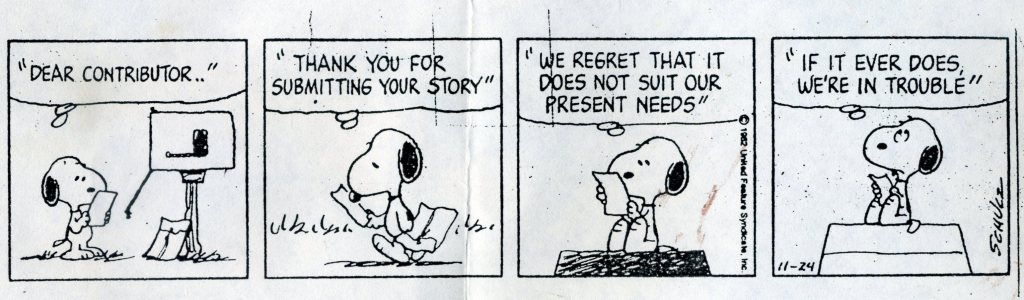
You’ve done your research, worked your mental fingers to the bone, and devoted all your time, energy and attention to detail into nailing the anatomy, structure and formatting of your very first short story/novel/poetry piece/article/screenplay, before sending it out for mass consumption.

And you wait, and wait, and wait, and wait for a response. When it finally arrives, your eyes will skim over the body of the letter and lock in on one sentence:

“After reviewing your work, we’ve decided that it isn’t a good fit for us and we’re going to have to pass.”

Don’t let that sentence shake you. Very rarely is a writer’s first written work good enough to be marketable. It takes experience to craft a truly sellable piece, experience you’ll earn by pressing on. This written piece leads to a second and a third and eventually you’ll find an editor, publisher or what have you that believes in your potential.

Write until you get it right.

Sally forth and be writeful.

— Rhyan Scorpio-Rhys

Writing Joke of the Day: How to Write Good (Extended Version)

https://i0.wp.com/lolsnaps.com/upload_pic/ImportantWritingTips-24246.jpeg

1. Avoid alliteration. Always.

2. Never use a long word when a diminutive one will do.

3. Employ the vernacular.

4. Eschew ampersands & abbreviations, etc.

5. Parenthetical remarks (however relevant) are unnecessary.

6. Remember to never split an infinitive.

7. Contractions aren’t necessary.

8. Foreign words and phrases are not apropos.

9. One should never generalize.

10. Eliminate quotations. As Ralph Waldo Emerson said, “I hate quotations. Tell me what you know.”

11. Comparisons are as bad as cliches.

12. Don’t be redundant; don’t use more words than necessary; it’s highly superfluous.

13. Be more or less specific.

14. Understatement is always best.

15. One-word sentences? Eliminate.

16. Analogies in writing are like feathers on a snake.

17. The passive voice is to be avoided.

18. Go around the barn at high noon to avoid colloquialisms.

19. Even if a mixed metaphor sings, it should be derailed.

20. Who needs rhetorical questions?

21. Exaggeration is a billion times worse than understatement.

22. Don’t never use a double negation.

23. capitalize every sentence and remember always end it with point

24. Do not put statements in the negative form.

25. Verbs have to agree with their subjects.

26. Proofread carefully to see if you words out.

27. If you reread your work, you can find on rereading a great deal of repetition can be avoided by rereading and editing.

28. A writer must not shift your point of view.

29. And don’t start a sentence with a conjunction. (Remember, too, a preposition is a terrible word to end a sentence with.)

30. Don’t overuse exclamation marks!!

31. Place pronouns as close as possible, especially in long sentences, as of 10 or more words, to the irantecedents.

32. Writing carefully, dangling participles must be avoided.

33. If any word is improper at the end of a sentence, a linking verb is.

34. Take the bull by the hand and avoid mixing metaphors.

35. Avoid trendy locutions that sound flaky.

36. Everyone should be careful to use a singular pronoun with singular nouns in their writing.

37. Always pick on the correct idiom.

38. The adverb always follows the verb.

39. Last but not least, avoid cliches like the plague; They’re old hat; seek viable alternatives.

The Opinions Expressed Do Not Necessarily Reflect blah-blah-blah…

The internet is filled with writers who either write for attention, because they’re bored, to fit in, to crack wise, to ruin people’s day, to make connections, to share experiences, etc. These are generally people who write because they can. Nothing wrong with that, but I’m not addressing those writers today.

I’d like to take a moment to turn the spotlight on the people who write because they have to. People with voices that won’t be silenced. Those invisible few who write to be seen. To whom candid writing is a necessity in order to make their message more relatable, significant, profound, and enduring.

I have a friend, well, that’s a bit of a stretch—that term is so inappropriately applied these days—more like an online acquaintance that I’m on friendly terms with (at present), whom I admire, even though I don’t always agree with their views or the appropriateness and timing in which they’re injected into a conversation.* But I respect the hell out of the person because they aren’t afraid of not being liked.

Different from finding your voice–I’ll address that in a future post–not being afraid to express an honest, unfavorable opinion for fear of losing fans or raising the ire of the audience is not only an admirable trait but also a fundamental step toward becoming a better writer.

It’s essential to develop the ability to say something important without getting hung up on the word important. There are those who put forward the challenge to only write what’s missing in the world. It’s a nice sentiment but the knowledge of what’s missing from the world is already out there and has probably, with all due respect, been written by someone more intelligent and eloquent than yourself. What’s missing from the world is the people’s willingness to put worldwide love, caring, peace and understanding into action, despite your personal views or belief system. There is obviously nothing wrong with writing about this… just as there’s nothing wrong with writing about what feels important to you.

So, what separates the “because I can” and “because I must” writers? The musters have generally identified and clarified their unique worldview. The keyword in the sentence is unique. Every writer has a worldview, even if they aren’t consciously aware of it, often adopted from one particular media source or a friend or relative. That’s a great starting point, but to be an authentic writer you need to know what you believe. What are your values? What do you stand for? How do you interpret life? Be aware that as you grow, your worldview will shift and your writing will become more candid.

Musters also strive to be clear and accurate in their writing as their goal is to reveal the truth.  They tend to be selective with words because they appreciate the potential words have to create images that makes their audience feel something profound and enduring.

In summary, write candidly, speak your mind. Say something important. If someone isn’t going to like you because of your opinion, let them dislike the real you. Better that than currying favor with folks who only like you for who you pretend to be, in my far-from-humble opinion.

But what do I know? I just write a blog.

Sally forth and be writeful.

*If we have an online relationship and you think this post is about you, you’re not vain at all, in fact, you’re probably right. Doesn’t mean I don’t have mad love for ya, kiddo.

Fending Off Them Pesky Writing Demons

photo-11

In a previous post I mentioned keeping the demons at bay and decided today I’d explore that in slightly more detail because there will be days, despite all the brilliant advice you’ve collected up to this point and your very best intentions, when you will not be able to write a single word. I just need you to realize:

You. Are. Not. Alone. In. This.

Every writer falls victim to these pesky writing demons at some point, but what marks your ability as a serious writer is how you rise to the challenge and get your writing back on track, secure in the knowledge that you have the power to keep the negative mental beasties at bay. As always, I offer a few tips for you to stuff inside your writing rucksack for a rainy day:

  1. When you pluck an idea from the ether, jot it down immediately. Ideas arrive without warning and evaporate from your mind like a dream upon waking. When you’re hit with an idea, you’re always sure you’ll remember it. Foolish mortal. How many story ideas have you lost relying solely on your overtaxed memory? When an idea hits, take a moment to put it in writing–we tend to remember things we physically write down–or carry around a digital voice recorder or use that recording app on your smartphone that you forgot you have.
  2. Don’t start on a blank page. La página en blanco. La page vierge. Die leere seite. La malplenan paĝon. Den tomma sidan.Built entirely of writers blocks, the blank page is the fire in which writers burn. The abyss that stares back and makes us overthink committing words to the page. The way to combat it? Don’t start with a blank page. Put something at the top of the page. Anything. A random sentence, the story’s mission statement, or ask a question. Better yet, have a character ask a question and then set out to answer it. Whatever you put there isn’t set in stone and can be altered or eliminated entirely once you work out what you truly want to write.
  3. You don’t always have to begin at the beginning. Sometimes you’re hit with a juicy dialogue exchange, or a powerful scene, or an intense interaction… but it belongs somewhere in the middle of a story that you haven’t quite sussed out yet. That’s all right. Take what you have and get it down on paper without worrying about the order in which scenes are written. Once you have that, you can begin fleshing out other connecting scenes and when your basic draft is done, you can go back, reshuffle the order and polish it.
  4. Stop waiting for the perfect word. When you sit down to write, write. Flipping through your mental thesaurus is not part of the creative process of capturing your ethereal ideas and solidifying them on the page. Keep writing. Don’t let anything take you away from the act of committing words to the page. Write first, show your brilliance later.
  5. Cheat on your favorite writing spot. Yes, yes, cheating is a bad thing and I would never condone it anywhere else, for any other reason (honest), but sometimes you can become so comfortable writing in one particular place that it ends up being the only place you can get your writing done. By venturing out and writing in new locations–the park, public library, coffee shop, public atriums–you’re training yourself to put words on paper wherever you are. The ideal location doesn’t make you a writer, your ability to write no matter where you are situated does.
  6. Know when to hold ’em, know when to fold ’em. There’s only so much revision, re-editing and perfecting a story can take. There comes a time in each story’s life when you’re going to have to accept that your baby is all grown up now and it’s about as perfect as you can make it. Also, continuously reworking a story is a little mind game you play with yourself. It’s an excuse for not starting on the next story, the one that really needs your attention. Stop holding yourself back. On to the next one.
  7. Develop agitation towards procrastination. It’s not your friend, really, it’s not. Despite how clever you think you’re being by justifying your reasons for not writing, you’re only hurting yourself because writing doesn’t get easier the more you fob it off. It simply means you have less time to do it. Writing isn’t the enemy here, time is. Make time to be heard.

There are many other writing demons and some time in the future I’ll address the more serious ones–insecurity, self-doubt, jealousy–but I will leave you with two parting thoughts: 1) Part of maturing as a writer is coming to the realization that your writing will never be the perfect little darling in the real world as it is in your mind, and 2) Writing something that’s acceptable (but not quite perfect) is a damn sight better than not writing anything at all.

Sally forth and be writeful.

Hone, Hone, Hone Your Writing Craft, Gently on the Page…

hone_your_craft_poster-r6b69f9c0d09d4cbea7a2a9de0e7a811b_ihk_8byvr_216

Hate to be the one to break it to you, but solid writing skills don’t suddenly blossom overnight. Like any skill, it has to be learned before it can be mastered. Your writing ability is a weapon unique to you, no one else has your voice, but raw talent isn’t enough to help you wield this weapon effectively. First it needs to be honed by patience, determination, experience, and the 10 practical tips listed below:

  1. WRITE EVERY DAYWriting is a muscle that needs to be exercised to get stronger. The blank page is that jogger’s path in the park you walk past everyday, the treadmill tucked in the corner of the garage, the exercise DVD that never quite found its way into the player, the dusty and unused gym membership you purchased at the beginning of the New Year. It’s the thing you need to show up for everyday in order to get it to work for you.
  2. DON’T PROCRASTINATE – Sometimes you can be too smart for your own good. Knowing how difficult and painfully agonizing writing can be, you begin hearing the siren call of all the things that attempt to lure you away from planting your hinder in a chair and committing words to the page. Sometimes you justify it with useful endeavors (housework, laundry, errands, and the like), other times you hide behind the white lie of doing research on the internet, or you flat out vegetate and do absolutely nothing at all. And I’m not saying there’s anything wrong with any of these activities… you simply don’t do them when it’s time to write.
  3. FIGHT THROUGH WRITER’S BLOCK – I’ve already addressed this in a previous post and since I’m not in the mood to repeat myself, you can read my thoughts on writer’s block, as well as some possible solutions to get you back into the flow here.
  4. LEARN FROM THE MASTERSYou may have noticed (head to the back of the class if you haven’t) that I continuously post lists featuring the thoughts, rules and writing habits of famous authors. The reason should be obvious. They’ve been where you are now, handled what you’re currently struggling with… and they made it through. Who better to get advice from?  It’s like that old story:

    A man walks down the street, not paying attention where he’s going and falls into a hole. The walls are so steep he can’t get out. A doctor passes by and the guy shouts up, “Hey you. Can you help me out?”  The doctor writes a prescription, throws it down in the hole and moves on.

    Then a priest comes along and the guy shouts up, “Father, I’m down in this hole can you help me out?” The priest writes out a prayer, throws it down in the hole and moves on.

    Then a friend walks by, “Hey, Joe, it’s me can you help me out?”  And the friend jumps in the hole. The man is dumbfounded, “Are you stupid? Now we’re both down here.”

    The friend says, “Yeah, but I’ve been down here before and I know the way out.”

  5. FIND YOUR MUSEIf you haven’t found your muse yet, you’re probably looking in the wrong place. And woe betide the scribe who only seeks inspiration online. There’s a time to interweb—truth of the matter, you can overload your brain to the point of creative blockage or total shutdown—and a time to get back to basics by venturing out into the world to experience things that catch your attention and identify the things that motivate you to be creative.
  6. KILL YOUR DARLINGS – You love your stories to the point of looking at them through the eyes of a proud parent. Nothing wrong with that, you should be proud of them, they’re your creation, after all. But are they healthy? Are they at the right weight or are they unnecessarily bloated? Editing is the balance in your writing, the order in chaos, and it’s every bit as grueling as struggling through writer’s block. But once you master this, you’ll be amazed to discover how your writing style changes.
  7. ASK FOR FEEDBACK – Don’t even fix your mouth to ask me why. You know the reasons (you’ll become a better writer, writing will become a less painful process, blah-blah-blah). When you might need feedback is probably a better question to ask. Maybe you’ve just plotted out a story and want to run the idea past a family member or friend? Or perhaps you’re halfway through a draft and you’re unsure about the direction you’ve decided to take. Essentially, asking for feedback helps you break out of the isolation of writing and you’re no longer working in a vacuum, wondering whether or not you’re making yourself understood. Seeking feedback from others is taking positive, constructive steps to improve your own writing and develop as a writer. And develop a tough skin because not all of the feedback you get will be positive.
  8. READ, READ, READ – Stephen King once wrote, “If you don’t have time to read, you don’t have the time (or the tools) to write. Simple as that.” and if you don’t believe that and don’t like to read, you shouldn’t pursue writing as a profession. Reading good writing can teach you about structure, dialogue, pacing, plot, using symbols and imagery to convey a point. Reading expert writing gives you something to strive for, as well as keeping you humble; there will always be writers out there who are better than you, just accept it. You can even learn lessons from reading bad writing (Why doesn’t the dialogue flow? Why are scenes dragging? Why don’t i care about the characters?).
  9. STUDY THE RULES, THEN BREAK THEMLearning to be a more efficient writer can be a chore—it’s always daunting trying to adopt a new way of working. Stepping outside your comfort zone is never fun and rules generally tend to seem restrictive. But before you ask, “Why can’t I just pick and choose stuff that suits me?” consider that in order to be able to choose the bits to use and the parts to leave behind, it’s necessary to first learn all the rules before you can go cherry-picking through them.
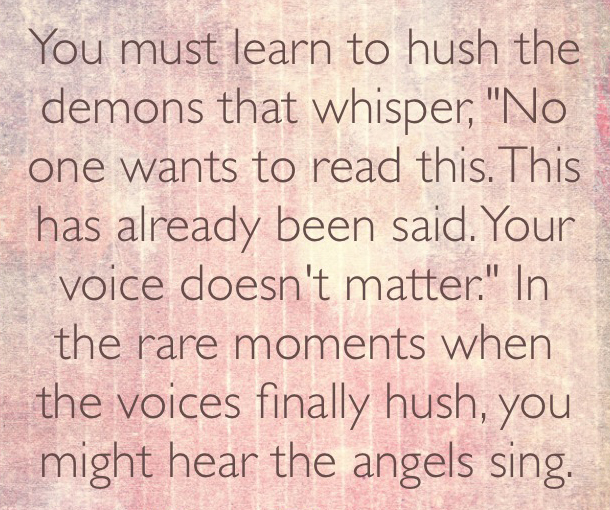
  10. KEEP THE DEMONS AT BAY – That brainbox of yours is a Pandora’s Box jam-packed with surprises and miracles and as-yet-untapped genius… and the counterbalance to that are the demons that nurture that tortured writer’s spirit you possess. They feed on rejection and whisper fear and doubt in your ear, but since they’re a necessary evil, it’s important that you develop the ability to silence them while you’re writing. Nothing gets between you and your writing, especially not some crabs in a barrel mind demons.

Sally forth and be writeful… and enjoy your weekend.

21 Writing Lessons A Wise Man Would Share (and no, I’m not calling myself wise)

270497_5510453_lz

  1. Commitment is what transforms an idea floating around in your head into reality. Putting pen to paper speaks boldly of your intentions and are the actions which speak louder than the words. It is making the time when there is none. Coming through time after time after time, year after year after year. Commitment is the stuff character is made of; the power to shape ethereal things. It is the daily triumph of integrity over skepticism.
  2. No one is perfect. The quicker this is realized the faster you can get on with being excellent. Start every morning ready to write harder than you did the day before and plot further than you ever imagine.
  3. Avoid over explaining yourself in writing. Be confident that your audience is intelligent enough to understand.
  4. Write down what’s most important to you in your writing career and the steps to accomplish that goal and show up. Sometimes we tend to do the things that are most important to us when it’s written down.
  5. Play the hand you’re dealt. Stop envying someone else’s talent or success. Have the courage to face your own writing challenges head on. It builds character. Start looking for a way through instead of a way out.
  6. Become a student of life. Learn something new every day. The day you stop learning is the day you become obsolete so keep learning and keep writing.
  7. No excuses. Stop making excuses for not writing and replace them with ways to do better writing. Excuses are a waste of time and energy.
  8. Never be ashamed to tell anyone you’re a writer, whether you’re published or not. The definition of a writer is a person who writes or is able to write. Being ashamed to acknowledge this fact to people speaks to self-doubt, which is a desire killer.
  9. Never be afraid of a writing challenge. If you never strive to be more than what you are, you’ll never truly know what you can become.
  10. Service to others. Pointing people in the right direction is such a small thing. Give advice to those who ask for it. Offer support to those who want it. We’re all here to teach as well as learn.
  11. Work like hell. If you want to earn a living as a writer, that is. Treat it like a profession, put your absolute best foot forward and be thorough. Cross every “T” and dot every “I”.
  12. Discover you. Find your passion, life purpose, and pursue them… then write about them.
  13. Don’t take it personally. Don’t be afraid to acknowledge and laugh at something that you’ve written in the past that’s just plain awful. Self-awareness and self-confidence shows that you’re comfortable in your own skin.
  14. Manage your time. Our situation and environment is ever changing so be careful not to confuse the things that are urgent with the things that are important. Look for time wasters and eliminate them.
  15. Ask for help. Writing can be tough and although you do a majority of it alone, you should never write in a total vacuum and there’s no shame in seeking advice when you’re stuck.
  16. Do your homework. Know what you’re getting into before you start writing in a particular field, format or genre. Doing your homework reduces uncertainty and fear.
  17. Daydream often. Your imagination is a muscle that requires exercise and daydreaming is an excellent way to flex. Embrace and preserve your daydreams at all cost.
  18. Forgive and set free. Freeing your mind to write is almost as important as actually sitting down to write, so cultivate a healthy dose of forgiveness and set someone free. Learn to forgive others and stop carrying those bags of hate, guilt or regret.
  19. Stay one step ahead. Avoid big fish/small pond thinking if at all possible. If you’ve mastered a particular style of writing, why not be proactive, take the initiative, and see what other types of writing challenges are out there for you?
  20. Self-love. Become your own priority. Strive to be the you, you want to be. Once you accomplish this, it will show in your writing, trust me.
  21. Finish what you started. Avoid the urge to stray. Distractions are the writer’s most fearsome adversary. Avoid jumping off a project because a better idea has come along. Jot the better idea down, set it aside, and come back to it when you’re done with your current project.

Sally forth and be wisely writeful.

— Rhyan Scorpio-Rhys


The Three Simple Facts Of Writing

Today’s entry is a shortie because I’m busy wrestling with a wordy bastard of a story that refuses to be tamed but I’m in a particularly stubborn mood, so challenge met!

That said, I offer you my three simple facts of writing:

  1. If you do not write the story you truly want to write, it will never be read. You can’t have the unwashed masses confirm your greatness when you haven’t given them anything to be in awe of.
  2. If you don’t submit your work—–for review, publication, employment, or whatever—–the answer will always be no. The cruelest rejection you can ever receive is from yourself, the toughest critic you’ll ever know. If you never show your work, you never give an editor, publisher, prodco, or whatever, the chance to say yes (exercise caution, of course, and protect your writing before letting it fly out into the world).
  3. If you don’t write, you’ll never be a writer. Plain and simple. Also, many, many, many years from now, when you’re lying on your deathbed, do you really want a box of regret—–filled with all the unwritten stories of your life—–hanging over your head like the sword of Damocles? I think not.

Sally forth and be writeful.

— Rhyan Scorpio-Rhys

50 Questions That Can Help Free Your Mind (to concentrate on writing… hopefully)

The common advice for freeing your mind to write is to create a journal. I’m fairly certain that most of you have either 1) created a journal that you may or may not keep current, or 2) heard the advice and decided journaling isn’t for you (hey, it happens).

So, what other options do you have when you’ve lost your self in a quagmire of self-pity, mundane daily obligations and insurmountable life woes and can’t quite seem to maintain your true identify or nurture your creative center?

Why, you slap on your pith helmet, turn your gaze inward, and explore that largely ignored country of your core self, naturally. And the best way to accomplish this is with the list below. Why a list? Because you’re a writer and writers love lists.

Be advised that there are no right or wrong answers because sometimes simply asking the right questions is the answer.

  1. How old would you be if you didn’t know how old you are?
  2. Which is worse, failing or never trying?
  3. If life is so short, why do we do so many things we don’t like and like so many things we don’t do?
  4. When it’s all said and done, will you have said more than you’ve done?
  5. What is the one thing you would most like to change about the world?
  6. If happiness was the national currency, what kind of work would make you rich?
  7. Are you doing what you believe in, or are you settling for what you are doing?
  8. If the average human life span was 40 years, how would you live your life differently?
  9. To what degree have you actually controlled the course your life has taken?
  10. Are you more worried about doing things right, or doing the right things?
  11. You are having lunch with three people you respect and admire. They all start criticizing a close friend of yours, not knowing she is your friend. The criticism is distasteful and unjustified. What do you do?
  12. If you could offer a newborn child only one piece of advice, what would it be?
  13. Would you break the law to save a loved one?
  14. Have you ever seen insanity where you later saw creativity?
  15. What is something you know you do differently than most people?
  16. How come the things that make you happy don’t make everyone happy?
  17. What is one thing have you not done that you really want to do? What’s holding you back?
  18. Are you holding onto something you need to let go of?
  19. If you had to move to a state or country besides the one you currently live in, where would you move and why?
  20. Do you push the elevator button more than once? Do you really believe it makes the elevator faster?
  21. Would you rather be a worried genius or a joyful simpleton?
  22. Why are you, you?
  23. Have you been the kind of friend you want as a friend?
  24. Which is worse, when a good friend moves away, or losing touch with a good friend who lives right near you?
  25. What are you most grateful for?
  26. Would you rather lose all of your old memories, or never be able to make new ones?
  27. Is it possible to know the truth without challenging it first?
  28. Has your greatest fear ever come true?
  29. Do you remember that time 5 years ago when you were extremely upset? Does it really matter now?
  30. What is your happiest childhood memory? What makes it so special?
  31. At what time in your recent past have you felt most passionate and alive?
  32. If not now, then when?
  33. If you haven’t achieved it yet, what do you have to lose?
  34. Have you ever been with someone, said nothing, and walked away feeling like you just had the best conversation ever?
  35. Why do religions that support love cause so many wars?
  36. Is it possible to know, without a doubt, what is good and what is evil?
  37. If you just won a million dollars, would you quit your job?
  38. Would you rather have less work to do, or more work you actually enjoy doing?
  39. Do you feel like you’ve lived this day a hundred times before?
  40. When was the last time you marched into the dark with only the soft glow of an idea you strongly believed in?
  41. If you knew that everyone you know was going to die tomorrow, who would you visit today?
  42. Would you be willing to reduce your life expectancy by 10 years to become extremely attractive or famous?
  43. What is the difference between being alive and truly living?
  44. When is it time to stop calculating risk and rewards, and just go ahead and do what you know is right?
  45. If we learn from our mistakes, why are we always so afraid to make a mistake?
  46. What would you do differently if you knew nobody would judge you?
  47. When was the last time you noticed the sound of your own breathing?
  48. What do you love? Have any of your recent actions openly expressed this love?
  49. In 5 years from now, will you remember what you did yesterday? What about the day before that? Or the day before that?
  50. Decisions are being made right now. The question is: Are you making them for yourself, or are you letting others make them for you?

Sally forth and be free-mindedly writeful.

— Rhyan Scorpio-Rhys