
The Ten (Plus Four) Commandments (of Writing)

10crack-commandments

1. “The one great rule of composition is to speak the truth.” — Henry David Thoreau

2. “If you require a practical rule of me, I will present you with this: Whenever you feel an impulse to perpetrate a piece of exceptionally fine writing, obey it–wholeheartedly–and delete it before sending your manuscript to press. Murder your darlings.” — Arthur Quiller-Couch

3. “The best rule for writing–as well as for speaking—is to use always the simplest words that will accurately convey your thought.” — David Lambuth

4. “There are simple maxims . . . which I think might be commended to writers of expository prose. First: never use a long word if a short one will do. Second: if you want to make a statement with a great many qualifications, put some of the qualifications in separate sentences. Third: do not let the beginning of your sentence lead the readers to an expectation which is contradicted by the end.” — Bertrand Russell

5. “I have made three rules of writing for myself that are absolutes: Never take advice. Never show or discuss a work in progress. Never answer a critic.” — Raymond Chandler

6. “There are three rules for writing the novel. Unfortunately, no one knows what they are.” — W. Somerset Maugham

7. “Writing has laws of perspective, of light and shade, just as painting does, or music. If you are born knowing them, fine. If not, learn them. Then rearrange the rules to suit yourself.” — Truman Capote

8. “There is probably some long-standing “rule” among writers, journalists, and other word-mongers that says: “When you start stealing from your own work you’re in bad trouble.” And it may be true.” — Hunter S. Thompson

9. “If I were to advise new writers, if I were to advise the new writer in myself, going into the theater of the Absurd, the almost-Absurd, the theater of Ideas, the any-kind-of-theater-at-all, I would advise like this:

  • Tell me no pointless jokes. I will laugh at your refusal to allow me laughter.
  • Build me no tension toward tears and refuse me my lamentations. I will go find me better wailing walls.
  • Do not clench my fists for me and hide the target. I might strike you, instead.
  • Above all, sicken me not unless you show me the way to the ship’s rail.”

Ray Bradbury

10. “Breslin’s Rule: Don’t trust a brilliant idea unless it survives the hangover.” — Jimmy Breslin

11. “One of the great rules of art: Do not linger.” — Andre Gide

12. “Do not pay any attention to the rules other people make…. They make them for their own protection, and to Hell with them.” — William Saroyan

13. “Over the years, I’ve found one rule. It is the only one I give on those occasions when I talk about writing. A simple rule. If you tell yourself you are going to be at your desk tomorrow, you are by that declaration asking your unconscious to prepare the material. You are, in effect, contracting to pick up such valuables at a given time. Count on me, you are saying to a few forces below: I will be there to write.” — Norman Mailer

14. “I’ll give you the sole secret of short-story writing, and here it is: Rule 1. Write stories that please yourself. There is no rule 2. The technical points you can get from Bliss Perry. If you can’t write a story that pleases yourself, you will never please the public. But in writing the story forget the public.” — O. Henry

Of Inspiration and Imagination

Imagination_by_t1nus

1. “Imagination is the real and eternal world of which this vegetable universe is but a faint shadow.” — William Blake

2. “An idea, like a ghost, must be spoken to a little before it will explain itself.” — Charles Dickens

3. “If writers had to wait until their precious psyches were completely serene there wouldn’t be much writing done.” — William Styron

4. “I sit in the dark and wait for a little flame to appear at the end of my pencil.” — Billy Collins

5. “Use your imagination. Trust me, your lives are not interesting. Don’t write them down.” — W.P. Kinsella

6. “You get ideas from daydreaming. You get ideas from being bored. You get ideas all the time. The only difference between writers and other people is we notice when we’re doing it.” — Neil Gaiman

7. “You go to the attic of your mind and rummage around and find something.” — Mary Higgins Clark

8. “Thinking is the enemy of creativity. It’s self-conscious, and anything self-conscious is lousy. You can’t try to do things. You simply must do things.” — Ray Bradbury

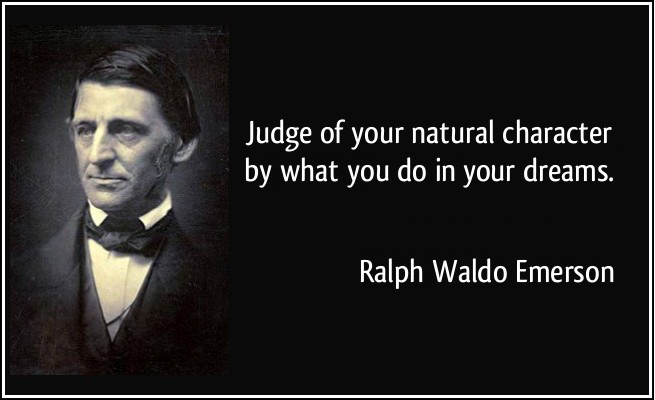
The Best Judge of Character? Why, 10 Famous Authors, Naturally

quote-judge-of-your-natural-character-by-what-you-do-in-your-dreams-ralph-waldo-emerson-57859

1. “Creation of character is, like much of fiction writing, a mixture of subjective feel and objective control.” — Julian Barnes

2. “Characters are not created by writers. They pre-exist and have to be found.” — Elizabeth Bowen

3. “The characters that I create are parts of myself and I send them on little missions to find out what I don’t know yet.” — Gail Godwin

4. “I don’t have a very clear idea of who the characters are until they start talking.” — Joan Didion

5. “I visualize the characters completely; I have heard their dialogue. I know how they speak, what they want, who they are, nearly everything about them.” — Joyce Carol Oates

6. “When I write, I live with my characters. It’s like going to work. You see the people at the next desk in full regalia all the time, and you know where they came from and where they are going. The point is to define the nuances of everything that’s happening with them and to find the element of their lives that is fascinating enough to record. That takes a lot of doing.” — William Kennedy

7. “Don’t write about a character. Become that character, and then write your story.” — Ethan Canin

8. “The character that lasts is an ordinary guy with some extraordinary qualities.” — Raymond Chandler

9. “It doesn’t matter if your lead character is good or bad. He just has to be interesting, and he has to be good at what he does.” — David Chase

10. “Think of your main characters as dinner guests. Would your friends want to spend ten hours with the characters you’ve created? Your characters can be loveable, or they can be evil, but they’d better be compelling.” — Po Bronson

Elizabeth Bowen’s 7 Tips on Approaching Dialogue

1. Dialogue should be brief.

2. It should add to the reader’s present knowledge.

3. It should eliminate the routine exchanges of ordinary conversation.

4. It should convey a sense of spontaneity but eliminate the repetitiveness of real talk.

5. It should keep the story moving forward.

6. It should be revelatory of the speaker’s character, both directly and indirectly.

7. It should show the relationships among people.

10 Thoughts on Dialogue From Notable Authors

1. “Dialogue has to show not only something about the speaker that is its own revelation, but also maybe something about the speaker that he doesn’t know but the other character does know.” — Eudora Welty

2. “Dialogue in fiction should be reserved for the culminating moments and regarded as the spray into which the great wave of narrative breaks in curving toward the watcher on the shore.” — Edith Wharton

3. “Good writers do not litter their sentences with adverbial garbage. They do not hold up signs reading ‘laughter!’ or ‘applause!’ The content of dialogue ought to suggest the mood.” — James J. Kilpatrick

4. “Nouns, verbs, are the workhorses of language. Especially in dialogue, don’t say, ‘she said mincingly,’ or ‘he said boisterously.’ Just say, ‘he said, she said.’” — John P. Marquand

5. “A man or woman who does not write good dialog is not a first-rate writer.” — George V. Higgins

6. “Dialogue that is written in dialect is very tiring to read. If you can do it brilliantly, fine. If other writers read your work and rave about your use of dialect, go for it. But be positive that you do it well, because otherwise it is a lot of work to read short stories or novels that are written in dialect. It makes our necks feel funny.” — Anne Lamott

7. “Dialogue which does not move the story along, or add to the mood of the story, or have an easily definable reason for being there at all (such as to establish important characterization), should be considered superfluous and therefore cut.” — Bill Pronzini

8. “To write successful dialogue the author must have access to the mind of all his characters, but the reader must not perceive any more than he would in real life.” — William Sloane

9. “Don’t write stage directions. If it is not apparent what the character is trying to accomplish by saying the line, telling us how the character said it, or whether or not she moved to the couch isn’t going to aid the case. We might understand better what the character means but we aren’t particularly going to care.” – David Mamet

10, “Remember that you should be able to identify each character by what he or she says. Each one must sound different from the others. And they should not all sound like you.” — Anne Lamott

A Special Brand of Bravery

In yesterday’s post, villains took center stage so it’s only fitting that the heroes receive a little equal time. In a future post I plan on discussing the anatomy of a hero (all right, guttermind, give it a rest) but today I’d like to explore the key ingredient your protagonist must possession to some degree in order to attract your audience and keep them invested:

Bravery.

And it should come as no surprise to any of you that if I’ve brought the subject up, there must be more than one type of courage you may either instill or bestow upon your hapless hero:

1. Heroic Bravery is the most typical brand of courage found in fictional characters nowadays, where the protagonist places themselves in jeopardy for the protection of others or to further a cause in which they passionately believe, knowing in their heart of hearts that the risk to their own well-being is completely worth it.

2. Steadfast Bravery is usually displayed by someone who routinely endures a mental or physical dangerous situation and challenges fate by meeting it head on with patient doggedness every single day.

3. Quiet Bravery, often confused with cowardice, is an offshoot of steadfast bravery where the situations are less physically dangerous. Protagonists maintain their sense of self-worth and hope as they handle their business with grace and patience.

4. Personal Bravery is exactly what it says on the tin. The protagonist risks everything for a chance at a better life as they pursue their seemingly impossible dreams. This type of bravery speaks to us all as we’ve all experienced it in some fashion at one time or another.

5. Devil-May-Care Bravery comes from protagonists that feel they have nothing left to live for–the loss of everything dear to them, a terminal illness, etc.–so they display insane courage in order to meet their inevitable death with open arms on their terms.

6. Frightened Bravery is easily the most interesting type of courage to explore within a protagonist. A character that normally chooses flight in fight-or-flight situations that has either mentally or physically been backed into a corner and forced to face their fears and rise above them can be viewed as the bravest of all the courageous archetypes (and it makes for one hell of a character arc).

The best thing about these? You’re not limited to one type per character, in fact, your protagonist may display each and every one of these types of bravery as they trod along their hero’s path. Your job as creator is to recognize which category suits your character best in order to fully flesh them out on the page.

Sally forth bravely and be writeful.


Every Villain is a Hero

“Every villain is a hero in his or her own mind.” – Allison Brennan

What suits a hero best? That which opposes them. Despite the fact your protagonist is an expert in whatever field applies to your story, the very best at what they do, they’re only really as strong as their antagonist.  And how do you create a strong antagonist? By not treating them like a mustache-twirling villain.

While your shouldn’t limit yourself to the suggestions below, here are the most common antagonist archetypes writers tend to use for ideas and inspiration:

The Immoral Antagonist

Easily the most popular form of antagonist–the person your audience will have no trouble hating. They’re usually set in clear contrast against the hero. The lines are drawn in varying shades of black and white, and readers have no problem choosing whom to root for.

1. The Hypocrite is an antagonist who feigns goodness. They may be guilty of all sorts of treachery and evil, but on the surface they’re all sweetness and light. They put a righteous face on their misdeeds–perhaps even accusing the protagonist of hypocrisy to disguise their own–but the audience knows the truth: this person isn’t just bad, they’re a fraud, which makes them all the more hateable.

2. The Psycho is simply evil through and through. No excuses, no thread of goodness leading them back to redemption. They’re rotten to the core… and crazy to boot. Serial killers, genocidal world leaders, and sadists fit the bill and if you do your job properly, your audience will not only hate the psycho, but fear them as well.

3. The Regular Person Forced to Do Bad Things for an Illegitimate Reason who has let their weaknesses get the better of them. Lust, greed, and hatred can drive even ordinary people to do extraordinary evil.

The Moral Antagonist

In the moral antagonist we find a more complicated—and often more compelling—character, since they presents more parallels than contrasts with the protagonist. This is a person who is doing the right thing—as they see it—and usually for the right reasons, but who has nonetheless been forced to do battle with the hero, thanks to the requirements of your story’s overall conflict.

1. The Good Guy on the Opposing Side is usually present in stories where the conflict is between good people with opposing views who appear on both sides of the battle lines. Lawyers fighting each other for causes in which they each believe passionately, football teams competing for a championship, two love interests trying to win the same girl—none of them have to be inherently bad. Stories of this nature can provide all kinds of interesting possibilities for exploring the grey areas of life, relationships, and morality.

2. The Crusader can be insanely scary in their own right, someone who fiercely believes they’re doing the right thing, and indeed may well be fighting for a good cause. They may be someone who believes they’ve to choose between the lesser of two evils in their decisions. Or they may be someone driven to fanaticism—and thus dangerous decisions—by their passion for the cause. In fact, they may be just plain out right, while the protagonist is the one who’s wrong.

3. The Regular Person Forced to Do Bad Things for a Legitimate Reason because they feel they have no choice. A character who robs a bank to pay for their family member’s operation or to save themselves from the Mafia’s threats may be a hero in their own right—or they may be a compelling and relatable antagonist to the detective protagonist who has to go after them.

So, what are you waiting for? Walk a mile in your antagonist’s shoes, see the world from their point of view, empathize with their plight, understand the justifications for their actions. In other words, treat them with the same love and respect you do your hero for they’re equally as important to the overall success of your story.

Sally forth and be writeful.

21 Writing Lessons A Wise Man Would Share (and no, I’m not calling myself wise)

270497_5510453_lz

  1. Commitment is what transforms an idea floating around in your head into reality. Putting pen to paper speaks boldly of your intentions and are the actions which speak louder than the words. It is making the time when there is none. Coming through time after time after time, year after year after year. Commitment is the stuff character is made of; the power to shape ethereal things. It is the daily triumph of integrity over skepticism.
  2. No one is perfect. The quicker this is realized the faster you can get on with being excellent. Start every morning ready to write harder than you did the day before and plot further than you ever imagine.
  3. Avoid over explaining yourself in writing. Be confident that your audience is intelligent enough to understand.
  4. Write down what’s most important to you in your writing career and the steps to accomplish that goal and show up. Sometimes we tend to do the things that are most important to us when it’s written down.
  5. Play the hand you’re dealt. Stop envying someone else’s talent or success. Have the courage to face your own writing challenges head on. It builds character. Start looking for a way through instead of a way out.
  6. Become a student of life. Learn something new every day. The day you stop learning is the day you become obsolete so keep learning and keep writing.
  7. No excuses. Stop making excuses for not writing and replace them with ways to do better writing. Excuses are a waste of time and energy.
  8. Never be ashamed to tell anyone you’re a writer, whether you’re published or not. The definition of a writer is a person who writes or is able to write. Being ashamed to acknowledge this fact to people speaks to self-doubt, which is a desire killer.
  9. Never be afraid of a writing challenge. If you never strive to be more than what you are, you’ll never truly know what you can become.
  10. Service to others. Pointing people in the right direction is such a small thing. Give advice to those who ask for it. Offer support to those who want it. We’re all here to teach as well as learn.
  11. Work like hell. If you want to earn a living as a writer, that is. Treat it like a profession, put your absolute best foot forward and be thorough. Cross every “T” and dot every “I”.
  12. Discover you. Find your passion, life purpose, and pursue them… then write about them.
  13. Don’t take it personally. Don’t be afraid to acknowledge and laugh at something that you’ve written in the past that’s just plain awful. Self-awareness and self-confidence shows that you’re comfortable in your own skin.
  14. Manage your time. Our situation and environment is ever changing so be careful not to confuse the things that are urgent with the things that are important. Look for time wasters and eliminate them.
  15. Ask for help. Writing can be tough and although you do a majority of it alone, you should never write in a total vacuum and there’s no shame in seeking advice when you’re stuck.
  16. Do your homework. Know what you’re getting into before you start writing in a particular field, format or genre. Doing your homework reduces uncertainty and fear.
  17. Daydream often. Your imagination is a muscle that requires exercise and daydreaming is an excellent way to flex. Embrace and preserve your daydreams at all cost.
  18. Forgive and set free. Freeing your mind to write is almost as important as actually sitting down to write, so cultivate a healthy dose of forgiveness and set someone free. Learn to forgive others and stop carrying those bags of hate, guilt or regret.
  19. Stay one step ahead. Avoid big fish/small pond thinking if at all possible. If you’ve mastered a particular style of writing, why not be proactive, take the initiative, and see what other types of writing challenges are out there for you?
  20. Self-love. Become your own priority. Strive to be the you, you want to be. Once you accomplish this, it will show in your writing, trust me.
  21. Finish what you started. Avoid the urge to stray. Distractions are the writer’s most fearsome adversary. Avoid jumping off a project because a better idea has come along. Jot the better idea down, set it aside, and come back to it when you’re done with your current project.

Sally forth and be wisely writeful.

— Rhyan Scorpio-Rhys


The Three Simple Facts Of Writing

Today’s entry is a shortie because I’m busy wrestling with a wordy bastard of a story that refuses to be tamed but I’m in a particularly stubborn mood, so challenge met!

That said, I offer you my three simple facts of writing:

  1. If you do not write the story you truly want to write, it will never be read. You can’t have the unwashed masses confirm your greatness when you haven’t given them anything to be in awe of.
  2. If you don’t submit your work—–for review, publication, employment, or whatever—–the answer will always be no. The cruelest rejection you can ever receive is from yourself, the toughest critic you’ll ever know. If you never show your work, you never give an editor, publisher, prodco, or whatever, the chance to say yes (exercise caution, of course, and protect your writing before letting it fly out into the world).
  3. If you don’t write, you’ll never be a writer. Plain and simple. Also, many, many, many years from now, when you’re lying on your deathbed, do you really want a box of regret—–filled with all the unwritten stories of your life—–hanging over your head like the sword of Damocles? I think not.

Sally forth and be writeful.

— Rhyan Scorpio-Rhys

50 Questions That Can Help Free Your Mind (to concentrate on writing… hopefully)

The common advice for freeing your mind to write is to create a journal. I’m fairly certain that most of you have either 1) created a journal that you may or may not keep current, or 2) heard the advice and decided journaling isn’t for you (hey, it happens).

So, what other options do you have when you’ve lost your self in a quagmire of self-pity, mundane daily obligations and insurmountable life woes and can’t quite seem to maintain your true identify or nurture your creative center?

Why, you slap on your pith helmet, turn your gaze inward, and explore that largely ignored country of your core self, naturally. And the best way to accomplish this is with the list below. Why a list? Because you’re a writer and writers love lists.

Be advised that there are no right or wrong answers because sometimes simply asking the right questions is the answer.

  1. How old would you be if you didn’t know how old you are?
  2. Which is worse, failing or never trying?
  3. If life is so short, why do we do so many things we don’t like and like so many things we don’t do?
  4. When it’s all said and done, will you have said more than you’ve done?
  5. What is the one thing you would most like to change about the world?
  6. If happiness was the national currency, what kind of work would make you rich?
  7. Are you doing what you believe in, or are you settling for what you are doing?
  8. If the average human life span was 40 years, how would you live your life differently?
  9. To what degree have you actually controlled the course your life has taken?
  10. Are you more worried about doing things right, or doing the right things?
  11. You are having lunch with three people you respect and admire. They all start criticizing a close friend of yours, not knowing she is your friend. The criticism is distasteful and unjustified. What do you do?
  12. If you could offer a newborn child only one piece of advice, what would it be?
  13. Would you break the law to save a loved one?
  14. Have you ever seen insanity where you later saw creativity?
  15. What is something you know you do differently than most people?
  16. How come the things that make you happy don’t make everyone happy?
  17. What is one thing have you not done that you really want to do? What’s holding you back?
  18. Are you holding onto something you need to let go of?
  19. If you had to move to a state or country besides the one you currently live in, where would you move and why?
  20. Do you push the elevator button more than once? Do you really believe it makes the elevator faster?
  21. Would you rather be a worried genius or a joyful simpleton?
  22. Why are you, you?
  23. Have you been the kind of friend you want as a friend?
  24. Which is worse, when a good friend moves away, or losing touch with a good friend who lives right near you?
  25. What are you most grateful for?
  26. Would you rather lose all of your old memories, or never be able to make new ones?
  27. Is it possible to know the truth without challenging it first?
  28. Has your greatest fear ever come true?
  29. Do you remember that time 5 years ago when you were extremely upset? Does it really matter now?
  30. What is your happiest childhood memory? What makes it so special?
  31. At what time in your recent past have you felt most passionate and alive?
  32. If not now, then when?
  33. If you haven’t achieved it yet, what do you have to lose?
  34. Have you ever been with someone, said nothing, and walked away feeling like you just had the best conversation ever?
  35. Why do religions that support love cause so many wars?
  36. Is it possible to know, without a doubt, what is good and what is evil?
  37. If you just won a million dollars, would you quit your job?
  38. Would you rather have less work to do, or more work you actually enjoy doing?
  39. Do you feel like you’ve lived this day a hundred times before?
  40. When was the last time you marched into the dark with only the soft glow of an idea you strongly believed in?
  41. If you knew that everyone you know was going to die tomorrow, who would you visit today?
  42. Would you be willing to reduce your life expectancy by 10 years to become extremely attractive or famous?
  43. What is the difference between being alive and truly living?
  44. When is it time to stop calculating risk and rewards, and just go ahead and do what you know is right?
  45. If we learn from our mistakes, why are we always so afraid to make a mistake?
  46. What would you do differently if you knew nobody would judge you?
  47. When was the last time you noticed the sound of your own breathing?
  48. What do you love? Have any of your recent actions openly expressed this love?
  49. In 5 years from now, will you remember what you did yesterday? What about the day before that? Or the day before that?
  50. Decisions are being made right now. The question is: Are you making them for yourself, or are you letting others make them for you?

Sally forth and be free-mindedly writeful.

— Rhyan Scorpio-Rhys