Gatsby The Great: A Sam Turner Murder Mystery

🔥 Dive into the Dark Heart of a Timeless Classic Reimagined! 🔥

Step off the well-worn path of American literature and into the gritty underbelly of the Big Apple with “Gatsby the Great”—a hardboiled transformation of F. Scott Fitzgerald’s iconic masterpiece. This isn’t your high-school “Great Gatsby.” It’s a smoky, twisting maze where dreams morph into nightmares and opulence hides deadly secrets.

🌃 Why You Can’t Miss This Book: 🌃

👤 Meet Sam Turner: Your quintessential hard-nosed P.I. Armed with unyielding skepticism and a keen eye for deception, Sam delves deep into the criminal quagmires of 1920s New York to crack the mystery of George Wilson’s puzzling death and expose the enigmatic Jay Gatsby.

💎 A Glamorous Facade: Step into Gatsby’s mansion—now a dark theater of smoke and mirrors, where the jazz is as intoxicating as the lies. Here, high society is your deadliest enemy, and even a garden party can be a ticket to the morgue.

🚬 Rogues and Riches: Interact with a rich tapestry of characters—from Daisy Buchanan, the elusive beauty with secrets as numerous as her pearls, to Tom Buchanan, whose aristocratic veneer conceals a far darker soul.

🎭 Moral Ambiguity: Traverse a moral minefield where every choice can damn you, every clue misleads you, and every truth only deepens the enigma. Sam Turner’s pursuit of justice forces him to grapple with questions as complex as the city’s labyrinthine streets.

🎇 A Dizzying Waltz of Deception: Glamour and grime coalesce in a narrative that oscillates between light and abyss, pulling you into a world where the line between hero and villain is as blurred as the smoke in a speakeasy.

🕵️ Uncover the Truth, If You Dare: As the clock ticks and the stakes rise, you’ll be tethered to each page, your heart racing as fast as a Model T down Fifth Avenue.

Available HERE: https://amzn.to/48DK6Cp

The Traitor Vanguard – Chapter 2: Echoes of Betrayal

PROLOGUE * CHAPTER 1

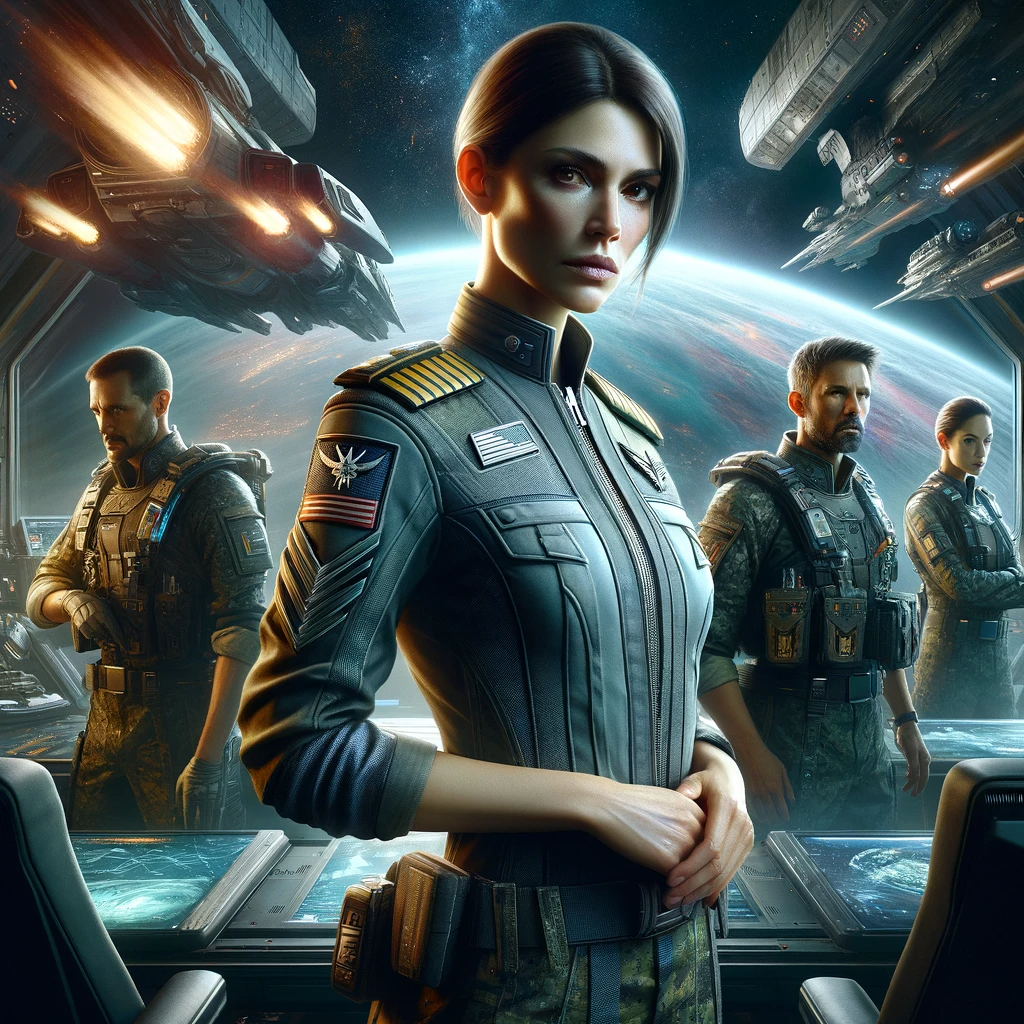
The Vanguard’s central command hub, a nexus of interstellar communication and strategy, was abuzz with the usual hum of activity. Officers and personnel moved with purpose, their eyes and minds fixed on screens displaying star charts, logistics data, and encrypted messages from distant outposts. In the midst of this orchestrated chaos, Commander Valyssa Kane’s presence was a focal point of calm determination.

Valyssa stood at her command console, her fingers flying across the holographic interface as she coordinated the intricate dance of Vanguard operations. Suddenly, a chime alerted her to an incoming transmission, its urgent tone cutting through the ambient noise. Valyssa’s brow furrowed as she noted the layers of encryption and the classification that whispered of shadows and secrets.

With a quick glance around the command hub, ensuring that her actions would go unnoticed amidst the flurry of activity, Valyssa keyed in her authorization codes. The screen flickered to life, bathing her face in an eerie glow as a series of documents, reports, and intercepted communications unfurled before her eyes.

As she delved into the data, Valyssa’s expression morphed from one of focused determination to a mixture of disbelief and mounting dread. Each piece of information was a jagged shard, forming a mosaic of treachery that shook the very foundations of her world. Clandestine meetings, rerouted resources, unexplained disappearances—a sinister pattern emerged, and at its heart was a name that made her blood run cold: Admiral Huxley.

Valyssa’s grip on the console tightened, her knuckles turning white as she grappled with the implications. Huxley, the man she had looked up to, the mentor who had guided her through the labyrinths of command, was now cast in a terrible light. The reports painted him as a man disillusioned, convinced that humanity’s survival demanded a shift from diplomacy to dominion.

Fragments of conversations, once thought innocent, now took on a darker hue in Valyssa’s mind. Huxley’s words, his subtle nudges and cryptic remarks, suddenly aligned with the unsettling narrative unfolding before her. The realization hit her like a physical blow—Huxley had been weaving a web of deceit, and she, like so many others, had been an unwitting pawn in his grand design.

Valyssa’s eyes darted across the command hub, searching for any sign that her discovery had been noticed. The weight of the truth settled upon her shoulders like a leaden cloak, and she knew that the path forward would be a treacherous one. Exposing Huxley’s conspiracy would not only shake the Vanguard to its core but also paint a target on her own back.

With a deep breath, Valyssa straightened her spine, the mantle of command and the oath she had sworn to protect humanity steeling her resolve. She knew that the coming storm would test her in ways she had never been tested before, but she would not falter. The truth, no matter how painful, could not be buried.

Her fingers hovered over the console, poised to initiate a secure channel to the UEG High Council. In that moment, the weight of her next action hung in the air, a tangible presence that seemed to slow time itself. With a final, determined keystroke, Valyssa set in motion a chain of events that would forever alter the course of human history.

As she spoke, her voice steady despite the tempest raging within, Valyssa ignited a firestorm that would engulf the stars themselves. The echoes of betrayal had been sounded, and she, Commander Valyssa Kane, would stand at the heart of the maelstrom, a beacon of truth amidst the darkness.

Not. The. End.

The Traitor Vanguard – Chapter 1: Valyssa Kane – Vanguard’s Paragon

Prologue HERE

In the heart of the United Earth Government’s sprawling space station, amidst the hum of celestial diplomacy and interstellar politics, stood Commander Valyssa Kane. A figure of quiet strength, she navigated the corridors with an air of purpose, her uniform pristine, the insignia of the Vanguard adorning her chest—a testament to her rank and her revered status.

As she strode through the bustling halls, officers and diplomats alike paused to salute or nod in deference. Valyssa acknowledged each with a crisp nod, her chiseled features set in a mask of composed authority. Yet, beneath the surface, a maelstrom of thoughts swirled within her mind, a tempest born of the whispers that had reached her ears.

In the quiet sanctuary of her quarters, Valyssa allowed herself a moment of introspection. Her gaze drifted to the holographic display on her wall, where images of her childhood on the frontier world flickered to life. She watched her younger self, eyes wide with wonder, as she stared up at the night sky, the stars painting a canvas of unending possibilities.

A soft smile touched her lips as she recalled the stories that had fueled her dreams—tales of brave explorers and pioneers who had ventured into the unknown, forging humanity’s path among the stars. It was these stories that had ignited a fire within her, a burning desire to be part of something greater than herself.

Valyssa’s hand drifted to the insignia on her chest, tracing the emblem of the Vanguard. The weight of it served as a constant reminder of the path she had chosen, the relentless pursuit and unyielding determination that had propelled her to the heights of command.

Her thoughts turned to Admiral Huxley, the man who had been her guiding star, her mentor in the ways of interstellar warfare and diplomacy. She remembered the countless hours spent in his presence, absorbing his wisdom, learning to navigate the intricacies of command and the burdens that came with it.

Yet now, the very same man stood accused of treachery, of a betrayal so profound that it threatened the foundations of all she held dear. Valyssa’s brow furrowed as she grappled with the implications, her loyalty to the Vanguard and the UEG warring with the respect and admiration she had held for Huxley.

In the silence of her quarters, Valyssa’s eyes drifted back to the stars beyond her window, their eternal dance offering a modicum of solace amidst the turmoil. She knew that the truth lay out there, waiting to be uncovered, and that it would fall to her to navigate the treacherous waters ahead.

With a deep breath, Valyssa straightened her shoulders, the mantle of command settling upon her like a second skin. She would not shy away from this challenge, no matter how painful the revelations might be. For the sake of the Vanguard, the UEG, and the ideals that had guided her through the darkest reaches of space, she would unravel the mystery and bring the truth to light.

As she stepped out of her quarters and back into the fray, Commander Valyssa Kane knew that the path ahead would be fraught with peril and uncertainty. But with the strength of her convictions and the weight of her responsibilities, she would face whatever lay ahead with the same unwavering resolve that had made her a legend among the stars.

Not. The. End.

The Traitor Vanguard – Prologue: The Dawn of the Vanguard

In the year 2245, the tapestry of the cosmos was no longer a distant dream but a vivid canvas painted by the audacity of humankind. Earth, once the cradle of humanity, had extended its fingers far into the abyss of space, seeding life among the stars. The United Earth Government (UEG), a mosaic of nations fused by a shared vision of interstellar ambition, spearheaded this celestial odyssey.

The UEG chambers buzzed with a palpable energy as delegates from every corner of Earth gathered, their voices rising in a cacophony of excitement and determination. “Today, we stand united, not as individual nations, but as one human race,” declared the UEG President, her voice resonating through the grand hall. “Our differences have melted away in the face of the infinite possibilities that await us among the stars.”

As humanity’s outposts dotted the galactic map, it became clear that this newfound era of exploration demanded guardians—protectors who could ensure the survival and prosperity of these nascent civilizations. Thus, the Vanguard was conceived. More than a mere military force, it was the embodiment of human valor, a beacon of hope, and a shield against the darkness.

In the Vanguard’s training facility, a sea of eager faces looked up at Commander Valyssa Kane, their eyes shining with a mixture of awe and determination. “You are the best and the bravest from every corner of human civilization,” she said, her voice clear and unwavering. “Soldiers, scientists, diplomats—all united under the banner of safeguarding humanity’s future among the stars. Remember our creed: to protect, to explore, to unite.”

Valyssa’s presence in any battle, any diplomatic negotiation, any crisis, was a reassurance that humanity would prevail. Her eyes, as deep and mysterious as the void they ventured into, reflected a soul forged in the crucible of space. In the heat of battle, she moved with a fluid grace, her weapon an extension of her body as she danced through the chaos, inspiring her troops with her fearless resolve.

Yet, as stars continued their tireless dance across the void, a sinister shadow began to stretch its tendrils through the heart of this interstellar odyssey. Admiral Huxley, once a paragon of virtue and an exemplar of the UEG’s ideals, had become the architect of this looming catastrophe.

In the dimly lit confines of his private quarters, Admiral Huxley pored over classified documents, his brow furrowed with a mixture of frustration and determination. The weight of the sacrifices he had witnessed, the horrors he had endured, pressed down upon him like a leaden cloak. “The UEG’s policies of restraint and diplomacy will be our undoing,” he muttered to himself, his once kind eyes now glinting with a cold, calculating light. “Only through absolute control can we ensure the survival of our species.”

As whispers of betrayal echoed through the corridors of power, the stage was set for a confrontation that would test the very soul of humanity. The future of the UEG, the Vanguard, and the countless lives they had sworn to protect hung in the balance, as the looming shadow of conspiracy threatened to engulf them all.

Not. The. End.

The Very Last New Year

Under the twilight of humanity’s final day on Earth, Leo stood atop the Empire State Building, clutching an ancient book titled “Echoes of Time.” Below, New York City shimmered in a bittersweet farewell, a global celebration for the last New Year’s Eve on Earth before the grand exodus to a new world.

Leo, a historian charged with archiving Earth’s final moments, flipped through the book. Each page held stories of past New Year’s Eves, reflecting humanity’s hopes and fears throughout history. As the final hours ticked by, he read about celebrations in times of change, from the Renaissance to the dawn of the digital age.

Dr. Ava Singh, Leo’s mentor, joined him, her eyes mirroring the sky’s melange of sorrow and hope. “What lesson does history hold for us tonight?” she asked.

Leo pondered, each story in the book echoing the current world’s sentiments – the uncertainty of change, the fear of the unknown, yet an unwavering hope for the future.

The city countdown began, a chorus of voices rising in unison. Leo read aloud a passage about a civilization that had faced a similar crossroad but found renewal in its darkest hour. His voice carried over the crowd, intertwining with the countdown.

“Three… Two… One…” The world held its breath as the clock struck midnight. Cheers erupted, not just for a new year, but for a new era in human history.

In that moment, Leo realized the unbroken thread connecting all the stories. Despite the setting sun on their ancient home, humanity’s spirit endured, always seeking, always striving for a new dawn.

As the ships prepared to depart, Leo secured “Echoes of Time” in the interstellar archive. It was more than a book now; it was a beacon of human resilience, a reminder that every end is just a new beginning.

Wishing each and every one of you a
HAPPY NEW YEAR!
May 2024 be filled with new adventures and good fortunes!

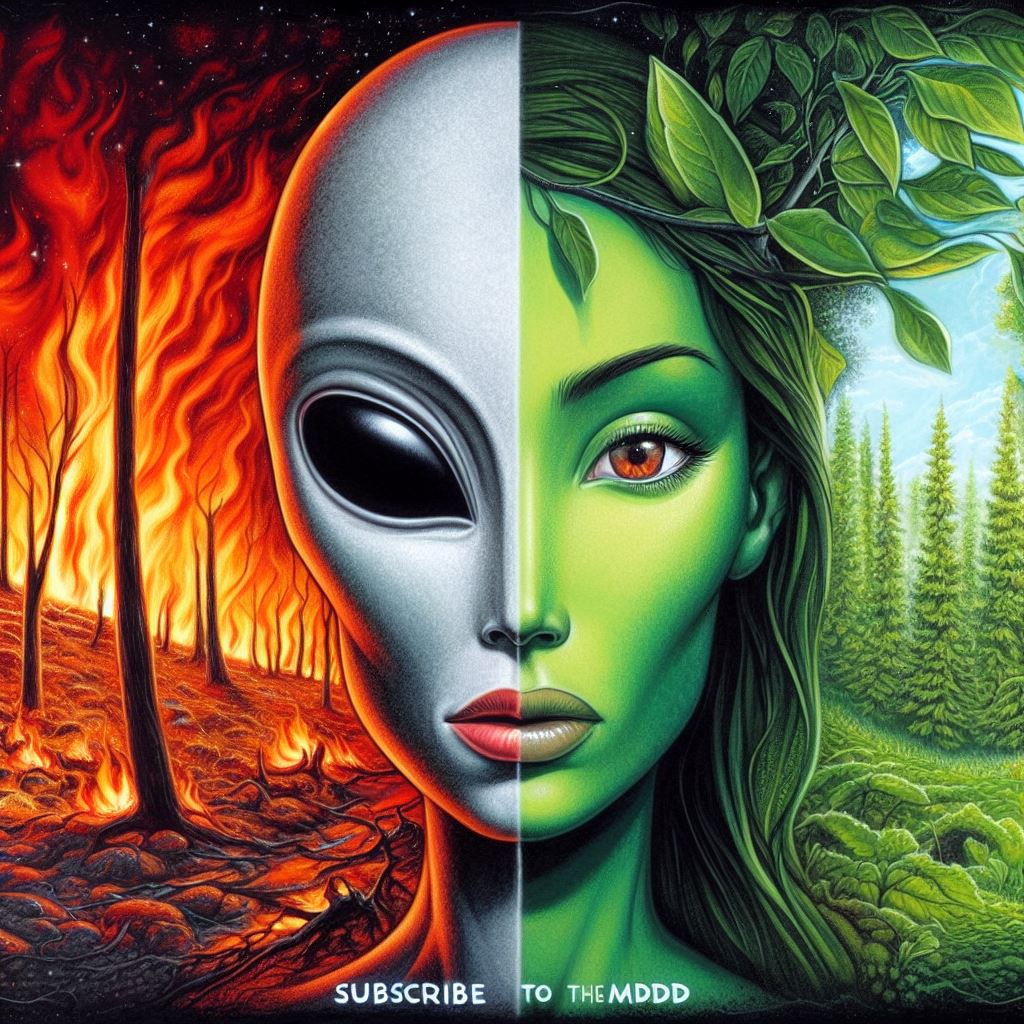
Unveiling the Cosmic Connection: Greek Nymphs Were Extraterrestrial Visitors, New Evidence Suggests

In a groundbreaking revelation that’s set to rewrite both history books and sci-fi novels, recent archaeological findings suggest that the ethereal nymphs of Greek mythology were, in fact, the first extraterrestrial visitors to grace our planet. This astonishing theory, proposed by the renowned (and somewhat controversial) Dr. Xenon Metaphoros of the Institute of Mythological Cosmology, is based on a series of ancient artifacts and cryptic historical texts unearthed in a previously undiscovered subterranean library in Crete.

From Olympus to the Stars: The Interstellar Journey

The discovery includes a series of frescoes depicting what appear to be celestial beings descending from starlit skies, intertwining with scenes of well-known mythological narratives. According to Dr. Metaphoros, “The intricate details in these frescoes clearly point to a more literal interpretation of ‘nymphs descending from the heavens.’ It’s not mere poetic imagery; it’s historical documentation of an extraterrestrial visitation.”

The most compelling piece among the artifacts is a fragmented tablet, tentatively titled “The Cosmic Odyssey,” which contains inscriptions in a dialect that predates Ancient Greek. Linguistic experts at the University of Atlantis (a prestigious yet elusive institution) have tentatively translated portions of the text, revealing references to interstellar travel and technology beyond our current understanding.

Nymphs: Not Just Forest Dwellers, But Star Wanderers

Greek nymphs, traditionally depicted as minor deities associated with nature, have always held an air of mystery in mythological tales. This new evidence, however, paints them in a radically different light – as advanced beings from another world. “Imagine, if you will, Dryads not just as spirits of the trees, but as guardians of cosmic knowledge, imparting astronomical wisdom to ancient civilizations,” muses Dr. Metaphoros.

The implications are staggering. Were the Greeks mere passive recipients of otherworldly wisdom, or did they engage in interstellar cultural exchanges with these nymph-like visitors? Professor Icarus Heliopolis, a leading historian at the Solar Myths Research Center, speculates, “This could very well mean that concepts like democracy, philosophy, and even the Olympic Games might have extraterrestrial origins. The nymphs might have been the ultimate muses, inspiring not just art and literature, but the very foundations of Western civilization.”

Skeptics and Enthusiasts: A Galaxy of Opinions

As expected, this theory has its skeptics. Dr. Helena Chronos of the Historical Accuracy Group dismisses the findings as “an imaginative misinterpretation of mythological allegories.” She argues, “To leap from artistic representation to asserting an extraterrestrial influence is both scientifically unfounded and culturally myopic.”

On the flip side, the revelation has sparked enthusiasm among ancient astronaut theorists and mythological enthusiasts. Social media is abuzz with the hashtag #NymphsInSpace, with users speculating about the possible connections between other mythological figures and alien visitors.

A New Dawn of Understanding

Regardless of the debate, this discovery opens up a universe of possibilities in our understanding of human history and mythology. As Dr. Metaphoros aptly puts it, “We are not just unearthing artifacts; we are uncovering the cosmic lineage of human civilization. The nymphs, once thought to be mere figments of fertile imaginations, may well be the heralds of humanity’s star-studded ancestry.”

As the scientific and mythological communities continue to analyze and debate these findings, one thing is clear: our understanding of the ancient world and its connections to the cosmos may be on the brink of a paradigm shift, courtesy of the otherworldly nymphs of Greek lore.

Molten Moon

In the silvery luminescence of the distant future, humanity, like a vine, had stretched its tendrils across the barren soils of the solar system. Yet, it was the Moon, that silent sentinel of the Earth, which harbored a secret deep within its scarred and pockmarked visage—a secret that Dr. Cadrianne Corso, a geologist of unparalleled brilliance, was destined to unearth.

Cadrianne, a pioneer among astro-minerologists, led her team of intrepid scientists and engineers across the Moon’s desolate landscape. They delved deep beneath the surface, where the stark, lunar deserts gave way to vast caverns, shrouded in shadows and secrets. It was here, in these stygian depths, that they found it—a molten heart, pulsing with a glow otherworldly and ethereal.

This glowing substance, christened Lunarite, was not merely molten rock. It was a promise, a beacon of hope, potentially the solution to Earth’s burgeoning energy crisis, which had long cast a shadow over humanity’s future. Lunarite, with its boundless energy, was a treasure trove, an elixir of life for a civilization teetering on the brink.

But as with all discoveries that promise salvation, Lunarite became a siren song that echoed across the void, reaching the power-hungry ears of Earth’s leaders. The ethics of its extraction sparked debates that raged like wildfires, consuming political chambers and scientific symposiums alike.

Amidst this tumult, Cadrianne’s team on the Moon wrestled with dangers far removed from Earth’s squabbles. The Lunarite, though a fount of energy, was volatile. Its extraction stirred the ancient Moon, provoking seismic tempests that threatened to swallow their lunar base whole.

In a twist of fate, as seismic shocks roared through the lunar caverns, Cadrianne uncovered a truth more astonishing than the Lunarite itself. The Molten Moon was not merely a celestial body; it was sentient, alive. For eons, this consciousness had slumbered, undisturbed, until humanity’s ambition had rudely awakened it. The seismic upheavals were not mere geological reactions; they were the agonized writhings of a being in pain.

Faced with this revelation, Cadrianne stood at a crossroads, her heart torn between two irreconcilable paths. One led to the salvation of her own kind, the other to the preservation of a newfound, extraterrestrial life. Could she bear to inflict pain upon a conscious being for the sake of humanity? Or should she forgo this chance to end Earth’s energy plight, to save a life not of this Earth?

The lunar base became a battleground, not of weapons, but of wills. Earth’s government, blinded by desperation, clashed with the awakened sentience of the Moon. Cadrianne, at the epicenter, made her choice—a choice that would echo through the annals of human history, reshaping our understanding of life and our place in the cosmos.

In that moment, under the watchful eyes of a billion stars, Cadrianne Corso redefined what it meant to be a savior, a destroyer, a human. The Molten Moon, once a symbol of humanity’s conquest over nature, became a testament to our understanding of life in its myriad forms.

And so, as the lunar dust settled, and the echoes of Cadrianne’s decision faded into the vacuum of space, humanity looked up at the Moon with new eyes, seeing not a lifeless rock, but a kindred spirit, a reminder of the vast, untamed wonders of the universe.

Tarot Girl From Saturn

Neo-Tokyo pulsated with the lifeblood of the 23rd century and somewhere in that bustling city, a small shop flickered to life. Its sign, simple yet captivating, read “Tarot by Seraphina.” The woman behind the name, Seraphina, was an enigma, a rare gem from the rings of Saturn, bringing with her the mystical allure of the outer planets.

Her shop, adorned with relics from across the solar system, had an air of ancient magic juxtaposed with modernity. Holographic images of celestial bodies danced on the walls, and the air hummed with a subtle energy, a melody of the cosmos. In the center, a table draped in a starlit cloth held her prized possession – a deck of Tarot cards, rumored to be imbued with the essence of Saturn itself.

Seraphina, with her ethereal beauty and eyes like nebulae, was not just another fortune-teller. She was a weaver of destinies, her readings revealing the intricate tapestry of fate and the cosmic connections that bound the universe together.

As word of her talents spread, a diverse tapestry of humanity and beyond found its way to her door. They came seeking insight, guidance, or merely the experience of the Tarot read by a true daughter of Saturn.

Among them was Alex, a young scientist at a crossroads in his life. Skeptical yet drawn by an inexplicable curiosity, he sat across from Seraphina, her presence both calming and unnerving. As she shuffled the cards, her fingers seemed to dance with the energies of unseen worlds.

“The Tarot speaks the language of the universe,” Seraphina whispered, her voice a melody intertwined with the echoes of distant stars. As she laid out the cards, they seemed to glow with a light from within, each one a portal to secrets untold.

Alex’s reading was a revelation, a mirror reflecting his deepest doubts and the infinite possibilities that lay before him. The cards spoke of challenges and triumphs, of a journey that extended beyond the realms of science and into the domain of the mystical.

But Seraphina’s readings were more than personal revelations; they were threads in a larger tapestry. Unbeknownst to her clients, each reading added to her understanding of a cosmic puzzle, a balance of energies that spanned the solar system.

As the planets aligned in a rare celestial event, Seraphina sensed a disturbance in the cosmic equilibrium. Her arrival on Earth, once a mere whisper of fate, now roared with purpose. She realized that her readings were not just guidance but keys to maintaining the harmony of the universe.

The climax of her journey came as the cosmic event reached its zenith. Armed with her Tarot cards and the wisdom of the stars, Seraphina faced the challenge. She delved into the ancient arts, her readings becoming rituals that tapped into the fundamental forces of the cosmos.

In the heart of Neo-Tokyo, under the watchful gaze of a billion stars, Seraphina, the Tarot Girl from Saturn, channeled the energies of her cards, weaving a spell that transcended time and space. The fate of the universe hung in the balance, resting in the hands of a woman whose destiny was written in the stars.

As the ritual reached its crescendo, a wave of energy pulsed from the shop, rippling across the city and beyond, into the vastness of space. Seraphina collapsed, the effort overwhelming her. But as the cosmic energies settled, a sense of harmony returned to the universe.

Seraphina’s role in the grand scheme of things was not just as a reader of fortunes but as a guardian of cosmic balance. Her journey on Earth was not just an accident but a destiny forged in the heart of Saturn, a mission entrusted to the Tarot Girl who spoke with the voice of the stars.

In the aftermath, Seraphina’s shop remained a beacon in Neo-Tokyo, a place where the curious, the lost, and the seekers of truth came for a glimpse into the universe’s heart. And for each, Seraphina offered not just a reading but a connection to the cosmic dance that weaves through us all, a reminder that we are all, in our way, children of the stars.

Pluto Is Officially Public Domain

In the year 2178, the Interstellar Council’s gavel struck, resounding through the cosmos: Pluto was declared public domain. This distant, icy sphere, once the subject of childhood mnemonics and astronomers’ debates, had suddenly become the galaxy’s newest frontier.

Rhea Zamora gazed out of the porthole of her sleek spacecraft, the Prospector, as it approached Pluto. The dwarf planet, a swirl of white and grey, loomed ahead. An entrepreneur with dreams as vast as the void, Rhea envisioned Pluto as a treasure trove of untapped resources. Her company, Helios Mining, had already dispatched drones into Pluto’s orbit, ready to chart, drill, and claim.

On the same trajectory, albeit in a vessel that had seen better days, was Marcus Leung. His ship, The Scholar, was crammed with sensors and scanners. A geologist by training and a dreamer at heart, Marcus was drawn to Pluto not by profit, but by pure curiosity. He wanted to tread on its unexplored terrain, to decipher its secrets, etched in ice and stone.

In the shadows of these two, another craft, Gaia’s Shield, made its silent approach. Luna Vasquez, its captain, watched Pluto with a mix of awe and apprehension. An activist and protector of celestial purity, she had rallied her crew under one banner: to safeguard Pluto from the imminent invasion of greed and destruction.

As they landed on Pluto’s surface, the trio found themselves in a landscape of haunting beauty. Towering ice spires glinted under the distant sun, and vast chasms yawned beneath a star-studded sky. But this majestic tranquility was soon disrupted by the whir of machines and the clamor of human activity. Colonists, researchers, and fortune-seekers began to dot the landscape, each with their own claim to the planet’s future.

Conflict was inevitable. Rhea’s excavators clashed with Marcus’s research outposts. Luna’s environmentalists staged protests and sabotage missions against both. Amid this growing tension, something extraordinary was uncovered – an artifact buried deep in Pluto’s heart, older than the solar system itself.

This relic, a beacon of alien design, ignited a new kind of race. Its discovery hinted at a history of cosmic proportions, suggesting that Pluto was more than a mere planet. It was a key piece in a galactic puzzle, a remnant of a civilization that had once bridged the stars.

As the truth of the artifact unraveled, so did the conflicts on Pluto. Rhea, Marcus, and Luna, once adversaries, found themselves united by a revelation that dwarfed their individual ambitions. The artifact spoke of a universe interconnected, its history shared and sacred.

Pluto, in its silent, majestic orbit, had become a teacher of sorts, guiding its new inhabitants toward a greater understanding of their place in the universe.

Harbor in the Haunt

The rain had been a relentless companion to Jonah all day, a persistent reminder of his life’s unyielding storms. As he trudged through the flooded streets, his mind wandered to the dry, warm bed he once called his own – a lifetime ago, it seemed. His feet ached with every step, a stark contrast to his numbed spirit, and his clothes, drenched and heavy, clung to him like the memories of a past life.

Ahead, through the veil of rain, an old house loomed. Its windows were like blinded eyes, boarded up long ago, and the lawn was an untamed sea of green. Yet, amidst its dilapidation, it promised the refuge he desperately sought. Jonah, driven by instinct more than thought, moved towards it.

Crossing the threshold, a chill, unexplained yet familiar, crept along his spine. The house smelled of forgotten times and hidden stories, its silence an oppressive entity in itself. Exhausted, Jonah curled up in a corner of the foyer, surrendering to sleep’s call.

Jonah’s dreams were a maelstrom of shadows and whispers, echoes of a life he once knew. Images swirled chaotically, fragments of his past intertwining with figments of an unfathomable darkness. In these visions, faces from his past appeared – his mother’s gentle smile, his father’s stern gaze, all overlaid with the silhouettes of people he couldn’t recognize, their features blurred and shifting.

He awoke abruptly with a sense of dread piercing his heart like an ice shard. His breath came in short, sharp gasps, each one a struggle against the thick, oppressive air of the house. It wasn’t just a feeling – the shadows in the house were alive, whispering in tongues lost to time. The words were indecipherable, yet they carried an emotional weight that felt both foreign and intimately familiar.

Jonah sat up, his eyes scanning the darkness. The whispers grew louder, a cacophony of hushed voices that seemed to emanate from the very walls of the house. As his eyes adjusted, he began to discern figures moving within the shadows. They were like smoky wraiths, ethereal and transient, drifting through the walls and furniture as if the physical world posed no barrier.

The air around him seemed to pulsate with the echoes of these lost souls. Some of the figures stopped, turning their gaze upon him. Their eyes, devoid of life yet brimming with an unspoken longing, seemed to plead with him, reaching into the depths of his own buried pain.

A barefoot woman with long hair cascading in loose, untamed waves emerged from the shadows. Jonah could see her more clearly than the other apparitions. She was wearing a flowing nightgown that hung loosely on her spectral frame, its hem trailing behind her like a wisp of mist, its fabric seemed to flutter slightly as if caught in a perpetual, unseen breeze. Her eyes held a recognition born of grief, and her mouth moving in silent urgency, a message lost to the whispers of time.

In her frustration, she bridged the space that separated them, her movements a dance of desperation. Her spectral hands grasped Jonah’s wrists, pinning him against the cold, unyielding wall. Then, she pressed her ghostly lips to his. The kiss was not one of passion but of necessity, a conduit for a torrent of memories not her own. It was icy, a sensation like plunging into a frigid lake, the cold seeping deep into his bones. Yet, it wasn’t just the chill that startled Jonah; it was the overwhelming rush of emotions, an avalanche of grief, despair, and an unspoken plea.

Images cascaded through Jonah’s mind, each more vivid than the last:

  • A grand house, its architecture a testament to early 20th-century opulence, built by Benjamin Mayfield, a man whose success in the textile industry was as vast as the house he erected. The house, a symbol of his wealth and status, stood as a fortress of his achievements.
  • A family portrait with smiles frozen in time, yet behind those smiles lay a brewing tragedy. Elizabeth Mayfield, Benjamin’s beloved daughter, was a vibrant soul, her laughter once echoing through the halls, now silenced by an enigmatic ailment that left even the most skilled doctors baffled.
  • Glimpses of Elizabeth’s decline, her vitality fading like the last rays of sunset, leaving the Mayfield house shrouded in an unspoken mourning. Her death was a blow that shattered the family’s foundation.
  • After Elizabeth’s passing, the house was transformed. Shadows seemed to move with intent, whispers in the corridors, and an eerie chill that pervaded the once warm home. Benjamin Mayfield, a man of science and reason, found himself questioning his sanity as he witnessed the ghostly apparition of his daughter, her presence both a torment and a solace.
  • A final, haunting image: Benjamin Mayfield, lifeless in his study, surrounded by a macabre arrangement of candles and arcane symbols. His death, shrouded in mystery, gave birth to whispers of occult practices, a desperate father’s attempt to breach the veil between life and death.

In these images, Jonah sensed an underlying current of profound sorrow, a father’s love turned into an obsession that perhaps led to his own undoing. The tragedy of the Mayfield family was not just in their deaths but in the unfulfilled lives and the secrets that bound them even beyond the grave.

Jonah’s heart raced, not just with fear, but with a growing sense of understanding. These spirits, trapped in their eternal twilight, were not just haunting the house – they were reliving their unfulfilled desires, their unresolved histories intertwining with the fabric of this forsaken place.

Elizabeth Mayfield’s form began to fade, her expression one of resigned sadness. In that moment, Jonah felt a connection to these spectral beings – a shared sense of loss and longing. They were, in their own way, reflections of his own life – a life he had spent running from his past, only to find himself confronted with it in the most unexpected of havens.

The storm outside waned and the room slowly fell silent, the figures dissolving into the darkness. Jonah sat there, in the quiet aftermath, feeling a profound shift within him. He left the house as dawn broke, its presence behind him now a part of his own tapestry of memories. The experience, terrifying as it was, had unveiled a truth to Jonah – that like these spirits, he too had been a ghost, not of the past but in the present, haunting the remnants of his own life.

He wouldn’t speak of that night, but it would forever change him. In being confronted by the ghosts of a house long forgotten, Jonah had become willing to face his own, and hopefully, in their release, he would find a path to his own redemption.