Eulogy For Gurgi

OLYMPUS DIGITAL CAMERA

A man died today, a man whose name I never knew. We were given codenames, you see, and they became our identities. I was Eilonwy, named after the princess in my favorite book at the time, The Book of Three from The Chronicles of Prydain. And he was called Gurgi. I was a little girl when we met and the things I first remembered about him were that he always opened doors for me and he always carried a gun.

I never touched a door when Gurgi was around. He opened them when I approached and also as I exited. He spent a great deal of his time with me standing by doors or shooing me away from windows. I was too young to understand at the time that he was saving the life of a hot-tempered, stubborn and resolute little girl who happened to have royal blood coursing through her veins.

A fit man, ramrod straight back, dressed in a neatly pressed grey suit that he wore like a uniform, Gurgi was always polite even when I tested his patience demanding to play with his guns. He had so many of them. Mostly revolvers, with the occasional pump shotgun or automatic rifle. His belts were decorated with bullets and small pouches, compartments that held first aid kits, anti-venom and antidotes for most known poisons.

Gurgi would talk with me after the room had been secured and measures put into place so that my safety was insured. He told me of his many professions before finding employment with my father. A physician on his homeworld, he was unable to secure a medical license on Earth and forced to find work as an electrician, a skill taught to him by his father. A skill that introduced him to my father.

After being properly vetted, Gurgi was hired to rewire our home and during that time, the house came under attack and I was separated from my family. Men came to me, to hurt me, to abduct me, to possibly even kill me. Thankfully I never had the opportunity to discover which, as Gurgi happened upon the men who happened upon me and dispatched them. He took a gun off one of my attackers and shot them all until they no longer moved. A skill taught to him by his mother. A skill that impressed my mother.

On the rare occasion, he spoke about the life he left behind. His wife, whose name I sadly couldn’t remember, was famous in their colony for the roast she prepared for the Feast of Xoncha, a planetwide day of life appreciation. She roasted bamen but never relied on shop-bought, insisting instead on raising her own from pups that were well fed, cared for and loved just shy of becoming pets. Gurgi’s role in the process included rendering the bamen incapacitated, exsanguination, scalding and dehairing, evisceration and dividing the carcass in half longitudinally. The last one weighed five hundred and sixty kilos and was simply too large for his wife to handle alone.

I asked him if his wife served the bamen with its head.

“Of course!” Gurgi replied. “The tongue, cheeks, and ears were served as the appetizer with dipping sauces made from blood and innards.” I crinkled my nose and he burst into raucous laughter. It was the only time he both laughed and saddened when he reminisced about his life before me. It would be years before I understood that only love and nostalgia had the power to make you feel both happiness and sorrow at the same time.

He took breaks between the tellings to smoke. Out of necessity, not habit. In order to exist in our atmosphere, his lungs required an intake of a combination of elements that could only be found in the smoky by-product of a chemical reaction. He always made sure another man stood guard as he left the area to light his pipe, even though I told him I was quite capable of taking care of myself.

One recent evening when Gurgi stepped out into the garden to prolong his life, a number of people disguised as guards cut power to the house, slipped through father’s security systems and attempted to kidnap me. Gurgi hadn’t finished tamping down the compound in his pipe before he whirled to the sound of my muffled cries.

Glass exploded as two shots ripped through the sliding patio door and tore jagged wounds into two of the faux guards, one in the neck, the other in the eye. Gurgi crashed through the door in a shower of broken glass and before he could react, a baton from his blindside whipped down hard on his forearm and his gun went spinning across the floor.

He flung his arm back brutally as he spun, a wild swing — and a lucky one. His elbow smashed the nose of the attacker behind him who dropped like a stone. A heel to the Adam’s apple made sure the intruder stayed down.

Gurgi turned and locked eyes with the woman who held me by the throat and used me as a shield. He assessed but didn’t move. His stance was wide, his hands flexed.

My captor wrapped my hair around her hand, balled it into a fist, yanked my head back, and placed the muzzle of her pistol on my exposed neck. Gurgi dove, tackling us both to the ground. A shot went off before the gun skittered out of the woman’s grip.

The woman was agile, nimble. She spun away from Gurgi, and they both scrambled to their feet and faced each other, circling. The woman drew a knife from her belt and with cat-like reflexes leapt forward. The blade caught the light as it arced down and sliced into Gurgi’s arm.

I scurried to a corner of the room and grabbed a gun and aimed it in the direction of the two circling shapes in the dark, unable to get a clear shot and not wanting to shoot Gurgi by mistake.

“Run!” Gurgi yelled through a tight throat. He hadn’t smoked his compound so every breath he took now was slowly killing him. “Go!”

I hesitated, my heart pounding painfully, worried that I’d make the wrong choice. Too afraid to pull the trigger, and resisting the urge to turn and run.

The moment Gurgi shot me a sideward glance, the woman feinted to the side, then spun around, using her canted balance to put weight behind her thrust as she lunged. Gurgi grabbed her knife hand but the momentum of her pivot crashed her into him. They slammed into the wall with teeth-rattling violence, furiously grappling. The woman drove a knee into Gurgi’s midsection. He exhaled a grunt and nearly fainted.

She struck him with her free hand, a backhanded fist to the temple and followed with another knee to his stomach. Gurgi’s legs crumpled beneath him. The woman pounced on top of Gurgi, straddling him. He blocked her fatal knife thrust, but the blade bore down directly over Gurgi’s throat.

The pair were locked in a death embrace, but the woman had the advantage. She pressed her body on the blade and Gurgi struggled beneath her. Slowly, inexorably, the blade inched down until the tip pierced his skin and drew blood.

With the last of his strength, Gurgi bucked and threw the woman off balance. I panicked and slid the gun to him. The woman recovered quickly and brought the knife down on him again. A shot rang out. The back of the woman’s head exploded outward. She blinked once in disbelief, tugged weakly on Gurgi, then dropped to the floor.

I ran to Gurgi, who shivered and convulsed, as he fought every instinct to draw a breath. I fumbled through the compartment on his belt where he kept his pipe. It was empty. The garden! I raced outside and scoured the grass until I found where he had dropped the pipe. When I returned with it, it was too late. He was dead.

He will be sorely missed—both by his family and by his many friends, like me, whom he helped and inspired. But as he rests from his life’s long labor, this great bodyguard and friend should know that he made this princess proud. The world was most definitely a better place because of a man I only knew as Gurgi.

©2011 Rhyan Scorpio-Rhys

About Eulogy For Gurgi: This started as a very vague idea ten years ago, after reading a novel in which the heroine was forced to undergo a transformation after the loss of her protector. I wondered what would make someone of royal blood want to become a bodyguard? It was such an unusual status/occupation that the idea stayed with me for years.

The idea simmered in my unconscious mind as I read piles of crime novels. It toyed with me as I watched the myriad twists on the crime procedural genre play out on television. It teased me mercilessly until I decided I wanted to take one of the twenty story snippets I had laying around and finish it. The princess bodyguard idea emerged from the pile and demanded a fairy tale happy ending suitable for a princess.

I wrote fast and ended up with a first draft with a gaping plot problem. It took me a month to figure out how to fix it. I was sitting in a meeting at work when the solution suddenly popped into my head. I scribbled the idea in the margin of my meeting notes and re-wrote the first chapter that night.

It will be a novel someday.

This is the teaser I wrote to get my juices flowing.

Songs As Stories: My Mind Is Not My Own Today

detail,face-e527aba1ae21f4eb9561ad18105b98b6_h

*Inspired by the song “Once In A Lifetime” by The Talking Heads

My mind is not my own today. Neither of my minds.

That reality continues to plague me as I make my way through both my workaday lives, and I mingle with people both strange and familiar. My minds are not my own today. I have to keep telling myself not to put too much stock in my conflicting thoughts as none of them truly belong to me.

But it wasn’t always this way. Once I had a singular life. A life I can no longer recall because I am not in control of my memories. Not since this morning, when I woke up living two separate lives simultaneously and asking myself, “How did I get here?”

In my left eye, I see the existence where I live in squalor in some poverty-stricken part of the world, and although I have many friends and am surrounded by people who care about me, I am alone and lonely. There is no one here for me. No one to share my life. But somehow I manage to remain happy. Or at least I am not unhappy. Which is more than most can claim.

In my right eye, I live the other side of the coin. My house is unbelievably vast and luxurious. My wife is statuesque and blindingly beautiful, and my car, my car is large enough for a small family to live within.

One would think as my wealth has no limit, it would be a freeing thing, correct? But I find that I can’t manage it properly, for this fortune comes with no instruction manual. Can you tell me how a beautiful wife, a gorgeous specimen of a woman that was supposedly tailored to suit my needs actually works? What of a house and car that I feel absolutely microbic in? It is all somehow wrong as if I am a three dimensional being living in a three and one-quarter dimension reality.

Then my doubts become corporeal and wrap their bony fingers around my ankle in a death grip and pull me under the rushing tide of all the moral debts I have incurred throughout my lifetime.

The tide is a repo service that removes all the things that I possess. The push-to-start conveyance is no longer my large automobile, the mansion is no longer my beautiful house and the amazon is no longer my beautiful wife. Unable to hold my breath for long, I gasp for air, each mouthful leaking my fortune along with my air.

The repossession waters dissolve my belongings, removing them from my existence, remnants of luxury items sink to the bottom of the ocean as waves push me away from opulence and wash me onto a fork in the road of a highway, the signposts of which points left for “Right” and right for “Wrong”. What do these signs mean? Which should I take? What have I done? What have I become? Am I right, or am I wrong?

And when I question my realities, a voice keeps repeating, a voice inside my head, a voice that is not my own, one phrase that is meant to calm me, to reassure me that everything is as it’s meant to be…

Same as it ever was.

Same as it ever was.

Same as it ever was.

Sally forth and be letting the days go byingly writeful.

– Rhyan Scorpio-Rhys

Creative Commons License

Stories Are the Creatures That Forage in the Wilderness of Our Minds

“Stories are the creatures that forage in the wilderness of our minds. Their claws pierce our curiosity, digging in deep to prevent our escape, as they force us into their maw, past razor sharp teeth of conflict.” —- Rhyan Scorpio-Rhys

Tell me a story.” the woman said, book opened to a blank page on her lap, graphite stick firmly in hand and at the ready. The reading chair in which she sat was, what appeared to my eyes, nothing more than a series of interwoven vines that had grown from the lush green carpet in the center of the room. This indoor library of hers smelled of petrichor, the scent of rain on dry earth, which would explain the moisture that dotted the spines of the books stacked in chaotic fashion on the recessed shelves lining the walls.

I — I don’t have any stories.” I shifted uncomfortably in a small puddle on the carpet—that was most assuredly grass—as the woman took in the sum of me.

Nonsense, everyone has stories, some more interesting than others, but they are stories nonetheless.” she said, gesturing with a nod for me to sit. “Everything is present for a story to exist: a teller, that would be you, and an audience, which would be me.”

My seat—a normal metal folding chair with padding—was as much out of place with the room’s décor as I. A reminder, no doubt, that although invited, I was still considered an interloper. The fact that the chair was bone dry despite the moist surroundings was of small consolation. I squirmed until I found the position that afforded the least amount of discomfort and said, “All right, then… I don’t know how to tell a story.”

Ah, a different matter altogether.” she said, placing the book and graphite aside. “The act of storytelling is as old as the creative spark that burns within us all. And though truly great storytellers are born, those lacking the unique gift may still acquire the skill.”

1. Keep it simple.

The first thing to bear in mind is if you have the choice between a complicated or simple telling, choose the simple approach. As marvelous as the brain may be, it can become overwhelmed if it attempts to process too much information at one time.

2. Open big.

Next, you mustn’t be afraid to grab your audience by the balls!” the woman smiled, amused by my unease. “And never apologize for doing so. You’re familiar with the saying, ‘you only get one chance to make a first impression,’ aren’t you? The same applies to your story. You need to carefully craft your opening line to grab your audience’s attention immediately, and represent the promise of your story by displaying a unique voice and perspective.

“There is no going soft here. Your opening line should possess the elements that make up the story as a whole, told in a distinctive voice, a point of view, a rudimentary plot and some hint of characterization. By the end of the first paragraph, your audience should know the setting and conflict… unless there is a particular reason to withhold this information.”

3. Be mindful of your story’s spine.

“Stories are the creatures that forage in the wilderness of our minds. Their claws pierce our curiosity, digging in deep to prevent our escape, as they force us into their maw, past razor sharp teeth of conflict. But despite outward appearances, these beasts are only as strong as their spine.

“Your duty is to support that spine by arranging your content in a logical order and supporting it with anecdotes that raise questions to keep up interest and moments of reflection to show your story’s appeal. We, as the audience, need a reason to care.

“And lop off the vestigial appendages of tangents where you find them. Going too far astray will only lose your audience’s attention.”

4. Don’t alienate your audience.

Some subjects require a delicate touch. You’ll know them by their appearance and the uneasy feeling they leave in your gut. By no means avoid them if they’re integral to your story, but instead find the best way to craft the tale so that you draw your audience in before revealing sensitive details. Invest them in the story before you shock them and then give them time to digest it.

5. End strong.

Whether you end your story on an upbeat note, allow your audience to fill in the blanks, come full circle with your lead, close with a relevant quote, provide a brief summary, or wrap things up with either a surprise or anecdotal ending… you need to come strong. Elevate your story’s effectiveness with a great ending and leave them with a lasting impression. The yang to your ‘first impression’ yin.

“You should also give your audience the proper space to appreciate your ending. A mere sentence or two in which you take a step back and let the story meaning steep in their mind.

And finally, allow your audience to hear the door click shut behind them, signifying that the story is well and truly over. Everything’s done and dusted. Thank you for visiting my world, now it’s time to return to your own.”

Got all that?” she asked. I nodded that I understood.

Good,” the woman rested the tip of the graphite stick on the book leaf, “now tell me a story.

Click.

Sally forth and be writeful.

©2013 Rhyan Scorpio-Rhys

Creative Commons License

Writing Style Is the Dress of Thoughts

Parsing prose. Syntactical structure. Conceptual framework. Your writing style is the voice you use to speak to your audience and is more than just diction and the words you choose, as it offers a glimpse at your true personality. It takes the literal and transforms it into a subjective expression that evokes an emotional response from the reader.

As to how you develop a writing style… you write. Write what comes natural to you. Write without worrying about acceptance or being published. Write without concentrating on influences. But you’ve heard me bang on about this already, so I invited a few friends to help get you into the proper frame of mind:

1. “A good style must, first of all, be clear. It must not be mean or above the dignity of the subject. It must be appropriate.” — Aristotle

2. “Don’t say you were a bit confused and sort of tired and a little depressed and somewhat annoyed. Be tired. Be confused. Be depressed. Be annoyed. Don’t hedge your prose with little timidities. Good writing is lean and confident.” — William Zinsser

3. “Carefully examined, a good–an interesting–style will be found to consist in a constant succession of tiny, unobservable surprises.” — Ford Maddox Ford

4. “A good style should show no sign of effort. What is written should seem a happy accident.” — W. Somerset Maugham

5. “A strict and succinct style is that, where you can take away nothing with­out loss, and that loss to be manifest.” — Ben Jonson

6. “The hardest thing about writing, in a sense, is not writing. I mean, the sentence is not intended to show you off, you know. It is not supposed to be “look at me!” “Look, no hands!” It’s supposed to be a pipeline between the reader and you. Once condition of the sentence is to write so well that no one notices that you’re writing.” — James Baldwin

7. “The greatest possible mint of style is to make the words absolutely disappear into the thought.” — Nathaniel Hawthorne

8. “When you say something, make sure you have said it. The chances of your having said it are only fair.” — E.B. White

9. “I am well aware that an addiction to silk underwear does not necessarily imply that one’s feet are dirty. Nonetheless, style, like sheer silk, too often hides eczema.” — Albert Camus

10. “It was from Handel that I learned that style consists in force of assertion. If you can say a thing with one stroke, unanswerably you have style; if not, you are at best a marchande de plaisir, a decorative litterateur, or a musical confectioner, or a painter of fans with cupids and coquettes. Handel had power.” — George Bernard Shaw

11. “Who cares what a man’s style is, so it is intelligible, as intelligible as his thought. Literally and really, the style is no more than the stylus, the pen he writes with; and it is not worth scraping and polishing, and gilding, unless it will write his thoughts the better for it. It is something for use, and not to look at.” — Henry David Thoreau

12. “People think that I can teach them style. What stuff it all is! Have something to say, and say it as clearly as you can. That is the only secret of style.” — Matthew Arnold

13. “Style is the dress of thoughts; and let them be ever so just, if your style is homely, coarse, and vulgar, they will appear to as much disadvantage.” — Philip Dormer Stanhope, Earl of Chesterfield

14. “A man’s style should be like his dress. It should be as unobtrusive and should attract as little attention as possible.” — C. E. M. Joad

15. “The style is the man himself.” — George-Louis Leclerc de Buffon

16. “The old saying of Buffon’s that style is the man himself is as near the truth as we can get–but then most men mistake grammar for style, as they mistake correct spelling for words or schooling for education.” — Samuel Butler

17. “When we see a natural style, we are astonished and delighted; for we expected to see an author, and we find a man.” — Blaise Pascal

18. “Style is the hallmark of a temperament stamped upon the material at hand.” — Andre Maurois

19. “The essence of a sound style is that it cannot be reduced to rules–that it is a living and breathing thing with something of the devilish in it–that it fits its proprietor tightly yet ever so loosely, as his skin fits him. It is, in fact, quite as seriously an integral part of him as that skin is. . . . In brief, a style is always the outward and visible symbol of a man, and cannot be anything else.” — H.L. Mencken

20. “You do not create a style. You work, and develop yourself; your style is an emanation from your own being.” — Katherine Anne Porter

21. “Style is the perfection of a point of view.” — Richard Eberhart

22. “Where there is no style, there is in effect no point of view. There is, essentially, no anger, no conviction, no self. Style is opinion, hung washing, the caliber of a bullet, teething beads.” — Alexander Theroux

23. “Style is that which indicates how the writer takes himself and what he is saying. It is the mind skating circles around itself as it moves forward.” — Robert Frost

24. “What’s important is the way we say it. Art is all about craftsmanship. Others can interpret craftsmanship as style if they wish. Style is what unites memory or recollection, ideology, sentiment, nostalgia, presentiment, to the way we express all that. It’s not what we say but how we say it that matters.” — Federico Fellini

25. “Proper words in proper places, make the true definition of style.” — Jonathan Swift

26. “The web, then, or the pattern, a web at once sensuous and logical, an elegant and pregnant texture: that is style.” — Robert Louis Stevenson

27. “The most durable thing in writing is style, and style is the most valuable investment a writer can make with his time. It pays off slowly, your agent will sneer at it, your publisher will misunderstand it, and it will take people you have never heard of to convince them by slow degrees that the writer who puts his individual mark on the way he writes will always pay off.” — Raymond Chandler

28. “The style of an author should be the image of his mind, but the choice and command of language is the fruit of exercise.” — Edward Gibbon

29. “One arrives at style only with atrocious effort, with fanatical and devoted stubbornness.” — Gustave Flaubert

30. “To me style is just the outside of content, and content the inside of style, like the outside and the inside of the human body. Both go together, they can’t be separated.” — Jean-Luc Godard

31. “Thought and speech are inseparable from each other. Matter and expression are parts of one; style is a thinking out into language.” — Cardinal John Henry Newman

32. “In matters of grave importance, style, not sincerity, is the vital thing.” — Oscar Wilde

33. “Style, in its finest sense, is the last acquirement of the educated mind; it is also the most useful. It pervades the whole being.” — Alfred North Whitehead

34. “Style is not something applied. It is something that permeates. It is of the nature of that in which it is found, whether the poem, the manner of a god, the bearing of a man. It is not a dress.” — Wallace Stevens

35. “All my stories are webs of style and none seems at first blush to contain much kinetic matter. . . . For me ‘style’ is matter.” — Vladimir Nabokov

And if I may tack on a few extras pieces of advice: don’t forget to take risks, give voice to that quirkiness of thought that you possess, avoid clichés, if at all possible, be concise and precise, and develop a keen sense of word choice.

Oh, and be patient. Style is a thing that can’t be rushed and it might take a while for yours to become evident, but you’ll know when it finally arrives. Words will flow easier, you’ll feel more comfortable with the act of writing, and you’ll be able to recognize that identifiable cadence that belongs to only one person in the world… you.

Sally forth and be writeful… in style.

— Rhyan Scorpio-Rhys

What’s Your Shark?

This is an oldie but a goodie. A blog post I wrote many years ago, about the patterns I have noticed in screenwriters. – See more at: http://www.justeffing.com/2013/06/27/patterns-in-screenwriters/#.Uc3DXPxljGI.twitter
51989793_SHark_224346c
This is an oldie but a goodie. A blog post I wrote many years ago, about finding the thing that challenges you. You’re probably familiar with the story, Sharks and Fish–it’s been doing online rounds since the days when I relied on AOL, my gas-powered PC, hand-cranked monitor and an ultra-fast 14.4k modem to gain access to the interwebz. For those of you who haven’t tripped over it yet:

Sharks and Fish

The Japanese have always loved fresh fish, but the waters close to Japan haven’t held a great deal of fish for decades. So they built bigger fishing boats and traveled farther out to sea but the farther the fishermen went, the longer it took to bring in the fish. If the return trip took more than a few days, the fish weren’t fresh and people didn’t like the taste.

To solve this problem, fishing companies installed freezers on their boats to allow the vessels to go farther and stay longer. However, people could taste the difference and didn’t care for frozen fish, which brought down the price.

Then the fishing companies installed fish tanks, but once placed in the tanks, after a little thrashing around, the fish stopped moving. They were tired and dull, but alive. Unfortunately, the Japanese public could still taste the difference.

Apparently, because the fish didn’t move for days, they lost their fresh-fish taste. The fishing companies pondered over the dilemma until they stumbled onto the solution:

To keep the fish tasting fresh, the fishing companies still put the fish in the tanks, but now they add a small shark to each tank. Sure, the shark eats a few fish, but most of the fish arrive in a very lively state. The fish are challenged.

My personal belief is that writers should be in a constant state of fear when writing. This, of course, requires your willingness to break free from your comfort zone and push boundaries. I’ve already discussed tackling that seemingly unconquerable writing task, that ambitious bit of scribbling that you either feel you lack the confidence, skill or proper desire to finish, in an earlier post (see: It Ain’t Impossible Once Somebody Gets It Done).

If it isn’t already, writing needs to be your exploration into that frightening undiscovered country. Every new project is an opportunity to attempt narrative feats above your current skill set. To see what lies beyond the unfamiliar horizon. To embrace bizarre new thoughts, take on larger themes and alien points of view. To shake hands with new intimidating characters. To paint the world in unique hues of poetry. Anything less and you do a disservice not only to your work but also to yourself as a writer.

But it isn’t as simple as all that, is it? I mean, we’re not talking about the same brand of fear that adrenaline junkies face when they undertake risky physical activities. A writer’s fear is an abject terror laced with insecurity, inadequacy, doubt, the sinking feeling that we’ve bitten off more than we can chew, and the risk of exposing too much of our core selves.

These are also the things that fuel our excuses.

To be clear, challenging yourself in writing is more than simply writing everyday, especially if you aren’t inspired by what you’re writing, as the end result could wind up being flavorless, tired and dull. Challenging yourself is about punching above your weight class in each write and rewrite, learning to not only chew but swallow that which you’ve bitten off, and in essence growing as you come to the realization that you’ve just written something better than you believed yourself capable of.

What’s your shark? Only you can answer that. The one thing I do know is a writer’s fear is the only cycle of fear that is absotively posolutely worth repeating.

Writing for a living – no matter what you write – is a struggle. Whether you’re a freelance copywriter, a contracted novelist, or a self-publishing author, there’s countless distractions between you and your deadlines and professional goals. In order to stay on track to develop your skills, grow your business, and meet your deadlines, you need to challenge yourself to making the most of your time writing.

Challenge yourself to set a timer

The late copywriting legend Eugene Schwartz worked within the confines of a timer set to 33 minutes and 33 seconds. In that time, he would concentrate fully on his writing, giving himself over to the project at hand with a few exceptions detailed in this great Copyblogger article.

  1. He could drink coffee
  2. He could stare out the window, or at the wall
  3. He could sit and do absolutely nothing for 33.33 minutes
  4. He could write the ad
  5. He could not leave the chair for any reason
  6. He could not do anything else

At the end of time, he’d take a break and let his creative juices recharge. The practice not only gave him structure for producing great content, it pushed him to complete projects faster. As your timer ticks down, you ignite a competitive spirit within yourself to finish what you’re doing before the timer goes off.

This is, of course, not necessarily the most novel idea in writing. Sprints and timers have long been the go-to solution for increased productivity. However, settling into a routine and resolving to work this hard every day is difficult for us – especially in the time of constant connectivity and social media. Which brings me to my next point…

Challenge yourself to a routine that you actually stick to

When your impending deadline is your only structure, you’ll find that your routine often flounders until you find yourself furiously working to hit your word count in the days (or hours) before your project is due. If you’re anything like me, you tell yourself during each of these mad-dash midnight struggles, “It’ll be different next time. I’ll use my time more wisely.” And then I don’t. It’s the weight loss New Year’s Resolution of the writing world… and it’s just as impossible to stick to.

But, if you’re going to thrive as a writer, you need to establish a solid routine for your work week. Sit down with the calendar of your choice and realistically address your schedule and routine. Set office hours and put them in your calendar. Take these hours into consideration when you’re making appointments and planning lunch dates. Then, start each week and each day by taking a look at what your goals and deadlines are and assessing how to make them fit within your established routine.

The first few weeks are hard, but – once you’ve settled in – you’ll find that you’re meeting your deadlines with less stress.

Challenge yourself to take time off

When you’re freelancing, it’s easy to never take a day off. Even on your weekends (even if your “weekend” isn’t Saturday and Sunday), you’ll check email or try to get a little writing in, but you need to stop that. Time off is essential to sustain creative output. Setting aside time for your family, yourself, and your friends is an investment in your career as a writer.

Find activities that replenish you and do them. Whether it’s a bottle of wine and a good book, time at the gym, dinner with your family, or a massage, putting value on self-care means that you’ll be ready for the challenges of being a writer.

– See more at: http://style-matters.com/blog/challenge-yourself-to-be-a-better-writer.html#sthash.lWcLoEzR.dpuf

Sally forth fearfully and be writeful.

A Special Brand of Bravery

In yesterday’s post, villains took center stage so it’s only fitting that the heroes receive a little equal time. In a future post I plan on discussing the anatomy of a hero (all right, guttermind, give it a rest) but today I’d like to explore the key ingredient your protagonist must possession to some degree in order to attract your audience and keep them invested:

Bravery.

And it should come as no surprise to any of you that if I’ve brought the subject up, there must be more than one type of courage you may either instill or bestow upon your hapless hero:

1. Heroic Bravery is the most typical brand of courage found in fictional characters nowadays, where the protagonist places themselves in jeopardy for the protection of others or to further a cause in which they passionately believe, knowing in their heart of hearts that the risk to their own well-being is completely worth it.

2. Steadfast Bravery is usually displayed by someone who routinely endures a mental or physical dangerous situation and challenges fate by meeting it head on with patient doggedness every single day.

3. Quiet Bravery, often confused with cowardice, is an offshoot of steadfast bravery where the situations are less physically dangerous. Protagonists maintain their sense of self-worth and hope as they handle their business with grace and patience.

4. Personal Bravery is exactly what it says on the tin. The protagonist risks everything for a chance at a better life as they pursue their seemingly impossible dreams. This type of bravery speaks to us all as we’ve all experienced it in some fashion at one time or another.

5. Devil-May-Care Bravery comes from protagonists that feel they have nothing left to live for–the loss of everything dear to them, a terminal illness, etc.–so they display insane courage in order to meet their inevitable death with open arms on their terms.

6. Frightened Bravery is easily the most interesting type of courage to explore within a protagonist. A character that normally chooses flight in fight-or-flight situations that has either mentally or physically been backed into a corner and forced to face their fears and rise above them can be viewed as the bravest of all the courageous archetypes (and it makes for one hell of a character arc).

The best thing about these? You’re not limited to one type per character, in fact, your protagonist may display each and every one of these types of bravery as they trod along their hero’s path. Your job as creator is to recognize which category suits your character best in order to fully flesh them out on the page.

Sally forth bravely and be writeful.


Every Villain is a Hero

“Every villain is a hero in his or her own mind.” – Allison Brennan

What suits a hero best? That which opposes them. Despite the fact your protagonist is an expert in whatever field applies to your story, the very best at what they do, they’re only really as strong as their antagonist.  And how do you create a strong antagonist? By not treating them like a mustache-twirling villain.

While your shouldn’t limit yourself to the suggestions below, here are the most common antagonist archetypes writers tend to use for ideas and inspiration:

The Immoral Antagonist

Easily the most popular form of antagonist–the person your audience will have no trouble hating. They’re usually set in clear contrast against the hero. The lines are drawn in varying shades of black and white, and readers have no problem choosing whom to root for.

1. The Hypocrite is an antagonist who feigns goodness. They may be guilty of all sorts of treachery and evil, but on the surface they’re all sweetness and light. They put a righteous face on their misdeeds–perhaps even accusing the protagonist of hypocrisy to disguise their own–but the audience knows the truth: this person isn’t just bad, they’re a fraud, which makes them all the more hateable.

2. The Psycho is simply evil through and through. No excuses, no thread of goodness leading them back to redemption. They’re rotten to the core… and crazy to boot. Serial killers, genocidal world leaders, and sadists fit the bill and if you do your job properly, your audience will not only hate the psycho, but fear them as well.

3. The Regular Person Forced to Do Bad Things for an Illegitimate Reason who has let their weaknesses get the better of them. Lust, greed, and hatred can drive even ordinary people to do extraordinary evil.

The Moral Antagonist

In the moral antagonist we find a more complicated—and often more compelling—character, since they presents more parallels than contrasts with the protagonist. This is a person who is doing the right thing—as they see it—and usually for the right reasons, but who has nonetheless been forced to do battle with the hero, thanks to the requirements of your story’s overall conflict.

1. The Good Guy on the Opposing Side is usually present in stories where the conflict is between good people with opposing views who appear on both sides of the battle lines. Lawyers fighting each other for causes in which they each believe passionately, football teams competing for a championship, two love interests trying to win the same girl—none of them have to be inherently bad. Stories of this nature can provide all kinds of interesting possibilities for exploring the grey areas of life, relationships, and morality.

2. The Crusader can be insanely scary in their own right, someone who fiercely believes they’re doing the right thing, and indeed may well be fighting for a good cause. They may be someone who believes they’ve to choose between the lesser of two evils in their decisions. Or they may be someone driven to fanaticism—and thus dangerous decisions—by their passion for the cause. In fact, they may be just plain out right, while the protagonist is the one who’s wrong.

3. The Regular Person Forced to Do Bad Things for a Legitimate Reason because they feel they have no choice. A character who robs a bank to pay for their family member’s operation or to save themselves from the Mafia’s threats may be a hero in their own right—or they may be a compelling and relatable antagonist to the detective protagonist who has to go after them.

So, what are you waiting for? Walk a mile in your antagonist’s shoes, see the world from their point of view, empathize with their plight, understand the justifications for their actions. In other words, treat them with the same love and respect you do your hero for they’re equally as important to the overall success of your story.

Sally forth and be writeful.

The Dynamic Progression of Dual Protagonists (say what?)

Twins-600x449

Being normal and following the rules bores the pants off of you, so how do you shake up an otherwise blasé story? Why, you chuck in another protagonist, of course! Two for the price of one, double the bang for your buck, right? Well, I hate to be the one to break it to you, kiddo, but it’s generally not a good idea (unless you’re writing an ensemble/multi-plot screenplay like Crash or Magnolia). Each plot should have a single protagonist—–or Main Character—–whose eyes we see the story through. Une. Unus. Uno. Uma. Eins. Ena. One.

But you’re a rebel, aren’t you? You ain’t gonna have no faceless hack on a blog tell you how to write your story. So, since you’re determined to go the dual protagonist route, why not try thinking of your screenplay in terms of a Dynamic Progression —–having a Main Character who arcs and a Dynamic Character who teaches the Main Character what they need to know? (Pay, I say, pay attention, kid… I’m tryin’ to show you how you can have your cake and eat it too).

THE DYNAMIC PROGRESSION

The Main Character: the main character’s experience or emotional journey is emphasized through his active misbehavior (the way the character acts which affects other people around him/her negatively.)

Example 1: the main character uses violence to solve problems, but then, in the end, works through the main climax utilizing non-violent methods. The active misbehavior doesn’t have to be a negative behavior necessarily, but it does have to affect everyone else around the main character in a negative fashion.

Example 2: In The Apartment, the main character is a human doormat, constantly allowing himself to be trodden upon by others——this is his active misbehavior. Then, he finally learns to stand up for himself at the end.

The Dynamic Character: the central relationship between the main character and a secondary character, with this relationship acting as a catalyst for change in the main character.

Example: Adrian is the reason we care about Rocky. The main character’s active misbehavior affects the secondary character in a negative way. This dynamic relationship is useful in structuring the second act.

The dynamic character may also have an active misbehavior—–most often this is the exact opposite misbehavior exhibited by the main character (violent main character paired up with a non-violent partner; an obsessive-compulsive main character paired up with a laid-back partner, etc). This is true for buddy movies such as Lethal Weapon—–a crazy, suicidal cop is partnered up with a careful, conservative family man—–and on top of this, the conservative, family man cop is retiring in a week.

The 4 Stage Dynamic Progression – in which the main character and the dynamic character are transformed by each other (extremely useful for structuring the second act).

1. Dynamic Introduction: Not necessarily when the main character and the dynamic character meet, but when the nature of their relationship is firmly established.

Example 1: The Sting – Redford meets Newman in scene X, but in scene Y, Redford asks him, “Will you teach me?” and Newman says yes—–the nature of their relationship has then been established.

Example 2: Heathers – when Winona and Christian, together, cover up the accidental death of a friend–they are now locked together in their cover-up. Note that they had met earlier, but the exact nature of their relationship had not been established until the point of said cover-up. The Dynamic Introduction usually happens just before or just after the Act 1 to Act 2 shift.

2. Dynamic Escalation: the deepening of the dynamic relationship, where it becomes more profound, and usually hits The Point of No Return at the mid point.

Example: in Witness—-Harrison Ford and Kelly McGillis are locked together when they realize he has to protect her by allowing him to hide out at her place, but their relationship deepens and reaches The Point of No Return when they fall in love (and have sex for the first time–another common Dynamic Escalation). The Dynamic Escalation usually happens halfway through Act 2, at the Mid-Act 2 Reversal.

3. Dynamic Estrangement. The main character and the dynamic character are separated: whether it be mentally, physically, or both. In Star Wars, Ben Kenobi dies, in The Matrix Morpheus is captured, etc. The Dynamic Estrangement usually happens at the Low Point just before the Act 2 to Act 3 shift and is typically the catalyst which begins Act 3 (Neo’s decision that, yes, he is in fact going back into the Matrix to rescue Morpheus, etc.)

4. Dynamic Convergence/Resolution. The dynamic relationship is resolved—–there is closure to the relationship. Sometimes this means the two cannot hope to be together, but they understand at the same time why it has to be this way (Casablanca, Roman Holiday or in Star Wars when Ben Kenobi returns, in a sense, with the sage advice, “Use the Force, Luke” while Luke makes his final run on the Death Star). The Dynamic Convergence takes place in the climax, the battle scene, at the height of Act 3.

See? That wasn’t so painful, was it? Sally forth and be writeful.

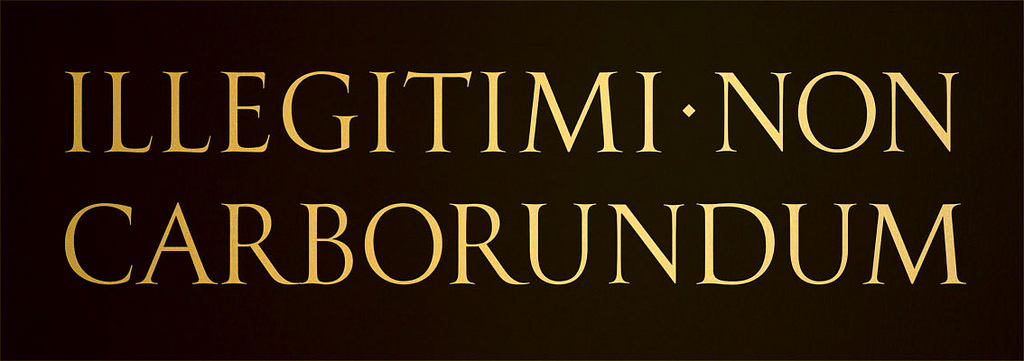
Illegitimi Non Carborundum (no matter who they are)

ImageThe aphorism “illegitimi non carborundum.” is mock-Latin for “don’t let the bastards grind you down.”

This isn’t about handling the countless rejection letters you’ll receive if you plan to pursue writing as a profession. That’s already been addressed in a previous post.

I’m talking about the little things—–the offhanded comments, the pieces of friendly advice, the hard doses of reality (meant for your own good, of course)—–that chip away at your self-confidence bit by bit and make you want to turn your back on writing.

Maybe you’re no good at it, maybe you’ll never make it as a writer, maybe you’ll never finish that novel, maybe you’ll never get your name out there, maybe no one will ever pay you for what you’ve written. So what? I’ve said it once before but it bears repeating: if you want to write, write.

You don’t need to justify your desire to do so. Ever. To anyone.

Sally forth and be writeful.

Every Picture Tells A Story, Though Not Always A Good One

It’s easy to put the boots to M. Night Shyamalan whenever he debuts a new film, but the fact of the matter is as long as Lady In The Water, The Happening and The Last Airbender exist, After Earth will never be considered his worst film.

The story, conceived by Will Smith while he was watching an episode of I Shouldn’t Be Alive, was originally meant to tell the tale of a father and son crashing their car in some remote region, and the son having to venture into rough terrain to get rescue for his father. Will later changed it to:

after-earth-1a

A crash landing leaves Kitai Raige and his father Cypher stranded on Earth, 1,000 years after events forced humanity’s escape. With Cypher injured, Kitai must embark on a perilous journey to signal for help.

It’s a simple story, which is what you should strive for when creating fiction. So, why doesn’t it work (apart from the wooden acting and bizarre futuristic southern military accents)? What storytelling lessons can you learn from After Earth?

1. When good exposition goes bad – Avoiding exposition is nigh-impossible when dealing with science fiction set in the future. In the case of After Earth, the audience needs to be brought up to speed on why humans fled the planet one thousand years ago, as well as being introduced to the new homeworld, Nova Prime. And that’s where it should end. Everything else the audience needs to know should be introduced organically. The one thing you should not use your opening expository scene for is telegraphing the solution for the climax of the story. It’s lazy and a cheat.

2. The protagonist/antagonist relationship – Even with coming of age stories, which After Earth is—–well, that and a motivational speech dressed up as a sci-fi actioner—–the strength and audience interest lies in the conflict found in the relationship between the protagonist and antagonist. The reason After Earth doesn’t ring true isn’t because the protagonist, Kitai, is weak—possessing a weakness that must be overcome is exactly what any good story needs.

The first problem is the antagonist. The thing that combats Kitai in the film is nature—which is filled with its fair share of animal and insect nasties (plus one blast from Kitai’s past, conveniently placed to help him arc properly)—but it doesn’t oppose him. There isn’t one beast that stalks him with animal cunning and outflanks him at every turn, with the ultimate goal of turning him into a tasty morsel. The wilderness isn’t planting snares and death traps in his path to prevent him from reaching his destination.

Not that either of those scenarios are particularly original or great, but something else is needed than to have Kitai stumble and bumble his way through unfamiliar and dangerous terrain. I would have been more invested if he actively tried to outwit the environment and was constantly met with defeat. At least then he would have gained some insight. We learn from mistakes.

Which is the problem I had with the resolution. At the all is lost stage, Kitai suddenly masters the gimmick that allows him to prevail in the end. Without obtaining the wisdom or acquiring the experience to properly do so. And again, it’s a cheat and lazy storytelling.

3. Telegraphing – Some writers mistake this with foreshadowing—the act of dropping hints about certain plot developments that will come to be later in the story. The difference between them? Telegraphing is giving away too much, too soon, thereby ruining the suspense, or the impact of the event.

Before using foreshadowing, have a good think. Is it necessary to heighten the tension? It can be difficult knowing which side of the line you’re on, so if you’re attempting to foreshadow, you should ask yourself if there’s any chance the audience can predict what you’re hinting at? If the answer is yes, take a good look around. You’re standing in telegraph territory. Try a subtler approach.

4. Flashbacks – It’s amazing how many screenwriters still get this wrong by thinking flashback sequences serve the purpose of filling in plot holes in the past. A well-constructed flashback should always move the story forward. Always. If your flashback doesn’t accomplish this, you need to rework your story and find a way to introduce whatever bit of information is missing from your plot.

In After Earth, we have dueling flashback sequences, one set belonging to Cypher which explains his estrangement from his son and the other set telegraphing Kitai’s final obstacle. Nether of these string-of-past-event-sequences impact the present day story, nor do they escalate the conflict. The just provide information that could have be delivered during the Act 1 set-up.

Naturally, there are other problems I had with this film, but delving into them would reveal too many spoilers, so I’ll just end the post here. If you happen to see the film and want to discuss it, feel free to comment below or drop me a line.

Sally forth and be writeful.