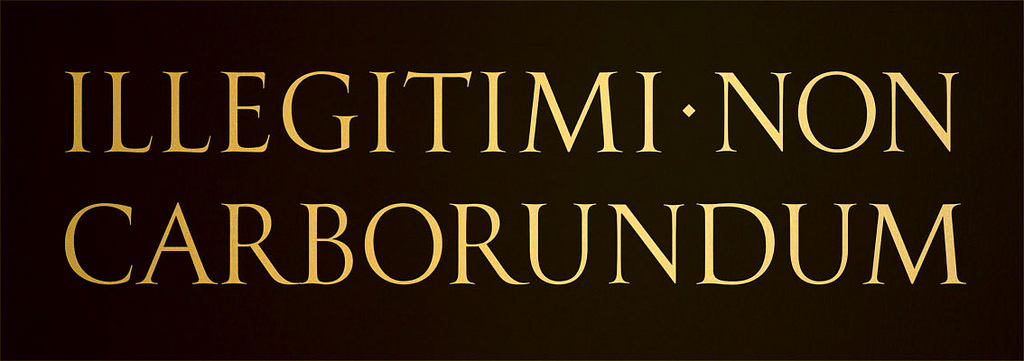
Illegitimi Non Carborundum (no matter who they are)

ImageThe aphorism “illegitimi non carborundum.” is mock-Latin for “don’t let the bastards grind you down.”

This isn’t about handling the countless rejection letters you’ll receive if you plan to pursue writing as a profession. That’s already been addressed in a previous post.

I’m talking about the little things—–the offhanded comments, the pieces of friendly advice, the hard doses of reality (meant for your own good, of course)—–that chip away at your self-confidence bit by bit and make you want to turn your back on writing.

Maybe you’re no good at it, maybe you’ll never make it as a writer, maybe you’ll never finish that novel, maybe you’ll never get your name out there, maybe no one will ever pay you for what you’ve written. So what? I’ve said it once before but it bears repeating: if you want to write, write.

You don’t need to justify your desire to do so. Ever. To anyone.

Sally forth and be writeful.

Every Picture Tells A Story, Though Not Always A Good One

It’s easy to put the boots to M. Night Shyamalan whenever he debuts a new film, but the fact of the matter is as long as Lady In The Water, The Happening and The Last Airbender exist, After Earth will never be considered his worst film.

The story, conceived by Will Smith while he was watching an episode of I Shouldn’t Be Alive, was originally meant to tell the tale of a father and son crashing their car in some remote region, and the son having to venture into rough terrain to get rescue for his father. Will later changed it to:

after-earth-1a

A crash landing leaves Kitai Raige and his father Cypher stranded on Earth, 1,000 years after events forced humanity’s escape. With Cypher injured, Kitai must embark on a perilous journey to signal for help.

It’s a simple story, which is what you should strive for when creating fiction. So, why doesn’t it work (apart from the wooden acting and bizarre futuristic southern military accents)? What storytelling lessons can you learn from After Earth?

1. When good exposition goes bad – Avoiding exposition is nigh-impossible when dealing with science fiction set in the future. In the case of After Earth, the audience needs to be brought up to speed on why humans fled the planet one thousand years ago, as well as being introduced to the new homeworld, Nova Prime. And that’s where it should end. Everything else the audience needs to know should be introduced organically. The one thing you should not use your opening expository scene for is telegraphing the solution for the climax of the story. It’s lazy and a cheat.

2. The protagonist/antagonist relationship – Even with coming of age stories, which After Earth is—–well, that and a motivational speech dressed up as a sci-fi actioner—–the strength and audience interest lies in the conflict found in the relationship between the protagonist and antagonist. The reason After Earth doesn’t ring true isn’t because the protagonist, Kitai, is weak—possessing a weakness that must be overcome is exactly what any good story needs.

The first problem is the antagonist. The thing that combats Kitai in the film is nature—which is filled with its fair share of animal and insect nasties (plus one blast from Kitai’s past, conveniently placed to help him arc properly)—but it doesn’t oppose him. There isn’t one beast that stalks him with animal cunning and outflanks him at every turn, with the ultimate goal of turning him into a tasty morsel. The wilderness isn’t planting snares and death traps in his path to prevent him from reaching his destination.

Not that either of those scenarios are particularly original or great, but something else is needed than to have Kitai stumble and bumble his way through unfamiliar and dangerous terrain. I would have been more invested if he actively tried to outwit the environment and was constantly met with defeat. At least then he would have gained some insight. We learn from mistakes.

Which is the problem I had with the resolution. At the all is lost stage, Kitai suddenly masters the gimmick that allows him to prevail in the end. Without obtaining the wisdom or acquiring the experience to properly do so. And again, it’s a cheat and lazy storytelling.

3. Telegraphing – Some writers mistake this with foreshadowing—the act of dropping hints about certain plot developments that will come to be later in the story. The difference between them? Telegraphing is giving away too much, too soon, thereby ruining the suspense, or the impact of the event.

Before using foreshadowing, have a good think. Is it necessary to heighten the tension? It can be difficult knowing which side of the line you’re on, so if you’re attempting to foreshadow, you should ask yourself if there’s any chance the audience can predict what you’re hinting at? If the answer is yes, take a good look around. You’re standing in telegraph territory. Try a subtler approach.

4. Flashbacks – It’s amazing how many screenwriters still get this wrong by thinking flashback sequences serve the purpose of filling in plot holes in the past. A well-constructed flashback should always move the story forward. Always. If your flashback doesn’t accomplish this, you need to rework your story and find a way to introduce whatever bit of information is missing from your plot.

In After Earth, we have dueling flashback sequences, one set belonging to Cypher which explains his estrangement from his son and the other set telegraphing Kitai’s final obstacle. Nether of these string-of-past-event-sequences impact the present day story, nor do they escalate the conflict. The just provide information that could have be delivered during the Act 1 set-up.

Naturally, there are other problems I had with this film, but delving into them would reveal too many spoilers, so I’ll just end the post here. If you happen to see the film and want to discuss it, feel free to comment below or drop me a line.

Sally forth and be writeful.

The Opinions Expressed Do Not Necessarily Reflect blah-blah-blah…

The internet is filled with writers who either write for attention, because they’re bored, to fit in, to crack wise, to ruin people’s day, to shamelessly hawk their wares, to make connections, to share experiences, etc. These are generally people who write because they can. Nothing wrong with that, but I’m not addressing those writers today.

I’d like to take a moment to turn the spotlight on the people who write because they have to. People with voices that won’t be silenced. Those invisible few who write to be seen. To whom candid writing is a necessity in order to make their message more relatable, significant, profound, and enduring.

I have a friend, well, that’s a bit of a stretch—that term is so inappropriately applied these days—more like an online acquaintance that I’m on friendly terms with (at present), whom I admire, even though I don’t always agree with their views or the appropriateness and timing in which they’re injected into a conversation.* But I respect the hell out of the person because they aren’t afraid of not being liked.

Different from finding your voice–I’ll address that in a future post–not being afraid to express an honest, unfavorable opinion for fear of losing fans or raising the ire of the audience is not only an admirable trait but also a fundamental step toward becoming a better writer.

It’s essential to develop the ability to say something important without getting hung up on the word important. There are those who put forward the challenge to only write what’s missing in the world. It’s a nice sentiment but the knowledge of what’s missing from the world is already out there and has probably, with all due respect, been written by someone more intelligent and eloquent than yourself. What’s missing from the world is the people’s willingness to put worldwide love, caring, peace and understanding into action, despite your personal views or belief system. There is obviously nothing wrong with writing about this… just as there’s nothing wrong with writing about what feels important to you.

So, what separates the “because I can” and “because I must” writers? The musters have generally identified and clarified their unique worldview. The keyword in the sentence is unique. Every writer has a worldview, even if they aren’t consciously aware of it, often adopted from one particular media source or a friend or relative. That’s a great starting point, but to be an authentic writer you need to know what you believe. What are your values? What do you stand for? How do you interpret life? Be aware that as you grow, your worldview will shift and your writing will become more candid.

Musters also strive to be clear and accurate in their writing as their goal is to reveal the truth.  They tend to be selective with words because they appreciate the potential words have to create images that make their audience feel something profound and enduring.

In summary, write candidly, speak your mind. Say something important. If someone isn’t going to like you because of your opinion, let them dislike the real you. Better that than currying favor with folks who only like you for who you pretend to be, in my far-from-humble opinion.

But what do I know? I just write a blog.

Sally forth and be writeful.

*If we have an online relationship and you think this post is about you, you’re not vain at all, in fact, you’re probably right. Doesn’t mean I don’t have mad love for ya, kiddo.

Writers Are Defined by the Words They Use

“In the most basic way, writers are defined not by the stories they tell, or their politics, or their gender, or their race, but by the words they use. Writing begins with language, and it is in that initial choosing, as one sifts through the wayward lushness of our wonderful mongrel English, that choice of vocabulary and grammar and tone, the selection on the palette, that determines who’s sitting at that desk. Language creates the writer’s attitude toward the particular story he’s decided to tell.” — Donald E. Westlake

Annie Proulx Suggests You Live Before You Write

Spend some time living before you start writing. What I find to be very bad advice is the snappy little sentence, “Write what you know.” It is the most tiresome and stupid advice that could possibly be given. If we write simply about what we know we never grow. We don’t develop any facility for languages, or an interest in others, or a desire to travel and explore and face experience head-on. We just coil tighter and tighter into our boring little selves. What one should write about is what interests one.

Frank Conroy: “The Author Makes A Tacit Deal with the Reader”

The author makes a tacit deal with the reader. You hand them a backpack. You ask them to place certain things in it—to remember, to keep in mind — as they make their way up the hill. If you hand them a yellow Volkswagen and they have to haul this to the top of the mountain—to the end of the story—and they find that this Volkswagen has nothing whatsoever to do with your story, you’re going to have a very irritated reader on your hands.

Have No Unreasonable Fear of Repetition

Have no unreasonable fear of repetition. True, the repetition of a particular word several times in the same paragraph can strike a jarring note, but ordinarily the problem arises differently. The story is told of a feature writer who was doing a piece on the United Fruit Company. He spoke of bananas once; he spoke of bananas twice; he spoke of bananas yet a third time, and now he was desperate. “The world’s leading shippers of the elongated yellow fruit,” he wrote. A fourth banana would have been better. — James J. Kilpatrick

The Arrogance of Presumption

write_wicked_good_black_logo_bumper_sticker-rda7a88b1f4ad4c758065ba89ce3a5282_v9wht_8byvr_512

“There is no excuse. If you want to write, write. This is your life, you are responsible for it. You will not live forever. Don’t wait. Make the time now.” ― Natalie Goldberg

On occasion, people stuck in a writing rut seek advice, which has become harder to dispense without sounding like a scribe’s bumper-sticker, especially since you can’t swing Schrödinger’s cat on the interwebz without hitting hundreds of inspirational tips and tidbits.

The simple, honest and truest bit of advice is to write. Write when you’re too tired to write. Write when writing hates your very existence. Write when words have moved out of your head in the wee hours of the night and left no forwarding address. Write when every word you put to paper is like pulling teeth. Write when your inner critic is telling you you’re a talentless shit. Write when the words refuse to make sense. Just write.

But no one wants to hear that because it isn’t a magical solution offered up by a Bagger Vance muse that makes all the tumblers in their befuddled minds line up and open the creative sluice gates.

Which leaves the long way around:

So, things aren’t going your way with your writing and you might be inclined to mope around the house and bask in self-pity for What Might Have Been, but there’s no reason to get down on yourself. Wipe your tears on your sleeves, buck up and realize today marks the start of a whole new ball game. All the old bets are off. You’re back at square one and it’s time to get a new bottom line. Take all your expectation and aspiration and lay them out like cards on a table. This is the first step towards putting the pedal to the metal. You’ve got to make no bones about what you truly wish to accomplish with your writing—–aside from the ludicrous notion of instant riches and fame—–and pull no punches with yourself on the hard work needed to make your dream a reality. And if I can toss in one more tired cliché, your ship doesn’t always come in… sometimes you have to swim out and meet it halfway.

As a writer it’s important to strike a balance between the creative and rational minds. The problem with the creative mind is that it’s equipped with the arrogance of presumption that it knows all there is to know and sometimes it becomes difficult to suspend tyranny long enough to receive messages from life, the universe, the inner muse, and—if you can stretch your fantasy muscles around the strange-but-true notion—your future self. Scoff all you like, but the part of you that exists on a higher plane of consciousness occasionally tries to contact you in order to provide panoramic views of the far horizon. The messages may be brief and strange, or they may appear in a matter-of-fact guise in the midst of your daily routine. Either way, if you turn a blind eye to the minute workings of the world all around you, you may be missing pithy pointers on how to shape your life’s mission to become a happy writer—–note that I didn’t say a successful writer, writing should first and foremost lead to happiness and fulfillment—–in the near and distant future.

A more metaphorical view on encountering obstacles in moving your writing forward is akin to walking in the deep dark forest and encountering a savvy old crone camouflaged as a wolf. Your fear, already swarming because of the unfamiliarity of your surroundings, kicks instantly into high gear, causing you to flee before you can see through the disguise. But now that you know the truth, go back and find the crone again. She has much to teach you about harvesting the treasure that comes from the deep recesses of the creative mind and taking aggressive measures to build up your confidence and mental wellness. Stop talking about and start manifesting the dream, and get as bawdy and funky as you dare.

Those last three paragraphs are a bit cringe-inducing, aren’t they? And they sound like a load of gibberishy nonsense. So, why not take the simple advice and…

Just write.

Sally forth and be writeful.

— Rhyan Scorpio-Rhys

Writer’s Rut Is A Pain In The Butt

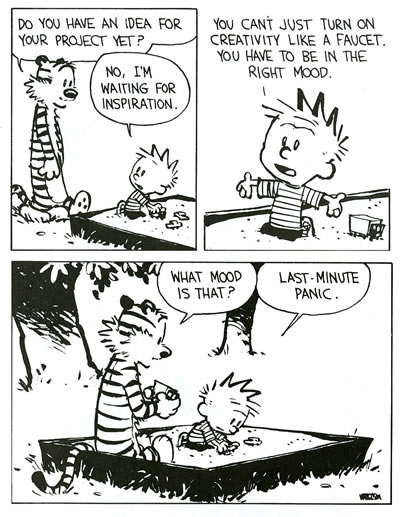
Calvin and Hobbes PanicWell, it is if you actually believe in it. I’ve run into more than my fair share of scribes who emphatically state that writer’s block is about as real as Santa, the Easter Bunny, or Steven Spielberg’s dinosaurs. I’m of the opinion that if it’s real to you, then it exists. But whichever side of the fence you personally stand on, there’s no denying the fact that writers, somewhere during the process of penning their magnum opus, can get stuck.

The first telltale sign of blockage is Oculos Computator, better known as The Stare. If you’ve ever experienced it, you know exactly what I mean. Hinder parked in your favorite writing chair, knuckles cracked, fingers nimble and hovering above your keyboard… when you become mesmerized by the siren song—I always hear Bali Hai from South Pacific—of the vast white void of your computer screen.

But you’re a determined writer, so you shake it off, gird your loins, and make resolute your desire to put words to paper. The problem is you can’t. That scene that’s so clear in your mind has suddenly become uncomfortable and difficult to write. Your synopsis refuses to mold itself into story form. An unbridgeable chasm has open up between you and the end of the story. The next scene (or chapter) is an empty pit of nothingness that stares back at you like the abyss and mocks your talent and very existence. Somehow—not through any fault of your own, surely—your characters have all been written into inescapable corners. But you have to write, that ache is in your bones, so what do you wind up doing? You rewrite, edit, rewrite, and edit what’s already been written instead of moving on.

That, my friend, is the kiss of death for creativity.

So, what are the workarounds? Hate to break it to ya, kiddo, but there ain’t no one surefire method. It’s like that line from the Diff’rent Strokes theme, “What might be right for you, may not be right for some.”

What’s that? You think that’s a cop out answer? You want what? Actual advice, even though everybody and their mother uses a different approach? Fine. Here are some of the more popular methods, in a nutshell:

Plot the story out beforehand. It’s akin to knowing the destination before you begin the journey. Stop whinging, you artsy bastard. Sure, preplanned structure can be viewed as limiting the creative spontaneity of your currently unwritten baby, but it’s only a suggested story path that you can alter along the way. Nothing’s written in stone—rewrites’ll drive that point home soon enough, trust me—until your work has been published.

Gender swap. As silly as it might sound, tinkering with the XX and XY chromosomes of your protagonist or antagonist actually helps change the character’s viewpoints and perspective. Or if you’re not up to playing God—who are you kidding? You’re a writer. You think you’re God, go on and admit it—try switching up your writing style. If you normally write in first person, why not give third person a go?

Dora, of Explorer fame, is keen to shout, “Swiper, no swiping!” But you ain’t her and no one’s watching, so why not rip a page from the Star Trek TV series plot device book (from Next Generation to Enterprise) and give your characters a mini goal they must accomplish and pair them up with other characters they absolutely cannot stand. Conflict is story. Just ask Moses. It was written on the back of one of the stone tablets. Trust me on this.

Don’t allow yourself to get hung up on formatting, grammar, punctuation, spelling, capitalization, and all that crap, and save editing for the very end. Right now, your goal is to transport that nagging story from the ether of your mind and plunk it firmly down on the page. You’ll have plenty of time to go back and gussy it up later.

And the simplest bit of advice I can offer any of you lazy sods who positively hates following patterns and formulas or doing any sort of precursor to writing; the quick and dirty solution to putting the boots to writer’s block is to stop waiting for your muse—she’s really not that into you and it’s embarrassing how you chase her around like a lovesick puppy—and simply write. Let your thoughts spill out and let it be awful and unstructured and nonsensical, just as long as you’re actively engaging in the process of writing. Hell, start a blog. Works for me.

Now, what are you doing still staring at this? Stop procrastinating. Sally forth and be writeful.

— Rhyan Scorpio-Rhys

Your Writing Says More About Your Character Than You Realize

Image

Creating worlds? That’s the easy bit. Populating them with three dimensional characters… that’s a bit trickier. Whether you write for a living, a hobby, for sport, or just to have a laugh, you will eventually reach a point in your storytelling where you’re forced to pluck the innocent bystanders from your life and slap them smack dab in the middle of your literary dreamscape. Don’t be embarrassed. It happens to us all.

But just because a fictional character has a fleshy counterpart, imbued with their quirks, verbal crutches and personality tics, it doesn’t always mean they’re actually memorable.

So, how do you combat that? Dig, my friend. You need to burrow underneath the surface layer affectations and unearth the true source of their core character and examine what piqued your interest in the first place.

Even the most boring person you know can be a source of inspiration in your writing if you scratch the surface carefully enough. As corny as it sounds, we all carry within us a wealth of creativity and inspiration. Your job is to look deeper.

One of the most important parts of being a writer, aside from textual flourishes and clever turns of phrase, is the ability to see the world, both the one you’re creating and the one you live in, through their eyes. What are their views on major and minor things? Are they blessed or cursed with odd perceptions of the way the world should and/or actually works? Do they engage in activities that exist outside social norms?

Once you’ve identified these tidbits, you have the first building blocks for your memorable character’s foundation. But it’s only the beginning. You’ll need to build on this in order to make your newly birthed person dynamic.

Since you’re not creating a clone or an exact replica of your best bud or the nosy neighbor down the hall who tracks you via her peephole every time you leave or enter your front door—seriously, lady, get a life—you’ll want to take a few pages from Baron Victor von’s notebook and Frankenstein your creation up a bit.

If you do your job properly, your patchwork person will seem more believable because they contain traits your friends have that you secretly covet—we covet what we see everyday, Clarice—family member habits that absolutely drive you up the wall, as well as the little insecure bits of yourself you pray nobody really notices (FYI: they do, they’re just too polite to bring it up in conversation). Stop moaning, you’ll always be a part of the mix. You can’t help it. You’re the person you know the best. Yup, it’s true and you heard it here first.

The best thing about your ethereal Prometheus is only you will be able to see the stitches that hold the monstrosity together. To everyone else, the jigsaw pieces fit together seamlessly. But you’re still not done.

You can’t have your bouncing baby entity walking around all starkers—well, you can if you’re writing one of those 50 Shades thingies—so you’ll need to dress them with your imagination and layer in true life details like articles of clothing, substantiating them as a new independent life form while better solidifying your understanding of them.

Then, to top things off, dab them with a little Eau de real desires—just behind the ears—and spray obstacles in the air and have them walk through the mist, before you powder them down with motivations.

And voilà! Take a step back and view your bonafide multidimensional, absolutely-fictional-but-seems-so-damn-real-it’s-scary character. Now all you have to do is repeat the process several more times.

Hey, I never said this would be easy.

Sally forth and be writeful.

— Rhyan Scorpio-Rhys