
The author makes a tacit deal with the reader. You hand them a backpack. You ask them to place certain things in it—to remember, to keep in mind — as they make their way up the hill. If you hand them a yellow Volkswagen and they have to haul this to the top of the mountain—to the end of the story—and they find that this Volkswagen has nothing whatsoever to do with your story, you’re going to have a very irritated reader on your hands.
Tag Archives: screenplay

Have No Unreasonable Fear of Repetition
Have no unreasonable fear of repetition. True, the repetition of a particular word several times in the same paragraph can strike a jarring note, but ordinarily the problem arises differently. The story is told of a feature writer who was doing a piece on the United Fruit Company. He spoke of bananas once; he spoke of bananas twice; he spoke of bananas yet a third time, and now he was desperate. “The world’s leading shippers of the elongated yellow fruit,” he wrote. A fourth banana would have been better. — James J. Kilpatrick

The Arrogance of Presumption
“There is no excuse. If you want to write, write. This is your life, you are responsible for it. You will not live forever. Don’t wait. Make the time now.” ― Natalie Goldberg

On occasion, people stuck in a writing rut seek advice, which has become harder to dispense without sounding like a scribe’s bumper-sticker, especially since you can’t swing Schrödinger’s cat on the interwebz without hitting hundreds of inspirational tips and tidbits.
The simple, honest and truest bit of advice is to write. Write when you’re too tired to write. Write when writing hates your very existence. Write when words have moved out of your head in the wee hours of the night and left no forwarding address. Write when every word you put to paper is like pulling teeth. Write when your inner critic is telling you you’re a talentless shit. Write when the words refuse to make sense. Just write.
But no one wants to hear that because it isn’t a magical solution offered up by a Bagger Vance muse that makes all the tumblers in their befuddled minds line up and open the creative sluice gates.
Which leaves the long way around:
So, things aren’t going your way with your writing and you might be inclined to mope around the house and bask in self-pity for What Might Have Been, but there’s no reason to get down on yourself. Wipe your tears on your sleeves, buck up and realize today marks the start of a whole new ball game. All the old bets are off. You’re back at square one and it’s time to get a new bottom line. Take all your expectation and aspiration and lay them out like cards on a table. This is the first step towards putting the pedal to the metal. You’ve got to make no bones about what you truly wish to accomplish with your writing—–aside from the ludicrous notion of instant riches and fame—–and pull no punches with yourself on the hard work needed to make your dream a reality. And if I can toss in one more tired cliché, your ship doesn’t always come in… sometimes you have to swim out and meet it halfway.
As a writer it’s important to strike a balance between the creative and rational minds. The problem with the creative mind is that it’s equipped with the arrogance of presumption that it knows all there is to know and sometimes it becomes difficult to suspend tyranny long enough to receive messages from life, the universe, the inner muse, and—if you can stretch your fantasy muscles around the strange-but-true notion—your future self. Scoff all you like, but the part of you that exists on a higher plane of consciousness occasionally tries to contact you in order to provide panoramic views of the far horizon. The messages may be brief and strange, or they may appear in a matter-of-fact guise in the midst of your daily routine. Either way, if you turn a blind eye to the minute workings of the world all around you, you may be missing pithy pointers on how to shape your life’s mission to become a happy writer—–note that I didn’t say a successful writer, writing should first and foremost lead to happiness and fulfillment—–in the near and distant future.
A more metaphorical view on encountering obstacles in moving your writing forward is akin to walking in the deep dark forest and encountering a savvy old crone camouflaged as a wolf. Your fear, already swarming because of the unfamiliarity of your surroundings, kicks instantly into high gear, causing you to flee before you can see through the disguise. But now that you know the truth, go back and find the crone again. She has much to teach you about harvesting the treasure that comes from the deep recesses of the creative mind and taking aggressive measures to build up your confidence and mental wellness. Stop talking about and start manifesting the dream, and get as bawdy and funky as you dare.
Those last three paragraphs are a bit cringe-inducing, aren’t they? And they sound like a load of gibberishy nonsense. So, why not take the simple advice and…
Just write.
Sally forth and be writeful.
— Rhyan Scorpio-Rhys
Writer’s Rut Is A Pain In The Butt
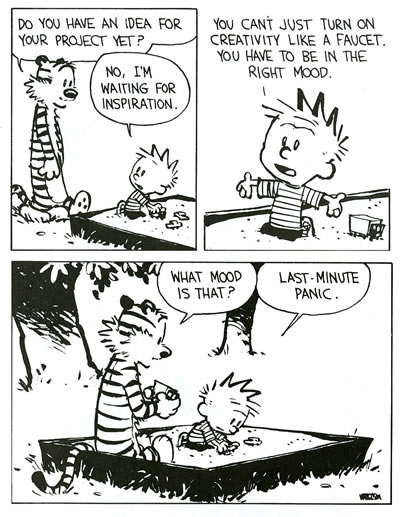 Well, it is if you actually believe in it. I’ve run into more than my fair share of scribes who emphatically state that writer’s block is about as real as Santa, the Easter Bunny, or Steven Spielberg’s dinosaurs. I’m of the opinion that if it’s real to you, then it exists. But whichever side of the fence you personally stand on, there’s no denying the fact that writers, somewhere during the process of penning their magnum opus, can get stuck.
The first telltale sign of blockage is Oculos Computator, better known as The Stare. If you’ve ever experienced it, you know exactly what I mean. Hinder parked in your favorite writing chair, knuckles cracked, fingers nimble and hovering above your keyboard… when you become mesmerized by the siren song—I always hear Bali Hai from South Pacific—of the vast white void of your computer screen.
But you’re a determined writer, so you shake it off, gird your loins, and make resolute your desire to put words to paper. The problem is you can’t. That scene that’s so clear in your mind has suddenly become uncomfortable and difficult to write. Your synopsis refuses to mold itself into story form. An unbridgeable chasm has open up between you and the end of the story. The next scene (or chapter) is an empty pit of nothingness that stares back at you like the abyss and mocks your talent and very existence. Somehow—not through any fault of your own, surely—your characters have all been written into inescapable corners. But you have to write, that ache is in your bones, so what do you wind up doing? You rewrite, edit, rewrite, and edit what’s already been written instead of moving on.
That, my friend, is the kiss of death for creativity.
So, what are the workarounds? Hate to break it to ya, kiddo, but there ain’t no one surefire method. It’s like that line from the Diff’rent Strokes theme, “What might be right for you, may not be right for some.”
What’s that? You think that’s a cop out answer? You want what? Actual advice, even though everybody and their mother uses a different approach? Fine. Here are some of the more popular methods, in a nutshell:
Plot the story out beforehand. It’s akin to knowing the destination before you begin the journey. Stop whinging, you artsy bastard. Sure, preplanned structure can be viewed as limiting the creative spontaneity of your currently unwritten baby, but it’s only a suggested story path that you can alter along the way. Nothing’s written in stone—rewrites’ll drive that point home soon enough, trust me—until your work has been published.
Gender swap. As silly as it might sound, tinkering with the XX and XY chromosomes of your protagonist or antagonist actually helps change the character’s viewpoints and perspective. Or if you’re not up to playing God—who are you kidding? You’re a writer. You think you’re God, go on and admit it—try switching up your writing style. If you normally write in first person, why not give third person a go?
Dora, of Explorer fame, is keen to shout, “Swiper, no swiping!” But you ain’t her and no one’s watching, so why not rip a page from the Star Trek TV series plot device book (from Next Generation to Enterprise) and give your characters a mini goal they must accomplish and pair them up with other characters they absolutely cannot stand. Conflict is story. Just ask Moses. It was written on the back of one of the stone tablets. Trust me on this.
Don’t allow yourself to get hung up on formatting, grammar, punctuation, spelling, capitalization, and all that crap, and save editing for the very end. Right now, your goal is to transport that nagging story from the ether of your mind and plunk it firmly down on the page. You’ll have plenty of time to go back and gussy it up later.
And the simplest bit of advice I can offer any of you lazy sods who positively hates following patterns and formulas or doing any sort of precursor to writing; the quick and dirty solution to putting the boots to writer’s block is to stop waiting for your muse—she’s really not that into you and it’s embarrassing how you chase her around like a lovesick puppy—and simply write. Let your thoughts spill out and let it be awful and unstructured and nonsensical, just as long as you’re actively engaging in the process of writing. Hell, start a blog. Works for me.
Now, what are you doing still staring at this? Stop procrastinating. Sally forth and be writeful.
— Rhyan Scorpio-Rhys
Your Writing Says More About Your Character Than You Realize
Creating worlds? That’s the easy bit. Populating them with three dimensional characters… that’s a bit trickier. Whether you write for a living, a hobby, for sport, or just to have a laugh, you will eventually reach a point in your storytelling where you’re forced to pluck the innocent bystanders from your life and slap them smack dab in the middle of your literary dreamscape. Don’t be embarrassed. It happens to us all.
But just because a fictional character has a fleshy counterpart, imbued with their quirks, verbal crutches and personality tics, it doesn’t always mean they’re actually memorable.
So, how do you combat that? Dig, my friend. You need to burrow underneath the surface layer affectations and unearth the true source of their core character and examine what piqued your interest in the first place.
Even the most boring person you know can be a source of inspiration in your writing if you scratch the surface carefully enough. As corny as it sounds, we all carry within us a wealth of creativity and inspiration. Your job is to look deeper.
One of the most important parts of being a writer, aside from textual flourishes and clever turns of phrase, is the ability to see the world, both the one you’re creating and the one you live in, through their eyes. What are their views on major and minor things? Are they blessed or cursed with odd perceptions of the way the world should and/or actually works? Do they engage in activities that exist outside social norms?
Once you’ve identified these tidbits, you have the first building blocks for your memorable character’s foundation. But it’s only the beginning. You’ll need to build on this in order to make your newly birthed person dynamic.
Since you’re not creating a clone or an exact replica of your best bud or the nosy neighbor down the hall who tracks you via her peephole every time you leave or enter your front door—seriously, lady, get a life—you’ll want to take a few pages from Baron Victor von’s notebook and Frankenstein your creation up a bit.
If you do your job properly, your patchwork person will seem more believable because they contain traits your friends have that you secretly covet—we covet what we see everyday, Clarice—family member habits that absolutely drive you up the wall, as well as the little insecure bits of yourself you pray nobody really notices (FYI: they do, they’re just too polite to bring it up in conversation). Stop moaning, you’ll always be a part of the mix. You can’t help it. You’re the person you know the best. Yup, it’s true and you heard it here first.
The best thing about your ethereal Prometheus is only you will be able to see the stitches that hold the monstrosity together. To everyone else, the jigsaw pieces fit together seamlessly. But you’re still not done.
You can’t have your bouncing baby entity walking around all starkers—well, you can if you’re writing one of those 50 Shades thingies—so you’ll need to dress them with your imagination and layer in true life details like articles of clothing, substantiating them as a new independent life form while better solidifying your understanding of them.
Then, to top things off, dab them with a little Eau de real desires—just behind the ears—and spray obstacles in the air and have them walk through the mist, before you powder them down with motivations.
And voilà! Take a step back and view your bonafide multidimensional, absolutely-fictional-but-seems-so-damn-real-it’s-scary character. Now all you have to do is repeat the process several more times.
Hey, I never said this would be easy.
Sally forth and be writeful.
— Rhyan Scorpio-Rhys
Greets The Lightning, Fears The Thunder

Although the rough draft was completed years ago, I finally put the spit and polish touches on the official first draft of my favorite horror screenplay, “Greets The Lightning, Fears The Thunder.” And while the screenplay format might be new, the story isn’t. “Greets” first saw life as a short story written for a long-forgotten vanity press, Writerarium, way back in the Fall of 1988. It was loosely based on actual events involving my then girlfriend who suffered from a severe case of astraphobia and night terrors.
There’s a strange sense of satisfaction in breathing new life into old work that I wish I experienced more often, Most times, old stories lose their malleability, having found contentment in their original form. This work fought me a little as well, but in the end we were able to come to a suitable compromise (which is a fancy way of saying the story allowed itself to be written by me).
This draft went up for review on the Trigger Street Labs site on May 15, 2013 and the first review was:
“This is an action packed, intense thriller!
I’d love to see this made into a movie. I feel like your dialogue and script feels well developed. I feel like maybe more comic relief would break up the intense moments. But overall really well written.
Your opening scene really sucked me in and I couldn’t stop reading. I couldn’t tell if it was a dream she was having or real at the beginning.
i liked the flashback scenes to Africa – so you get the background story. I feel like this was a perfect way to get the information you needed about Leyna.
The ending was awesome, gives you the notion that there was more to the elements than we knew. That maybe Gordon is now a catalyst of the bird… I loved the ending.”
“Greets” then got the screenplay review treatment on June 3, 2013, by the New York City Screenwriters Collective.
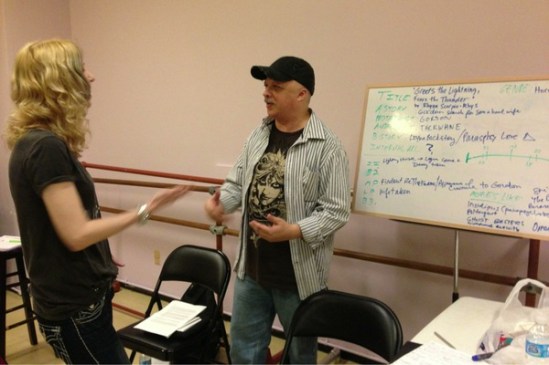


Unaltered, “Greets” was subjected to a third round of script review, this time in Los Angeles on February 2, 2014, courtesy of Write Club.
The draft was subjected to a fourth round of script review in Los Angeles on April 1, 2014, courtesy of the Malibu Screenwriting Group.
Still unaltered, “Greets” was subjected to a fifth round of script review in Los Angeles on April 20, 2014, courtesy of the Inktank Screenwriting Group.
The only reason I’m blogging about it now is because the story has been on my mind, not foremost, I’m working on another screenplay at the mo with a difficult Act 2, and “Greets” is on the back burner tempting me to pull it out of mothballs for another go-round, assuring me that is won’t give me a hard time during the rewriting process. We both know it’s a lie.
It’s a selfish story, jealous of all its siblings, and it never misses a beat to try to get my attention when I’m struggling with a scene, or a patch of dialogue. But when it has a turn at bat, it gives me the same problems as always, and never apologizes for being difficult.
Unlock Your Inner Story

They say, “Everyone has at least one good book in them” and while I think book might be a bit of a stretch, I wholeheartedly believe that everyone has at least one good story in them. The natural length—the pure story without padding or the encumbrance of unnecessary detail or description—of which can range from flash fiction (under 1,000 words) to short story (under 7,500 words) to novelette (7,500 to 17,500 words) to novella (17,500 to 40,000 words) to a proper novel (over 40,000 words).
No matter how non-creative you believe yourself to be, your brain is nonetheless gifted with the special ability of imagination, and regardless of how infrequently you put it to use, you still are able to dream up intricate realities, despite your age or IQ level. Haven’t we all, at one time or another, projected a new reality in our minds in the form of daydreaming our desires? And no two daydreams are exactly the same since we each possess unique preferences, points of view, wants and needs.
Yet, even armed with the knowledge of this gift, we, as writers, tend to suffer because we either do not fully believe in or properly comprehend our true nature as creators. Sure, we continue to imagine “what if” scenarios but sometimes we find it difficult to allow those thoughts to flow through us—the conduit—and blossom into the stories they need to become.
The following list isn’t a step-by-step “how to” guide, because no one can tell you precisely what you need to do to access your inner story. You are a totally unique entity, after all. View it more as a broom to help you sweep away the clutter piled up on the footpath to your personal tale.
1. Examine your self-image.
The first battle you must face is the one against your self-image. You are more than pen and paper, more than a keyboard, more than “just another writer” or more than whatever obstacle your past or conditioning has placed in your path. The main reason why most writers fail to connect with their inner story is because of their limited knowledge of who they truly are.
As flawed human beings we are so engrossed with the perceptions of who we are that we fail to see that we are usually the source for the reality we have created for ourselves. Sure, the walls of the prison may have been constructed by events of the past, by family, peers or environment, but we continue to fortify the walls and never once open the lock–the key is always in our possession–push the cell door to step out into freedom.
This in no way suggests you have to deconstruct your self-image–unless that’s your goal, then by all means, have at it. You’re merely peeling away the layers of the identity you’ve created for yourself for societal purposes and exposing your core self, the real you. Don’t worry, it’s only for the exercise of writing. You can reapply your layers once you’re done.
Your secret identity is safe with me.
2. Take note of your gifts.
Different from writer traits–talent, the hunger for knowledge, and diligence–a writer’s gift can range from an eye for detail, to a flair for description, to a talent for dialogue. Or, you might not even be aware of your talents, so I want you to grab a piece of paper and something to write with and in 60 seconds jot down a list of what you’re good at. Don’t think about it. Simply jot down, off the top of your head, the things that come easiest to you when you write.
All done? Now take a long, hard, honest look at your list. The things you don’t concentrate on, those bits and bobs that just sort of come naturally to you when you write… those are your gifts. You’d be surprised to discover how many writers aren’t aware of their innate skills because they aren’t utilized in their everyday work lives and wind up being placed in the “Hobby” category.
3. Exploit your strengths.
Since you’re bothering to read this, my guess is that you’ve written a couple of pieces already and maybe even finished a few of them. Now, if you’re an avid reader, you will have no doubt compared your piece to your author idols, and have developed the brutally honest ability to cast a critical eye upon your own work and spot areas in your writing that aren’t as strong as others. And since the writing isn’t perfect, you are therefore a horrible writer who should no longer legally be allowed to string a sentence together in an email, let alone write a story.
Maybe it’s true. Maybe you really are a bad writer–hey, they exist–but that’s not my call to make. I don’t know you, so I’ll assume you at least have some fundamental writing potential. However, no matter how good you are, there is one basic truth you must learn to face: Your writing will never be perfect. Why? As stated in a previous post: Because wunderkind wasn’t conveniently inserted into your backstory, and perfection isn’t DNA-encodable at this point in time. Still, you should always strive to get your writing as close to perfection as you can manage, and accept the fact that: It. Will. Not. Be. Perfect.
Maybe you can’t write a convincing love scene. Maybe you struggle with organic dialogue. Maybe you get stumped when attempting to create a character’s internal arc. Maybe you’re rubbish at tying up all your story’s loose threads. Console yourself in the knowledge that you wouldn’t be the first. A few of these “weaknesses” and more are true for authors of published works, some of which even make bestseller lists.
And because, as a writer, you are always a student and ever pushing yourself and learning new ways to hone your craft, you will eventually learn to strengthen your weaknesses. In the meantime, put all of the aspects of your writing into perspective, make a deal to stop beating yourself up so much, and focus on your strengths. They’re your “A” game.
4. Gird your loins against the enemy.
In addition to dealing with possible self-image barriers, there are other obstacles that can block your path: Fear, intimidation, procrastination, and self-doubt. The problem with these buggers is that they often take the form of lies you tell yourself. And they happen to be effective as hell because they insulate your brain from facing unpleasantries, in this case the difficult portions of the writing process that you need to slog through in order to strike gold.
The biggest lie you can tell yourself as a writer is, “I’ll do it later.” It’s a dishonest postponement because later never comes. If you don’t confront the enemies that keep you from your writing and tamp the bastards down long enough to complete your piece, then you don’t have what it takes to be a writer. Staring into the gaping maw of the harsh realities that terrify you is one of the most important parts of the process.
Slap a “H” on your chest and “Handle” it.
5. Identify your genre.
At this point, you arch an eyebrow and ask, “Rhyan, how can anyone not know the genre of their story?”
The answer lies within the fact that writers are creators. Some are resistant to the notion of placing labels or classifications on their work. For others, classification difficulties arise when their piece contains elements from several genres as some writers disagree with the act of limiting creative freedom in order to adhere to strictly delineated genre segregation.
For your audience, knowing the genre sets not only the stage, but their expectations as well, and puts them in the proper mindset to both understand and accept the rules of your story.
At this stage in the process, the importance of identifying your genre has to do with story mechanics. Certain elements step to the forefront and operate differently depending on genre, so you should be aware of the rules of the category–even if you decide to break them because of the maverick you are–as you’re arranging your idea into the proper story structure (see: Simple Anatomy of a Plot Outline).
6. Plant your feet firmly in the soil of your story.
This is your story. First and foremost, it must feel natural to you. No matter how fantastical the environment, how outrageous the yarn you’re spinning, if you don’t feel confident in the pocket dimension you’ve created, there’s little chance of you selling the story as being credible. Your job is to take utter nonsense and portray it with as much authenticity as possible.
7. Go with your gut.
Some people seek permission to write. Thinly disguised under the “Oh, it’s just an idea I’m toying with” veil, they will ask family and friends if they should write about such-and-such or if this-that-or-the-other-thing would make an interesting topic.
I urge you not to be this person.
I’m reminded of a quote by Jerome Lawrence, “The whole point of writing is to have something in your gut or in your soul or in your mind that’s burning to be written.” So, if you can actually feel inspiration or instinct churning like hot snakes in your gut to write, forget the opinions of those around you, disregard the idea of “should” and just go for it.
Never live with regret, if you can help it.
8. Do it now. No better time than the present.
To snatch a line from Pixar’s Ratatouille “Why not here? Why not now?”
By now you know you must show up for writing everyday, and there’s no time like the present. So, why not find yourself a quiet spot, practice listening, and trust what you hear. That’s your inner story talking to you, and it not only has to be unlocked but it must be accessible at will.
I know it’s become hackneyed to instruct you to follow your bliss, but if you deny your instincts to do what you truly want to do, then the problem becomes one of trust. Do you trust the voice within you or do you trust reality as you are made to perceive it? Or, are you willing to trust the voice and write what you hear, no matter how crazy it sounds?
You have to learn to be compassionate with yourself, as well as having compassion for yourself. Especially during the vulnerable times when you’re blocked and can’t bring yourself to write because you’re scared you’ll be rejected. Take some small comfort in knowing you’re not alone in this.
Since all art must be criticized, every single published author had to overcome fear of rejection. What you need to keep in mind is that your audience–human, just the same as you–can only relate to your writing from their own experience, and sometimes their feedback will be negative. That doesn’t necessarily indicate problems in your writing, and may simply reflect a varying viewpoint.
But fear of rejection has no business rearing its ugly head right now as it’s time for you to honor your inner story by listening to the words it shares with you and writing about it. Trust me, if you’re willing to enjoy the process, you can write damn near anything.
So, why not sally forth and be inner story writeful?
— Rhyan Scorpio-Rhys
Famous Thoughts on Grammar and Usage

1. “You can be a little ungrammatical if you come from the right part of the country.” — Robert Frost
2. “Word has somehow got around that the split infinitive is always wrong. That is a piece with the outworn notion that it is always wrong to strike a lady.” — James Thurber
3. “It is indeed acceptable practice to sometimes split an infinitive. If infinitive-splitting makes available just the shade of meaning you desire or if avoiding the separation creates a confusing ambiguity or patent artificiality, you are entitled to happily go ahead and split!” — Richard Lederer
4. “When you catch an adjective, kill it.” — Mark Twain
5. “The adjective is the banana peel of the parts of speech.” — Clifton Fadiman
6. “The adjective is the enemy of the noun.” — Voltaire
7. “If the noun is good and the verb is strong, you almost never need an adjective.” — J. Anthony Lukas
8. “Don’t say it was ‘delightful’; make us say ‘delightful’ when we’ve read the description. You see, all those words (horrifying, wonderful, hideous, exquisite) are only like saying to your readers ‘Please will you do my job for me?’” — C.S. Lewis
9. “Forward motion in any piece of writing is carried by verbs. Verbs are the action words of the language and the most important. Turn to any passage on any page of a successful novel and notice the high percentage of verbs. Beginning writers always use too many adjectives and adverbs and generally use too many dependent clauses. Count your words and words of verbal force (like that word “force” I just used).” — William Sloane
10. “The editorial ‘we’ has often been fatal to rising genius; though all the world knows that it is only a form of speech, very often employed by a single needy blockhead.” — Thomas Baington Macaulay
11. “Only presidents, editors and people with tapeworm have the right to use the editorial ‘we.’” — Mark Twain
Writing Joke of the Day: Comforting a Grammar Nazi

English Professor
“In English,” he said, “A double negative forms a positive. In some languages, though, such as Russian, a double negative is still a negative. However, there is no language wherein a double positive can form a negative.”
A voice from the back of the room piped up, “Yeah, right.”
Library
A Texan was visiting Harvard University, and was lost. He stopped a student and asked, “Do you know where the library is at?”
“I sure do,” replied the student, “But, you know, you’re not supposed to end sentences with prepositions.”
“What?”
“Prepositions. You ended your sentence with an ‘at’, which you aren’t supposed to do.”
“Oh, ok,” said the Texan, “Do you know where the library is at, asshole?”
Grammar walks into a Bar
Three intransitive verbs walk into a bar. They sit. They Drink. They Leave
A comma splice walks into a bar, it has a drink and then leaves.
A dangling modifier walks into a bar. After finishing a drink, the bartender asks it to leave.
A Question mark walks into a bar?
Two Quotation marks “walk into” a bar.
A gerund and an infinitive walk into a bar, drinking a drink.
The bar was walked into by the passive voice.
The past, the present, and the future walked into a bar. It was tense.
A synonym ambles into a pub.
A gerund and an infinitive walk into a bar, drinking to drink.
A hyperbole totally ripped into this bar and destroyed everything.
A run on sentence walks into a bar it is thirsty.
Falling slowly, softly falling, the chiasmus collapsed to the bar floor.
A group of homophones wok inn two a bar.
Panda
A panda walks into a cafe. He orders a sandwich, eats it, then draws a gun and fires two shots in the air.
“Why?” asks the confused waiter, as the panda makes towards the exit. The panda produces a badly punctuated wildlife manual and tosses it over his shoulder.
“I’m a panda,” he says at the door. “Look it up.”
The waiter turns to the relevant entry and, sure enough, finds an explanation.
“Panda. Large black-and-white bear-like mammal, native to China. Eats, shoots and leaves.”
Writing Joke of the Day: Heaven or Hell?
A writer died and was given the option of going to heaven or hell.
She decided to check out each place first. As the writer descended into the fiery pits, she saw row upon row of writers chained to their desks in a steaming sweatshop. As they worked, they were repeatedly whipped with thorny lashes.
“Oh my,” said the writer. “Let me see heaven now.”
A few moments later, as she ascended into heaven, she saw rows of writers, chained to their desks in a steaming sweatshop. As they worked, they, too, were whipped with thorny lashes.
“Wait a minute,” said the writer. “This is just as bad as hell!”
“Oh no, it’s not,” replied an unseen voice. “Here, your work gets published.”
 MADD FICTIONAL