
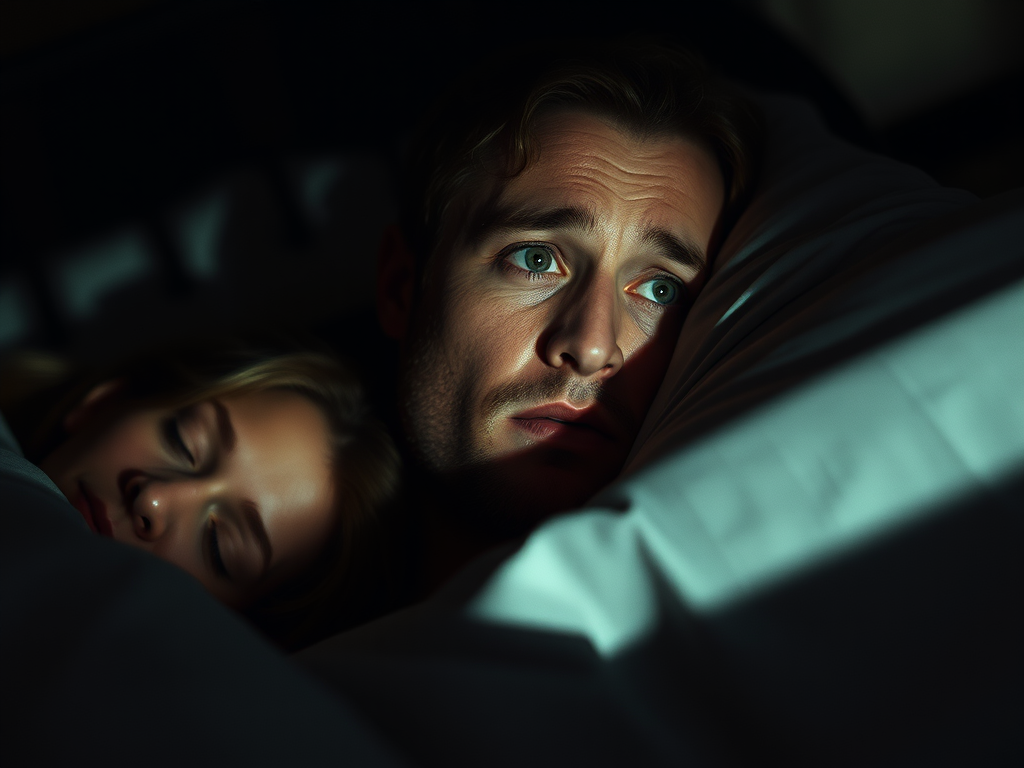
Jeremy woke with a start, a cold sweat prickling his ribs as though someone had poured ice water under his skin. His heart worked too hard in the dark. For a moment, the room didn’t feel like his—like the walls had shifted while he slept and he’d returned to a stranger’s life wearing his own face.
Beside him, Sharon breathed softly, the steady sound of someone who still believed in mornings. Her hair spilled over the pillow; her hand lay open near his, relaxed, unguarded. She murmured once and turned, and the mattress dipped with the small, ordinary weight of a real person.
But it wasn’t Sharon’s voice Jeremy had heard in the dream.
It was Olivia’s.
Not loud. Not hysterical. Just a whisper, threaded through his skull with a precision that felt practiced.
Forget me.
It didn’t land like a plea. It landed like a dare.
Jeremy lay still and tried to let the dream drain away, but it clung to him—metallic on the tongue, intimate as breath at the ear. It had been years since he’d allowed himself to think of Olivia in any serious way. Years since he’d clawed his way out of that relationship, shaking and starved for quiet, promising himself he would never again confuse chaos for love. Sharon was the proof that he’d survived. Sharon was the life he’d built with his bare hands after the fire.
And yet the dream had lit something in him. Not a memory. A craving.
Sharon shifted again, half-awake. “Bad dream?”
Jeremy swallowed. The lie arrived easily, like muscle memory. “Yeah,” he said. “Just a bad dream.”
“Come back to bed,” she murmured, soft as forgiveness.
He did. He lay down. He closed his eyes.
But inside his chest, something tightened the way it used to whenever Olivia walked into a room: that anticipatory dread disguised as electricity. The feeling wasn’t new. It was simply returning to its favorite shape.
The next day, Jeremy told himself it was nothing. The mind did what the mind did—dragged up old faces, stitched them into sleep. But the feeling didn’t dissipate. It gathered. It sharpened.
At lunch, he found himself scrolling without thinking, thumb moving as if it had its own agenda. Old text threads. Old photos that should have been deleted a long time ago, like empty bottles kept “for the glass.” Olivia’s smile in a dim restaurant. Olivia’s eyes, bright with too much certainty. Olivia on a balcony with city lights behind her, looking straight at the camera like it was a person she meant to win.
He stared too long. Then longer.
He knew the comparison. Recovering alcoholic, liquor aisle. He knew how pathetic it was to voluntarily step into the part of the brain that still thought suffering was a kind of romance. He told himself he wasn’t indulging. He was confronting. He was burying.
But the more he looked, the more the present blurred at the edges. Sharon’s texts popped up—small practical things, dinner plans, a heart emoji, a photo of something she wanted him to laugh at—and they felt strangely distant, as if they belonged to someone else’s relationship.
That night, Jeremy slept and found the bar again.
It was crowded, hot with bodies, the air thick with smoke and clinking glass. The kind of place where everyone looked half-lit, half-forgiven. And there she was, across the room, leaning against the far wall like she’d always belonged to whatever corner of the world held the most attention.
Olivia looked different. Not softer, exactly. Calmer. Familiar in a way that hurt.
She didn’t wave. She didn’t call him over.
She simply met his eyes with a quiet certainty, and the room rearranged itself around that look.
When Jeremy woke, he felt euphoric in a way that was almost embarrassing—like a teenager who’d found a secret. For a few minutes the world looked bright and sharp, as if someone had turned up the contrast. He stood at the sink brushing his teeth and caught his own eyes in the mirror, and he recognized the expression immediately: the one he used to have after Olivia had forgiven him for something she’d engineered.
The brightness faded fast. It always did. It left behind a hollow ache that gnawed at his ribs like an animal.
He spent the day irritable, restless, unanchored. Sharon asked him how work was going. He kissed her cheek and answered too quickly. He laughed at the right moments, then caught himself counting the hours until night.
He didn’t tell himself he needed Olivia. That would have been too honest, too melodramatic.
He told himself he needed the feeling again.
Just one more hit.
It wasn’t long before his feet started carrying him places without permission. He walked at night, alone, through streets that looked different after dark—less like infrastructure, more like an organism. The city pulsed with a hidden life; the shadows felt crowded with things that didn’t speak unless you were desperate enough to listen.
On one of those walks, he found the door.
It was tucked into a narrow alley between a closed café and a building that looked permanently under renovation. No branding. No posters. Just an unmarked black door and, above it, a faint neon sign that flickered as if it had trouble deciding whether to exist.
ONEIRONAUTICS.
The word meant nothing to him, and everything. It hooked under his ribs.
Jeremy stood there longer than he meant to. He should have turned around. He should have texted Sharon, asked if she wanted tea, done anything that belonged to the life he was supposedly protecting.
Instead he reached for the handle.
Inside, the air smelled wrong—not rotten, not sweet. Chemical musk, like a memory of perfume trapped in old velvet. The room was dimly lit, lined with heavy curtains that made the space feel smaller than it was. The silence had weight.
Behind a counter sat a man with an impassive face and calculating eyes. He looked up once, as if he’d been expecting Jeremy at a particular hour.
“You looking for something specific?” the man asked. His voice was detached, polite, almost bored.
Jeremy’s throat was dry. “I… heard this is the place for dreams.”
The man’s expression didn’t change, but his interest sharpened by a degree. “We deal in memories. Visions. Everything in between.” He paused. “For a price.”
Jeremy’s pulse ticked harder. The sign outside felt less like advertising now and more like an invitation he’d already accepted days ago in his sleep.
“Give me something that brings back the past,” he said, and hated how small his voice sounded. “Just a taste.”
The man smiled thinly, like someone recognizing a pattern. “We can arrange that.”
He led Jeremy down a narrow corridor where the walls were lined with strange, mundane artifacts that felt staged to unsettle: a clock frozen at midnight, a rusted key, a row of doll eyes in a glass jar, photographs of strangers captured mid-blink. As Jeremy walked, the chemical musk thickened until it felt like it had seeped into his pores.
At the end of the hall, a door opened onto a small room with a reclining chair and a headset connected to a tangle of wires and machinery. The setup looked improvised and surgical at once, like a dentist’s office designed by someone with a grudge.
“Low-dose induction,” the man said, matter-of-fact. “Memory fragment simulation. Familiar, but slightly altered. Strong déjà vu. Disorienting your first time.”
Jeremy sat. The chair accepted him with the quiet hunger of something built to hold people who didn’t plan on staying long but always did.
The headset was cool against his scalp. The man secured it over his temples with practiced hands.
“Relax,” he said, already turning away. “This will only take a moment.”
A switch flicked.
Jeremy’s vision dimmed, the present peeling back like wet paper. He felt himself falling—down through a tunnel of images and sounds: laughter, arguments, the sensation of lips against his throat. Then the fall stopped abruptly, and the world snapped into place.
The bar again.
The air thick with tobacco and spilled beer. Dim light. Cracked wooden floor. And Olivia, leaning against the far wall, as if she’d been waiting in that exact patch of shadow for years.
Jeremy took a step forward. Olivia turned, and her eyes landed on him with a softness he didn’t remember—softness that made his stomach drop.
“You came back,” she said. Her voice was low, almost amused.
He tried to speak, but his mind felt heavy, sluggish, as though language was a tool he’d left in another room. Olivia stepped closer. Her hand found his, and the touch went through him like current.
In that moment, everything he’d spent years building—Sharon’s patient love, his fragile peace, the careful work of becoming a better man—went distant and pale, like scenery behind glass. The bar was real. Olivia was real. The feeling was real.
When the headset released him, the room at Oneironautics seemed too bright, too thin, as if it couldn’t quite bear the weight of what he’d just experienced. Jeremy sat up slowly, lungs working like he’d been underwater.
The man watched him from behind the counter, mild curiosity in his eyes.
“How was your first hit?” he asked.
Jeremy’s mouth opened before his pride could stop him. “It was… real.”
The man’s thin smile returned. “It feels that way. That’s the point.” He tapped the counter once, like punctuation. “Come back when you’re ready for more. But it won’t feel the same every time. If you want that feeling again, you’ll need a stronger dose.”
“How much?” Jeremy asked, too fast.
“A higher price.”
Jeremy walked home with a dull ache in his chest that had nothing to do with guilt and everything to do with hunger. The hit had been brief—brutally brief—and it had made the rest of his life look like an imitation.
Sharon noticed. Of course she did.
At dinner she studied him over the rim of her glass the way you study a small crack in the wall and pretend you’re not afraid it will widen. “You’ve been distracted lately,” she said. “Is everything okay?”
Jeremy forced a smile that didn’t reach his eyes. “Work stress,” he said. “You know how it is.”
Sharon’s gaze lingered a moment too long. Then she nodded, letting him keep his lie because love sometimes mistakes silence for mercy. “I’m here if you need to talk.”
The guilt hit him—sharp, immediate—and instead of stopping him, it made the craving worse. The guilt became fuel. It turned his longing into something entitled: I’ve already hurt her in my head. I might as well get what I came for.
He went back.
And then he went back again.
He paid more. He stayed longer. The sessions grew deeper and stranger, splicing his memories with fabricated scenes so seamlessly he stopped caring which was which. Olivia became vivid and unpredictable: sometimes cruel, reminding him why he’d left; sometimes tender, saying the exact thing his nervous system still wanted to hear.
His waking life thinned. Deadlines slipped. Small mistakes multiplied. Sharon’s voice became background noise. Home became a place he moved through like a visitor.
One night he stumbled in late and found Sharon waiting, not angry—worse. Afraid.
“You’re coming home later and later,” she said quietly. “You’re distant. I feel like I’m losing you.”
Jeremy stared at the floor, unable to look at her because her face had become evidence. “I’m fine,” he said, and the words tasted like ash. “I just need some space.”
“Space from what?” Sharon’s voice tightened. “From me?”
He turned away because if he faced her, he might have to choose. “From everything,” he said.
Sharon watched him for a long moment, then nodded once with a quiet resolve that made his throat tighten. “I’ll be at my sister’s,” she said. “Take all the time you need.”
The door clicked shut behind her, and the house filled with silence so thick it felt staged.
Jeremy stood there, motionless, with the awful clarity of someone watching himself make the wrong decision and feeling too empty to stop it.
The next night he went to Oneironautics as if he’d been summoned.
The shop looked different. Colder. The dim lighting harsher, the shadows less forgiving. The man behind the counter didn’t greet him this time. He simply gestured toward the back.
The machine waiting in the room was larger, more intricate, surrounded by looping coils of cable and small screens spitting static. The chair looked less like a chair and more like an altar.
“This is the deepest level we can take you,” the man said as he adjusted the headgear. His voice held something that might have been caution, or might have been ceremony. “There’s no coming back from this if you stay too long. It’s not just simulation anymore. It’s a place. At least to your mind.”
Jeremy nodded, throat dry, pulse loud. He had crossed too many lines to pretend there was still a safe side to stand on. “Do it,” he said.
The world collapsed.
He woke in the house again—except it wasn’t a house so much as an idea of a house built from his longing. Elegant rooms that felt unlived-in. Furniture that seemed chosen by someone trying to impress a version of him that no longer existed. The air was stifling, the light dim and flickering. The walls carried a low rhythmic pulse, as if the structure itself had a heartbeat.
As Jeremy moved, the corridors rearranged themselves. Doors led to places that did not belong to any blueprint: their old apartment, a moonlit beach he’d never visited, a hospital room that smelled like antiseptic and regret. The scenes stitched together too smoothly. The past and the fabricated merged like strands of the same rope.
Olivia’s voice drifted through the halls, faint and mournful. “Jeremy,” she called, and the sound made his stomach flip with the old reflex of obedience. “Why did you leave me?”
He followed.
The hallway stretched longer the closer he got. The walls whispered his name softly, multiplying until it felt like the house was saying it with a thousand mouths.
At the end of the corridor she stood, half-hidden in shadow. Olivia looked exactly as he remembered and nothing like it. Her eyes gleamed with a strange alertness, as if she knew she wasn’t supposed to be here and enjoyed that fact.
“You kept coming back,” she said, not accusing, not pleading. Just stating a law. “Even after everything.”
Jeremy reached toward her, desperate to touch the thing his brain had turned into salvation. “Olivia, I—”
Her shape shifted.
Not into a monster in the simple way he’d expected, but into something far more personal: a grotesque quilt of faces—his father’s stare, his mother’s tired smile, Sharon’s eyes, wet and steady. The expressions didn’t rage. They judged.
“You left us all,” the chorus seemed to say. “You chose a dream over reality.”
Jeremy backed away, breath coming fast. “This isn’t real,” he whispered. “It’s a simulation.”
The house answered by tightening.
The floor buckled. The walls leaned in. The corridor narrowed like a throat preparing to swallow. The whispering became louder until it drowned out his thoughts, until his own name sounded like a condemnation.
Then the world snapped apart.
Jeremy opened his eyes on the floor of the Oneironautics room. His limbs felt wrong, as if they belonged to someone he’d once been. The lights above him wavered at the edges, and the air seemed too thick to breathe.
The man behind the counter stood over him, expression unreadable.
“You stayed too long,” he said, almost clinically. “Your mind is fractured. You won’t be able to tell what’s real anymore. The dreams will bleed into your waking life.”
Jeremy struggled upright, hands shaking. His fingers flickered in and out of focus for a second, and he blinked hard, convinced it was exhaustion. But the room continued to ripple faintly, as if reality itself had become a bad signal.
“I have to get back,” Jeremy murmured. “There has to be a way.”
The man shook his head once. Not cruelly. Not kindly. Like a person closing a file. “There’s no going back. You crossed the threshold.”
Jeremy stumbled out into the night. The street looked wrong. Familiar places felt staged. The city’s sounds arrived half a second late, like audio out of sync.
He walked home, and the closer he got, the more he smelled that chemical musk—the velvet-and-memory scent of Oneironautics—until he was certain it had followed him.
The house was empty when he entered, but as the door shut, he heard Sharon’s voice upstairs, soft and unmistakable.
“Jeremy?”
Relief speared through him, raw and desperate. He rushed up the stairs, following her voice into the bedroom—
—and found it dark and vacant.
The voice came again, closer this time, not from upstairs, not from any room.
From his own mouth.
“Jeremy,” it said.
He clamped his lips shut, heart slamming, and in the silence that followed, another voice slid through the crack he’d made inside himself—faint, intimate, amused.
You came back, Olivia whispered, as if she were leaning in right beside him.
Jeremy stood in the dark, holding his breath, realizing with a sick, cold clarity that he hadn’t been chasing Olivia through dreams.
He had been teaching his life how to dream him back.
And somewhere deep in the house—somewhere deep in his mind—a door he couldn’t see clicked softly open, as if it had been unlocked the whole time.
©2001 Rhyan Scorpio-Rhys, All Rights Reserved.






 MADD FICTIONAL