Top Ten 2013 Mundanities I Didn’t Mind Being Mired In

Yeah, yeah, I know what you’re thinking, “A top ten 2013 list is so… December 2013,” but I didn’t realize I had this great idea until I swiped it from Lani-Lani-bo-Bani-Bonana-fanna-fo-Fani-Fee-fy-mo-Mani, sole proprietor of Life the Universe and Lani.

Why roll out this blog post version of a best of clip show? Is it some clever ruse to get you to follow me til your dying day? To shower me with much deserved (and ever elusive) praise? To send in donations so that I might begin construction on my pet project: The Everlasting Dream Church of Rhyan (my genius must be preserved!)?

Yes, yes, and yes.

So take a gander, and enjoy… or not. Totally your call, mate.
Macon

Number 10: The Maconheiro Preview Clips

Clips from a disastrous horror film I attempted to shoot with absolutely no money and with the kind assistance of local talent, until locations became increasingly difficult to obtain and actors booked paying jobs. Still, ya gotta try to find out what’s doable and what ain’t, am I right? Rhetorical question. Of course I’m right.

Number 9: Snatched From the Heart of Stars: What’s Your Creative DNA?

You most likely won’t like this one. No one does but yours truly. It originated from a dream and while I might have bungled it a bit bringing it into reality, I loved the internal exploration. It breaks the blog post rules of being too damned long and meandering, but it’s my baby, and I love it just the way it is. So, deal.

Number 8: My Mad Fat Brain Bug: A Story Box Full of Regret

Writing this actually prompted me to dust off some of my more prehistorically published short speculative fiction stories and repurpose them as a collection (available on Amazon, in case you’re interested)

Number 7: A Message to My Younger Self: Try Harder

An actual message I wrote to my younger self. I’m still working on the Dezil-Washington-Deja-Vu-esque time machine to send it into the past.

https://maddfictional.com/wp-content/uploads/2013/09/dead-worms-in-ohio.jpg

Number 6: Passage Through the Graveyard of Earthworms

One of the easiest posts I’ve ever written. Standing in the midst of sun-dried worm cadavers, I typed it up on my iPhone.

Number 5: Rise of the Fallen 722nd

The post pretty much says it all. Rarely am I inspired by a piece of commercial art, but…

hand-string-tied_~x10591428

Number 4: I Put This Moment Here

Sadly, this post hits closest to home because I am forgetting things at an alarming rate.

braid

Number 3: Braiding Tales: We Built a World, Row by Row

A true story I had forgotten about until an idle comment in some random conversation with absolute strangers triggered the memory. I love when that happens, but I fear how many memories I’ve already forgotten that will never find their triggers.

Number 2: Duchess and the Anecdote

A sort of indirect sequel post to my Number 1 pick, in which I finally managed to utilize a character that’s been stuck in my head for ages.

Number 1: Stories Are the Creatures That Forage in the Wilderness of Our Minds

Although a writing advice post, I really like the wraparound bits in this one and I realize that it’s a bit gauche to fall in love with your own cleverness, but the quote from which the title was extracted is inspired.

And there you have it. My personal best bits of 2013. Let’s see what gems this year brings.

Sally forth and be whipping out your credit card and dialing because operators are standing byingly writeful.

©2014 Rhyan Scorpio-Rhys

Creative Commons License

Famous Thoughts on Grammar and Usage

1. “You can be a little ungrammatical if you come from the right part of the country.” — Robert Frost

2. “Word has somehow got around that the split infinitive is always wrong. That is a piece with the outworn notion that it is always wrong to strike a lady.” — James Thurber

3. “It is indeed acceptable practice to sometimes split an infinitive. If infinitive-splitting makes available just the shade of meaning you desire or if avoiding the separation creates a confusing ambiguity or patent artificiality, you are entitled to happily go ahead and split!” — Richard Lederer

4. “When you catch an adjective, kill it.” — Mark Twain

5. “The adjective is the banana peel of the parts of speech.” — Clifton Fadiman

6. “The adjective is the enemy of the noun.” — Voltaire

7. “If the noun is good and the verb is strong, you almost never need an adjective.” — J. Anthony Lukas

8. “Don’t say it was ‘delightful’; make us say ‘delightful’ when we’ve read the description. You see, all those words (horrifying, wonderful, hideous, exquisite) are only like saying to your readers ‘Please will you do my job for me?’” — C.S. Lewis

9. “Forward motion in any piece of writing is carried by verbs. Verbs are the action words of the language and the most important. Turn to any passage on any page of a successful novel and notice the high percentage of verbs. Beginning writers always use too many adjectives and adverbs and generally use too many dependent clauses. Count your words and words of verbal force (like that word “force” I just used).” — William Sloane

10. “The editorial ‘we’ has often been fatal to rising genius; though all the world knows that it is only a form of speech, very often employed by a single needy blockhead.” — Thomas Baington Macaulay

11. “Only presidents, editors and people with tapeworm have the right to use the editorial ‘we.’” — Mark Twain

Writing Joke of the Day: Comforting a Grammar Nazi

Q: What do you say when you are comforting a grammar nazi?
A: There, Their, They’re

English Professor

“In English,” he said, “A double negative forms a positive. In some languages, though, such as Russian, a double negative is still a negative. However, there is no language wherein a double positive can form a negative.”

A voice from the back of the room piped up, “Yeah, right.”

Library

A Texan was visiting Harvard University, and was lost. He stopped a student and asked, “Do you know where the library is at?”

“I sure do,” replied the student, “But, you know, you’re not supposed to end sentences with prepositions.”

“What?”

“Prepositions. You ended your sentence with an ‘at’, which you aren’t supposed to do.”

“Oh, ok,” said the Texan, “Do you know where the library is at, asshole?”

Grammar walks into a Bar

Three intransitive verbs walk into a bar. They sit. They Drink. They Leave

A comma splice walks into a bar, it has a drink and then leaves.

A dangling modifier walks into a bar. After finishing a drink, the bartender asks it to leave.

A Question mark walks into a bar?

Two Quotation marks “walk into” a bar.

A gerund and an infinitive walk into a bar, drinking a drink.

The bar was walked into by the passive voice.

The past, the present, and the future walked into a bar. It was tense.

A synonym ambles into a pub.

A gerund and an infinitive walk into a bar, drinking to drink.

A hyperbole totally ripped into this bar and destroyed everything.

A run on sentence walks into a bar it is thirsty.

Falling slowly, softly falling, the chiasmus collapsed to the bar floor.

A group of homophones wok inn two a bar.

Panda

A panda walks into a cafe. He orders a sandwich, eats it, then draws a gun and fires two shots in the air.

“Why?” asks the confused waiter, as the panda makes towards the exit. The panda produces a badly punctuated wildlife manual and tosses it over his shoulder.

“I’m a panda,” he says at the door. “Look it up.”

The waiter turns to the relevant entry and, sure enough, finds an explanation.

“Panda. Large black-and-white bear-like mammal, native to China. Eats, shoots and leaves.”

Eleven Thoughts on Fiction

1. “Fiction reveals truths that reality obscures.” — Jessamyn West

2. “Truth may be stranger than fiction, but fiction is truer.” — Frederic Raphael

3. “Fiction’s about what it is to be a human being.” — David Foster Wallace

4. “First-rate fiction lays hands on the reader, to heal him or rough him up or, ideally, to do both.” — Ellen Currie

5. “The trouble with fiction is that it makes too much sense, whereas reality never makes sense.” — Aldous Huxley

6. “Details make stories human, and the more human a story can be, the better.” — V.S. Pritchett

7. “Character is the very life of fiction. Setting exists so that the character has someplace to stand. Plot exists so the character can discover what he is really like, forcing the character to choice and action. And theme exists only to make the character stand up and be somebody.” — John Gardner

8. “In writing fiction, the more fantastic the tale, the plainer the prose should be. Don’t ask your readers to admire your words when you want them to believe your story.” — Ben Bova

9. “Basically, fiction is people. You can’t write fiction about ideas.” — Theodore Sturgeon

10. “Structure is the key to narrative. These are the crucial questions any storyteller must answer: Where does it begin? Where does the beginning start to end and the middle begin? Where does the middle start to end and the end begin?” — Nora Ephron

11. “Fiction is a lie, and good fiction is the truth inside the lie.” — Stephen King

The Three Characteristics of Successful Fiction

Three characteristics a work of fiction must possess in order to be successful:

1. It must have a precise and suspenseful plot.

2. The author must feel a passionate urge to write it.

3. He must have the conviction, or at least the illusion, that he is the only one who can handle this particular theme.

— Isaac Bashevis Singer

The Ten (Plus Four) Commandments (of Writing)

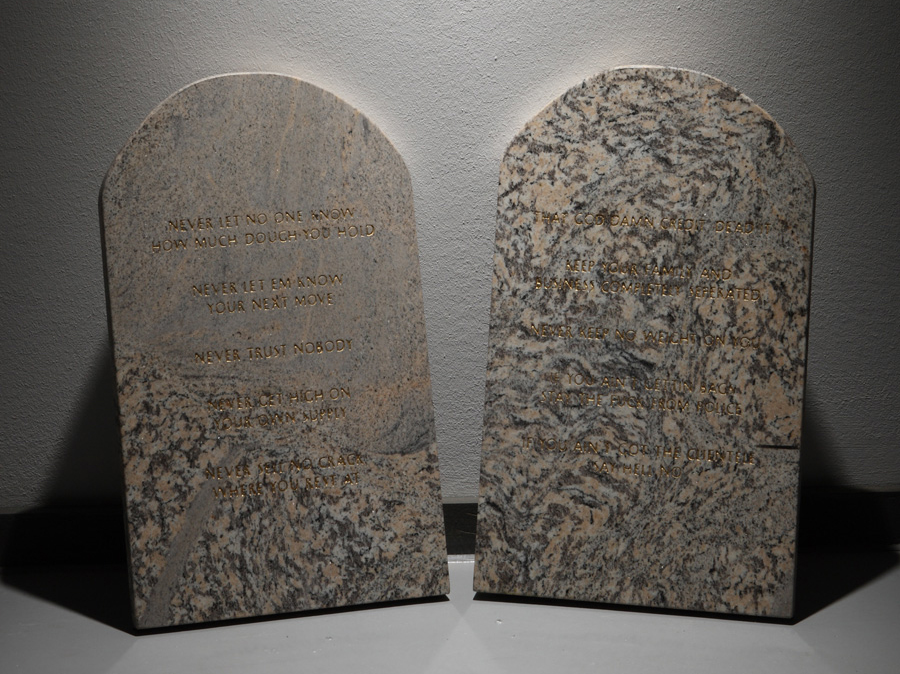
10crack-commandments

1. “The one great rule of composition is to speak the truth.” — Henry David Thoreau

2. “If you require a practical rule of me, I will present you with this: Whenever you feel an impulse to perpetrate a piece of exceptionally fine writing, obey it–wholeheartedly–and delete it before sending your manuscript to press. Murder your darlings.” — Arthur Quiller-Couch

3. “The best rule for writing–as well as for speaking—is to use always the simplest words that will accurately convey your thought.” — David Lambuth

4. “There are simple maxims . . . which I think might be commended to writers of expository prose. First: never use a long word if a short one will do. Second: if you want to make a statement with a great many qualifications, put some of the qualifications in separate sentences. Third: do not let the beginning of your sentence lead the readers to an expectation which is contradicted by the end.” — Bertrand Russell

5. “I have made three rules of writing for myself that are absolutes: Never take advice. Never show or discuss a work in progress. Never answer a critic.” — Raymond Chandler

6. “There are three rules for writing the novel. Unfortunately, no one knows what they are.” — W. Somerset Maugham

7. “Writing has laws of perspective, of light and shade, just as painting does, or music. If you are born knowing them, fine. If not, learn them. Then rearrange the rules to suit yourself.” — Truman Capote

8. “There is probably some long-standing “rule” among writers, journalists, and other word-mongers that says: “When you start stealing from your own work you’re in bad trouble.” And it may be true.” — Hunter S. Thompson

9. “If I were to advise new writers, if I were to advise the new writer in myself, going into the theater of the Absurd, the almost-Absurd, the theater of Ideas, the any-kind-of-theater-at-all, I would advise like this:

  • Tell me no pointless jokes. I will laugh at your refusal to allow me laughter.
  • Build me no tension toward tears and refuse me my lamentations. I will go find me better wailing walls.
  • Do not clench my fists for me and hide the target. I might strike you, instead.
  • Above all, sicken me not unless you show me the way to the ship’s rail.”

Ray Bradbury

10. “Breslin’s Rule: Don’t trust a brilliant idea unless it survives the hangover.” — Jimmy Breslin

11. “One of the great rules of art: Do not linger.” — Andre Gide

12. “Do not pay any attention to the rules other people make…. They make them for their own protection, and to Hell with them.” — William Saroyan

13. “Over the years, I’ve found one rule. It is the only one I give on those occasions when I talk about writing. A simple rule. If you tell yourself you are going to be at your desk tomorrow, you are by that declaration asking your unconscious to prepare the material. You are, in effect, contracting to pick up such valuables at a given time. Count on me, you are saying to a few forces below: I will be there to write.” — Norman Mailer

14. “I’ll give you the sole secret of short-story writing, and here it is: Rule 1. Write stories that please yourself. There is no rule 2. The technical points you can get from Bliss Perry. If you can’t write a story that pleases yourself, you will never please the public. But in writing the story forget the public.” — O. Henry

Of Inspiration and Imagination

Imagination_by_t1nus

1. “Imagination is the real and eternal world of which this vegetable universe is but a faint shadow.” — William Blake

2. “An idea, like a ghost, must be spoken to a little before it will explain itself.” — Charles Dickens

3. “If writers had to wait until their precious psyches were completely serene there wouldn’t be much writing done.” — William Styron

4. “I sit in the dark and wait for a little flame to appear at the end of my pencil.” — Billy Collins

5. “Use your imagination. Trust me, your lives are not interesting. Don’t write them down.” — W.P. Kinsella

6. “You get ideas from daydreaming. You get ideas from being bored. You get ideas all the time. The only difference between writers and other people is we notice when we’re doing it.” — Neil Gaiman

7. “You go to the attic of your mind and rummage around and find something.” — Mary Higgins Clark

8. “Thinking is the enemy of creativity. It’s self-conscious, and anything self-conscious is lousy. You can’t try to do things. You simply must do things.” — Ray Bradbury

The Best Judge of Character? Why, 10 Famous Authors, Naturally

quote-judge-of-your-natural-character-by-what-you-do-in-your-dreams-ralph-waldo-emerson-57859

1. “Creation of character is, like much of fiction writing, a mixture of subjective feel and objective control.” — Julian Barnes

2. “Characters are not created by writers. They pre-exist and have to be found.” — Elizabeth Bowen

3. “The characters that I create are parts of myself and I send them on little missions to find out what I don’t know yet.” — Gail Godwin

4. “I don’t have a very clear idea of who the characters are until they start talking.” — Joan Didion

5. “I visualize the characters completely; I have heard their dialogue. I know how they speak, what they want, who they are, nearly everything about them.” — Joyce Carol Oates

6. “When I write, I live with my characters. It’s like going to work. You see the people at the next desk in full regalia all the time, and you know where they came from and where they are going. The point is to define the nuances of everything that’s happening with them and to find the element of their lives that is fascinating enough to record. That takes a lot of doing.” — William Kennedy

7. “Don’t write about a character. Become that character, and then write your story.” — Ethan Canin

8. “The character that lasts is an ordinary guy with some extraordinary qualities.” — Raymond Chandler

9. “It doesn’t matter if your lead character is good or bad. He just has to be interesting, and he has to be good at what he does.” — David Chase

10. “Think of your main characters as dinner guests. Would your friends want to spend ten hours with the characters you’ve created? Your characters can be loveable, or they can be evil, but they’d better be compelling.” — Po Bronson

Every Villain is a Hero

“Every villain is a hero in his or her own mind.” – Allison Brennan

What suits a hero best? That which opposes them. Despite the fact your protagonist is an expert in whatever field applies to your story, the very best at what they do, they’re only really as strong as their antagonist.  And how do you create a strong antagonist? By not treating them like a mustache-twirling villain.

While your shouldn’t limit yourself to the suggestions below, here are the most common antagonist archetypes writers tend to use for ideas and inspiration:

The Immoral Antagonist

Easily the most popular form of antagonist–the person your audience will have no trouble hating. They’re usually set in clear contrast against the hero. The lines are drawn in varying shades of black and white, and readers have no problem choosing whom to root for.

1. The Hypocrite is an antagonist who feigns goodness. They may be guilty of all sorts of treachery and evil, but on the surface they’re all sweetness and light. They put a righteous face on their misdeeds–perhaps even accusing the protagonist of hypocrisy to disguise their own–but the audience knows the truth: this person isn’t just bad, they’re a fraud, which makes them all the more hateable.

2. The Psycho is simply evil through and through. No excuses, no thread of goodness leading them back to redemption. They’re rotten to the core… and crazy to boot. Serial killers, genocidal world leaders, and sadists fit the bill and if you do your job properly, your audience will not only hate the psycho, but fear them as well.

3. The Regular Person Forced to Do Bad Things for an Illegitimate Reason who has let their weaknesses get the better of them. Lust, greed, and hatred can drive even ordinary people to do extraordinary evil.

The Moral Antagonist

In the moral antagonist we find a more complicated—and often more compelling—character, since they presents more parallels than contrasts with the protagonist. This is a person who is doing the right thing—as they see it—and usually for the right reasons, but who has nonetheless been forced to do battle with the hero, thanks to the requirements of your story’s overall conflict.

1. The Good Guy on the Opposing Side is usually present in stories where the conflict is between good people with opposing views who appear on both sides of the battle lines. Lawyers fighting each other for causes in which they each believe passionately, football teams competing for a championship, two love interests trying to win the same girl—none of them have to be inherently bad. Stories of this nature can provide all kinds of interesting possibilities for exploring the grey areas of life, relationships, and morality.

2. The Crusader can be insanely scary in their own right, someone who fiercely believes they’re doing the right thing, and indeed may well be fighting for a good cause. They may be someone who believes they’ve to choose between the lesser of two evils in their decisions. Or they may be someone driven to fanaticism—and thus dangerous decisions—by their passion for the cause. In fact, they may be just plain out right, while the protagonist is the one who’s wrong.

3. The Regular Person Forced to Do Bad Things for a Legitimate Reason because they feel they have no choice. A character who robs a bank to pay for their family member’s operation or to save themselves from the Mafia’s threats may be a hero in their own right—or they may be a compelling and relatable antagonist to the detective protagonist who has to go after them.

So, what are you waiting for? Walk a mile in your antagonist’s shoes, see the world from their point of view, empathize with their plight, understand the justifications for their actions. In other words, treat them with the same love and respect you do your hero for they’re equally as important to the overall success of your story.

Sally forth and be writeful.