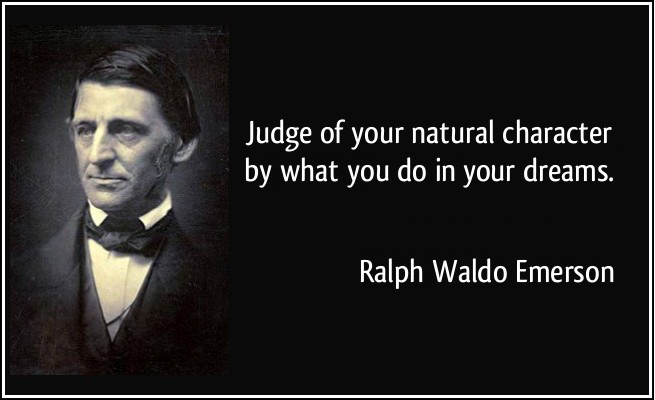
The Best Judge of Character? Why, 10 Famous Authors, Naturally

quote-judge-of-your-natural-character-by-what-you-do-in-your-dreams-ralph-waldo-emerson-57859

1. “Creation of character is, like much of fiction writing, a mixture of subjective feel and objective control.” — Julian Barnes

2. “Characters are not created by writers. They pre-exist and have to be found.” — Elizabeth Bowen

3. “The characters that I create are parts of myself and I send them on little missions to find out what I don’t know yet.” — Gail Godwin

4. “I don’t have a very clear idea of who the characters are until they start talking.” — Joan Didion

5. “I visualize the characters completely; I have heard their dialogue. I know how they speak, what they want, who they are, nearly everything about them.” — Joyce Carol Oates

6. “When I write, I live with my characters. It’s like going to work. You see the people at the next desk in full regalia all the time, and you know where they came from and where they are going. The point is to define the nuances of everything that’s happening with them and to find the element of their lives that is fascinating enough to record. That takes a lot of doing.” — William Kennedy

7. “Don’t write about a character. Become that character, and then write your story.” — Ethan Canin

8. “The character that lasts is an ordinary guy with some extraordinary qualities.” — Raymond Chandler

9. “It doesn’t matter if your lead character is good or bad. He just has to be interesting, and he has to be good at what he does.” — David Chase

10. “Think of your main characters as dinner guests. Would your friends want to spend ten hours with the characters you’ve created? Your characters can be loveable, or they can be evil, but they’d better be compelling.” — Po Bronson

Elizabeth Bowen’s 7 Tips on Approaching Dialogue

1. Dialogue should be brief.

2. It should add to the reader’s present knowledge.

3. It should eliminate the routine exchanges of ordinary conversation.

4. It should convey a sense of spontaneity but eliminate the repetitiveness of real talk.

5. It should keep the story moving forward.

6. It should be revelatory of the speaker’s character, both directly and indirectly.

7. It should show the relationships among people.

10 Thoughts on Dialogue From Notable Authors

1. “Dialogue has to show not only something about the speaker that is its own revelation, but also maybe something about the speaker that he doesn’t know but the other character does know.” — Eudora Welty

2. “Dialogue in fiction should be reserved for the culminating moments and regarded as the spray into which the great wave of narrative breaks in curving toward the watcher on the shore.” — Edith Wharton

3. “Good writers do not litter their sentences with adverbial garbage. They do not hold up signs reading ‘laughter!’ or ‘applause!’ The content of dialogue ought to suggest the mood.” — James J. Kilpatrick

4. “Nouns, verbs, are the workhorses of language. Especially in dialogue, don’t say, ‘she said mincingly,’ or ‘he said boisterously.’ Just say, ‘he said, she said.’” — John P. Marquand

5. “A man or woman who does not write good dialog is not a first-rate writer.” — George V. Higgins

6. “Dialogue that is written in dialect is very tiring to read. If you can do it brilliantly, fine. If other writers read your work and rave about your use of dialect, go for it. But be positive that you do it well, because otherwise it is a lot of work to read short stories or novels that are written in dialect. It makes our necks feel funny.” — Anne Lamott

7. “Dialogue which does not move the story along, or add to the mood of the story, or have an easily definable reason for being there at all (such as to establish important characterization), should be considered superfluous and therefore cut.” — Bill Pronzini

8. “To write successful dialogue the author must have access to the mind of all his characters, but the reader must not perceive any more than he would in real life.” — William Sloane

9. “Don’t write stage directions. If it is not apparent what the character is trying to accomplish by saying the line, telling us how the character said it, or whether or not she moved to the couch isn’t going to aid the case. We might understand better what the character means but we aren’t particularly going to care.” – David Mamet

10, “Remember that you should be able to identify each character by what he or she says. Each one must sound different from the others. And they should not all sound like you.” — Anne Lamott

Every Villain is a Hero

“Every villain is a hero in his or her own mind.” – Allison Brennan

What suits a hero best? That which opposes them. Despite the fact your protagonist is an expert in whatever field applies to your story, the very best at what they do, they’re only really as strong as their antagonist.  And how do you create a strong antagonist? By not treating them like a mustache-twirling villain.

While your shouldn’t limit yourself to the suggestions below, here are the most common antagonist archetypes writers tend to use for ideas and inspiration:

The Immoral Antagonist

Easily the most popular form of antagonist–the person your audience will have no trouble hating. They’re usually set in clear contrast against the hero. The lines are drawn in varying shades of black and white, and readers have no problem choosing whom to root for.

1. The Hypocrite is an antagonist who feigns goodness. They may be guilty of all sorts of treachery and evil, but on the surface they’re all sweetness and light. They put a righteous face on their misdeeds–perhaps even accusing the protagonist of hypocrisy to disguise their own–but the audience knows the truth: this person isn’t just bad, they’re a fraud, which makes them all the more hateable.

2. The Psycho is simply evil through and through. No excuses, no thread of goodness leading them back to redemption. They’re rotten to the core… and crazy to boot. Serial killers, genocidal world leaders, and sadists fit the bill and if you do your job properly, your audience will not only hate the psycho, but fear them as well.

3. The Regular Person Forced to Do Bad Things for an Illegitimate Reason who has let their weaknesses get the better of them. Lust, greed, and hatred can drive even ordinary people to do extraordinary evil.

The Moral Antagonist

In the moral antagonist we find a more complicated—and often more compelling—character, since they presents more parallels than contrasts with the protagonist. This is a person who is doing the right thing—as they see it—and usually for the right reasons, but who has nonetheless been forced to do battle with the hero, thanks to the requirements of your story’s overall conflict.

1. The Good Guy on the Opposing Side is usually present in stories where the conflict is between good people with opposing views who appear on both sides of the battle lines. Lawyers fighting each other for causes in which they each believe passionately, football teams competing for a championship, two love interests trying to win the same girl—none of them have to be inherently bad. Stories of this nature can provide all kinds of interesting possibilities for exploring the grey areas of life, relationships, and morality.

2. The Crusader can be insanely scary in their own right, someone who fiercely believes they’re doing the right thing, and indeed may well be fighting for a good cause. They may be someone who believes they’ve to choose between the lesser of two evils in their decisions. Or they may be someone driven to fanaticism—and thus dangerous decisions—by their passion for the cause. In fact, they may be just plain out right, while the protagonist is the one who’s wrong.

3. The Regular Person Forced to Do Bad Things for a Legitimate Reason because they feel they have no choice. A character who robs a bank to pay for their family member’s operation or to save themselves from the Mafia’s threats may be a hero in their own right—or they may be a compelling and relatable antagonist to the detective protagonist who has to go after them.

So, what are you waiting for? Walk a mile in your antagonist’s shoes, see the world from their point of view, empathize with their plight, understand the justifications for their actions. In other words, treat them with the same love and respect you do your hero for they’re equally as important to the overall success of your story.

Sally forth and be writeful.

To Make a Long Story Shortest: #TwitterFiction

First there was the micro novel, or microblogging novel, a work of fiction intended as a full-length novel written and distributed in chunks, varying in size, depending on the social media site it was being published on. Then, flash fiction burst onto the scene (see: The Short and Short of Flash Fiction) and dared to tell big stories with extreme brevity. Not to be undone, a new arrival,Twitter fiction (aka tweet fiction), tossed its hat into the ring, boasting its ability to tell a story within 140 characters.

Thumb your literary nose up at it, if you will, but surely you can see the art in concise writing. Catching the key moment of a story and carefully selecting the proper words so that your audience infers your meaning and does all the heavy lifting of filling in the details themselves requires a level of skill and finesse. Not to mention the challenge of drawing laughter or tears from your reader, or filling them with horror or dread as you build suspense in such a confined space.

And this latest sub-genre hasn’t escaped the notice of well-known writers who have tried their hand at 140-character novels:

Geoff Dyer – I know I said that if I lived to 100 I’d not regret what happened last night. But I woke up this morning and a century had passed. Sorry.

James Meek – He said he was leaving her. “But I love you,” she said. “I know,” he said. “Thanks. It’s what gave me the strength to love somebody else.”

Ian Rankin – I opened the door to our flat and you were standing there, cleaver raised. Somehow you’d found out about the photos. My jaw hit the floor.

Andrew O’Hagan – Clyde stole a lychee and ate it in the shower. Then his brother took a bottle of pills believing character is just a luxury. God. The twins.

Jeffrey Archer – “It’s a miracle he survived,” said the doctor. “It was God’s will,” said Mrs Schicklgruber. “What will you call him?” “Adolf,” she replied.

SJ Watson – She thanks me for the drink, but says we’re not suited. I’m a little “intense”. So what? I followed her home. She hasn’t seen anything yet.

Charlie Higson – Jack was sad in the orphanage til he befriended a talking rat who showed him a hoard of gold under the floor. Then the rat bit him & he died.

India Knight – Soften, my arse. I’m a geezer. I’m a rock-hard little bastard. Until I go mushy overnight for you, babe. #pears

Rachel Johnson – Rose went to Eve’s house but she wasn’t there. But Eve’s father was. Alone. One thing led to another. He got 10 years.

Inspired and curious, I even took a stab at Twitter narrative one idle Sunday and among my favorites are:

A large stone, the opportunity, a swampside grave; all that was needed to end a lifelong sibling rivalry. Guess who’s Daddy’s favorite now?

Mother warned him not to look but curiosity was his master. Now he struggles to reverse the time of eye to unsee the horror.

Regardless of your personal views on Twitter and tweet fiction, I honestly think you should give it a go. If nothing else, you can consider it a warm-up exercise to get your mental juices flowing. Can you think of a better way to hone your craft than practicing clear, clean and concise writing? And what have you got to lose? Surely not time. In the moments wasted complaining about the artform, you could have written several magnum opuses.

Sally forth and be tweetful.

— Rhyan Scorpio-Rhys

PS. If you’re looking for more famous author tweet novels, you can find them by searching #140novel on Twitter.

P.P.S. Not exactly #tweetfiction-related, but dealing with creating fiction, the NY Times ran an article on the importance of Twitter in today’s pop-culture era: How To Make a TV Drama in the Twitter Age.

21 Writing Lessons A Wise Man Would Share (and no, I’m not calling myself wise)

270497_5510453_lz

  1. Commitment is what transforms an idea floating around in your head into reality. Putting pen to paper speaks boldly of your intentions and are the actions which speak louder than the words. It is making the time when there is none. Coming through time after time after time, year after year after year. Commitment is the stuff character is made of; the power to shape ethereal things. It is the daily triumph of integrity over skepticism.
  2. No one is perfect. The quicker this is realized the faster you can get on with being excellent. Start every morning ready to write harder than you did the day before and plot further than you ever imagine.
  3. Avoid over explaining yourself in writing. Be confident that your audience is intelligent enough to understand.
  4. Write down what’s most important to you in your writing career and the steps to accomplish that goal and show up. Sometimes we tend to do the things that are most important to us when it’s written down.
  5. Play the hand you’re dealt. Stop envying someone else’s talent or success. Have the courage to face your own writing challenges head on. It builds character. Start looking for a way through instead of a way out.
  6. Become a student of life. Learn something new every day. The day you stop learning is the day you become obsolete so keep learning and keep writing.
  7. No excuses. Stop making excuses for not writing and replace them with ways to do better writing. Excuses are a waste of time and energy.
  8. Never be ashamed to tell anyone you’re a writer, whether you’re published or not. The definition of a writer is a person who writes or is able to write. Being ashamed to acknowledge this fact to people speaks to self-doubt, which is a desire killer.
  9. Never be afraid of a writing challenge. If you never strive to be more than what you are, you’ll never truly know what you can become.
  10. Service to others. Pointing people in the right direction is such a small thing. Give advice to those who ask for it. Offer support to those who want it. We’re all here to teach as well as learn.
  11. Work like hell. If you want to earn a living as a writer, that is. Treat it like a profession, put your absolute best foot forward and be thorough. Cross every “T” and dot every “I”.
  12. Discover you. Find your passion, life purpose, and pursue them… then write about them.
  13. Don’t take it personally. Don’t be afraid to acknowledge and laugh at something that you’ve written in the past that’s just plain awful. Self-awareness and self-confidence shows that you’re comfortable in your own skin.
  14. Manage your time. Our situation and environment is ever changing so be careful not to confuse the things that are urgent with the things that are important. Look for time wasters and eliminate them.
  15. Ask for help. Writing can be tough and although you do a majority of it alone, you should never write in a total vacuum and there’s no shame in seeking advice when you’re stuck.
  16. Do your homework. Know what you’re getting into before you start writing in a particular field, format or genre. Doing your homework reduces uncertainty and fear.
  17. Daydream often. Your imagination is a muscle that requires exercise and daydreaming is an excellent way to flex. Embrace and preserve your daydreams at all cost.
  18. Forgive and set free. Freeing your mind to write is almost as important as actually sitting down to write, so cultivate a healthy dose of forgiveness and set someone free. Learn to forgive others and stop carrying those bags of hate, guilt or regret.
  19. Stay one step ahead. Avoid big fish/small pond thinking if at all possible. If you’ve mastered a particular style of writing, why not be proactive, take the initiative, and see what other types of writing challenges are out there for you?
  20. Self-love. Become your own priority. Strive to be the you, you want to be. Once you accomplish this, it will show in your writing, trust me.
  21. Finish what you started. Avoid the urge to stray. Distractions are the writer’s most fearsome adversary. Avoid jumping off a project because a better idea has come along. Jot the better idea down, set it aside, and come back to it when you’re done with your current project.

Sally forth and be wisely writeful.

— Rhyan Scorpio-Rhys


The Three Simple Facts Of Writing

Today’s entry is a shortie because I’m busy wrestling with a wordy bastard of a story that refuses to be tamed but I’m in a particularly stubborn mood, so challenge met!

That said, I offer you my three simple facts of writing:

  1. If you do not write the story you truly want to write, it will never be read. You can’t have the unwashed masses confirm your greatness when you haven’t given them anything to be in awe of.
  2. If you don’t submit your work—–for review, publication, employment, or whatever—–the answer will always be no. The cruelest rejection you can ever receive is from yourself, the toughest critic you’ll ever know. If you never show your work, you never give an editor, publisher, prodco, or whatever, the chance to say yes (exercise caution, of course, and protect your writing before letting it fly out into the world).
  3. If you don’t write, you’ll never be a writer. Plain and simple. Also, many, many, many years from now, when you’re lying on your deathbed, do you really want a box of regret—–filled with all the unwritten stories of your life—–hanging over your head like the sword of Damocles? I think not.

Sally forth and be writeful.

— Rhyan Scorpio-Rhys

50 Questions That Can Help Free Your Mind (to concentrate on writing… hopefully)

The common advice for freeing your mind to write is to create a journal. I’m fairly certain that most of you have either 1) created a journal that you may or may not keep current, or 2) heard the advice and decided journaling isn’t for you (hey, it happens).

So, what other options do you have when you’ve lost your self in a quagmire of self-pity, mundane daily obligations and insurmountable life woes and can’t quite seem to maintain your true identify or nurture your creative center?

Why, you slap on your pith helmet, turn your gaze inward, and explore that largely ignored country of your core self, naturally. And the best way to accomplish this is with the list below. Why a list? Because you’re a writer and writers love lists.

Be advised that there are no right or wrong answers because sometimes simply asking the right questions is the answer.

  1. How old would you be if you didn’t know how old you are?
  2. Which is worse, failing or never trying?
  3. If life is so short, why do we do so many things we don’t like and like so many things we don’t do?
  4. When it’s all said and done, will you have said more than you’ve done?
  5. What is the one thing you would most like to change about the world?
  6. If happiness was the national currency, what kind of work would make you rich?
  7. Are you doing what you believe in, or are you settling for what you are doing?
  8. If the average human life span was 40 years, how would you live your life differently?
  9. To what degree have you actually controlled the course your life has taken?
  10. Are you more worried about doing things right, or doing the right things?
  11. You are having lunch with three people you respect and admire. They all start criticizing a close friend of yours, not knowing she is your friend. The criticism is distasteful and unjustified. What do you do?
  12. If you could offer a newborn child only one piece of advice, what would it be?
  13. Would you break the law to save a loved one?
  14. Have you ever seen insanity where you later saw creativity?
  15. What is something you know you do differently than most people?
  16. How come the things that make you happy don’t make everyone happy?
  17. What is one thing have you not done that you really want to do? What’s holding you back?
  18. Are you holding onto something you need to let go of?
  19. If you had to move to a state or country besides the one you currently live in, where would you move and why?
  20. Do you push the elevator button more than once? Do you really believe it makes the elevator faster?
  21. Would you rather be a worried genius or a joyful simpleton?
  22. Why are you, you?
  23. Have you been the kind of friend you want as a friend?
  24. Which is worse, when a good friend moves away, or losing touch with a good friend who lives right near you?
  25. What are you most grateful for?
  26. Would you rather lose all of your old memories, or never be able to make new ones?
  27. Is it possible to know the truth without challenging it first?
  28. Has your greatest fear ever come true?
  29. Do you remember that time 5 years ago when you were extremely upset? Does it really matter now?
  30. What is your happiest childhood memory? What makes it so special?
  31. At what time in your recent past have you felt most passionate and alive?
  32. If not now, then when?
  33. If you haven’t achieved it yet, what do you have to lose?
  34. Have you ever been with someone, said nothing, and walked away feeling like you just had the best conversation ever?
  35. Why do religions that support love cause so many wars?
  36. Is it possible to know, without a doubt, what is good and what is evil?
  37. If you just won a million dollars, would you quit your job?
  38. Would you rather have less work to do, or more work you actually enjoy doing?
  39. Do you feel like you’ve lived this day a hundred times before?
  40. When was the last time you marched into the dark with only the soft glow of an idea you strongly believed in?
  41. If you knew that everyone you know was going to die tomorrow, who would you visit today?
  42. Would you be willing to reduce your life expectancy by 10 years to become extremely attractive or famous?
  43. What is the difference between being alive and truly living?
  44. When is it time to stop calculating risk and rewards, and just go ahead and do what you know is right?
  45. If we learn from our mistakes, why are we always so afraid to make a mistake?
  46. What would you do differently if you knew nobody would judge you?
  47. When was the last time you noticed the sound of your own breathing?
  48. What do you love? Have any of your recent actions openly expressed this love?
  49. In 5 years from now, will you remember what you did yesterday? What about the day before that? Or the day before that?
  50. Decisions are being made right now. The question is: Are you making them for yourself, or are you letting others make them for you?

Sally forth and be free-mindedly writeful.

— Rhyan Scorpio-Rhys

The Arrogance of Presumption

write_wicked_good_black_logo_bumper_sticker-rda7a88b1f4ad4c758065ba89ce3a5282_v9wht_8byvr_512

“There is no excuse. If you want to write, write. This is your life, you are responsible for it. You will not live forever. Don’t wait. Make the time now.” ― Natalie Goldberg

On occasion, people stuck in a writing rut seek advice, which has become harder to dispense without sounding like a scribe’s bumper-sticker, especially since you can’t swing Schrödinger’s cat on the interwebz without hitting hundreds of inspirational tips and tidbits.

The simple, honest and truest bit of advice is to write. Write when you’re too tired to write. Write when writing hates your very existence. Write when words have moved out of your head in the wee hours of the night and left no forwarding address. Write when every word you put to paper is like pulling teeth. Write when your inner critic is telling you you’re a talentless shit. Write when the words refuse to make sense. Just write.

But no one wants to hear that because it isn’t a magical solution offered up by a Bagger Vance muse that makes all the tumblers in their befuddled minds line up and open the creative sluice gates.

Which leaves the long way around:

So, things aren’t going your way with your writing and you might be inclined to mope around the house and bask in self-pity for What Might Have Been, but there’s no reason to get down on yourself. Wipe your tears on your sleeves, buck up and realize today marks the start of a whole new ball game. All the old bets are off. You’re back at square one and it’s time to get a new bottom line. Take all your expectation and aspiration and lay them out like cards on a table. This is the first step towards putting the pedal to the metal. You’ve got to make no bones about what you truly wish to accomplish with your writing—–aside from the ludicrous notion of instant riches and fame—–and pull no punches with yourself on the hard work needed to make your dream a reality. And if I can toss in one more tired cliché, your ship doesn’t always come in… sometimes you have to swim out and meet it halfway.

As a writer it’s important to strike a balance between the creative and rational minds. The problem with the creative mind is that it’s equipped with the arrogance of presumption that it knows all there is to know and sometimes it becomes difficult to suspend tyranny long enough to receive messages from life, the universe, the inner muse, and—if you can stretch your fantasy muscles around the strange-but-true notion—your future self. Scoff all you like, but the part of you that exists on a higher plane of consciousness occasionally tries to contact you in order to provide panoramic views of the far horizon. The messages may be brief and strange, or they may appear in a matter-of-fact guise in the midst of your daily routine. Either way, if you turn a blind eye to the minute workings of the world all around you, you may be missing pithy pointers on how to shape your life’s mission to become a happy writer—–note that I didn’t say a successful writer, writing should first and foremost lead to happiness and fulfillment—–in the near and distant future.

A more metaphorical view on encountering obstacles in moving your writing forward is akin to walking in the deep dark forest and encountering a savvy old crone camouflaged as a wolf. Your fear, already swarming because of the unfamiliarity of your surroundings, kicks instantly into high gear, causing you to flee before you can see through the disguise. But now that you know the truth, go back and find the crone again. She has much to teach you about harvesting the treasure that comes from the deep recesses of the creative mind and taking aggressive measures to build up your confidence and mental wellness. Stop talking about and start manifesting the dream, and get as bawdy and funky as you dare.

Those last three paragraphs are a bit cringe-inducing, aren’t they? And they sound like a load of gibberishy nonsense. So, why not take the simple advice and…

Just write.

Sally forth and be writeful.

— Rhyan Scorpio-Rhys

No Such Creature As A Bad Analogy (only funny ones)

“Analogies prove nothing, that is true, but they can make one feel more at home.” —–  Sigmund Freud

Normally I shy away from passing on emails and memes, but this one struck me as funny, so I decided to share it. As I’m sure you’re all aware, an analogy is a comparison between two things, typically on the basis of their structure, as a bridge between familiar situations and new ones.

The following list of analogies was allegedly collected by real high school English teachers from their students’ writings.

  1. Her face was a perfect oval, like a circle that had its two sides gently compressed by a ThighMaster.
  2. His thoughts tumbled in his head, making and breaking alliances like underpants in a dryer without Cling Free.
  3. He spoke with the wisdom that can only come from experience, like a guy who went blind because he looked at a solar eclipse without one of those boxes with a pinhole in it and now goes around the country speaking at high schools about the dangers of looking at a solar eclipse without one of those boxes with a pinhole in it.
  4. She grew on him like she was a colony of E. Coli, and he was room-temperature Canadian beef.
  5. She had a deep, throaty, genuine laugh, like that sound a dog makes just before it throws up.
  6. Her vocabulary was as bad as, like, whatever.
  7. He was as tall as a six-foot, three-inch tree.
  8. The revelation that his marriage of 30 years had disintegrated because of his wife’s infidelity came as a rude shock, like a surcharge at a formerly surcharge-free ATM machine.
  9. The little boat gently drifted across the pond exactly the way a bowling ball wouldn’t.
  10. McBride fell 12 stories, hitting the pavement like a Hefty bag filled with vegetable soup.
  11. From the attic came an unearthly howl. The whole scene had an eerie, surreal quality, like when you’re on vacation in another city and Jeopardy comes on at 7:00 p.m. instead of 7:30.
  12. Her hair glistened in the rain like a nose hair after a sneeze.
  13. The hailstones leaped from the pavement, just like maggots when you fry them in hot grease.
  14. Long separated by cruel fate, the star-crossed lovers raced across the grassy field toward each other like two freight trains, one having left Cleveland at 6:36 p.m. traveling at 55 mph, the other from Topeka at 4:19 p.m. at a speed of 35 mph.
  15. They lived in a typical suburban neighborhood with picket fences that resembled Nancy Kerrigan’s teeth.
  16. John and Mary had never met. They were like two hummingbirds who had also never met.
  17. He fell for her like his heart was a mob informant, and she was the East River.
  18. Even in his last years, Granddad had a mind like a steel trap, only one that had been left out so long it had rusted shut.
  19. Shots rang out, as shots are wont to do.
  20. The plan was simple, like my brother-in-law Phil. But unlike Phil, this plan just might work.
  21. The young fighter had a hungry look, the kind you get from not eating for a while.
  22. He was as lame as a duck. Not the metaphorical lame duck, either, but a real duck that was actually lame, maybe from stepping on a land mine or something.
  23. The ballerina rose gracefully en Pointe and extended one slender leg behind her, like a dog at a fire hydrant.
  24. It was an American tradition, like fathers chasing kids around with power tools.
  25. He was deeply in love. When she spoke, he thought he heard bells, as if she were a garbage truck backing up.

Sally forth and be writeful.

— Rhyan Scorpio-Rhys