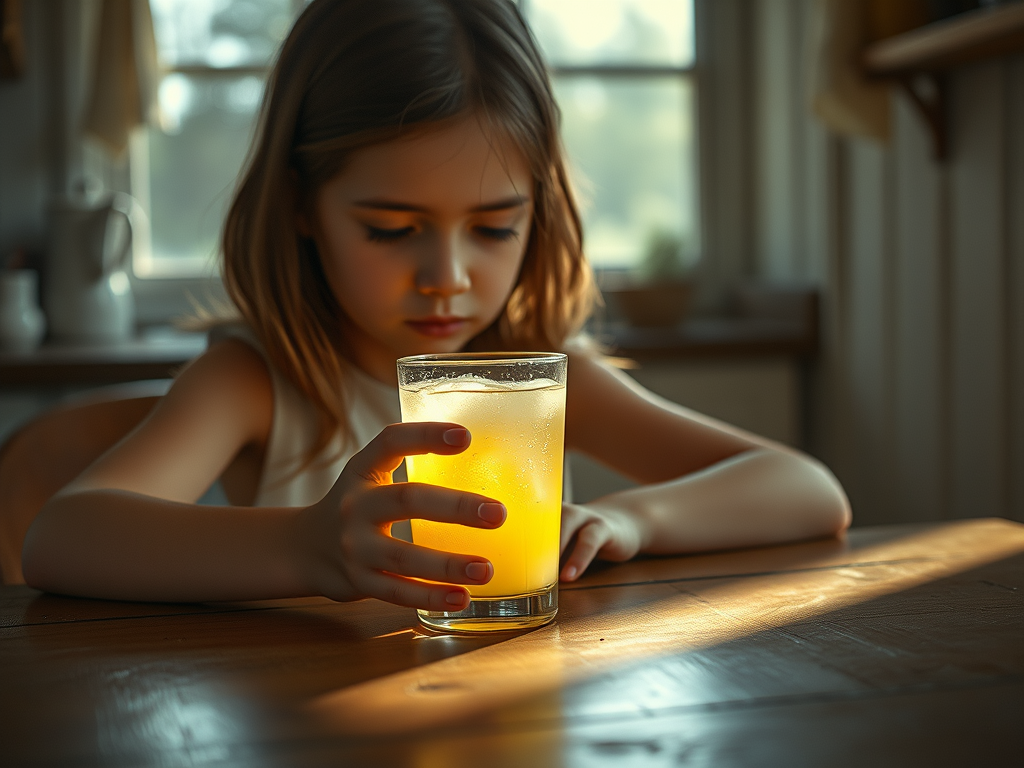
The Saddest Girl Ever To Hold A Glass of Lemonade

The first time Judith Engel made lemonade, she was five years old, standing on a stool in her mother’s sunlit kitchen. The scent of fresh lemons and sugar hung in the air, as familiar and comforting as her mother’s voice.

“You have to put your heart into it,” her mother said, her hands guiding Judith’s small ones as they squeezed juice from the lemons. “That’s the secret.”

Judith didn’t understand what her mother meant, but she nodded seriously. She wanted nothing more than to make her mother proud. When the lemonade turned out too sour, her mother only smiled and kissed the top of her head. “You’ll get it someday,” she said, her voice warm as sunlight.

Someday never came. Her mother’s laughter faded from the house, leaving behind an aching silence that Judith couldn’t fill, no matter how many glasses of lemonade she made.

Now, at nine years old, Judith stood behind a makeshift lemonade stand in front of her house. The wooden sign, painted with uneven letters, read: 25 cents. A jar of coins sat on the table, the product of neighbors’ polite purchases. They sipped the lemonade, their faces carefully neutral, offering gentle words of encouragement Judith barely heard.

The lemonade wasn’t very good. She knew that. But it was all she had left of her late mother, and she made it every day, hoping that somehow, she could pour her grief into the pitcher and sweeten it into something better.

One afternoon, as the sleepy sun blushed orange, beginning its daily routine of tucking itself into the horizon, and shadows stretched across the street, Judith stirred a new batch of lemonade. Her thoughts drifted to her mother, the sound of her voice, the way she would hum as she worked in the kitchen. Tears welled in Judith’s eyes, and before she could stop them, they spilled over, falling into the pitcher. She wiped her face quickly, embarrassed, though no one was there to see.

When the next customer, an elderly woman from two houses down, took a sip, her eyes widened. A single tear rolled down her cheek.

“Oh, my,” the woman whispered, clutching the cup as if it were something precious. “It’s like I can feel it all over again. My Henry…” Her voice broke, and she handed Judith a dollar before hurrying away, dabbing at her eyes with a handkerchief.

Judith stared after her, the dollar bill crumpled in her hand. She tasted the lemonade herself, and for a moment, it was as if her mother’s absence swelled inside her, sharp and all-consuming. But when she set the glass down, she felt lighter, as though the weight of her grief had shifted. She didn’t understand it, but she knew one thing: the lemonade had changed.

Word spread quickly. The neighbors came in droves, sipping the lemonade and leaving with red-rimmed eyes. They whispered about Judith’s stand, about how her lemonade could unearth old memories and long-buried sorrows. Some left generous tips; others lingered, thanking her softly before walking away.

Judith’s father noticed the change, too. He’d been a shadow of himself since her mother’s death, retreating into his armchair and barely speaking. But now, he watched the parade of visitors from the living room window, his face clouded with something Judith couldn’t name.

One evening, after the last customer had gone, the doorbell rang. Judith opened the door to find a man in a gray coat standing on the porch. He was tall and thin, with sharp features and eyes that seemed to see too much.

“Judith Engel?” he asked, his voice smooth and polite.

Judith nodded, gripping the doorframe.

“My name is Mr. Carrick. I’ve heard about your lemonade.” He glanced at the stand, now empty, and smiled faintly. “May I come in?”

Her father appeared behind her, his voice firm. “What do you want?”

“To help,” Mr. Carrick said, his gaze flicking between them. “Your daughter has a remarkable gift. One that others like her have learned to refine.”

Judith stepped back, her heart pounding. “Others like me?”

Mr. Carrick nodded. “People who can take emotions—grief, pain, even joy—and distill them into something tangible. Something transformative. It’s rare, but not unheard of.”

Her father’s face darkened. “She’s just a child. Leave her alone.”

But Mr. Carrick’s attention was on Judith. “You’ve already felt it, haven’t you? The way the sadness lifts, just a little, when you pour it into the lemonade. Imagine what you could do with guidance. You could help people, Judith. Not just your neighbors, but so many others.”

Judith hesitated. She thought of the strangers who came to her stand, the way they left lighter, as though she’d taken something heavy from them. She thought of her mother’s words: You have to put your heart into it.

Her father’s voice cut through her thoughts. “She doesn’t need your help. Get out.”

Mr. Carrick sighed and reached into his coat, pulling out a small glass vial. Inside was a liquid the color of sunlight, swirling gently as though alive. “This is what’s possible,” he said, setting the vial on the table. “Think about it, Judith. When you’re ready, I’ll find you.”

He left without another word, the door clicking shut behind him. Judith and her father stood in silence, staring at the vial. The room felt heavier, the air thick with unspoken questions.

Finally, her father spoke, his voice low and weary. “You don’t need him. Or anyone else. You’re my daughter, and that’s enough.”

Judith picked up the vial, its warmth surprising against her skin. She thought of her mother, of the lemonade, of the way the sadness seemed to flow from her and into the pitcher. She thought of the neighbors, their tears, their gratitude. And she wondered: Was this enough? Or was there more she could do?

That night, as she lay in bed, the vial sat on her nightstand, catching the moonlight. Judith closed her eyes, the echo of her mother’s voice in her ears. You’ll get it someday.

Someday, she promised herself, she would.

The Space Between

angel-statue-angel-statue-stock-by-stock-weeping-angel-statue-for-garden

When I was asked to deliver this eulogy, I was terrified. I am not the best orator in the family, that honor goes to Arthur, my brother, who couldn’t be in attendance because he and his family lived too far away, as opposed to my youngest sister, Ethel, who simply couldn’t be bothered to pack up their families again for a repeat memorial service. You see, we buried my great grandfather Walter two short weeks ago and while I understand the inconvenience, family is family and they should have made it their business to be here, if not to offer support to those of us this passing strikes hardest, then at least out of familial obligation. If it sounds like I’m bitter, I am, and I apologize for burdening you with it but not sorry for voicing the way I feel. That was one of the lessons I learned from the person we’re memorializing today.

This woman gave life to the woman who gave life to the woman who gave life to me and I owe her so much because I have a good life. If it’s true that grandparents give us a sense of who we are and where we come from, then great-grandparents let us know how far we’ve come and the sacrifices that had to be made for us to exist.

Today, as we bid farewell to GiGiMaw Eleanor, I realize the size of the hole left in my heart and in my family. I am truly blessed to have so many strong women in my life and it is extremely rare for a relationship three generations removed to be so crucial and so enduring but then Eleanor was that phenomenal sort of person every single day of her life. And you don’t have to take my word for it, others will come up and tell stories that will make you laugh and fill your hearts with joy and hope. I, on the other hand, wish to tell a different story, one that few of you know but I think it’s time to clear the air of ghosts and secrets from the past.

Eleanor and Walter had two children, a daughter, my wonderful GiMaw Ruth, who is with us today, and her older brother, Ned, who is no longer with us. From the stories Eleanor told me, Ned, the granduncle I never had the honor of meeting, was an active little boy, rambunctious and always full of playful mischief, but he was kindhearted, especially to his baby sister. Always the defender of the weak and a paladin of justice, he had the makings for growing into someone important, someone the world needed.

When he was just six years old he was the victim of a hit and run which cut his life short. Alerted by the neighbors, Eleanor and Walter rushed to the scene of the accident and gathered up their son’s body and immediately carried him home as not to cause a spectacle. They carefully and lovingly cleaned Ned head to toe, dressed him in his Sunday best and placed him on their bed in the space between them and mourned their loss in private all through the night.

This was in a time before the dead were taken to morgues, back when it was the family’s responsibility to take care of funeral arrangements themselves. My great grandparents were poor, like nearly everyone else in town, so these two people, these two parents, dug their son’s grave with their bare hands, wrapped him in his bedsheet and placed his body into the ground, burying his corpse handful by trembling handful.

Eleanor and Walter divorced each other two months later. They were still in their twenties and chose to remain living under the same roof for their daughter’s sake, together but separated. Eighty plus years of sleeping in their marriage bed with a space forever between them where their phantom son lay, sharing an experience that was so painful that they couldn’t risk casting an eye upon the other for fear of reopening a wound that never fully closed.

But as I mentioned, they were private people who managed to keep that pain to themselves and had I not known the story I would have been hardpressed to spot their unhappiness whenever we stopped round for a visit. Up until the end, GiGiMaw Eleanor had more energy and showed more interest in my life and the lives of my children than anyone I’ve ever known. No offense, Mom.

What made my great-grandmother special? So wonderful? As the relative who lived the closest, she was always present, part of our everyday lives in such a tangible way, baking and cooking and babysitting and taking our daughters for surprise days of shopping at the mall.

You impacted my life in so many ways, GiGiMaw Eleanor, helped shape who I am, who my children are. You influenced all of us so greatly and I will always love you and save a special corner of my heart to keep you with me because you held the family together.

And in keeping with your tradition, I wanted you to know that we are not only laying you to rest today. It took some doing but we located Ned’s original burial spot and we’re having your son reinterred with you and GiGPaw Walter in the place he never ceased to exist, in the space between the both of you because family needs to be together.

Text and Audio ©2018 & 2021 Rhyan Scorpio-Rhys

The Space Between

angel-statue-angel-statue-stock-by-stock-weeping-angel-statue-for-garden

When I was asked to deliver this eulogy, I was terrified. I am not the best orator in the family, that honor goes to Arthur, my brother, who couldn’t be in attendance because he and his family lived too far away, as opposed to my youngest sister, Ethel, who simply couldn’t be bothered to pack up their families again for a repeat memorial service. You see, we buried my great grandfather Walter two short weeks ago and while I understand the inconvenience, family is family and they should have made it their business to be here, if not to offer support to those of us this passing strikes hardest, then at least out of familial obligation. If it sounds like I’m bitter, I am, and I apologize for burdening you with it but not sorry for voicing the way I feel. That was one of the lessons I learned from the person we’re memorializing today.

This woman gave life to the woman who gave life to the woman who gave life to me and I owe her so much because I have a good life. If it’s true that grandparents give us a sense of who we are and where we come from, then great-grandparents let us know how far we’ve come and the sacrifices that had to be made for us to exist.

Today, as we bid farewell to GiGiMaw Eleanor, I realize the size of the hole left in my heart and in my family. I am truly blessed to have so many strong women in my life and it is extremely rare for a relationship three generations removed to be so crucial and so enduring but then Eleanor was that phenomenal sort of person every single day of her life. And you don’t have to take my word for it, others will come up and tell stories that will make you laugh and fill your hearts with joy and hope. I, on the other hand, wish to tell a different story, one that few of you know but I think it’s time to clear the air of ghosts and secrets from the past.

Eleanor and Walter had two children, a daughter, my wonderful GiMaw Ruth, who is with us today, and her older brother, Ned, who is no longer with us. From the stories Eleanor told me, Ned, the granduncle I never had the honor of meeting, was an active little boy, rambunctious and always full of playful mischief, but he was kindhearted, especially to his baby sister. Always the defender of the weak and a paladin of justice, he had the makings for growing into someone important, someone the world needed.

When he was just six years old he was the victim of a hit and run which cut his life short. Alerted by the neighbors, Eleanor and Walter rushed to the scene of the accident and gathered up their son’s body and immediately carried him home as not to cause a spectacle. They carefully and lovingly cleaned Ned head to toe, dressed him in his Sunday best and placed him on their bed in the space between them and mourned their loss in private all through the night.

This was in a time before the dead were taken to morgues, back when it was the family’s responsibility to take care of funeral arrangements themselves. My great grandparents were poor, like nearly everyone else in town, so these two people, these two parents, dug their son’s grave with their bare hands, wrapped him in his bedsheet and placed his body into the ground, burying his corpse handful by trembling handful.

Eleanor and Walter divorced each other two months later. They were still in their twenties and chose to remain living under the same roof for their daughter’s sake, together but separated. Eighty plus years of sleeping in their marriage bed with a space forever between them where their phantom son lay, sharing an experience that was so painful that they couldn’t risk casting an eye upon the other for fear of reopening a wound that never fully closed.

But as I mentioned, they were private people who managed to keep that pain to themselves and had I not known the story I would have been hardpressed to spot their unhappiness whenever we stopped round for a visit. Up until the end, GiGiMaw Eleanor had more energy and showed more interest in my life and the lives of my children than anyone I’ve ever known. No offense, Mom.

What made my great-grandmother special? So wonderful? As the relative who lived the closest, she was always present, part of our everyday lives in such a tangible way, baking and cooking and babysitting and taking our daughters for surprise days of shopping at the mall.

You impacted my life in so many ways, GiGiMaw Eleanor, helped shape who I am, who my children are. You influenced all of us so greatly and I will always love you and save a special corner of my heart to keep you with me because you held the family together.

And in keeping with your tradition, I wanted you to know that we are not only laying you to rest today. It took some doing but we located Ned’s original burial spot and we’re having your son reinterred with you and GiGPaw Walter in the place he never ceased to exist, in the space between the both of you because family needs to be together.

©2018 Rhyan Scorpio-Rhys

Creative Commons License