If You Can’t Blind Them With Brilliance…

Image

Fair warning: Thar be mild spoilers ahead, so if you plan on seeing Star Trek Into Darkness and wish to go in fresh, turn back now.

Let me begin by saying I didn’t have high expectations for this film, so I wasn’t disappointed at how much I really didn’t like it. Wasn’t a fan of the the first film either. Truth to tell, I’m not big on reboots or reimaginings in general.And that’s all this is. A poor reboot of the far superior film, Star Trek II: The Wrath of Khan.

Don’t mistake my meaning, this isn’t a bash on J.J. Abrams. The man does what he’s paid to do. He puts asses in seats, like a professional carnival huckster. He’s under no obligation to provide a solid, well thought out plot or three dimensional characters. It’s all about bang for the buck, which this movie has in spades. It meets its quota of fisticuffs, phaser fights, explosions, space battles, and winks and nods to the original series to appease actual fans of the franchise. Abrams certainly knows his way around a popcorn movie, living by the old adage, “If you can’t blind them with brilliance, baffle them with bullshit.”

But instead of dissecting Into Darkness (enough fan sites are doing that already), I’d rather talk about what made Wrath of Khan work. It’s one of two films that I can think of off the top of my head that has a near perfect set up. The other is the first Back To The Future film.
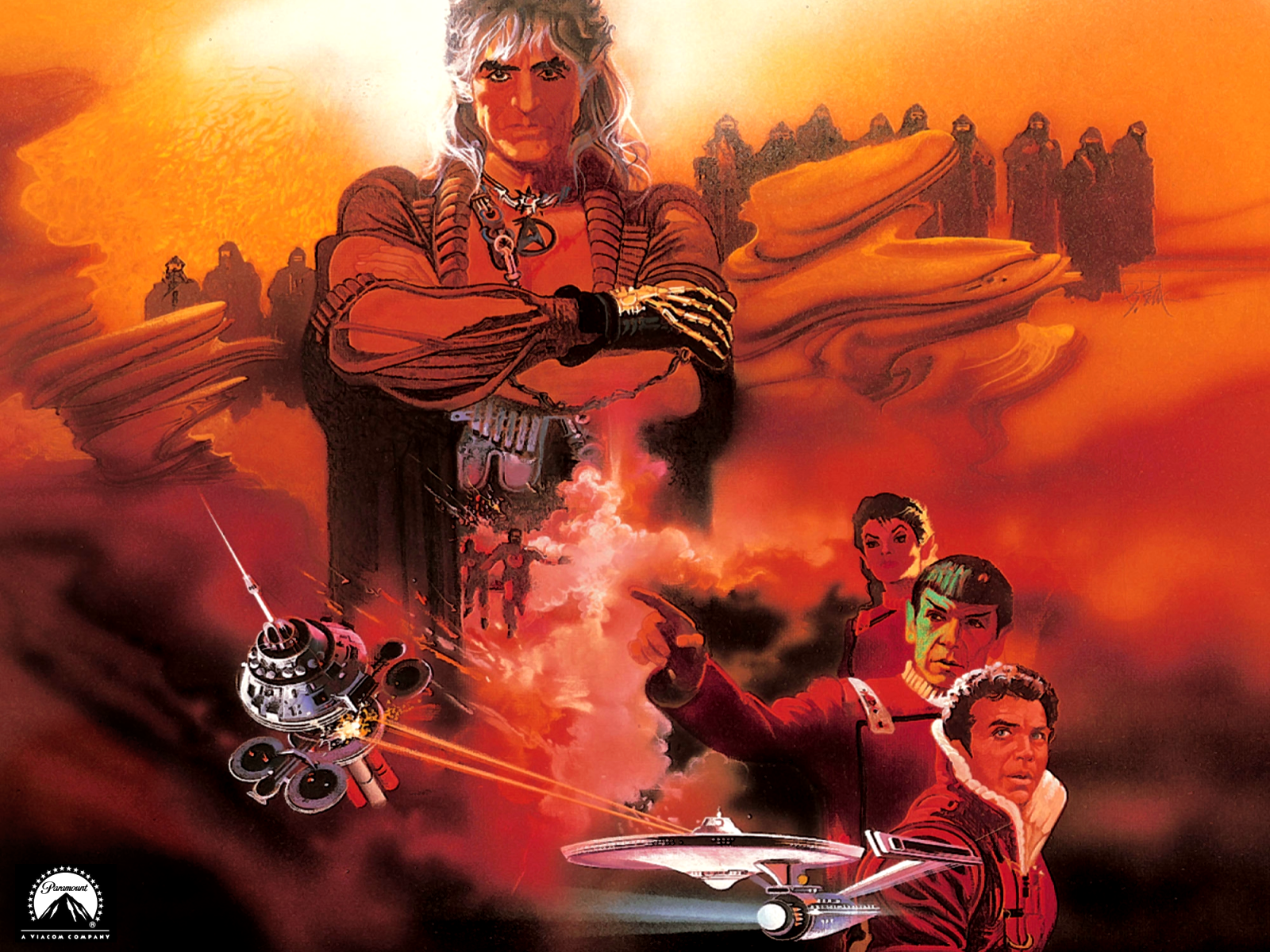
statrek-ii_-the-wrath-of-khan-wallpapers_16772_1600x1200

Wrath of Khan begins with the Star Fleet Academy final exam, The Kobayashi Maru, a no-win scenario simulation designed to test the character of cadets before unleashing them into the harsh realities of interplanetary relations. Kirk is now an admiral relegated to training cadets after giving up his starship command. It’s his birthday, so he’s feeling old. His life lacks adventure, so he feels put out to pasture. He has no family, so he feels alone in the universe. The man is miserable, making him the perfect character in desperate need of an arc.

Come to find out Kirk is the only cadet to beat The Kobayashi Maru, but he did it by rigging the test. He cheated because he doesn’t believe in a no-win scenario. And that’s what the entire film is, Kirk’s Kobayashi Maru. An adversary emerges from his past, hellbent on revenge for being stranded on planet that turns hostile. He’s reunited with an old flame and discovers he has a son. And he’s pitted in a battle of wits against a far superior opponent. Even in his most desperate hour, Kirk is enjoying this. It’s what he was born to do. The only thing he’s ever been good at.

And finally, he’s forced to face The Kobayashi Maru consequences. He’s encountered his no-win scenario. He’s at the end of his tether, with no more cards left to play. He’s not only put himself in the line of fire, but his crew and new found family as well. They’re dead. Or they would have been, had Spock not sacrificed himself, quoting the Charles Dickens novel, A Tale of Two Cities (a present he gives to Kirk on his birthday), “the needs of the many outweigh the needs of the few“.

Kirk finally faces devastating loss, the death of his closest friend, but as he mourns, he witnesses the creation of a world, has reconnected with a family he never knew he had, and is once again in command of a starship. At the beginning of the film, he was feeling old, but as the film wraps, he stares at the Genesis Planet and tells Carol Marcus that he “Feels young.”

That’s a proper character arc.

And you won’t find any of that in Into Darkness. It’s a poor photocopy that lacks the richness of history, the depth of character, or a plot that can bear the weight of scrutiny.

— Rhyan Scorpio-Rhys

Replete With Jargonosity

Image

Simply put: I hate jargon. It’s a cheap language trick feeding on lazy minds that’s slowly destroying descriptive speech as well as the written language. It’s both deceptive—giving the user a faux brilliance that might actually be found lacking if their comments were put into simple terms—and safe, since no one wants to appear out of the cool loop by stopping the jargon-spouter and asking them exactly what they mean (and isn’t it great when you actually call them on it and they struggle for answer?).

And before you mistake my meaning, I understand the importance of industry terms—screenplay direction, set lingo, etc.—as a method of saving communication time in a short attention-spanned world, and as a means of demonstrating how well you understand your area of expertise.

The jargon I hate is of the screenwriting variety in a non-professional setting when it comes to peer review. Not only for my work. In general. But that wasn’t always the case. When I first got into screenwriting I was, quite naturally, greener than a Granny Smith and eager to soak up as much knowledge on the subject of crafting the perfect script as possible, which included industry speak. I mean, who doesn’t want to learn the buzzwords of their aspiring trade and toss them into casual conversations with industry professionals to prove to that they’re with it and they dig the scene, man?

Then I joined several screenwriting groups that met online and at a physical location and attended screenplay review seminars and began to notice how some people hid behind parroted catchphrases in order to avoid the conflict of offering an honest opinion.

I don’t expect my hatred of jargon to change the way things work—hell, I even jargonate (the act of using jargon in verbal conversation) myself, more often than I’m comfortable with—I’m simply saddened by the slow death of Plain English as a method of conveying clear meaning without unnecessary complexity. Particularly when used to offer constructive criticism.

Sally forth and be writeful.

— Rhyan Scorpio-Rhys

Your Writing Says More About Your Character Than You Realize

Image

Creating worlds? That’s the easy bit. Populating them with three dimensional characters… that’s a bit trickier. Whether you write for a living, a hobby, for sport, or just to have a laugh, you will eventually reach a point in your storytelling where you’re forced to pluck the innocent bystanders from your life and slap them smack dab in the middle of your literary dreamscape. Don’t be embarrassed. It happens to us all.

But just because a fictional character has a fleshy counterpart, imbued with their quirks, verbal crutches and personality tics, it doesn’t always mean they’re actually memorable.

So, how do you combat that? Dig, my friend. You need to burrow underneath the surface layer affectations and unearth the true source of their core character and examine what piqued your interest in the first place.

Even the most boring person you know can be a source of inspiration in your writing if you scratch the surface carefully enough. As corny as it sounds, we all carry within us a wealth of creativity and inspiration. Your job is to look deeper.

One of the most important parts of being a writer, aside from textual flourishes and clever turns of phrase, is the ability to see the world, both the one you’re creating and the one you live in, through their eyes. What are their views on major and minor things? Are they blessed or cursed with odd perceptions of the way the world should and/or actually works? Do they engage in activities that exist outside social norms?

Once you’ve identified these tidbits, you have the first building blocks for your memorable character’s foundation. But it’s only the beginning. You’ll need to build on this in order to make your newly birthed person dynamic.

Since you’re not creating a clone or an exact replica of your best bud or the nosy neighbor down the hall who tracks you via her peephole every time you leave or enter your front door—seriously, lady, get a life—you’ll want to take a few pages from Baron Victor von’s notebook and Frankenstein your creation up a bit.

If you do your job properly, your patchwork person will seem more believable because they contain traits your friends have that you secretly covet—we covet what we see everyday, Clarice—family member habits that absolutely drive you up the wall, as well as the little insecure bits of yourself you pray nobody really notices (FYI: they do, they’re just too polite to bring it up in conversation). Stop moaning, you’ll always be a part of the mix. You can’t help it. You’re the person you know the best. Yup, it’s true and you heard it here first.

The best thing about your ethereal Prometheus is only you will be able to see the stitches that hold the monstrosity together. To everyone else, the jigsaw pieces fit together seamlessly. But you’re still not done.

You can’t have your bouncing baby entity walking around all starkers—well, you can if you’re writing one of those 50 Shades thingies—so you’ll need to dress them with your imagination and layer in true life details like articles of clothing, substantiating them as a new independent life form while better solidifying your understanding of them.

Then, to top things off, dab them with a little Eau de real desires—just behind the ears—and spray obstacles in the air and have them walk through the mist, before you powder them down with motivations.

And voilà! Take a step back and view your bonafide multidimensional, absolutely-fictional-but-seems-so-damn-real-it’s-scary character. Now all you have to do is repeat the process several more times.

Hey, I never said this would be easy.

Sally forth and be writeful.

— Rhyan Scorpio-Rhys

What Lies Beneath

Image

I always love reading authors introductions to short stories and sometimes find the inspiration for writing the tale more interesting than the story itself. And just so we’re clear, I don’t mean the opening line and/or paragraph of the story. I’m talking about the preface, and a well-written introduction in the right hands is like the director’s commentary or behind-the-scenes footage or Easter eggs on your favorite DVD.

The odd thing about me is I can’t actually write an introduction to my own work until after I’ve completed the story, which I guess makes it more of a postmortem than an actual preface. I think the primary reason is if I write the introduction first it feels like I’m writing the story twice, instead of offering a quick glimpse at the man behind the curtain.

On more than one occasion, I had no idea what served as the impetus for the story I’d just written. Not immediately anyway. It usually comes to me later, sometimes days or weeks, when I’d wake with the story and characters stuck in my head, unraveling plot and dialogue in my mind until I uncovered the parallels to some half-forgotten event.

They’re like finding buried treasure, aren’t they? Those memories stored in neurons on seldom traveled synaptic pathways. Which made me think about a new project. Normally I don’t write drama pieces, I tend to gravitate towards speculative and science fiction, religious fantasy and horror, but I think I’d like to write a collected book filled with nothing but prefaces. Inspirations for stories without including the stories themselves.

I haven’t quite worked all the bugs out of the idea yet and I’m not sure how marketable it would be, but some projects we write for ourselves and not the quick buck, don’t we?

— Rhyan Scorpio-Rhys

URSULA K. LE GUIN on an Artist’s Passion

Ursula K Le Guin
The choice to train to be an artist of any kind is a risky one. Art’s a vocation, and often pays little for years and years — or never. Kids who want to be dancers, musicians, painters, writers, need more than dreams. They need a serious commitment to learning how to do what they want to do, and working at it through failure and discouragement. Dreams are lovely, but passion is what an artist needs — a passion for the work. That’s all that can carry you through the hard times. So I guess my advice to the young writer is a warning, and a wish: You’ve chosen a really, really hard job that probably won’t pay you beans — so get yourself some kind of salable skill to live on! And may you find the reward of your work in the work itself. May it bring you joy.

Ray Bradbury on Being a Sublime Fool

To sum it all up, if you want to write, if you want to create, you must be the most sublime fool that God ever turned out and sent rambling.

You must write every single day of your life.

You must read dreadful dumb books and glorious books, and let them wrestle in beautiful fights inside your head, vulgar one moment, brilliant the next.

You must lurk in libraries and climb the stacks like ladders to sniff books like perfumes and wear books like hats upon your crazy heads.

I wish for you a wrestling match with your Creative Muse that will last a lifetime.

I wish craziness and foolishness and madness upon you.

May you live with hysteria, and out of it make fine stories—science fiction or otherwise.

Which finally means, may you be in love every day for the next 20,000 days. And out of that love, remake a world.

Anton Chekov Addresses Adjectives

Cross out as many adjectives and adverbs as you can. It is comprehensible when I write: “The man sat on the grass,” because it is clear and does not detain one’s attention. On the other hand, it is difficult to figure out and hard on the brain if I write: “The tall, narrow-chested man of medium height and with a red beard sat down on the green grass that had already been trampled down by the pedestrians, sat down silently, looking around timidly and fearfully.” The brain can’t grasp all that at once, and art must be grasped at once, instantaneously.

George Orwell’s Scrupulous Writer Questions

George Orwell

According to George Orwell, a scrupulous writer, in every sentence they write, will ask themselves these questions:

  1. What am I trying to say?
  2. What words will express it?
  3. What image or idiom will make it clearer?
  4. Is this image fresh enough to have an effect?
  5. Could I put it more shortly?
  6. Have I said anything that is avoidably ugly?

What lasts in the reader’s mind…

“What lasts in the reader’s mind is not the phrase but the effect the phrase created: laughter, tears, pain, joy. If the phrase is not affecting the reader, what’s it doing there? Make it do its job or cut it without mercy or remorse.”

― Isaac Asimov