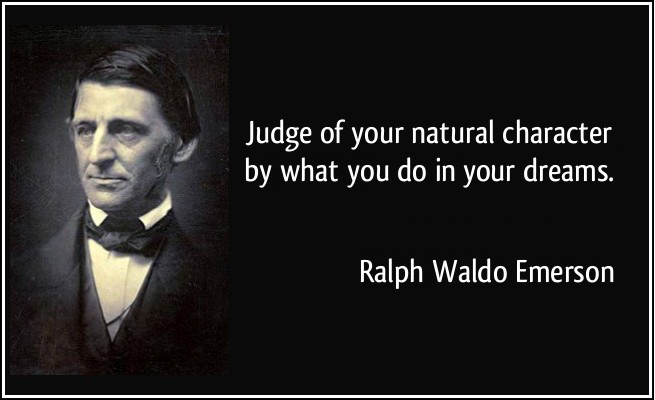
The Best Judge of Character? Why, 10 Famous Authors, Naturally

quote-judge-of-your-natural-character-by-what-you-do-in-your-dreams-ralph-waldo-emerson-57859

1. “Creation of character is, like much of fiction writing, a mixture of subjective feel and objective control.” — Julian Barnes

2. “Characters are not created by writers. They pre-exist and have to be found.” — Elizabeth Bowen

3. “The characters that I create are parts of myself and I send them on little missions to find out what I don’t know yet.” — Gail Godwin

4. “I don’t have a very clear idea of who the characters are until they start talking.” — Joan Didion

5. “I visualize the characters completely; I have heard their dialogue. I know how they speak, what they want, who they are, nearly everything about them.” — Joyce Carol Oates

6. “When I write, I live with my characters. It’s like going to work. You see the people at the next desk in full regalia all the time, and you know where they came from and where they are going. The point is to define the nuances of everything that’s happening with them and to find the element of their lives that is fascinating enough to record. That takes a lot of doing.” — William Kennedy

7. “Don’t write about a character. Become that character, and then write your story.” — Ethan Canin

8. “The character that lasts is an ordinary guy with some extraordinary qualities.” — Raymond Chandler

9. “It doesn’t matter if your lead character is good or bad. He just has to be interesting, and he has to be good at what he does.” — David Chase

10. “Think of your main characters as dinner guests. Would your friends want to spend ten hours with the characters you’ve created? Your characters can be loveable, or they can be evil, but they’d better be compelling.” — Po Bronson

Elizabeth Bowen’s 7 Tips on Approaching Dialogue

1. Dialogue should be brief.

2. It should add to the reader’s present knowledge.

3. It should eliminate the routine exchanges of ordinary conversation.

4. It should convey a sense of spontaneity but eliminate the repetitiveness of real talk.

5. It should keep the story moving forward.

6. It should be revelatory of the speaker’s character, both directly and indirectly.

7. It should show the relationships among people.

10 Thoughts on Dialogue From Notable Authors

1. “Dialogue has to show not only something about the speaker that is its own revelation, but also maybe something about the speaker that he doesn’t know but the other character does know.” — Eudora Welty

2. “Dialogue in fiction should be reserved for the culminating moments and regarded as the spray into which the great wave of narrative breaks in curving toward the watcher on the shore.” — Edith Wharton

3. “Good writers do not litter their sentences with adverbial garbage. They do not hold up signs reading ‘laughter!’ or ‘applause!’ The content of dialogue ought to suggest the mood.” — James J. Kilpatrick

4. “Nouns, verbs, are the workhorses of language. Especially in dialogue, don’t say, ‘she said mincingly,’ or ‘he said boisterously.’ Just say, ‘he said, she said.’” — John P. Marquand

5. “A man or woman who does not write good dialog is not a first-rate writer.” — George V. Higgins

6. “Dialogue that is written in dialect is very tiring to read. If you can do it brilliantly, fine. If other writers read your work and rave about your use of dialect, go for it. But be positive that you do it well, because otherwise it is a lot of work to read short stories or novels that are written in dialect. It makes our necks feel funny.” — Anne Lamott

7. “Dialogue which does not move the story along, or add to the mood of the story, or have an easily definable reason for being there at all (such as to establish important characterization), should be considered superfluous and therefore cut.” — Bill Pronzini

8. “To write successful dialogue the author must have access to the mind of all his characters, but the reader must not perceive any more than he would in real life.” — William Sloane

9. “Don’t write stage directions. If it is not apparent what the character is trying to accomplish by saying the line, telling us how the character said it, or whether or not she moved to the couch isn’t going to aid the case. We might understand better what the character means but we aren’t particularly going to care.” – David Mamet

10, “Remember that you should be able to identify each character by what he or she says. Each one must sound different from the others. And they should not all sound like you.” — Anne Lamott

This sentence has five words

“This sentence has five words. Here are five more words. Five-word sentences are fine. But several together become monotonous. Listen to what is happening. The writing is getting boring. The sound of it drones. It’s like a stuck record. The ear demands some variety. Now listen. I vary the sentence length, and I create music. Music. The writing sings. It has a pleasant rhythm, a lilt, a harmony. I use short sentences. And I use sentences of medium length. And sometimes, when I am certain the reader is rested, I will engage him with a sentence of considerable length, a sentence that burns with energy and builds with all the impetus of a crescendo, the roll of the drums, the crash of the cymbals—sounds that say listen to this, it is important.” —– Gary Provost

URSULA K. LE GUIN on an Artist’s Passion

Ursula K Le Guin
The choice to train to be an artist of any kind is a risky one. Art’s a vocation, and often pays little for years and years — or never. Kids who want to be dancers, musicians, painters, writers, need more than dreams. They need a serious commitment to learning how to do what they want to do, and working at it through failure and discouragement. Dreams are lovely, but passion is what an artist needs — a passion for the work. That’s all that can carry you through the hard times. So I guess my advice to the young writer is a warning, and a wish: You’ve chosen a really, really hard job that probably won’t pay you beans — so get yourself some kind of salable skill to live on! And may you find the reward of your work in the work itself. May it bring you joy.

Ray Bradbury on Being a Sublime Fool

To sum it all up, if you want to write, if you want to create, you must be the most sublime fool that God ever turned out and sent rambling.

You must write every single day of your life.

You must read dreadful dumb books and glorious books, and let them wrestle in beautiful fights inside your head, vulgar one moment, brilliant the next.

You must lurk in libraries and climb the stacks like ladders to sniff books like perfumes and wear books like hats upon your crazy heads.

I wish for you a wrestling match with your Creative Muse that will last a lifetime.

I wish craziness and foolishness and madness upon you.

May you live with hysteria, and out of it make fine stories—science fiction or otherwise.

Which finally means, may you be in love every day for the next 20,000 days. And out of that love, remake a world.

Anton Chekov Addresses Adjectives

Cross out as many adjectives and adverbs as you can. It is comprehensible when I write: “The man sat on the grass,” because it is clear and does not detain one’s attention. On the other hand, it is difficult to figure out and hard on the brain if I write: “The tall, narrow-chested man of medium height and with a red beard sat down on the green grass that had already been trampled down by the pedestrians, sat down silently, looking around timidly and fearfully.” The brain can’t grasp all that at once, and art must be grasped at once, instantaneously.

What lasts in the reader’s mind…

“What lasts in the reader’s mind is not the phrase but the effect the phrase created: laughter, tears, pain, joy. If the phrase is not affecting the reader, what’s it doing there? Make it do its job or cut it without mercy or remorse.”

― Isaac Asimov

The 10 Rules of Writing Elmore Leonard Lives By

elmore_leonard

From 1953 to present, Elmore Leonard, the king of gritty realism and strong dialogue, has written 49 novels, 9 screenplays, and more than a few short stories, so it’s fair to say the man knows a thing or two about writing. So, even if you aren’t a fan of his work, it couldn’t hurt to take a couple of tips from a man who’s been there, written that:

  1. Never open a book with the weather.
  2. Avoid prologues.
  3. Never use a verb other than “said” to carry dialogue.
  4. Never use an adverb to modify the verb “said.”
  5. Keep your exclamation points under control!
  6. Never use the words “suddenly” or “all hell broke loose.”
  7. Use regional dialect, patois, sparingly.
  8. Avoid detailed descriptions of characters.
  9. Same for places and things.
  10. Leave out the parts readers tend to skip.

Almost makes writing a novel sound easy, doesn’t it? Truth is, it’s only as hard as you allow it to be.

Sally forth and be writeful.