I Feel the Need, the Need For the Careful Build of Momentum

Print

You’ve finally finished your latest piece of fiction. Congratulations! Once you’ve stuck a feather in your cap and given your back a big, hearty slap, you pass your gem along to a trusted reader… and the notes you get back are, “the story feels uneven/ seems melodramatic/ lacks momentum/ becomes anticlimactic” and you haven’t got the foggiest how that could be possible. You made sure your writing has all the basic components a story of this type should have, so where’s the problem?

The simple and direct answer to that would be pacing, my friend.

Proper pacing is one of the critical elements needed to keep your audience actively engaged and as a writer you must develop structural and word choice skills and use a variety of devices to control the speed and rhythm at which your plot unfolds.

Here are a few tips to start you on your journey:

1. The most obvious momentum control is length.

When writing a tense scene—filled with action, danger or crisis—you want your audience to experience feelings of speed and intensity. There’s no room for distractions here, just the meat of the nutshell, which is accomplished by keeping your descriptions and sentences concise, and if there’s any dialogue, have your characters spit it out at a rapid-fire tempo.

During the times when you need to establish a character, place or event in order to build a foundation for your story, longer scenes with more descriptive sentences, character thoughts, richer dialogue and transitions, come into play.

2. Give your audience a chance to catch their breath.

Let’s say one of your strengths is creating sharp, high-tension scenes. You trim the fat off sentences, annihilate unnecessary prepositional phrases, and swap out passive linking verbs for active ones like a pro. In fact, you’re so good at it that it becomes your default style of writing. That’s great. I’m pleased as punch for ya. Your audience—not to mention your characters—however, will need a breather between high conflict points, which means you must vary your pacing by providing a slower, more introspective scene. Balancing your story with intentional calm moments also ensures your electrifying scenes maintain their power.

3. The devil—and a slower pace—is in the details.

I’ve mentioned in other posts that you should always plant your feet firmly in the soil of your story, and if you can accomplish this, it pays off during scenes when something extremely dramatic is about to happen. This is where you take your time and describe everything in detail so that your audience feels the full impact.

4. Remember the advice, “show, don’t tell?” Well, it doesn’t always apply.

Yup, I know, it’s been drilled into your head countless times and I’ve even written about it (see: Skip The Tell And Bring On The Show) but there are always exceptions to the rules. Tedium is the primary cause for this rule break, as your intention is to keep your audience’s focused on the important and interesting matters. By telling rather than showing, you can skim over unimportant scenes that you don’t want to linger on.

5. Become a master manipulator (of word choice and sentence structure)

You don’t need me to tell you that words are the tools by which you control the worlds you create, and those same words—both singular and in groupings—are your first best means of managing your story’s pace. But the manipulation of the length of words, phrases and clauses to control the ebb and flow of sentence and paragraph structures, isn’t the only way deal with pace. You also have allies in cliffhangers and prolonged outcomes.

Now that I’ve mentioned cliffhanger, you’re no doubt thinking, “oh yeah, naturally…” because as an avid reader, you know first hand that you hate being left in the lurch and will quickly flip the page to discover what happens next. Your job as a writer will be to introduce that uncertainty in the form of an impending threat, an interruption in the action, unfinished business, or a dangling peril.

Prolonged outcomes, on first thought, might appear to require a slower pacing, but the reverse is actually true. When you prolong an event, the story speed increases because you’ve piqued your audience’s interest and they’re eager to discover how the events play out and pay off.

As with all my posts, this is simply rudimentary information, and you will come to notice that each story you write has its own unique pace. Some will speed along fast and furious, while others will make their way unhurriedly to the end. What’s important is that you’re not only aware of the message your story’s pace conveys to the audience, but are also in absolute control of it.

Sally forth–at the proper pace–and be writeful.

— Rhyan Scorpio-Rhys

Unlock Your Inner Story

Photo: Unlock your inner story ...

They say, “Everyone has at least one good book in them” and while I think book might be a bit of a stretch, I wholeheartedly believe that everyone has at least one good story in them. The natural length—the pure story without padding or the encumbrance of unnecessary detail or description—of which can range from flash fiction (under 1,000 words) to short story (under 7,500 words) to novelette (7,500 to 17,500 words) to novella (17,500 to 40,000 words) to a proper novel (over 40,000 words).

No matter how non-creative you believe yourself to be, your brain is nonetheless gifted with the special ability of imagination, and regardless of how infrequently you put it to use, you still are able to dream up intricate realities, despite your age or IQ level. Haven’t we all, at one time or another, projected a new reality in our minds in the form of daydreaming our desires? And no two daydreams are exactly the same since we each possess unique preferences, points of view, wants and needs.

Yet, even armed with the knowledge of this gift, we, as writers, tend to suffer because we either do not fully believe in or properly comprehend our true nature as creators. Sure, we continue to imagine “what if” scenarios but sometimes we find it difficult to allow those thoughts to flow through us—the conduit—and blossom into the stories they need to become.

The following list isn’t a step-by-step “how to” guide, because no one can tell you precisely what you need to do to access your inner story. You are a totally unique entity, after all. View it more as a broom to help you sweep away the clutter piled up on the footpath to your personal tale.

1. Examine your self-image.

The first battle you must face is the one against your self-image. You are more than pen and paper, more than a keyboard, more than “just another writer” or more than whatever obstacle your past or conditioning has placed in your path. The main reason why most writers fail to connect with their inner story is because of their limited knowledge of who they truly are.

As flawed human beings we are so engrossed with the perceptions of who we are that we fail to see that we are usually the source for the reality we have created for ourselves. Sure, the walls of the prison may have been constructed by events of the past, by family, peers or environment, but we continue to fortify the walls and never once open the lock–the key is always in our possession–push the cell door to step out into freedom.

This in no way suggests you have to deconstruct your self-image–unless that’s your goal, then by all means, have at it. You’re merely peeling away the layers of the identity you’ve created for yourself for societal purposes and exposing your core self, the real you. Don’t worry, it’s only for the exercise of writing. You can reapply your layers once you’re done.

Your secret identity is safe with me.

2. Take note of your gifts.

Different from writer traits–talent, the hunger for knowledge, and diligence–a writer’s gift can range from an eye for detail, to a flair for description, to a talent for dialogue. Or, you might not even be aware of your talents, so I want you to grab a piece of paper and something to write with and in 60 seconds jot down a list of what you’re good at. Don’t think about it. Simply jot down, off the top of your head, the things that come easiest to you when you write.

All done? Now take a long, hard, honest look at your list. The things you don’t concentrate on, those bits and bobs that just sort of come naturally to you when you write… those are your gifts. You’d be surprised to discover how many writers aren’t aware of their innate skills because they aren’t utilized in their everyday work lives and wind up being placed in the “Hobby” category.

3. Exploit your strengths. 

Since you’re bothering to read this, my guess is that you’ve written a couple of pieces already and maybe even finished a few of them. Now, if you’re an avid reader, you will have no doubt compared your piece to your author idols, and have developed the brutally honest ability to cast a critical eye upon your own work and spot areas in your writing that aren’t as strong as others. And since the writing isn’t perfect, you are therefore a horrible writer who should no longer legally be allowed to string a sentence together in an email, let alone write a story.

Maybe it’s true. Maybe you really are a bad writer–hey, they exist–but that’s not my call to make. I don’t know you, so I’ll assume you at least have some fundamental writing potential. However, no matter how good you are, there is one basic truth you must learn to face: Your writing will never be perfect. Why? As stated in a previous post: Because wunderkind wasn’t conveniently inserted into your backstory, and perfection isn’t DNA-encodable at this point in time. Still, you should always strive to get your writing as close to perfection as you can manage, and accept the fact that: It. Will. Not. Be. Perfect.

Maybe you can’t write a convincing love scene. Maybe you struggle with organic dialogue. Maybe you get stumped when attempting to create a character’s internal arc. Maybe you’re rubbish at tying up all your story’s loose threads. Console yourself in the knowledge that you wouldn’t be the first. A few of these “weaknesses” and more are true for authors of published works, some of which even make bestseller lists.

And because, as a writer, you are always a student and ever pushing yourself and learning new ways to hone your craft, you will eventually learn to strengthen your weaknesses. In the meantime, put all of the aspects of your writing into perspective, make a deal to stop beating yourself up so much, and focus on your strengths. They’re your “A” game.

4. Gird your loins against the enemy.

In addition to dealing with possible self-image barriers, there are other obstacles that can block your path: Fear, intimidation, procrastination, and self-doubt. The problem with these buggers is that they often take the form of lies you tell yourself. And they happen to be effective as hell because they insulate your brain from facing unpleasantries, in this case the difficult portions of the writing process that you need to slog through in order to strike gold.

The biggest lie you can tell yourself as a writer is, “I’ll do it later.” It’s a dishonest postponement because later never comes. If you don’t confront the enemies that keep you from your writing and tamp the bastards down long enough to complete your piece, then you don’t have what it takes to be a writer. Staring into the gaping maw of the harsh realities that terrify you is one of the most important parts of the process.

Slap a “H” on your chest and “Handle” it.

5. Identify your genre.

At this point, you arch an eyebrow and ask, “Rhyan, how can anyone not know the genre of their story?”

The answer lies within the fact that writers are creators. Some are resistant to the notion of placing labels or classifications on their work. For others, classification difficulties arise when their piece contains elements from several genres as some writers disagree with the act of limiting creative freedom in order to adhere to strictly delineated genre segregation.

For your audience, knowing the genre sets not only the stage, but their expectations as well, and puts them in the proper mindset to both understand and accept the rules of your story.

At this stage in the process, the importance of identifying your genre has to do with story mechanics. Certain elements step to the forefront and operate differently depending on genre, so you should be aware of the rules of the category–even if you decide to break them because of the maverick you are–as you’re arranging your idea into the proper story structure (see: Simple Anatomy of a Plot Outline).

6. Plant your feet firmly in the soil of your story.

This is your story. First and foremost, it must feel natural to you. No matter how fantastical the environment, how outrageous the yarn you’re spinning, if you don’t feel confident in the pocket dimension you’ve created, there’s little chance of you selling the story as being credible. Your job is to take utter nonsense and portray it with as much authenticity as possible.

7. Go with your gut.

Some people seek permission to write. Thinly disguised under the “Oh, it’s just an idea I’m toying with” veil, they will ask family and friends if they should write about such-and-such or if this-that-or-the-other-thing would make an interesting topic.

I urge you not to be this person.

I’m reminded of a quote by Jerome Lawrence, “The whole point of writing is to have something in your gut or in your soul or in your mind that’s burning to be written.” So, if you can actually feel inspiration or instinct churning like hot snakes in your gut to write, forget the opinions of those around you, disregard the idea of “should” and just go for it.

Never live with regret, if you can help it.

8. Do it now. No better time than the present. 

To snatch a line from Pixar’s Ratatouille “Why not here? Why not now?”

By now you know you must show up for writing everyday, and there’s no time like the present. So, why not find yourself a quiet spot, practice listening, and trust what you hear. That’s your inner story talking to you, and it not only has to be unlocked but it must be accessible at will.

I know it’s become hackneyed to instruct you to follow your bliss, but if you deny your instincts to do what you truly want to do, then the problem becomes one of trust. Do you trust the voice within you or do you trust reality as you are made to perceive it? Or, are you willing to trust the voice and write what you hear, no matter how crazy it sounds?

You have to learn to be compassionate with yourself, as well as having compassion for yourself. Especially during the vulnerable times when you’re blocked and can’t bring yourself to write because you’re scared you’ll be rejected. Take some small comfort in knowing you’re not alone in this.

Since all art must be criticized, every single published author had to overcome fear of rejection. What you need to keep in mind is that your audience–human, just the same as you–can only relate to your writing from their own experience, and sometimes their feedback will be negative. That doesn’t necessarily indicate problems in your writing, and may simply reflect a varying viewpoint.

But fear of rejection has no business rearing its ugly head right now as it’s time for you to honor your inner story by listening to the words it shares with you and writing about it. Trust me, if you’re willing to enjoy the process, you can write damn near anything.

So, why not sally forth and be inner story writeful?

— Rhyan Scorpio-Rhys

The Short and Short of Flash Fiction

flash-fiction
Flash fiction is defined as a style of fictional literature or fiction of extreme brevity. And while there’s no widely accepted rule as to the proper length of a flash fiction piece, I’ve seen word counts cap between three hundred and a thousand words. Although usually containing standard story elements such as a protagonist, conflict, obstacles, complications, and resolution, the limited word length can result in some of these elements to be merely hinted at or implied in the storyline.

David Gaffney wrote an interesting article for The Guardian entitled, Stories in your pocket: how to write flash fiction, which included the following six steps:

1. Start in the middle. You don’t have time in this very short form to set scenes and build character.

2. Don’t use too many characters. You won’t have time to describe your characters when you’re writing ultra-short. Even a name may not be useful in a micro-story unless it conveys a lot of additional story information or saves you words elsewhere.

3. Make sure the ending isn’t at the end. In micro-fiction there’s a danger that much of the engagement with the story takes place when the reader has stopped reading. To avoid this, place the denouement in the middle of the story, allowing us time, as the rest of the text spins out, to consider the situation along with the narrator, and ruminate on the decisions his characters have taken. If you’re not careful, micro-stories can lean towards punchline-based or “pull back to reveal” endings which have a one-note, gag-a-minute feel – the drum roll and cymbal crash. Avoid this by giving us almost all the information we need in the first few lines, using the next few paragraphs to take us on a journey below the surface.

4. Sweat your title. Make it work for a living.

5. Make your last line ring like a bell. The last line is not the ending – we had that in the middle, remember – but it should leave the reader with something which will continue to sound after the story has finished. It should not complete the story but rather take us into a new place; a place where we can continue to think about the ideas in the story and wonder what it all meant. A story that gives itself up in the last line is no story at all, and after reading a piece of good micro-fiction we should be struggling to understand it, and, in this way, will grow to love it as a beautiful enigma. And this is also another of the dangers of micro-fiction; micro-stories can be too rich and offer too much emotion in a powerful one-off injection, overwhelming the reader, flooding the mind. A few micro-shorts now and again will amaze and delight – one after another and you feel like you’ve been run over by a lorry full of fridges.

6. Write long, then go short. Create a lump of stone from which you chip out your story sculpture. Stories can live much more cheaply than you realise, with little deterioration in lifestyle. But do beware: writing micro-fiction is for some like holidaying in a caravan – the grill may well fold out to become an extra bed, but you wouldn’t sleep in a fold-out grill for the rest of your life.

And if I might add a few tips to Mr. Gaffney’s list:

  • Do your homework and read a ton of flash fiction stories. Stop groaning, they’re ultra-short.
  • Pay close attention to story settings and character development
  • Tell a proper story. Having a character deliver a monolog or go off on a diatribe, or spending the word count describing a setting, doesn’t help you hone your brevity writing skills.
  • Do not toss away your story if it happens to be too big and you just can’t whittle it down to size. Instead, pat yourself on the back for creating a short story. Every cloud, right?
  • If you’re using a word processing program, make use of the built-in word count feature.

For the record, extremely short fiction isn’t a brand spanking new concept. In fact, Ernest Hemingway once wrote the following six-word story:

“For sale: baby shoes, never worn.”

According to sources, the author considered it to be the finest prose he had ever written. Even more remarkable, it comes in under the stringent 140 character count of Twitter’s tweet fiction (see: To Make A Long Story Shortest). Way to go, Hemmy!

Sally forth and be flash writeful.

— Rhyan Scorpio-Rhys

A Nickel’s Worth of Free Writing Advice: Fill Your Toolbox

Is your writing toolbox looking a little empty? Fill it with the words you collect today from snippets of conversations you overhear, newspapers, magazines, books, or wherever you draw inspiration from. Create freestyle associations from these words to build sentences and keep adding more words and associations. Your notebook now represents personal snapshots of your style in the words you’ve chosen and associations you’ve made.

Sally forth and be writeful.

— Rhyan Scorpio-Rhys


Writing Style Is the Dress of Thoughts

Parsing prose. Syntactical structure. Conceptual framework. Your writing style is the voice you use to speak to your audience and is more than just diction and the words you choose, as it offers a glimpse at your true personality. It takes the literal and transforms it into a subjective expression that evokes an emotional response from the reader.

As to how you develop a writing style… you write. Write what comes natural to you. Write without worrying about acceptance or being published. Write without concentrating on influences. But you’ve heard me bang on about this already, so I invited a few friends to help get you into the proper frame of mind:

1. “A good style must, first of all, be clear. It must not be mean or above the dignity of the subject. It must be appropriate.” — Aristotle

2. “Don’t say you were a bit confused and sort of tired and a little depressed and somewhat annoyed. Be tired. Be confused. Be depressed. Be annoyed. Don’t hedge your prose with little timidities. Good writing is lean and confident.” — William Zinsser

3. “Carefully examined, a good–an interesting–style will be found to consist in a constant succession of tiny, unobservable surprises.” — Ford Maddox Ford

4. “A good style should show no sign of effort. What is written should seem a happy accident.” — W. Somerset Maugham

5. “A strict and succinct style is that, where you can take away nothing with­out loss, and that loss to be manifest.” — Ben Jonson

6. “The hardest thing about writing, in a sense, is not writing. I mean, the sentence is not intended to show you off, you know. It is not supposed to be “look at me!” “Look, no hands!” It’s supposed to be a pipeline between the reader and you. Once condition of the sentence is to write so well that no one notices that you’re writing.” — James Baldwin

7. “The greatest possible mint of style is to make the words absolutely disappear into the thought.” — Nathaniel Hawthorne

8. “When you say something, make sure you have said it. The chances of your having said it are only fair.” — E.B. White

9. “I am well aware that an addiction to silk underwear does not necessarily imply that one’s feet are dirty. Nonetheless, style, like sheer silk, too often hides eczema.” — Albert Camus

10. “It was from Handel that I learned that style consists in force of assertion. If you can say a thing with one stroke, unanswerably you have style; if not, you are at best a marchande de plaisir, a decorative litterateur, or a musical confectioner, or a painter of fans with cupids and coquettes. Handel had power.” — George Bernard Shaw

11. “Who cares what a man’s style is, so it is intelligible, as intelligible as his thought. Literally and really, the style is no more than the stylus, the pen he writes with; and it is not worth scraping and polishing, and gilding, unless it will write his thoughts the better for it. It is something for use, and not to look at.” — Henry David Thoreau

12. “People think that I can teach them style. What stuff it all is! Have something to say, and say it as clearly as you can. That is the only secret of style.” — Matthew Arnold

13. “Style is the dress of thoughts; and let them be ever so just, if your style is homely, coarse, and vulgar, they will appear to as much disadvantage.” — Philip Dormer Stanhope, Earl of Chesterfield

14. “A man’s style should be like his dress. It should be as unobtrusive and should attract as little attention as possible.” — C. E. M. Joad

15. “The style is the man himself.” — George-Louis Leclerc de Buffon

16. “The old saying of Buffon’s that style is the man himself is as near the truth as we can get–but then most men mistake grammar for style, as they mistake correct spelling for words or schooling for education.” — Samuel Butler

17. “When we see a natural style, we are astonished and delighted; for we expected to see an author, and we find a man.” — Blaise Pascal

18. “Style is the hallmark of a temperament stamped upon the material at hand.” — Andre Maurois

19. “The essence of a sound style is that it cannot be reduced to rules–that it is a living and breathing thing with something of the devilish in it–that it fits its proprietor tightly yet ever so loosely, as his skin fits him. It is, in fact, quite as seriously an integral part of him as that skin is. . . . In brief, a style is always the outward and visible symbol of a man, and cannot be anything else.” — H.L. Mencken

20. “You do not create a style. You work, and develop yourself; your style is an emanation from your own being.” — Katherine Anne Porter

21. “Style is the perfection of a point of view.” — Richard Eberhart

22. “Where there is no style, there is in effect no point of view. There is, essentially, no anger, no conviction, no self. Style is opinion, hung washing, the caliber of a bullet, teething beads.” — Alexander Theroux

23. “Style is that which indicates how the writer takes himself and what he is saying. It is the mind skating circles around itself as it moves forward.” — Robert Frost

24. “What’s important is the way we say it. Art is all about craftsmanship. Others can interpret craftsmanship as style if they wish. Style is what unites memory or recollection, ideology, sentiment, nostalgia, presentiment, to the way we express all that. It’s not what we say but how we say it that matters.” — Federico Fellini

25. “Proper words in proper places, make the true definition of style.” — Jonathan Swift

26. “The web, then, or the pattern, a web at once sensuous and logical, an elegant and pregnant texture: that is style.” — Robert Louis Stevenson

27. “The most durable thing in writing is style, and style is the most valuable investment a writer can make with his time. It pays off slowly, your agent will sneer at it, your publisher will misunderstand it, and it will take people you have never heard of to convince them by slow degrees that the writer who puts his individual mark on the way he writes will always pay off.” — Raymond Chandler

28. “The style of an author should be the image of his mind, but the choice and command of language is the fruit of exercise.” — Edward Gibbon

29. “One arrives at style only with atrocious effort, with fanatical and devoted stubbornness.” — Gustave Flaubert

30. “To me style is just the outside of content, and content the inside of style, like the outside and the inside of the human body. Both go together, they can’t be separated.” — Jean-Luc Godard

31. “Thought and speech are inseparable from each other. Matter and expression are parts of one; style is a thinking out into language.” — Cardinal John Henry Newman

32. “In matters of grave importance, style, not sincerity, is the vital thing.” — Oscar Wilde

33. “Style, in its finest sense, is the last acquirement of the educated mind; it is also the most useful. It pervades the whole being.” — Alfred North Whitehead

34. “Style is not something applied. It is something that permeates. It is of the nature of that in which it is found, whether the poem, the manner of a god, the bearing of a man. It is not a dress.” — Wallace Stevens

35. “All my stories are webs of style and none seems at first blush to contain much kinetic matter. . . . For me ‘style’ is matter.” — Vladimir Nabokov

And if I may tack on a few extras pieces of advice: don’t forget to take risks, give voice to that quirkiness of thought that you possess, avoid clichés, if at all possible, be concise and precise, and develop a keen sense of word choice.

Oh, and be patient. Style is a thing that can’t be rushed and it might take a while for yours to become evident, but you’ll know when it finally arrives. Words will flow easier, you’ll feel more comfortable with the act of writing, and you’ll be able to recognize that identifiable cadence that belongs to only one person in the world… you.

Sally forth and be writeful… in style.

— Rhyan Scorpio-Rhys

Do Your Legwork… the Proper Way

Lately I seem to be coming across more and more authors who thumb their noses up at the thought of doing research, which makes me scratch my puzzler. Not only is it a fundamental part of the process, regardless of the type of fiction you write, it is also a chance to learn and grow as a person as well as a writer. The simple fact is, if research truly is the bane of your existence, then you’re not doing it right.

Yes, you are most likely creating an entire world from scratch, in your own image and the laws of reality obey whatever rules strike your fancy, but even the most fantastical setting must have a sturdy foundation. And that foundation must be built with bricks of solid facts in order for your story to have any sort of credence.

I personally enjoy the research stage almost as much as the construction stage, but I understand how daunting a task fact-finding can be, so I’ve jotted down a few of the steps I tend to use when I’m in that researching frame of mind:

1. Pinpoint the right questions. The assumption is that you either have a strong interest in or possess a rudimentary knowledge of the story you’re attempting to pen. And that’s all you need in the beginning when you’re plucking the idea from the ether and committing it to the page in the form of an outline. But as you rearrange the story sequentially and create scenes to flesh the idea out into proper story form, you should be asking yourself how you’re going to make the story mechanics work. If your story is a period piece, you should be knowledgeable of that era, if your main characters hold down specific jobs, you should be familiar with the basics of their occupations, if the story takes place in a different part of the world… you get the point. Your research begins when you write your outline because that’s where you’ll find the questions that need answering.

2. Locate your resources. You’re probably thinking this part’s a cinch as long as you’ve got internet access, and I can’t really argue the point. As I’ve stated in a previous post, the internet is the wise sage of our virtual village (see: Applying Life Lessons To Your Writing) but, as is true with a great deal of online content, the reliability of the source material found therein can be erroneous, so verify, verify, verify as best you can in order to avoid unnecessary embarrassment at a later date. Myself, I tend to be a bit old-fashioned in my approach to research and armed with my trusty dusty library card I visit ye olde public bibliotheca in search of books pertaining to the various subjects in my story. I only rely on the internet as a back-up resource if I come up empty at the library.

3. Make a treasure map for your gold. What good is that golden nugget bit of research that you’ve discovered if you can’t lay your hands on it when you need it? If you own the book, sure you can bookmark or dog-ear pages, underline or highlight passages–but only if you own the book, please, marking up someone else’s tome is utter book sacrilege. If the book isn’t yours to mar, you can create your own index system by jotting down the book title, page and paragraph numbers, and a few keywords on the passage’s content. Then when you’re done info-gathering, you can transfer the text to your computer (arranged by subject headings) or to a notepad if you prefer to write longhand.

4. Create a vision board. Sounds hokey, I know, but pictures have that magical ability to transport your fertile imagination to all the unfamiliar aspects within your story and adding a visual component to your research and writing can help to serve as inspiration for time periods, locales, era clothing, vehicles, weaponry, etc.

5. Walk around in your story like you own the place. Nothing worse than a writer who lacks the confidence to strut their stuff within the world they’ve created. Even if that world is rife with utter nonsense, your job is to sell that nonsense as truth. There’s a saying that used to be popular when I wore a younger man’s clothes, but I haven’t come across it in a dog’s age, “If you can’t blind them with brilliance, baffle them with bullshit.” Now, this doesn’t mean you should out-and-out lie to your audience, but if the moment arrives when research fails and you need to invent something in order to make your story work, you should endeavor to portray it with as much authenticity as possible.

All the rest of the time? You live up to the trust that your audience places in your hands by checking and double-checking your sources and making sure your facts are as accurate as they can be. Also, you need to keep in mind that despite your best efforts, you aren’t ever going to get the facts correct all the time, but that doesn’t give you a reason not to do your due diligence. And should you ever deliberately decide to ignore the facts, you should alert your audience either in the author’s notes or afterword.

One of a writer’s biggest attractions to the written art form can be best summed up as, ex nihilo omnia fiunt–from nothing, everything is created–but we owe a duty to our audience to make the lie of fiction as truthful as possible.

Sally forth and be researchful.

A Special Brand of Bravery

In yesterday’s post, villains took center stage so it’s only fitting that the heroes receive a little equal time. In a future post I plan on discussing the anatomy of a hero (all right, guttermind, give it a rest) but today I’d like to explore the key ingredient your protagonist must possession to some degree in order to attract your audience and keep them invested:

Bravery.

And it should come as no surprise to any of you that if I’ve brought the subject up, there must be more than one type of courage you may either instill or bestow upon your hapless hero:

1. Heroic Bravery is the most typical brand of courage found in fictional characters nowadays, where the protagonist places themselves in jeopardy for the protection of others or to further a cause in which they passionately believe, knowing in their heart of hearts that the risk to their own well-being is completely worth it.

2. Steadfast Bravery is usually displayed by someone who routinely endures a mental or physical dangerous situation and challenges fate by meeting it head on with patient doggedness every single day.

3. Quiet Bravery, often confused with cowardice, is an offshoot of steadfast bravery where the situations are less physically dangerous. Protagonists maintain their sense of self-worth and hope as they handle their business with grace and patience.

4. Personal Bravery is exactly what it says on the tin. The protagonist risks everything for a chance at a better life as they pursue their seemingly impossible dreams. This type of bravery speaks to us all as we’ve all experienced it in some fashion at one time or another.

5. Devil-May-Care Bravery comes from protagonists that feel they have nothing left to live for–the loss of everything dear to them, a terminal illness, etc.–so they display insane courage in order to meet their inevitable death with open arms on their terms.

6. Frightened Bravery is easily the most interesting type of courage to explore within a protagonist. A character that normally chooses flight in fight-or-flight situations that has either mentally or physically been backed into a corner and forced to face their fears and rise above them can be viewed as the bravest of all the courageous archetypes (and it makes for one hell of a character arc).

The best thing about these? You’re not limited to one type per character, in fact, your protagonist may display each and every one of these types of bravery as they trod along their hero’s path. Your job as creator is to recognize which category suits your character best in order to fully flesh them out on the page.

Sally forth bravely and be writeful.


Every Villain is a Hero

“Every villain is a hero in his or her own mind.” – Allison Brennan

What suits a hero best? That which opposes them. Despite the fact your protagonist is an expert in whatever field applies to your story, the very best at what they do, they’re only really as strong as their antagonist.  And how do you create a strong antagonist? By not treating them like a mustache-twirling villain.

While your shouldn’t limit yourself to the suggestions below, here are the most common antagonist archetypes writers tend to use for ideas and inspiration:

The Immoral Antagonist

Easily the most popular form of antagonist–the person your audience will have no trouble hating. They’re usually set in clear contrast against the hero. The lines are drawn in varying shades of black and white, and readers have no problem choosing whom to root for.

1. The Hypocrite is an antagonist who feigns goodness. They may be guilty of all sorts of treachery and evil, but on the surface they’re all sweetness and light. They put a righteous face on their misdeeds–perhaps even accusing the protagonist of hypocrisy to disguise their own–but the audience knows the truth: this person isn’t just bad, they’re a fraud, which makes them all the more hateable.

2. The Psycho is simply evil through and through. No excuses, no thread of goodness leading them back to redemption. They’re rotten to the core… and crazy to boot. Serial killers, genocidal world leaders, and sadists fit the bill and if you do your job properly, your audience will not only hate the psycho, but fear them as well.

3. The Regular Person Forced to Do Bad Things for an Illegitimate Reason who has let their weaknesses get the better of them. Lust, greed, and hatred can drive even ordinary people to do extraordinary evil.

The Moral Antagonist

In the moral antagonist we find a more complicated—and often more compelling—character, since they presents more parallels than contrasts with the protagonist. This is a person who is doing the right thing—as they see it—and usually for the right reasons, but who has nonetheless been forced to do battle with the hero, thanks to the requirements of your story’s overall conflict.

1. The Good Guy on the Opposing Side is usually present in stories where the conflict is between good people with opposing views who appear on both sides of the battle lines. Lawyers fighting each other for causes in which they each believe passionately, football teams competing for a championship, two love interests trying to win the same girl—none of them have to be inherently bad. Stories of this nature can provide all kinds of interesting possibilities for exploring the grey areas of life, relationships, and morality.

2. The Crusader can be insanely scary in their own right, someone who fiercely believes they’re doing the right thing, and indeed may well be fighting for a good cause. They may be someone who believes they’ve to choose between the lesser of two evils in their decisions. Or they may be someone driven to fanaticism—and thus dangerous decisions—by their passion for the cause. In fact, they may be just plain out right, while the protagonist is the one who’s wrong.

3. The Regular Person Forced to Do Bad Things for a Legitimate Reason because they feel they have no choice. A character who robs a bank to pay for their family member’s operation or to save themselves from the Mafia’s threats may be a hero in their own right—or they may be a compelling and relatable antagonist to the detective protagonist who has to go after them.

So, what are you waiting for? Walk a mile in your antagonist’s shoes, see the world from their point of view, empathize with their plight, understand the justifications for their actions. In other words, treat them with the same love and respect you do your hero for they’re equally as important to the overall success of your story.

Sally forth and be writeful.

It Ain’t Impossible Once Somebody Gets It Done


“To believe a thing impossible is to make it so.” – French Proverb

Everyone talks about the writer’s toolkit and all the utensils it should contain, but writers also need to have a storehouse equipped with a shelf that holds just one thing:

The belief that anything is possible.

I’m sure you’ve already sussed that if someone has done a thing, you can do it, too, once you’ve set your mind to it. But have you ever stopped to consider that even if no one has done this writing task that’s swimming around in your brain, you still can do it? All you need to do is cut out the middleman. You really don’t need anyone else to prove that your project is possible. You can just go on out there and do it for yourself.

Don’t worry, I’m not gonna sell you a load of universal law bollocks like “everything in life is possible because you’ve been gifted with all the necessary tools, skills, drive and connections you need to make it happen.” If your aim is to do the impossible, you’re gonna have to work at it. Hard. That’s a fact.

Now, you’re no doubt saying. “Okay, I get that it takes drive, dedication, passion and the right mindset, but let’s get to the meat of the nutshell. Just how do I do the impossible?”

I’m glad you asked.

1. Find the cost of your impossible. You know very well I’m not talking about money (cross that financial bridge when you come to it). Failure is the coin of the realm if you don’t reach your seemingly impossible goal, and you pay by taking in the pitying glances from the mundanes that use you as an example of why the impossible must never be strived for. You pay by watching your dreams burn to ash before being scattered by the winds of harsh reality. You pay by having your creative center scooped out of you with a melon baller.

Those, of course, are simply my silly examples. As stated previously, very few things in this world are impossible. Most times the price is just too high. You need to take a moment and truthfully examine what the personal costs to you will be (time, relationships with friends, family, etc.) and if you’ll make the commitment to remit payment should the ferryman demand a toll for crossing impossible waters.

2. Take baby steps towards the impossible. Once you’ve zeroed in on that impossible writing endeavor, start small. Slip on your water wings, dip your big toe in the shallow end of the pool and learn the basics. The impossible isn’t one gigantic thing, it’s a series of things that increase in difficulty or complexity. Splash around in the kiddie end of the pool and get yourself acclimated to the waters before you decide to breaststroke your way into the deep end.

3. Handcuff yourself to inspiration. Some people create a vision board with images, inspirational sayings, and the like. I know, these got a bad rap after Rhonda Byrnes’ book, The Secret, came under critical fire, but having a visual reminder of your ultimate goal is akin to keeping your eyes on the prize.

Others surround themselves with likeminded people or people who have achieved some level of success in the same or similar fields. Buddy up to them, pick their brains—politely and tactfully, of course—and find out what motivated them. Learning from someone else’s experiences, though your own will undoubtedly be completely different, can help you avoid potential pitfalls up ahead.

4. Stop gabbing about it and start doing it. It’s great having a goal to achieve and having done all your knowledge-gathering groundwork and psyching yourself up to the point where you become a one person cheerleading squad, but a lot of people get stuck in that complacency gap between research and action. You’ll know you’re there, if you talk about conquering your impossible task more than you’re acting on conquering your impossible task.

Making it happen is the point where your inspiration gets put to the test because it’s where you’ll begin running into obstacles and roadblocks, where excuses for why you can’t take action start springing up like daisies.

The workaround? Micro-goals. Remember when we talked about baby steps? Get used to them because you’ll be taking a lot of them. Inch by inch, everything’s a cinch. Set daily tasks, give yourself deadlines and milestones and keep in mind that you will have bad days, encounter setbacks, and misstep along the way. It’s all part of the process when conquering the impossible.

And get out of the habit of beating yourself up if things don’t go your way. Things will change as you begin to work towards something new, but the great thing is, your plans are not set in stone. If something doesn’t work, switch things up until it does. You’re a shark from this point on, always moving forward.

5. Celebrate the completion of micro-goals. Why shouldn’t you? You’ve just taken a chunk out of the impossible. You’ve pressed your nose to the grindstone, torn down mental barriers, plotted courses around obstacles. Take a moment to pat yourself on the back.

6. Do it again with the next plateau. Don’t get too full of yourself, you’ve still got a ways to go. The good news is, you now know the impossible is possible. Go get ’em, tiger!

Sally forth and be writeful.

The One Sentence You Should Get Used to When First Starting Out

You’ve done your research, worked your mental fingers to the bone, and devoted all your time, energy and attention to detail into nailing the anatomy, structure and formatting of your very first short story/novel/poetry piece/article/screenplay, before sending it out for mass consumption.

And you wait, and wait, and wait, and wait for a response. When it finally arrives, your eyes will skim over the body of the letter and lock in on one sentence:

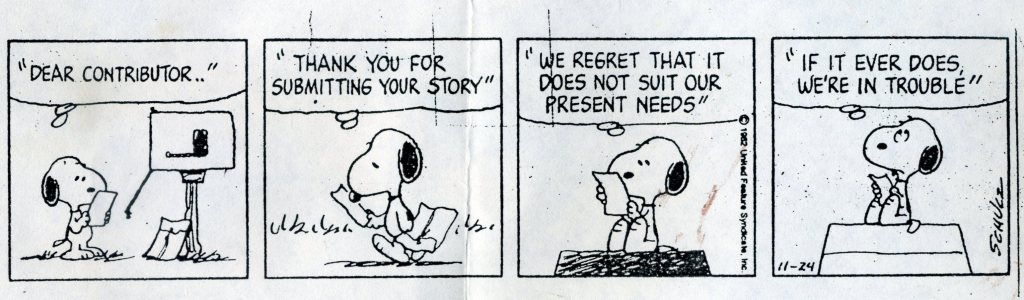
“After reviewing your work, we’ve decided that it isn’t a good fit for us and we’re going to have to pass.”

Don’t let that sentence shake you. Very rarely is a writer’s first written work good enough to be marketable. It takes experience to craft a truly sellable piece, experience you’ll earn by pressing on. This written piece leads to a second and a third and eventually you’ll find an editor, publisher or what have you that believes in your potential.

Write until you get it right.

Sally forth and be writeful.

— Rhyan Scorpio-Rhys