
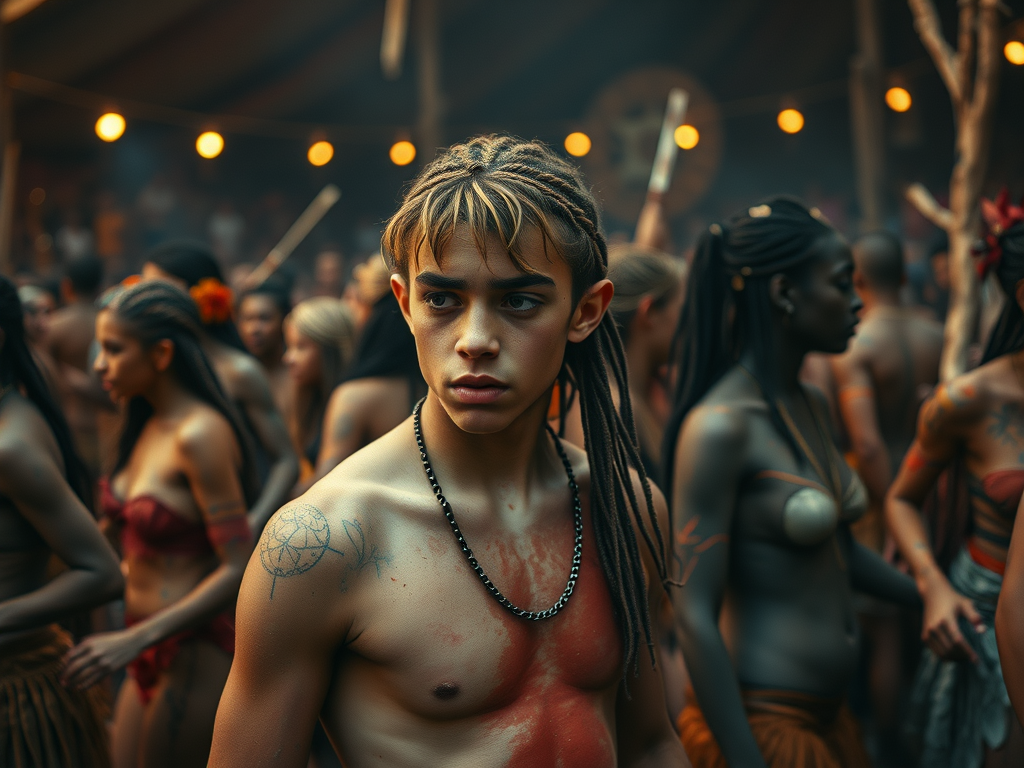
People call me a COI. Not the fish. The letters C-O-I which stands for Child of Invasion. A half-breed. They say it with a kind of pity that’s supposed to sound humane, like I’m someone who doesn’t have roots to take comfort in, like I’ll always be hanging between worlds that won’t have me.
They’re not exactly wrong.
It’s hard to explain what it feels like, the way it eats away at you layer by layer. The way you can look into a mirror and recognize the parts you were raised as—Earthborn posture, Earthborn manners—and still flinch at the other half of the face staring back, the half that never learned how to apologize for existing. Or the way you can walk through an Earther festival, through dusty lights strung between poles and the warm sting of spice-smoke, and feel like a hollow visitor in a place you’ve paid admission to but were never meant to enter.
That’s where I am now, on the outskirts of town, where the ground is packed hard and the air tastes like cheap sweetness and char. Drums thud with a rhythm I’m told is ancient. I’m never sure what ancient is supposed to mean when Earth uses it. In my mother’s stories, wars are so old their legends are practically fossils. On Earth, anything a century old gets called a relic and put behind glass.
The drums grow louder, beating a hollow cadence that settles in my ribs. A makeshift stage shivers under the dancers’ feet—worn planks, splintered edges—while bodies move in looping patterns that seem to pull the crowd along like a tide. The dancers are painted in swirls of clay-red and ash-gray, streaks across arms and legs, smudges over cheekbones and foreheads. Sweat darkens the paint until it looks like the patterns are melting, living, sliding into new shapes.
The sight does something to me. Not comfort. Not exactly fear. A familiar wrongness, the way a word can sit on your tongue and refuse to become a sound. The rhythm reaches for me, and I reach back, trying to let it take me the way it takes everyone else.
Around me, Earthers sway with their arms half-raised and their eyes half-lidded, letting the beat tug them into a trance. Their faces soften the way faces do when they feel safe enough to be stupid with joy. They laugh. They lean into each other. They move as if the world has never asked them to justify their presence in it.
When I try to follow, there’s an awkward hitch in my steps. The rhythm slips, catches, escapes again. The beat is close enough to feel but not close enough to hold. Something like shame coils inside me, tight and familiar, and something like anger follows it, because I shouldn’t have to beg a drum to let me belong.
“Isn’t it mesmerizing?” a voice says at my elbow.
I turn. She’s about my age, wide-eyed and bright with uncomplicated excitement, the kind that comes from assuming the night is here for you. She’s watching the dancers, watching the paint and sweat and motion like it’s a magic trick that will never get old.
I nod, because it’s easier than explaining what mesmerizing means when your body doesn’t agree.
Her gaze flicks to me, lingers for half a second too long, and sharpens the way curiosity becomes calculation. It’s subtle, the moment she notices the faint coppery glow beneath my skin, the way it shows at my throat when I swallow or at the inside of my wrist when the lights hit it right.
“Oh,” she says, and the word drops like a coin into a well. “You’re—are you one of them?”
There’s no malice in it, not overtly. Just the hush people use when they think they’ve stumbled onto something that should be behind a warning sign.
“Part Be’ralite,” I say, too quickly. I can hear my own defensiveness before the sentence finishes leaving my mouth. Be’ralite: the invaders in my mother’s stories, the ones who came in ships like teeth, who left glow in blood and myths in soil. “And Jadoak.” Jadoak: the ones who stayed after, who learned to live with what the invasion broke, whose bodies carry their own quiet light like a scar that never fades.
It’s easier to name both. It forces people to stop trying to sort me into a single clean box.
She tries to hide it, but her eyes widen anyway, as if I’ve confirmed a rumor. “That’s… different,” she murmurs, and she shifts away like she’s worried I might contaminate the air between us. Not a step. A drift. A polite retreat disguised as casual movement.
I close my eyes for a moment and let the drums push at me. The smoke wraps around my face. The night hums with other people’s belonging.
I tell myself I’m used to this. I tell myself this is what COI means: you exist as a concept before you exist as a person. People meet the invasion in you before they meet you. They meet the story first. They look for the part that will confirm what they’ve already decided.
When I open my eyes again, I catch my reflection in a dark patch of window glass—festival lights behind me, my face overlaid with a flicker of color. For a second, the copper beneath my skin looks like someone tried to paint me and forgot to finish.
Someone calls my name from across the crowd, clear and familiar.
I look up and see my sister, Yira, weaving through the Earthers like she’s cutting through tall grass. Unlike me, she doesn’t try to pass. She doesn’t angle her shoulders smaller or soften her expression into harmlessness. She’s taller than most humans, her skin dusted with that unmistakable silver-blue, like frost over clay. Her dark hair tumbles in waves, threaded with faint bands of luminescence—a Jadoak trait that only she inherited cleanly, without my copper complication.
She reaches me and doesn’t bother to pretend she hasn’t seen the way people look. Her eyes flick once to the girl who drifted away, then back to me.
“Let’s go,” she says, low and urgent. “They’re not worth it.”
She’s right. It’s not that I want to stay for the festival. It’s that I want to want to stay. I want to stand in the middle of it and not feel like the air is deciding whether to accept me.
I start to follow her, letting her shoulder slip in front of mine like a shield, and that should be the end of it—another night filed away under the quiet list of reasons I don’t come to these things.
But as we turn, the drumbeat changes.
Not in the simple way songs change. It tightens. It narrows. The dancers’ feet hit the boards in a new pattern, and the sound hooks under my sternum like a finger curling.
The copper glow beneath my skin answers.
It’s subtle at first, the warmth spreading along my veins, the faint brightening at my throat, at my hands. It feels like a muscle I didn’t know I had tensing on instinct. The beat snaps into place inside my body as if it has been waiting for the right frequency. For the first time all night, my steps stop hitching. My breathing stops fighting. The rhythm catches me clean.
Yira’s hand closes around my wrist, hard enough to hurt.
“Don’t,” she whispers, and the single word carries more fear than her face shows.
Behind us, the crowd’s swaying falters. A few heads turn. The dancers on the stage hesitate, just for a heartbeat, as if something has brushed the edge of their awareness. One of them lifts their painted face and looks straight at me through the lights and smoke.
Then—slowly, deliberately—they smile.
It’s not a friendly smile. It’s a recognition.
And in that moment I understand, with a cold clarity that cuts through the spice-smoke and the drums and my own foolish longing, that I haven’t been failing to belong.
I’ve been resisting whatever is reaching for me.
Yira pulls, and I finally let her drag me out of the tide of bodies, out toward the dark edge of the festival where the lights thin and the night feels less like a party and more like a warning.
Behind us, the drums keep playing.
But now they sound like they know my name.
©2001 Rhyan Scorpio-Rhys, All Rights Reserved.
 MADD FICTIONAL