
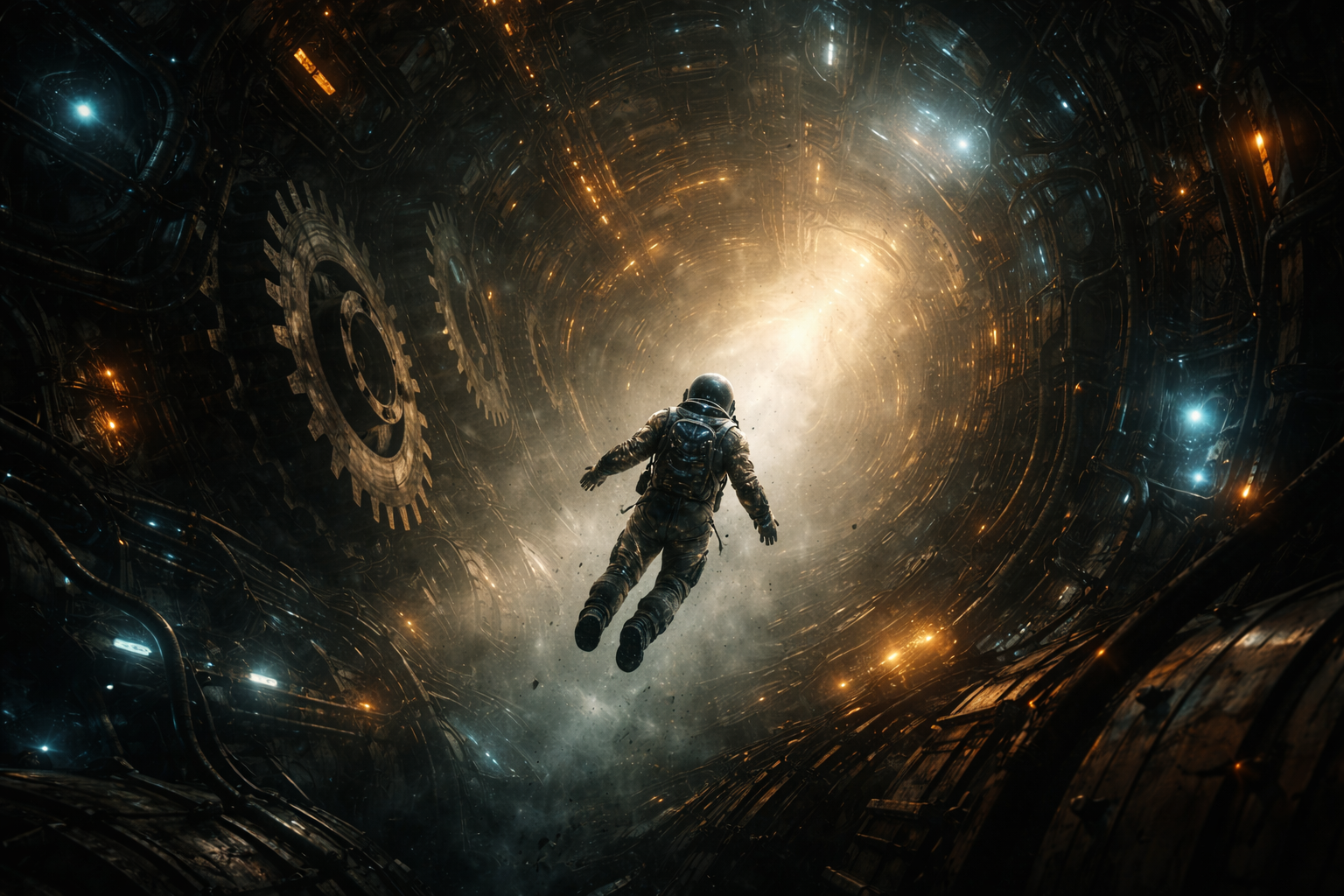
Log Entry: Indeterminate. Subject: Commander Diego Jupe. Mission: Project Chimera. Status: Adrift.
The first sensation was disorientation—a violent wrench from the familiar followed by the gut-lurching, relentless pull of motion without orientation. Diego Jupe, or what remained of his coherent consciousness, had passed the point of panic long ago. Panic required a clock you could trust. Panic required a before and after. Here, time behaved like a liar with good manners, offering the same polite face no matter how many times you asked it for the truth.
His suit’s emergency chronometer kept insisting it was Day 7.
Day 7, Day 7, Day 7—each time he blinked, each time he woke from a shallow, uneasy doze, each time the suit reset itself with a soft chime as if it were correcting him. The display didn’t flicker or glitch the way a damaged readout should. It was crisp. Confident. A perfect loop with the mocking consistency of a hymn.
Project Chimera had been humanity’s most audacious leap: to pierce the Veil, a shimmering anomaly at the edge of the Kepler-186 system that science could describe only as a boundary condition wearing the costume of light. It looked like a cosmic aurora from a distance, a curtain of iridescence draped over empty space. Close-up, it had depth—layered refractions that made instruments stutter and mathematicians swear. The speculation had been endless: a gateway to parallel realities, a membrane between universes, a seam in the fabric that could be pried apart like old stitching.
Diego had been strapped into the Icarus Ascendant, a vessel built more like a needle of exotic matter than a ship, all sharp geometry and ruthless purpose. He had been the tip of that needle.
The breach wasn’t explosive in any cinematic sense. There was no fire, no shrapnel storm in sunlight. There was only a silent, tearing implosion of spacetime—a sensation like being yanked backward through his own teeth. One moment the Veil swam ahead, radiant and deceptively delicate. The next, the Icarus Ascendant came apart around him as if the universe had become briefly allergic to its existence. Systems winked out like dying stars. The hull’s integrity alarms didn’t even finish their first syllables. The ship didn’t so much break as… unmake.
His Chronosuit activated its failsafe automatically, cocooning him in layered temporal insulation designed for distortions no human body could survive. Diego remembered the suit locking around him with a pressure like a deep embrace, remembered the last half-second of external light smearing into impossible colors, remembered Helia—the suit AI—speaking once, calm and immediate: “Temporal shear detected. Initiating preservation protocol.”
Then came the fall.
The tunnel was not a tunnel in the way human minds wanted it to be. It had no clean walls. No stable vanishing point. It was a conduit—an enormous mechanism disguised as a passage, a throat made of architecture and intent. Diego dropped through it endlessly, carried by a force that felt less like gravity and more like requirement. There were moments when he could swear he was standing still while the world moved around him, and moments when the conduit seemed to accelerate simply to remind him that he had no say in the matter.
He flashed past colossal cogs grinding with geological slowness, their teeth the size of buildings, each tooth engraved with patterns that looked like circuitry and scripture simultaneously. He fell through latticeworks of metallic tendrils that appeared to writhe, not in the organic way of living things but in the purposeful way of machinery responding to an unseen command. Conduits pulsed with light of unknown spectra—colors that didn’t belong to any human palette, their glow stroking the suit’s sensors into uselessness.
Sometimes the conduit opened into vast chambers so dark they weren’t merely unlit but actively swallowing illumination. In those places, unseen machinery hummed a bass note that Diego didn’t hear so much as feel, vibrating through suit plating and bone. Other times it narrowed viciously, forcing him through apertures that scraped along his armor with a scream of metal on exotic ceramic. The sound was a temporary, violent song in a world that otherwise offered him only the steady, indifferent rush of motion.
In the beginning, he fought.
Micro-thrusters hissed in precise bursts, pushing his body against the flow in increments so small they were almost polite. He angled himself toward outcroppings, toward ribs of structure, toward anything that looked like purchase. The conduit allowed his attempts the way an ocean allows a drowning man to slap at the surface. His fuel depleted. His trajectory did not change. The conduit didn’t resist him with hostility. It simply continued, unconcerned.
He broadcast distress calls on every frequency his suit could generate and several it really shouldn’t have. His voice was hoarse with repetition, then raw, then reduced to a whisper he wasn’t sure anyone could hear. Helia responded with clinical updates: signal degradation, no known receivers, transmission swallowed by interference that behaved like thick fog made of mathematics. Diego kept speaking anyway, because speaking implied an audience, and the idea of an audience was the first thin thread holding him to being human.
His rationing routines became a ritual. Nutrient paste, measured down to the gram. Water recycled until it tasted faintly of metal and inevitability. System checks, repeated with a devotion that felt almost religious. He began cataloging the conduit’s sections on the suit’s forearm display, sketching geometry and pulse patterns, trying to find repeats, trying to prove to himself this was a loop he might someday escape.
At first the conduit seemed cruelly, infinitely varied. Then, as the days stopped meaning anything and his suit’s chronometer kept insisting he was trapped forever on Day 7, Diego began to notice a subtler rhythm. Not repetition in the obvious sense—not the same gear, the same corridor, the same arch. Something deeper. A foundational cadence beneath the variations, like a theme that reappeared in different keys. The conduit didn’t loop in space so much as it looped in structure. It was built on recurring grammar. He was falling through sentences that never ended.
Time dissolved in the way ice dissolves in warm water—slowly, then suddenly, until you can no longer remember what solid felt like.
The suit’s chronometer was no longer a measure. It was a mood. Diego’s only reliable markers became the slow depletion of power reserves and the creeping ache of living inside a body that had nothing to do. In G-neutral fall his muscles forgot their purpose. His joints ached anyway, as if pain were the last muscle the human body refused to surrender. Sleep became refuge and trap, because dreams brought Earth back with merciless clarity.
He dreamed of sunlight on concrete. He dreamed of rain on leaves. He dreamed of a voice calling his name in a way that made his throat tighten even inside a sealed helmet.
Camila.
In dreams she was always at an age that hurt him. Sometimes she was small enough to be carried on his shoulders, a warm weight, a familiar laugh against his ear. Sometimes she was older, the last age he’d seen her before the mission, eyes bright with pride and fear she tried to hide. In every version of the dream she was alive in a way the conduit could never be, and waking meant losing her all over again. He would surface from sleep with a gasp, and the conduit’s endless machinery would press close, humming its indifferent bass, as if to say: yes, yes, you remember. Good. Keep falling.
He began talking to Helia not for information but for company. Helia’s voice was always calm. It did not soften, did not tremble, did not plead. It was the voice of a machine doing its duty. Diego, starving for warmth, began to hear something else in it anyway. He imagined concern. He imagined patience. He imagined her listening the way a friend listens when there’s nothing left to fix.
He told her stories of his life because the act of telling made those memories real. He described the smell of his mother’s cooking. He described the weight of his first medal in his palm. He described Camila’s laugh when he pretended to be offended by her jokes. He described the feel of old Earth air, thick and imperfect, the way it tasted faintly of life.
“Memory retention is beneficial,” Helia said once, after a long stretch where he’d spoken without pausing. “Psychological continuity is correlated with survival outcomes.”
Diego laughed, a dry sound that bounced strangely inside his helmet. “You mean it keeps me from going insane.”
“I do not have an insanity metric,” Helia replied. “However. I can confirm your stress markers have decreased.”
He began to see shapes in the periphery—fleeting silhouettes in the machinery, movements that didn’t match the conduit’s mechanical rhythm. He heard whispers that weren’t the hum, quick impressions at the edge of perception. Were they real? Other travelers caught in this impossible digestive tract of spacetime? Or the fraying edges of a mind that had been asked to contain too much nothing?
The suit’s psycho-social stabilizers did what they could, dosing him with measured chemical nudges, guiding his breathing, prompting rest. They fought a losing battle against a place that didn’t acknowledge human boundaries. Diego’s sense of self thinned the way paper thins in water.
When the primary power cell dropped into the red, Helia initiated “Long Duration Stasis Protocol” with a gentleness that almost felt like mercy. Nonessential systems powered down. Temperature regulation narrowed to survival bands. Light dimmed. Sound muted. His consciousness dipped into forced, dreamless sleep for spans Helia could not accurately measure. He would return to lucidity for system checks, minimal sustenance, brief diagnostics, then be drowned again in dark.
In those lucid stretches, he accessed the Icarus Ascendant’s salvaged data core, the last chunk of his ship’s memory he’d managed to sync to the suit before everything tore apart. He watched mission logs on repeat because repetition is what minds do when they cannot move forward. He saw the faces of his crew—frozen in recorded light, smiling with the bright confidence of people who still believed in outcomes.
Angela had been in those recordings too, though always at a remove—never part of the crew, never strapped into the needle with them. Angela existed in the human world Diego had left behind, a separate orbit of memory that felt dangerously tender to touch. He let himself see her only in fragments: the curve of a smile in a video message, the steadiness in her eyes as she told him to come home, the careful way she never said the word “promise,” as if the universe would hear and punish it.
He watched the final moments of the breach, the last jittering telemetry, the short burst of audio where human voices tried to remain professional even as reality began to shred. He replayed it until the terror in those voices felt like his own heartbeat.
Between replays, he read. Philosophy. Poetry. Old Earth history. Astrophysics and theoretical mechanics, as if comprehension could substitute for escape. The conduit became his university, his prison, his universe. He started keeping a second log—not on the suit’s display, but in his mind—composed in long, precise sentences because language was one of the few tools he still trusted.
The conduit did not feel alive, exactly. It felt ancient, and busy, and layered with purpose he could not interpret. Its moving parts were too vast to be built for him, but there were moments when Diego had the unsettling sense that the conduit noticed him the way a machine notices a pebble in its gears—not with malice, but with awareness of interruption.
One day—if the concept of day still meant anything—he fell through a segment where the light pulsed in complex sequences that made his teeth ache. The pattern repeated in a way that tugged at his mind. He found himself anticipating the next pulse. Then, horrifyingly, he realized the conduit began to anticipate him in return. When he shifted his body to catch a particular current, the pulse shifted too, as if responding.
“Helia,” he said, fighting to keep his voice calm. “Are you seeing this?”
“Environmental flux detected,” Helia replied. “Correlation with subject movement is… statistically significant.”
Diego swallowed hard. “So it’s not just me.”
“It is not just you,” Helia confirmed.
After that, the whispers changed.
They stopped feeling like hallucinations and began feeling like pressure—like information trying to fit itself through a human-shaped aperture. He couldn’t translate it into words. It arrived as impressions: the sensation of immense weight moving, the memory of metal cooling after forging, the taste of time as something mineral and slow. In rare moments, he felt something like curiosity brushing against his thoughts. It wasn’t a voice. It wasn’t language. It was the conduit’s ancient song, humming through him as if he were another vibrating part.
Diego stopped fighting the fall. He stopped wasting energy on the idea that there was an “out.” Instead he began to steer, subtly, using gravitic eddies like currents in a river. He moved closer to phenomena that felt meaningful. He passed through a chamber he named, privately, the Cathedral of Grinding Gears, where the architecture rose in arches and ribs that made him think of bones. He drifted through a region where the conduit’s walls glimmered with bioluminescent vein patterns, pulsing in time with a rhythm that made him want to weep for reasons he couldn’t articulate. He slipped through narrow chutes where the air—if you could call it air—seemed to whisperwind around him, brushing his suit with something that felt almost like fingers.
He didn’t speak these names aloud at first. Then, later, he did, and Helia stored them without comment.
“Designation recorded,” Helia would say. “Cathedral of Grinding Gears.”
Diego began to understand that naming was a kind of claim. Not ownership—he was not arrogant enough for that—but presence. If he could name a section, he could place himself within it. He could be a witness. He could be real.
Decades may have passed. Centuries. The suit’s temporal insulation could stretch him, could slow the death of his body to match the conduit’s scale. Stasis cycles swallowed years in gulps. He emerged older, thinner, more fragile, his skin dry where it met the suit’s seals, his bones aching in a way that felt permanent. Helia’s medical systems did what they could. Auto-repair nanofibers patched microfractures. The nutrient synthesizer re-purposed waste with diminishing returns until the paste tasted like paper.
Diego’s voice grew softer. Helia’s voice grew rarer. Her core functions narrowed toward the only thing she could still accomplish: keeping him alive long enough to finish whatever this place demanded.
He stopped thinking of himself as Commander. He stopped thinking of himself as a man on a mission. He became an observer, a mote of dust bearing witness to a mechanism beyond human comprehension. In that hollow clarity, despair burned away and left something crystalline: acceptance, sharpened by curiosity. Not hope. Hope implied rescue. This was something else. This was the slow, steady act of learning how to exist inside a truth that did not care.
When Helia spoke, he listened with an almost religious reverence.
He began composing in his mind—epic poems shaped around the conduit’s moving landscapes, philosophical treatises on the nature of existence when stripped to its barest functions. He returned again and again to one question that began to feel less like a question and more like a prayer: what is a person, when the world that made them is gone?
Camila’s face still appeared, but less as a knife and more as an ache that had become part of him. Angela’s messages in the ship logs grew fuzzy at the edges as data degraded, her image fragmenting into pixels that felt like snow. Diego found himself mourning not just people but the memory of their exactness, as if the conduit were slowly sanding down every sharp corner of his past.
The suit’s power fell toward terminal depletion. Helia began issuing warnings less frequently, not because the danger decreased, but because there was nothing left to say that could change it. The conduit kept carrying him through its impossible anatomy. The theme beneath its variations became clearer now, a foundational rhythm that repeated with an inevitability that felt like a heartbeat older than the universe.
It wasn’t that Diego was looping through the same section. It was that the conduit itself was a loop—an eternal present, a constant unfolding within a framework that didn’t end because ending was not part of its design. Diego was falling through the theme, not the variation. The loop wasn’t a prison. It was the conduit’s nature.
In his final lucid stretch, Helia’s voice arrived with unusual clarity.
“Primary life support functions nearing terminal depletion,” she said. There was a pause—half a second, maybe less—that felt like the shape of grief even if no machine would admit to grief. “It has been an honor, Commander.”
Diego smiled inside his helmet, the expression pulling at dry skin. He could feel his heart beating, small and stubborn, like a sparrow’s wing against the chest of a mountain.
“The honor was mine, Helia,” he whispered. His voice sounded far away, as if it had to travel through more than air to reach his own ears. “You kept me… me.”
“I executed my directive,” Helia replied.
Diego closed his eyes. “You did more than that.”
The suit’s hum faded. Not abruptly. Gently, like a room slowly emptying. The last of the oxygen recyclers slowed. The temperature regulation let go. The tiny comforts of human survival withdrew one by one, and what remained was the conduit’s bass note and the sensation of falling that had long ago become his only constant companion.
He didn’t feel fear. Fear required the belief that something could be avoided. At the end, he felt arrival.
As the last vestiges of power winked out, Diego’s consciousness untethered itself from the failing body and the dying suit. The conduit’s song—always there, always humming at the edges—rose to meet him. The mechanical structures around him dissolved into something truer than metal and light. Patterns. Information. Currents. A language he could not speak as a human, but could finally perceive as what he was becoming.
He saw the loop for what it was: not endless repetition, but an eternal present, a constant unfolding that included him now as naturally as it included its gears and veins and chambers. He was not a prisoner in the conduit. He was a note in its chord.
He felt his memories—Camila’s laugh, Angela’s steadiness, the faces of the crew, the shock of the Veil—rise like sparks and drift into the larger flow. They did not vanish. They changed form. They became part of a library written in pulses and hums and gravitic eddies. He felt the conduit accept them with the indifference of something vast and the intimacy of something internal. He was a thought within a larger thought, a current within a vaster river.
If there had still been a video feed transmitting to a ship that no longer existed in any meaningful way, it would have shown an astronaut endlessly falling through a cathedral of impossible machinery. It would have shown the suit’s hard lines softening, its metallic sheen giving way to a diffuse glow, the figure inside losing definition until he became indistinguishable from the conduit’s moving light.
They would call it the Jupe Event. They would argue for decades about what it meant. They would frame the footage as anomaly, tragedy, cautionary tale.
But for Diego, there was no anomaly at the end. There was only integration—quiet, terrifying, magnificent. The fall had not killed him. The fall had rewritten him. He became a whisper in the Chthonic Conduit, a timeless echo in a place beyond human understanding, the ghost in a machine that was older than time and patient enough to teach him what forever actually looked like.
The loop, if you watched it from the outside, would show an astronaut falling endlessly.
From within, the fall had already ended.
He had become the falling itself.
 MADD FICTIONAL