
Claude Vaillant held his torch the way a priest held incense, as if smoke alone could sanctify what he was about to do.
The wolf carcass hung above the stacked wood like a sermon. Its pelt was scorched in patches, its eyes burned out, its mouth slack with that thick, black seep of old blood. A warning delivered with craftsmanship. A message meant to lodge itself under Bzou’s ribs and stay there.
The square was full, but it was quiet in the way a courtroom was quiet: everyone waiting for the verdict, everyone pretending they weren’t eager to see it pronounced.
Claude stepped closer, boots grinding on damp stone, his men fanning out behind him in a practiced half-circle. Huntsmen coats. Huntsmen hands. Huntsmen faces that had learned to wear necessity like virtue. The fur stitched into Claude’s collar wasn’t just for warmth. It was a history he wanted everyone to read.
“We let you live on the edge of our land,” Claude said, as if mercy had been his idea. “We let you keep to your cave. We let you hunt the things that don’t belong.”
Bzou watched the crowd instead of Claude. A woman’s jaw clenched. A boy’s eyes went bright with fear and fascination. An old man’s fingers worried a charm in his pocket like he was paying in advance for whatever came next.
Claude continued, voice slow and measured, each word placed carefully. “Because you knew the rules.”
Bzou said nothing. Silence was always useful. It made people fill it with their own assumptions.
Claude smiled, not with his mouth but with his posture. “Now you’re walking among us.”
His gaze flicked, briefly, to Redalhia.
“And worse,” he added, “you’ve brought back the girl.”
Bzou didn’t look at her. He didn’t need to. He could hear the village pivot on that sentence, the way they had been pivoting ever since Redalhia appeared at the edge of town with a hood and a spine that refused to bow. She wasn’t just a person to them. She was a returned variable. A broken pattern. A story that had changed its mind about ending.
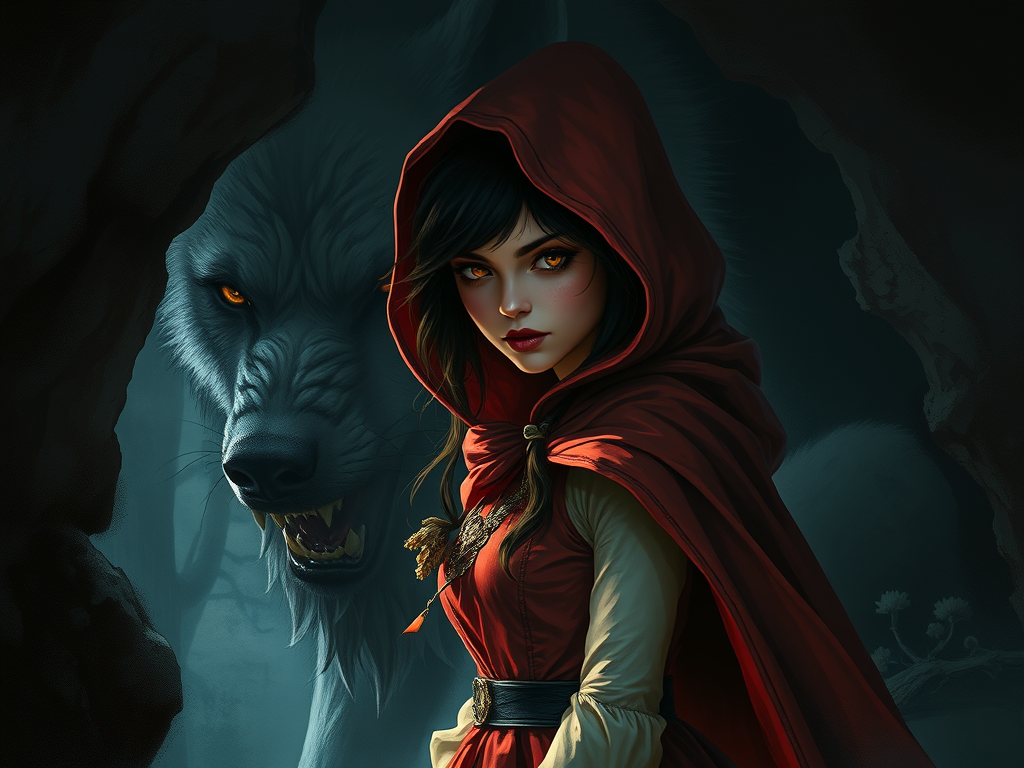
Redalhia stepped forward before Bzou could speak, her boots leaving dark prints on the wet stone. She stopped just short of Claude’s torchlight. Close enough that the heat kissed her cloak. Close enough that everyone understood she wasn’t hiding behind the wolf.
“You’re afraid,” she said, voice calm, almost conversational.
A ripple went through the crowd, so small it might’ve been the wind. Claude’s expression didn’t change, but his pupils tightened.
“You don’t burn things you aren’t afraid of,” Redalhia went on. “You don’t hang them up like a festival prize unless you need someone to see it.”
Claude held her gaze. For a moment, the mask almost slipped. Not enough for the villagers, but enough for Bzou.
Claude was afraid.
Not of Bzou’s teeth. Not of Redalhia’s knife. Of something else. Something beneath the village that the Huntsmen had sworn to manage.
Claude’s voice softened, as if he were indulging a child. “You’ve been away too long, Redalhia. You don’t understand how things work here anymore.”
“I understand,” Redalhia replied. “You work here. Like hired hands. Like butchers. Like men who think rules are the same thing as righteousness.”
One of Claude’s men shifted, grip tightening on a spear. Another’s jaw flexed. They were ready to turn the square into blood if Claude gave the nod.
Bzou finally spoke. His voice didn’t rise. It didn’t need to.
“You hunt,” he said. “I hunt. The difference is I don’t set fire to my kills.”
A murmur moved through the crowd, faint, involuntary. Claude’s mouth twitched—almost a grin.
“That’s because you still think like an animal,” Claude said. He lifted the torch higher, letting the flame brighten his face. “We’re men.”
The last word landed heavy, like a door being locked.
Bzou held Claude’s gaze. “Men do not need crowds to prove themselves.”
Claude’s smile faded. The torch hovered above the pyre, close enough that one careless flick would feed the whole stack. The village held its breath.
Bzou waited. Patience was not surrender. It was a weapon.
Claude’s eyes cut, briefly, to the wolf. To the message. To the leverage.
Then he lowered the torch a fraction. Not mercy. Not retreat. A postponement.
“Go back to your cave,” he said, voice carrying. “And take her with you.”
Redalhia didn’t speak. Neither did Bzou. They turned away together, walking out of the square with their backs exposed, daring the Huntsmen to be brave enough to strike in front of witnesses.
No one moved.
But Bzou felt the village’s gaze follow them like a hand on the throat. Felt Claude’s patience, cold and deliberate, settling into place.
Not tonight, the square said.
Soon.
They didn’t stop until they were two streets away, where the houses thinned and the fog thickened again. Even then, Bzou didn’t relax. He listened for pursuit, for boots, for the scrape of steel. There was none. Only the quiet hum of a village that was satisfied it had made itself understood.
Redalhia exhaled, slow. “They wanted you to snap.”
“They wanted me to burn,” Bzou corrected.
Redalhia’s eyes flashed beneath the hood. “They killed a wolf to get a reaction.”
“They killed one of mine,” Bzou said, and the words came out colder than he intended.
Redalhia’s mouth tightened. “Then why did you hold back?”
Bzou kept walking. “Because their rules are a net. If I thrash, it tightens.”
Redalhia fell silent for a beat, then spoke again, quieter. “So we cut the net instead.”
Bzou glanced at her. In the fog, her face was all angles and resolve, and something else—something that had been waiting a long time to stop playing polite.
“Yes,” he said. “We cut it where it’s anchored.”
They returned to Mireille’s sealed house without taking the main street. Redalhia led them through narrow alleys and back paths that remembered her. Bzou followed, reading the air like a map.
When they reached the porch, Bzou stopped before the door.
The scent was different.
Someone had been inside again.
Not lingering. Not rummaging. Just… touching. Shifting something by inches. Leaving a signature behind like a thumbprint in grease.
Tallow. Lanolin. The Huntsmen’s smell, trapped in the wood.
Redalhia saw Bzou’s expression and stiffened. “They came back.”
“Of course they did,” Bzou said. “They were listening for what we learned.”
Redalhia unlocked the door and stepped in. The air inside had changed in the same subtle way a room changed after an argument—everything still, everything holding a residue of intent.
The book still lay open on the table.
Untaken.
Bzou’s gaze slid over it and then away.
“They didn’t want the book,” he murmured.
Redalhia’s voice sharpened. “Then what did they want?”
Bzou walked past the table without looking at the pages. The draft under the floorboards had been there earlier, faint but present. Now it was stronger, a thin stream of cold air curling out from somewhere that shouldn’t have had an opening.
He stopped near the center of the room.
Redalhia followed his eyes. “What is it?”
Bzou didn’t answer. He crossed to the rug by the hearth and knelt. The rug was almost centered. Almost.
But not quite.
Someone had moved it a hand’s width, then tried to correct the shift, leaving it imperfect. A mistake made by someone who did not live here and did not care to be gentle.
Bzou pulled the rug back.
Beneath it was a trapdoor.
Iron-bound. Old. The kind of heavy, ugly practical thing built for keeping secrets underground. The lock was thick and scorched at the edges as if someone had once tried to melt it off and failed.
Redalhia’s face went pale in a way that had nothing to do with fear and everything to do with recognition.
“My grandmother…” she started, then stopped, swallowing the rest.
Bzou leaned close to the door, inhaled once, and felt his fur lift.
Cold. Preserved decay. Herbs used to mask the stink of bodies. And underneath that—something wronger than rot. Something like meat that had been interrupted mid-spoilage and forced to wait.
Redalhia’s hand went under her cloak. When it came out, she held a small knife, plain and sharp. She didn’t look at Bzou for permission.
She jammed the blade into the lock and worked it with quick, precise movements, as if she’d opened doors like this before.
The lock clicked.
Redalhia looked up at him. “Ready?”
Bzou’s eyes stayed on the trapdoor. “No.”
Redalhia lifted the iron ring handle anyway.
The trapdoor opened with a groan that sounded like wood complaining after decades of silence.
Cold air rolled up from below, thick enough to taste.
They descended into darkness.
The cellar was not a cellar. Not a place for canned fruit or spare blankets. It was stone-walled and damp, the air sharp with preservatives and old herbs. Shelves lined the walls, holding jars of dried things that might have been medicine once, now turned to ritual camouflage. A heavy wooden table sat in the center, scarred, scrubbed, scrubbed again, as if someone had tried to erase what had happened there and failed.
Redalhia lit a match. The flame shivered in her fingers.
Bzou’s eyes adjusted faster than hers, and he saw what the matchlight couldn’t quite make normal.
Bodies.
Wrapped tight in linen and laid out in a row against the far wall like offerings. Not fresh. Not ancient. Suspended between.
Redalhia stepped toward them, her knife still in her hand but forgotten. She crouched, fingers hovering over the nearest bundle, then resting lightly on the cloth as if she could feel through it who it had been.
Her voice came out thin. “This isn’t her.”
Bzou stayed still. He watched Redalhia move down the line, touching each one like she was counting. Like she needed to confirm what she already knew.
“None of these are her,” she whispered.
Bzou’s chest tightened. Relief and dread were sometimes the same emotion in different clothing.
If Mireille wasn’t here, she was either alive… or moved. Taken deeper.
Above them, the house creaked.
Bzou’s ears flicked.
Footsteps.
Not on the porch. Inside the house.
Two sets, maybe three. Slow. Controlled.
Not thieves. Not villagers looking for gossip.
Hunters.
Redalhia looked up sharply, matchlight trembling. “They followed us.”
“They didn’t follow,” Bzou corrected, voice low. “They waited.”
The trapdoor overhead shifted slightly.
Someone touched it. Testing. Listening.
Redalhia backed toward the shadowed shelves. Her knife came up.
Bzou melted into the darkness between the jars and the stone, silent as smoke.
The trapdoor creaked open.
Torchlight spilled down the steps, bright and hungry, carving the cellar into harsh shapes.
A man descended first, younger, shoulders tense, torch held high as if the flame made him brave. He saw the wrapped bodies and stopped, a curse catching in his throat.
“Saints’ mercy,” he muttered. “They kept them down here?”
A second man came down behind him, older, heavier, his coat thick with old blood. He glanced at the bodies like they were tools left out of place, then turned his gaze toward the darkness.
“Well,” he said, voice curling into something smug. “Look what came crawling back.”
Redalhia’s knife flashed in the torchlight.
The older Huntsman grinned. “You should’ve stayed gone, girl.”
Bzou moved.
Not a growl. Not a warning.
Just muscle and intent.
The younger Huntsman barely had time to turn before Bzou’s jaws closed around his throat. Bone cracked. The torch fell, spinning across the stone. The man hit the ground like a sack of wet grain.
The older Huntsman shouted, fumbling for his own blade.
Bzou slammed him back into the wall, pinning him with the full weight of something that did not belong to villages or rules.
The torch rolled into a puddle and hissed out.
Darkness swallowed the cellar.
The older Huntsman’s breathing turned ragged. He tried to lift his knife. Bzou’s teeth hovered at his throat, close enough to press the skin without breaking it.
A choice offered with perfect clarity.
The Huntsman’s knife clattered to the floor.
Bzou leaned in, his voice a low vibration against the man’s pulse. “Go back.”
The Huntsman shook, barely nodding.
“Tell Claude what you saw,” Bzou said. “Tell him you should have lit the pyre when you had the chance.”
The older man scrambled up the steps so fast his boots slipped. He vanished into the house, into the fog, into the village’s waiting mouth.
Redalhia stared at the dead Huntsman on the floor, her expression unreadable. “That was mercy,” she said softly.
Bzou looked at her. “That was a message.”
Redalhia’s lips pressed together. “Then Claude will answer.”
“Yes,” Bzou said. “With rules.”
They didn’t linger in the cellar. Not with the stink of bodies and the certainty of pursuit.
They moved through the back of Mireille’s house, out into the fog, taking alleys and narrow breaks between buildings, avoiding the open square. The village had already begun to change around them. Doors that had been slightly open were now shut. Lanterns that had burned warm were dimmed. The fog thickened, pressed closer, as if the village itself was trying to hide its throat.
Redalhia led them toward the edge of town. Not the road out.
The old part.
Where the houses leaned closer and the ground held older stories.
They stopped at a well.
It sat behind a row of derelict sheds, half-hidden by brambles. Heavy wooden boards had been laid across the top and nailed down with thick iron spikes, hammered deep with intent.
Not to keep children from falling in.
To keep something from climbing out.
Redalhia crouched, fingers brushing the nails. “This isn’t on any map.”
“No,” Bzou said. “It’s on theirs.”
Redalhia drew a small crowbar from beneath her cloak like she’d been born carrying it. She wedged it under the first board and leaned her weight into it.
The wood groaned.
A nail squealed, resisting.
Bzou watched the dark spaces between the boards. He could smell what lived below—not rot exactly, not water, but something old and blood-wet, something that had been breathing the same air for too long.
Redalhia hesitated for the first time since she’d walked into his cave. “If we do this…”
“We don’t stop,” Bzou finished.
Redalhia nodded once, then pried again.
The board split with a sharp crack, and the nail finally tore loose with a shriek of metal.
A cold gust surged upward, smelling of buried blood and stone.
Redalhia swallowed. “Do you hear that?”
Bzou did.
At first it was so faint it could have been wind in a hollow shaft.
Then it changed.
It became rhythm.
Not water dripping.
Not earth settling.
A low, slow sound, deep beneath them.
A breath.
Something down in the dark inhaled, as if it had been waiting for the seal to break.
Redalhia’s knuckles whitened around the crowbar.
Bzou leaned over the opening, eyes fixed on the black throat of the well.
And from below, in that cold, hungry air, the breathing came again—closer now, clearer.
Alive.
 MADD FICTIONAL