
Gildengrove looked the way a lie looks when it’s been rehearsed for generations.
From the road, it wore peace like good linen: warm windows, trimmed hedges, a square that suggested commerce instead of hunger. Even the fog seemed domesticated here, pressed low against the cobblestones as if the village had trained it to behave. But Bzou smelled the truth under the prettiness the way he smelled rot beneath perfume. Too much sage burned into the air. Too much tallow. Too much iron. The kind of careful cleanliness people used when they didn’t want the world to notice the mess they’d made.
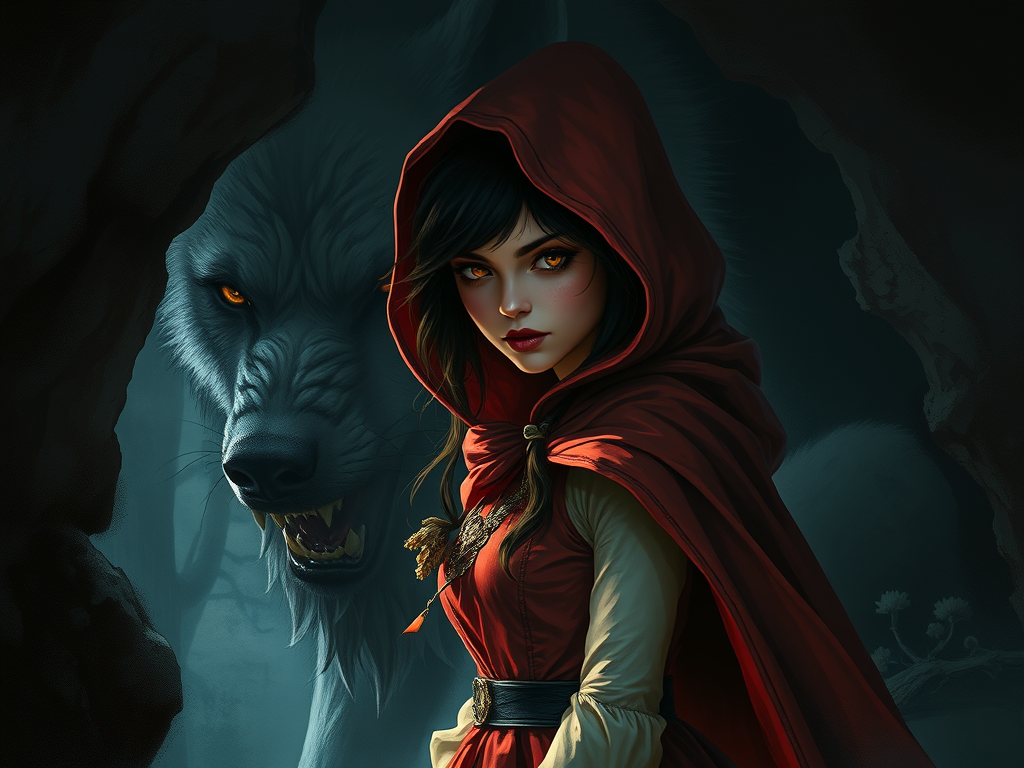
Redalhia walked slightly ahead of him, hood drawn low, her posture straight enough to pass for calm. She didn’t look at the houses as they passed, and she didn’t look at the faces in the windows either. Bzou saw them, though. Curtains moved a fraction. A door cracked open and closed. A man at the corner pretended to fuss with a lantern while his eyes flicked over Bzou’s shoulders, tracking his size, his gait, the way the fog seemed to lean away from him.
No one stared openly. Not yet. Gildengrove had manners. It smiled first.
“You belong here,” Redalhia murmured without moving her lips.
It wasn’t a comfort. It was an accusation, aimed at herself.
“I don’t,” Bzou said.
Redalhia didn’t argue. She led him through the square, past the little shops with their careful displays and their careful absence of customers at this hour. The village was awake, but it was awake in the way a hunting party was awake: quiet, observant, ready to move all at once if the signal came.
Bzou kept his hands loose at his sides and his shoulders broad under his cloak. He let them read him however they wanted. Let them misunderstand a predator’s patience for restraint. Let them mistake a pact for weakness.
Redalhia brought him to a small house just off the square, tucked behind a row of leafless trees. The place didn’t fit the village’s polished story. It wasn’t ruin, exactly, but it carried the look of something intentionally abandoned—shutters drawn, paint dulled by salt air, the porch steps worn down as if someone had paced them for years.
“They sealed it fast,” Redalhia said, and for the first time her voice carried something that wasn’t steel. It carried offense.
Bzou saw the iron nails before she pointed them out. Thick-headed, driven hard into the window frames and the doorjamb, not to keep thieves out but to keep something in. The kind of nails you used when you believed wood alone couldn’t hold.
“Your grandmother’s house,” he said.
Redalhia nodded. “Mireille’s.”
Bzou stepped close to the door without touching it. He didn’t need to. The air around it tasted wrong, like a room where someone had whispered prayers for hours and meant none of them. He inhaled once and sorted the layers.
Lavender, old paper, dust. A faint trace of ink. Beneath that: ash that wasn’t from a hearth. A cold burn. And threaded through it all—thin and greasy—lanolin.
He glanced at Redalhia.
“Tallow,” she said, as if she could hear his thoughts.
“Huntsmen,” Bzou replied.
Redalhia reached under the loose board at the porch edge and drew out a key. The move was too smooth, too practiced, the kind of action that said: I came prepared to be disbelieved. She slid the key into the lock.
The metal resisted for half a breath, then gave, with a soft, reluctant click that sounded too loud in the village’s quiet.
Bzou didn’t like that the lock still worked.
Sealed houses were meant to become tombs. Tombs didn’t get reopened unless the people who sealed them planned to return.
Redalhia pushed the door inward.
The air inside was cool and stale, not with death, not with decay, but with absence. The room felt held, like breath caught in lungs that refused to exhale. Dust floated in the thin strip of light that slipped through a gap in the shutters. The furniture hadn’t been overturned. Nothing looked looted. It was the stillness of a place people had left in a hurry and then pretended they hadn’t.
Redalhia stepped in first. Bzou followed, his boots quiet on the old wood.
“She didn’t take anything,” Redalhia said.
It was a statement, not a guess. Her eyes moved over the room the way you look at a loved one’s face for bruises, hoping to find none and expecting to find more.
Bzou moved to the center of the room and let his senses do what human eyes couldn’t. He smelled Mireille’s life in faded traces: tea, wool, the faint medicinal bite of dried herbs. That part was ordinary. Comforting, even. The wrongness was in what cut through it, sharp as a wire: cold ash and something else he couldn’t name at first.
He followed it to a table by the window.
A book lay open there, as if someone had been interrupted mid-sentence. It wasn’t simply old. It was injured. The page edges were blackened, but not with flame. The burn looked like frostbite—dark, crisp, and clean. The ink in the lines had bled into the paper like veins, branching outward as if it had tried to escape.
Bzou stared at it for a long moment.
Redalhia came up beside him, her breath tight. “That wasn’t there when I came last night.”
Bzou’s head turned slowly. “You were here.”
Redalhia didn’t flinch. She didn’t apologize. “I looked through the window cracks. I couldn’t get the door open. I didn’t have the key yet.”
The key, then, had been left for her to find.
Bzou’s jaw tightened. “Someone wanted you inside.”
Redalhia’s eyes tracked over the book. “Or wanted you.”
Bzou didn’t correct her. He extended one claw and hovered it above the paper without touching. The ink looked alive in the weak light. The characters weren’t any language Redalhia would have been taught in Gildengrove’s clean little schoolhouse. They weren’t even the sort of script humans wrote for each other. The shapes carried intent. They carried ritual. They carried a memory of mouths that didn’t form words the way human mouths did.
He had seen something like it once, long ago, carved into standing stones deep in the woods, where the trees grew too close together and the ground tasted of old iron.
Redalhia’s voice came carefully. “Can you read it?”
Bzou’s eyes stayed on the page. “It’s not meant to be read.”
He finally touched the paper, just a single point of claw to the margin.
The cold shot through him like a needle.
His fur bristled under his cloak, and the shadows in the room seemed to pull tighter to the corners as if they, too, wanted to hide from what lay on the table.
Bzou withdrew his claw. “Someone brought this here recently.”
Redalhia swallowed. “You think it’s connected to her disappearance.”
“It’s connected to the village,” Bzou said. “Which means it’s connected to her whether she wanted it or not.”
Redalhia leaned in, her gaze intense. “Then tell me what it is.”
Bzou looked at her, and for an instant he saw the child she must have been—small, listening to elders speak in half-truths, sensing the gaps in every story, not yet knowing the gaps were where the monsters lived. Then he saw the woman she was now, the one who had walked into his cave and asked for help like she’d already decided she would pay whatever price was required.
“It’s a map,” he said finally. “Or a warning. Or both.”
Redalhia’s eyes sharpened. “To what?”
Before Bzou could answer, the house shifted around them.
Not physically. Not in any way a human would have noticed. But Bzou heard it—the faint change in air pressure, the subtle tightening of sound as if the walls were listening harder. The scent of the room altered too. Lavender and ink stayed, but something new threaded in, thin and greasy, like a glove rubbed against wood.
Lanolin.
His ears flicked.
Redalhia saw the change in his face. “Someone’s here.”
Bzou didn’t move. He listened. The footsteps were outside, not on the porch yet, but close. Slow. Deliberate. Not lost. Not curious. The kind of steps taken by someone who knew exactly where the door was and exactly why it had been opened.
“Huntsmen?” Redalhia whispered.
“Not yet,” Bzou said, but he didn’t like how uncertain the words sounded even to him.
The footsteps stopped.
Silence held.
And then—nothing.
No knock. No attempt to enter. Just the knowledge that whoever had approached had chosen to wait instead.
Bzou’s gaze drifted to the window.
Across the street, through the narrow gap between shutter slats, he could see movement. A shadow behind a curtain. A figure that shifted back when Bzou’s head turned. The village wasn’t confronting them. It was observing them.
Gildengrove’s smile, Bzou realized, wasn’t warmth.
It was teeth held politely behind closed lips.
Redalhia’s voice went rigid. “They’re watching us.”
“Yes,” Bzou said, and his tone carried an old, tired understanding. “They always have.”
Redalhia’s fingers tightened around the edge of the table. “Then we leave. We take the book.”
Bzou shook his head. “We don’t take it.”
Redalhia’s eyes flashed. “Why not?”
“Because it’s bait,” Bzou said. “And because whoever placed it wants to know what you’ll do with it.”
Redalhia drew back slightly, frustrated, breathing through her nose like she was trying to keep herself from saying something reckless. Bzou understood the urge. When you were angry, it felt good to break rules just to prove the world couldn’t break you.
But the village wanted reckless.
The village wanted predictable.
Bzou stepped away from the table, letting the book sit open and untouched, like a mouth waiting to be fed.
“We learn what we can without giving them what they want,” he said.
Redalhia’s gaze cut to him. “What do they want?”
Bzou’s eyes narrowed. “To see whether you’ll look where Mireille looked.”
Redalhia went still. “So you think she found something.”
Bzou answered slowly, because the truth of it made his throat feel tight. “I think she remembered something they thought they’d made her forget.”
Redalhia’s jaw set, and Bzou heard the decision form behind her teeth. “Then I’m going to remember too.”
Bzou didn’t stop her. If he had, she would have gone anyway.
They left the house the way they’d entered—quiet, controlled, refusing to rush. Bzou locked the door behind them, not because he believed locks mattered to the village, but because leaving it open would have been an admission of fear. The kind of admission Gildengrove liked to collect.
As they stepped back onto the street, the village shifted around them in small, coordinated ways. A door closed softly. A curtain fell back into place. A woman carrying a basket paused just long enough to look at Redalhia’s cloak, then continued on with a smile that never reached her eyes.
Bzou kept his gaze forward, but his senses reached outward, tallying each watcher the way a wolf counts the deer in a field. Too many. Too alert. And beneath their human smells, that same greasy trace of tallow, woven into the air like a thread guiding them somewhere.
Redalhia noticed it too. “Where are they going?” she asked.
Bzou inhaled.
Then he smelled it—stronger now, unmistakable.
Burning hair.
Burning meat.
And beneath it, dark and wet, the copper sting of blood that hadn’t fully cooled.
Bzou stopped.
Redalhia’s head turned toward the village square. “What is that?”
Bzou didn’t answer. He started walking again, and Redalhia fell into step beside him, her hand still under her cloak.
The square opened ahead, fog thinning just enough to reveal a crowd gathered near the market stalls. Not loud, not celebratory, not even openly hostile. Just present. Silent. Watching as if they’d paid for a performance and didn’t want to miss the first act.
Torches ringed something at the center, their flames flickering impatiently.
Bzou slowed as they approached, and the crowd’s attention sharpened like a blade pulled from a sheath. He felt dozens of human eyes settle on him at once. Felt the slight satisfaction in them. The anticipation.
Someone stepped out from the half-circle of torchlight.
Claude Vaillant.
Bzou recognized him by scent before he recognized him by sight: old blood embedded in leather, tallow in the seams of his coat, steel that had tasted too much life. Claude wore his authority the way some men wore religion—loudly, like it excused everything.
His beard was peppered with gray, his shoulders broad, his posture relaxed in that deliberate way meant to signal: I’m not threatened.
But Bzou smelled the lie in Claude too.
Fear was there, under the confidence, compressed into something hard and hot.
Claude lifted his torch slightly—not as a threat yet, but as a gesture. A greeting meant for predators.
“You’ve come down from your cave,” Claude called, voice carrying across the square with practiced ease. “And you’ve brought the girl.”
Redalhia’s shoulders stayed squared. She didn’t look at the crowd. She didn’t look away either. She held her place like she’d learned long ago that flinching invited hands.
Bzou’s gaze went past Claude, to the thing at the center of the square.
A pyre.
Wood stacked carefully, not hastily, as if it mattered how the flames would travel. The scent of pitch and oil clung to it. A ritual pyre, not a disposal fire. And tied to it—
Bzou’s breath went cold.
A wolf carcass hung from the bindings, strung up like an offering. Its pelt was scorched in places, the fur stiffened with drying blood. The eyes—burned out. The mouth—slack, black rivulets still clinging around its teeth.
It wasn’t fresh enough to be tonight’s kill, but it wasn’t old enough to be forgotten either.
A message, timed precisely so Bzou would see it.
The crowd stayed silent, watching him watch it, waiting to see whether grief would make him stupid.
Claude’s voice came again, softer now, the way you speak when you think you’ve already won.
“Your kind have forgotten your place.”
Bzou didn’t look at Claude.
He stared at the wolf.
At the brutal care taken to display it.
At the deliberate cruelty.
They hadn’t killed a wolf for sport.
They’d killed one of his.
And they’d dragged it into the center of the village like a promise.
Bzou’s hands stayed loose at his sides, but his claws flexed once, almost imperceptibly.
Redalhia’s breath came slow beside him, controlled, but Bzou could hear the small shift in her pulse. She understood now—whatever she’d come back to Gildengrove for, it wasn’t only about her grandmother.
It was about what the village did when it wanted to remind monsters who the real monsters were.
Claude held the torch steady, letting the firelight dance.
Bzou’s gaze lifted at last, meeting Claude’s eyes.
And the village’s smile widened, polite and deadly, waiting for the moment the pyre would finally catch.
 MADD FICTIONAL