
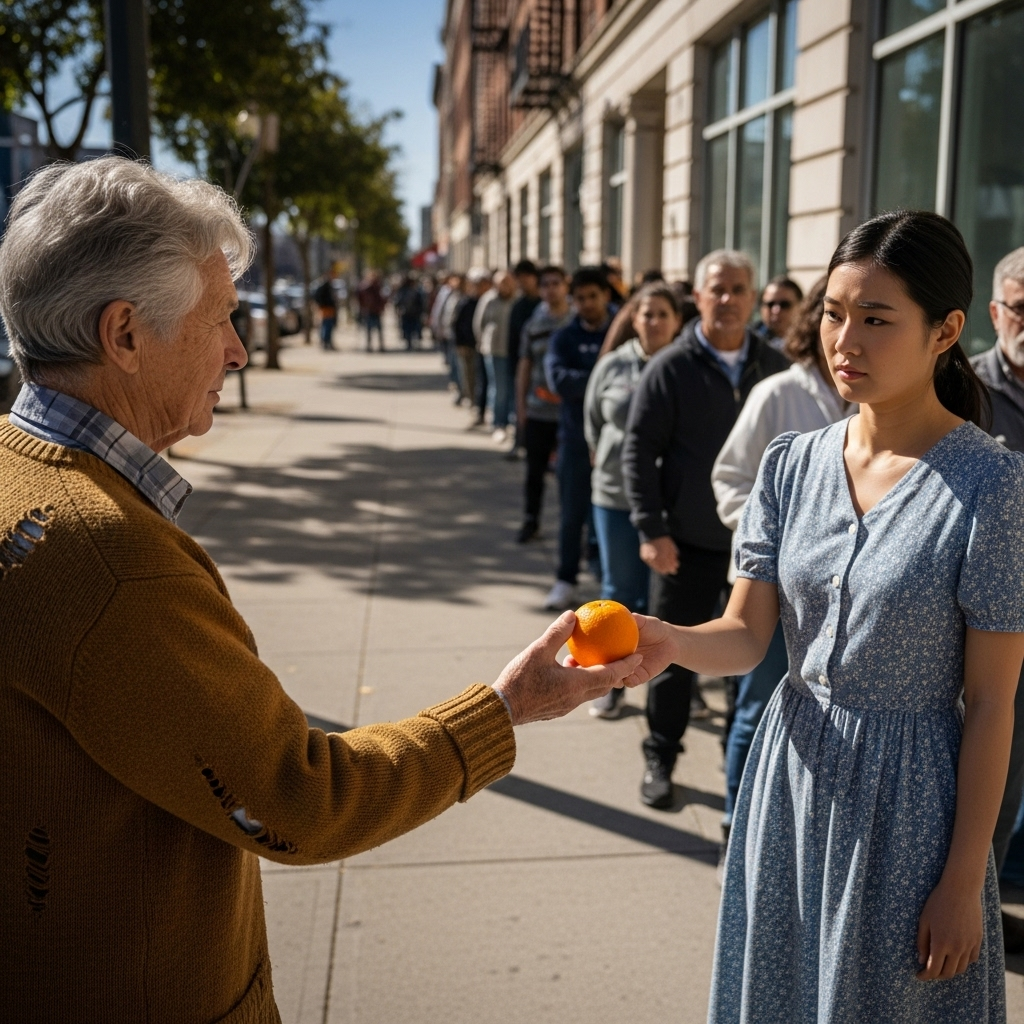
By way of explanation: I am easily bored. This usually leads to me getting into trouble in real life. In my writing, however, I can explore avenues of storytelling and the only fallout from that is the eye-rolling exhaustion experienced by my readership (there’s so few of you that I’m not overly bothered by that). This current experiment is based on a simple story: a man on a breadline makes a daily habit of handing one particular woman his orange. The goal is to see how weird I can make the retelling of the story each week. Simple, right?
In a city called The Glitch, where the sky is the color of a dead-channel screen and buildings sometimes forget their own geometry, the breadline is a daily scar. Time doesn’t just stand in line here; it curdles.
Every morning, just before the false-dawn light leaks through the perpetual grey, he would manifest. No one saw him arrive; he was simply there. A man whose age was a variable, his posture bent into a shape that suggested not a question, but a hook.
And every morning, as the volunteers in their smocks—themselves looking faded and translucent—dished out the grey paste and stale bread, the man would perform his function. He would reach into the folds of his own threadbare coat. His face would tighten, a mask of excruciating concentration. He would not pull out an orange.
He would peel a perfect, crescent-shaped sliver from his own skin.
In his palm, the sliver would curl, thicken, and blush into a sphere. It was not an orange. It was the idea of an orange—unnaturally warm, heavier than it should be, and smelling of citrus, ozone, and burnt sugar.
He would walk ten paces down the line, to where she always stood.
The woman. Her face was a landscape of quiet starvation, her eyes fixed on the cracked pavement as if reading the city’s obituary. He would reach out, his hand trembling slightly, and place the warm, impossible fruit into hers.
She never looked at him. She never said thank you.
He never expected it. The offering was not a gift; it was a transfer of burden.
This continued for seventy-three cycles.
On the seventy-fourth, he did not manifest. He was not absent; his space in the line was a void, a pixel of reality that had been deleted.
The woman didn’t notice at first. The Glitch erases things. But when a volunteer, their face a smear of confusion, handed her an actual, cold, mundane orange from a crate, her hand recoiled. The thing felt like a lie. An insult.
She did not eat it. She put it in her coat pocket, where it felt like a stone.
Day after day, he remained a void. The real oranges accumulated in her bag, cold and silent. She began asking questions, but the answers were static. One man remembered him with a face like a web of scars. A woman swore he was made of tightly wound twine. A third insisted he had no face at all, only a smooth, dimpled surface like a peel. He was a bug in the code, and now he was patched.
By the end of the week, she was carrying six dead oranges. That night, they began to move. In the darkness of her room, they rolled together in her bag, their skins dissolving, fusing into a single, softly glowing, heart-like fruit that pulsed with a slow, thick beat.
She didn’t dream of an orchard. The Heart-Fruit showed her.
It showed her a place outside The Glitch, a screaming geometry of flesh-barked trees growing from a ground of black glass. They were not trees; they were nervous systems. Their branches writhed, bearing not fruit, but luminous, weeping tumors that ripened with a low hum. At the center stood the Gardener—a being of blinding light and a thousand interlocking limbs, its “face” a constellation of patient, orange eyes. It was pruning a nerve-branch with a tool made of solidified sound. It did not notice her, but she understood.
The fruit was not a food. It was a seed.
She woke up with the taste of rust and sunrise in her mouth. Her skin had changed. Where the Heart-Fruit had rested against her hip, her flesh was now tough, dimpled, and smelled faintly of citrus.
She went to the breadline. She took the grey paste. She refused the dead orange. The transformation was slow, but it was happening. Over the weeks, the orange patch on her skin grew, a beautiful, terrible bloom. A new kind of hunger grew in her—not for food, but for… completion.
Then one day, she felt the pressure build beneath her own skin. A familiar, exquisite pain.
She saw him then, a boy shivering at the end of the line, his eyes wide with the transparent horror of the truly lost.
She walked towards him, her steps no longer entirely her own. She reached into her coat, her face tightening into a mask of excruciating concentration. She peeled a perfect, crescent-shaped sliver from her own body.
It curled in her palm, a gift of warmth and impossible color. She placed it in his hand.
He did not say thank you.
She did not wait for one.
No one knows how it starts. But they know it spreads. The Glitch was not a collapse.
It was a planting. And in the fertile soil of ruin, the orchard was learning to grow.
To. Be. Transmogrified.
 MADD FICTIONAL
I love it.
LikeLiked by 1 person
Thank you.
LikeLiked by 1 person