
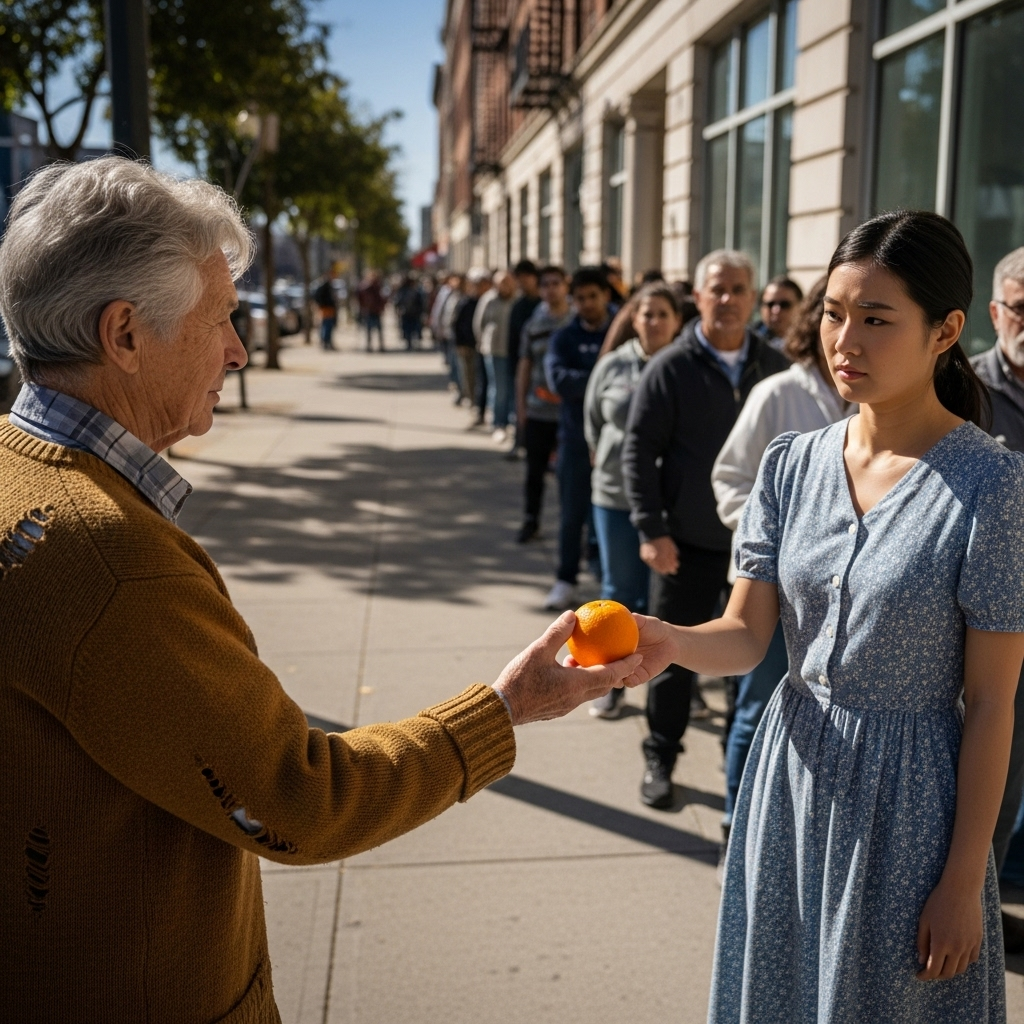
By way of explanation: I am easily bored. This usually leads to me getting into trouble in real life. In my writing, however, I can explore avenues of storytelling and the only fallout from that is the eye-rolling exhaustion experienced by my readership (there’s so few of you that I’m not overly bothered by that). This current experiment is based on a simple story: a man on a breadline makes a daily habit of handing one particular woman his orange. The goal is to see how weird I can make the retelling of the story each week. Simple, right?
In a city swallowed by the long winter of collapse—where time stands in line for food—the breadline snakes through cracked concrete and hollowed lives. Every morning, just before sunrise, he arrives. No one knows his name. A man of sixty, perhaps older, with the patient silence of a monk and the posture of a question mark.
And every morning, when the white-smocked volunteers hand out the ration—half-stale bread, a cup of lentil mush, and one bright, defiant orange—he waits his turn, accepts it with a nod, then turns without hesitation.
He walks ten paces down the line, to where she always stands.
The woman. Younger than him, though not by much. Her coat is too thin, her face too sharp with hunger, and her eyes, always lowered, never meet his. Yet he reaches out, wordless, and places the orange in her hand.
She never says thank you.
He never waits for one.
This ritual continues, without change, for seventy-three days.
On the seventy-fourth day, he does not appear.
She doesn’t notice at first. The cold makes everything blur, including absence. But when the volunteer hands her an orange—her orange, for the first time ever—her hand closes around it like it’s foreign, like it’s stolen.
She doesn’t eat it.
The next day, he’s still gone.
She waits. The line moves. The orange is given. She takes it. She does not eat it.
On the third day, she arrives earlier. She scans the crowd.
She begins to ask.
No one remembers him. Not his name. Not even his face. One man says he thinks he remembers a guy with a limp. Another insists he was tall. A woman recalls he always wore gloves. Another says no—he never did.
By the end of the week, she is carrying six untouched oranges in her bag.
That night, she dreams of an orchard.
Not just any orchard—but his. She is certain of this, though she’s never seen it before. It’s suspended in a place both before and after time. Each tree glows with burning fruit. And at the heart of it, he stands barefoot on soil that hums like a tuning fork.
He is younger. Or older. Or made of light.
When he sees her, he smiles—not as if he knows her, but as if she has finally arrived. He does not speak. He simply reaches up, plucks a perfect orange from the tree, and hands it to her.
This time, she takes it, peels it, and eats.
She wakes with the taste of sunlight in her mouth.
In the city, the breadline remains. She continues to go, but now, she keeps the orange. Eats it. Savors it. Every time she does, she feels she is carrying on something sacred. A chain unbroken.
And then one day, after nearly forgetting the feel of him, she sees someone new in line behind her. A boy. Twelve maybe, if that. Skin tight on bone.
She turns. Peels her orange. Hands it to him without a word.
He does not say thank you.
She does not wait for one.
No one remembers where it started. Or where he went. But now, every morning, someone gives away an orange.
Not out of charity. Not for thanks.
But because somewhere, in a forgotten orchard outside the reach of time, the trees are still glowing. And they need to be fed.
To. Be. Transmogrified.
 MADD FICTIONAL