
Lonnie Hatch was a cartographer of comfort, meticulously mapping the familiar coordinates of his life. Every morning, precisely at 7:18 AM, come fog thick as wool or sunshine that made the asphalt shimmer, he embarked on what his wife, Carol, called his “bagel pilgrimage.” The destination: Goldberg’s Deli, three blocks down, one block over. It wasn’t merely about the destination – the perfectly dense, chewy everything bagel, generously smeared edge-to-edge with their signature scallion cream cheese. It was the ritual itself. The rhythmic thump-thump of his worn sneakers on the sidewalk, the specific way Mrs. Henderson always waved from her window, the slightly-too-loud greeting from Sal behind the counter (“Lonnie! The usual? You got it!”). It was the comforting fug of malt, yeast, and roasting onions that hit you a half-block away, a promise of simple satisfaction.
Lonnie treasured these anchors in a world that often felt adrift. He was, by his own admission, a simple man. He found deep contentment in the steady rhythm of his days: his quiet work as an accountant, the shared laughter with Carol over dinner, the worn armchair where he read history books, and especially, his volunteer shifts ladling soup at St. Jude’s kitchen downtown. Helping felt less like a duty and more like breathing. His parents, pragmatic but kind souls, had woven service into the fabric of his upbringing – “Leave things a little better than you found them, son,” his father used to say. Lonnie lived a righteous life, not from fear of some celestial scorecard, but because kindness felt like the most logical, most human response to the world’s sharp edges. It simply felt right.
This particular Tuesday morning carried the crisp promise of early autumn. The air was cool against his face, carrying the scent of damp leaves and distant exhaust fumes. Lonnie walked with a familiar spring in his step, his thoughts pleasantly tangled around Carol’s upcoming birthday. A necklace? Too predictable. Those fancy gardening gloves she’d admired? Perhaps. He was so engrossed in weighing the merits of artisanal pruning shears versus a weekend getaway that he barely registered the frantic screech of tires tearing through the urban symphony.
He looked up, confused, just as a yellow taxi, moving far too fast, mounted the curb with a sickening lurch. It wasn’t aiming for him, but for the squat, red fire hydrant standing sentinel a few feet away. Time seemed to warp. He saw the driver’s wide, panicked eyes, the metallic shriek as bumper met iron, the impossible physics of the collision. The hydrant didn’t just break; it sheared off its base with explosive force, a sudden, brutal projectile launched directly into his path. Lonnie had only a fraction of a second to register the blur of red metal hurtling towards him, a final, absurd punctuation mark to his meticulously ordered life. Then, only blackness, absolute and instantaneous.
The newspapers would later describe it as a “one-in-a-million freak accident,” a tragic confluence of speed, distraction, and unfortunate positioning. A testament to the cruel randomness of urban life.
But randomness, Lonnie was about to learn, was a concept largely confined to the mortal plane. His death, far from being an anomaly, had been a scheduled event, noted centuries ago in the incomprehensibly vast ledger known colloquially as the Book of Life. A cosmic domino, nudged at the appointed hour.
There was no tunnel of light, no choir of angels, no St. Peter polishing the Pearly Gates. Instead, Lonnie experienced a profound sense of dislocation, like being pulled inside out and reassembled in the same instant. He found himself standing, disoriented but strangely intact, in a chamber of impossible scale. It was vast, utterly sterile, and bathed in a soft, sourceless light that cast no shadows. Around him, stretching further than his earthly eyes could comprehend, were others. Thousands upon thousands – a quick, bewildered estimate suggested maybe one hundred and fifty thousand souls – all freshly transitioned.
A low, pervasive hum filled the space, woven from the threads of countless emotions: the soft sobbing of bewildered grief, the sharp intake of shocked realization, the low murmur of confusion, the stony silence of utter disbelief. Some souls shimmered faintly, others looked as solid as they had moments before death. Lonnie instinctively touched his face, expecting to feel the catastrophic impact, but there was nothing. Only a strange, numb detachment. He looked for Carol, a desperate, automatic reflex, but saw only strangers adrift in the same sea of uncertainty.
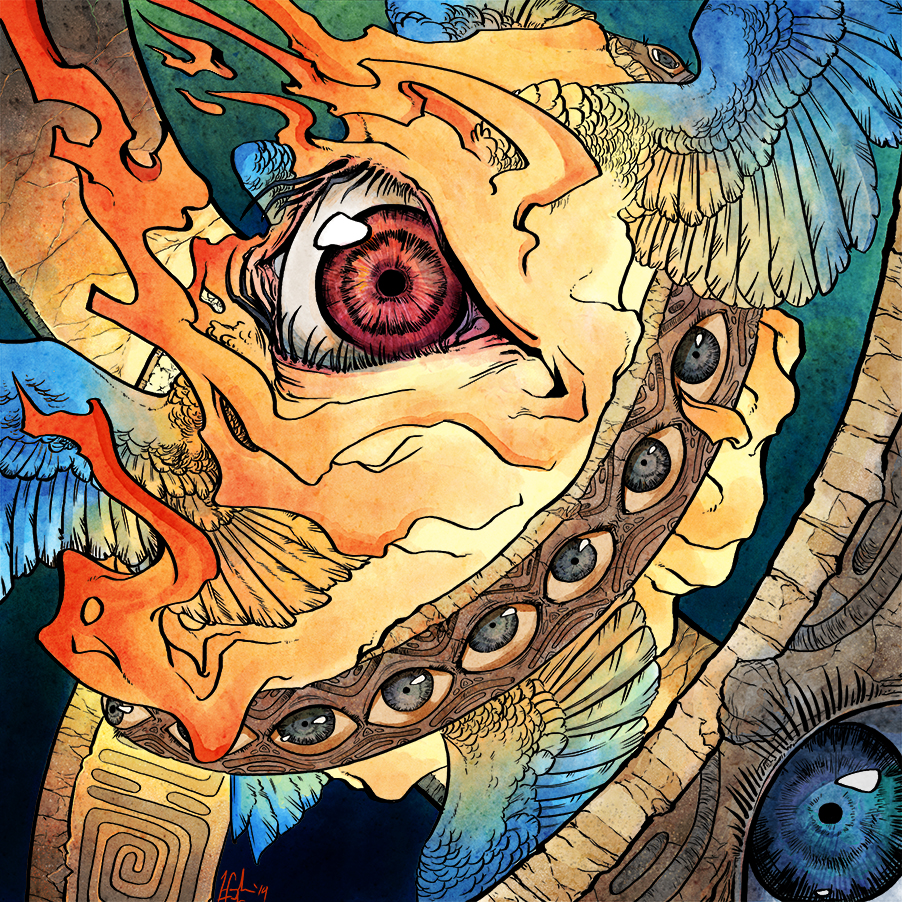
Then, the ambient hum shifted, coalescing into a focused point of energy at the perceived center of the immense room. Light didn’t bend towards it; reality itself seemed to warp, allowing the presence to manifest. It was an Ophanim, one of the formidable Wheels within Wheels described in hushed tones in ancient texts. Not a winged humanoid, but a construct of impossible geometry – interlocking rings of what looked like burning gold, constantly rotating in different directions, the rim of each wheel studded with countless, unblinking eyes. These eyes, terrifyingly perceptive, swept across the assembled souls, seeing not just their bewildered forms, but the entirety of their lives, their choices, their deepest natures. Its presence wasn’t merely seen; it was felt – an overwhelming wave of ancient power, intricate purpose, and undeniable authority.
“Welcome, Heaven Seekers,” the Ophanim’s voice resonated, not through the air, but directly within each soul’s consciousness. The sound was like the grinding of galaxies, yet perfectly clear. “Some among you may have already grasped the transition you have undergone. For those who remain uncertain, allow me to confirm: the existence you knew, the life you inhabited on Earth, is concluded.”
A collective sigh, a wave of despair and dawning acceptance, rippled through the multitude. The Ophanim paused, its thousand-fold gaze seeming to acknowledge their grief without dwelling on it.
“Your anticipated entry into the Kingdom,” the celestial being continued, its voice devoid of emotion yet carrying immense weight, “has been temporarily deferred. An exigency has arisen. Heaven requires assistance.”
Another ripple, this time of pure confusion. Heaven needed… help?
“The terrestrial sphere, your Earth, has been significantly disrupted by the recent global pandemic. Its effects ripple beyond the merely physical, upsetting delicate spiritual balances cultivated over millennia. While this event does not herald the prophesied End Times, the scales measuring hope against despair, connection against isolation, have tipped unfavorably. The trajectory, if unaltered, leads toward escalating devastation – not necessarily apocalyptic, but a profound diminishment of the qualities Heaven seeks to foster.”
The Ophanim’s wheels spun, eyes blinking in asynchronous patterns. “Therefore, we are extending an invitation. We seek volunteers from this cohort – souls whose earthly lives demonstrated resilience, compassion, and a propensity for service – to return to Earth. You would be imbued with entirely new identities, new circumstances, severed completely from your past lives. Your mission: to subtly intervene, to act as counterweights, to assist in mitigating the coming discord and gently guiding humanity back towards equilibrium, or at least towards a new, more sustainable ‘normal’.”
The Ophanim let the proposition hang in the vast silence. “Consider this carefully. Your decision will not prejudice your ultimate acceptance into the Kingdom; entry is assured for all present based on your earthly merits. Declining this task carries no penalty. However,” the voice seemed to lower conspiratorially, though it still filled every mind, “choosing to volunteer confers certain… benefits upon your eventual, permanent arrival here. The nature of these benefits, I am not at liberty to disclose at this juncture.”
A current of speculation surged through the crowd. Whispers erupted in thought-forms Lonnie could now perceive. Benefits? What benefits? A higher sphere? Less waiting?
Lonnie felt a familiar ache, a phantom sensation in his chest. If this offer had come yesterday, when he was still Lonnie Hatch, bagel pilgrim, soup kitchen volunteer, Carol’s husband… the choice would have been instantaneous. Pack a bag, lace up the boots, get to work. That was his nature. But here, now? Standing on the very threshold of Paradise, the promise of eternal rest, of reunion, of peace beyond understanding, was an almost physical pull. It was the ultimate reward, the cessation of striving he hadn’t known he craved until this very moment. He felt weary, not just from his life, but from the shock of its ending.
Was this the real test? Not the good deeds on Earth, but this choice, right here, right now? A final, cosmic essay question determining his ultimate placement? Refuse, and enjoy the earned rest. Accept, and plunge back into the struggle, albeit in a new form.
He looked around at the sea of souls, each facing the same impossible choice. The weight of it settled upon him, heavy and profound. Things were never easy, it seemed. Not in life, and certainly not at the doorstep of eternity. The Ophanim waited, its myriad eyes patient, eternal, observing the quiet, monumental struggles unfolding within one hundred and fifty thousand souls.
 MADD FICTIONAL