
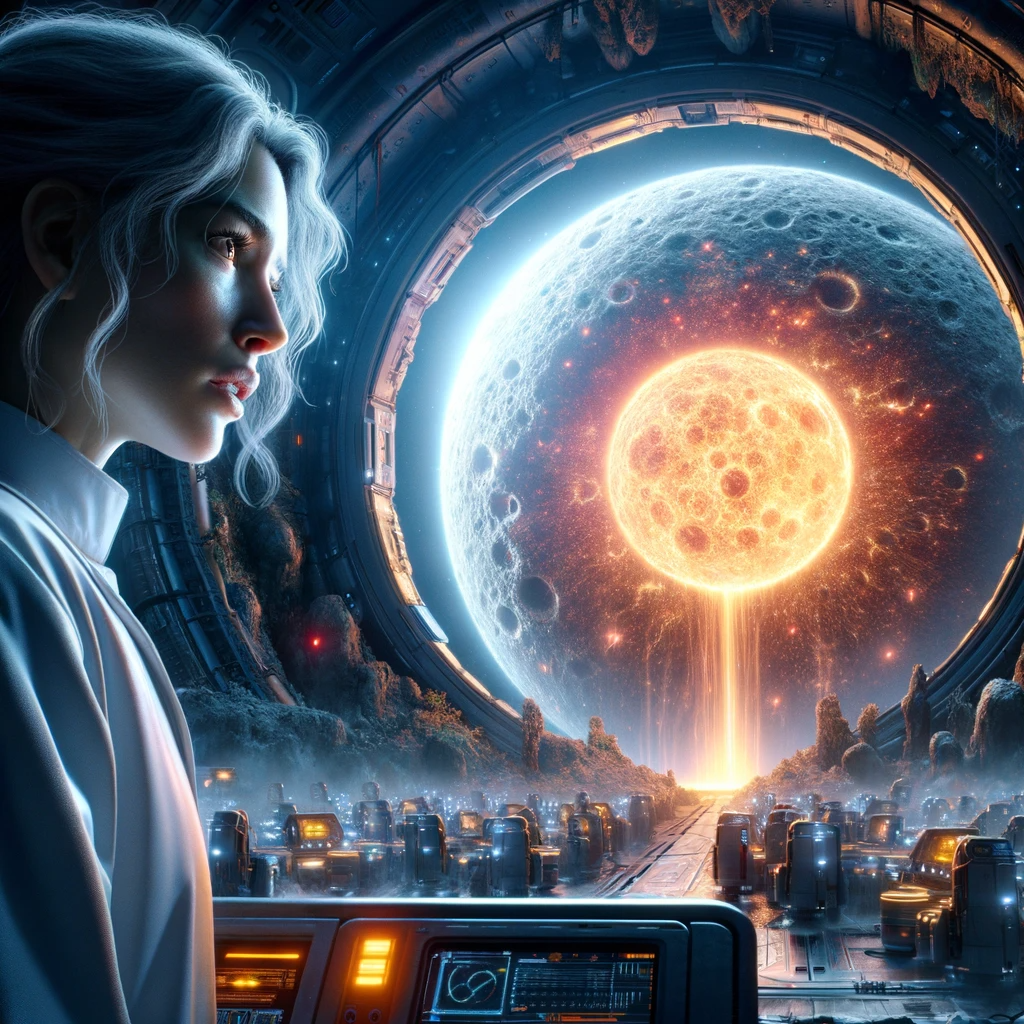
In the silvery luminescence of the distant future, humanity, like a vine, had stretched its tendrils across the barren soils of the solar system. Yet, it was the Moon, that silent sentinel of the Earth, which harbored a secret deep within its scarred and pockmarked visage—a secret that Dr. Cadrianne Corso, a geologist of unparalleled brilliance, was destined to unearth.
Cadrianne, a pioneer among astro-minerologists, led her team of intrepid scientists and engineers across the Moon’s desolate landscape. They delved deep beneath the surface, where the stark, lunar deserts gave way to vast caverns, shrouded in shadows and secrets. It was here, in these stygian depths, that they found it—a molten heart, pulsing with a glow otherworldly and ethereal.
This glowing substance, christened Lunarite, was not merely molten rock. It was a promise, a beacon of hope, potentially the solution to Earth’s burgeoning energy crisis, which had long cast a shadow over humanity’s future. Lunarite, with its boundless energy, was a treasure trove, an elixir of life for a civilization teetering on the brink.
But as with all discoveries that promise salvation, Lunarite became a siren song that echoed across the void, reaching the power-hungry ears of Earth’s leaders. The ethics of its extraction sparked debates that raged like wildfires, consuming political chambers and scientific symposiums alike.
Amidst this tumult, Cadrianne’s team on the Moon wrestled with dangers far removed from Earth’s squabbles. The Lunarite, though a fount of energy, was volatile. Its extraction stirred the ancient Moon, provoking seismic tempests that threatened to swallow their lunar base whole.
In a twist of fate, as seismic shocks roared through the lunar caverns, Cadrianne uncovered a truth more astonishing than the Lunarite itself. The Molten Moon was not merely a celestial body; it was sentient, alive. For eons, this consciousness had slumbered, undisturbed, until humanity’s ambition had rudely awakened it. The seismic upheavals were not mere geological reactions; they were the agonized writhings of a being in pain.
Faced with this revelation, Cadrianne stood at a crossroads, her heart torn between two irreconcilable paths. One led to the salvation of her own kind, the other to the preservation of a newfound, extraterrestrial life. Could she bear to inflict pain upon a conscious being for the sake of humanity? Or should she forgo this chance to end Earth’s energy plight, to save a life not of this Earth?
The lunar base became a battleground, not of weapons, but of wills. Earth’s government, blinded by desperation, clashed with the awakened sentience of the Moon. Cadrianne, at the epicenter, made her choice—a choice that would echo through the annals of human history, reshaping our understanding of life and our place in the cosmos.
In that moment, under the watchful eyes of a billion stars, Cadrianne Corso redefined what it meant to be a savior, a destroyer, a human. The Molten Moon, once a symbol of humanity’s conquest over nature, became a testament to our understanding of life in its myriad forms.
And so, as the lunar dust settled, and the echoes of Cadrianne’s decision faded into the vacuum of space, humanity looked up at the Moon with new eyes, seeing not a lifeless rock, but a kindred spirit, a reminder of the vast, untamed wonders of the universe.
 MADD FICTIONAL