
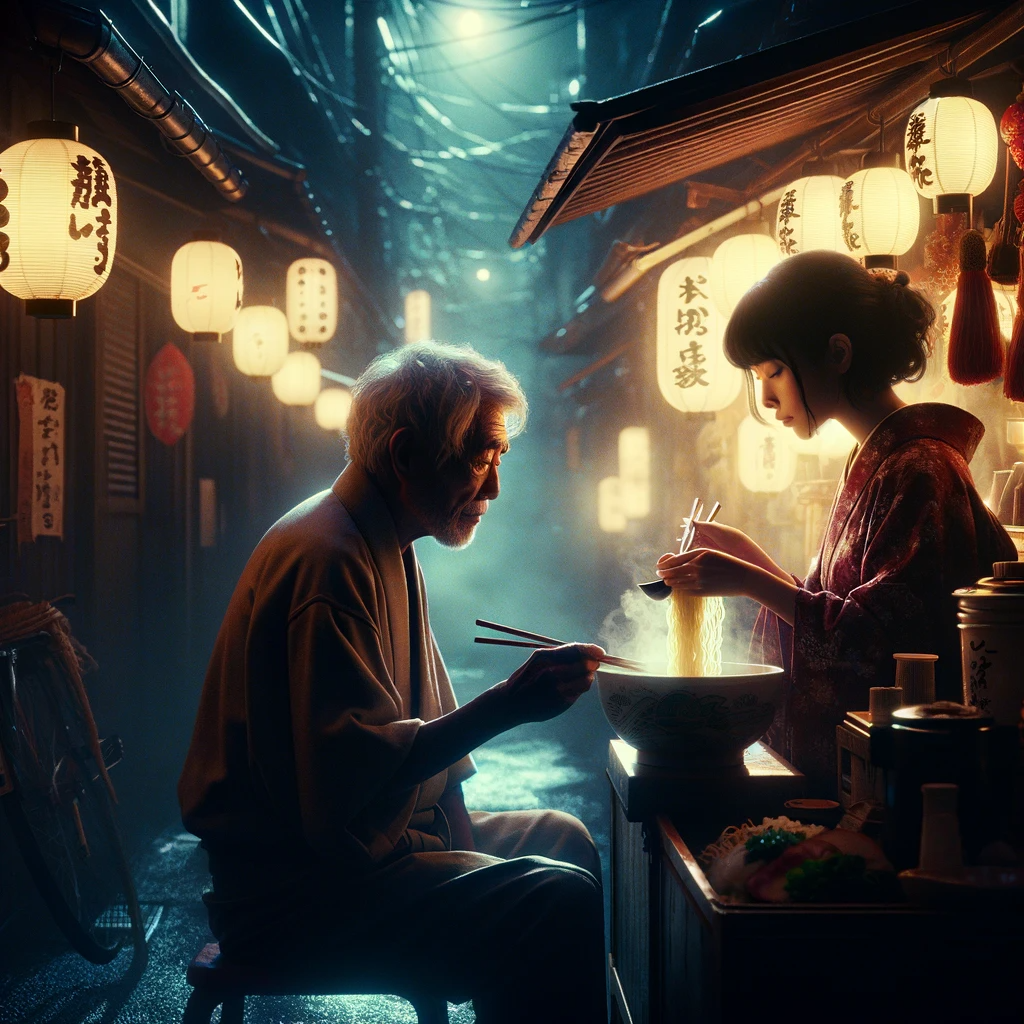
Gather ’round and lend me an ear while I tell you of a phantom who brewed destiny in a cauldron of broth and steam. A true story? Urban folklore? That’s for you to decide. This particular story took place in a neon-drenched metropolis, where skyscrapers pierced the night sky like glass monoliths. It was here that a mystery simmered in the labyrinth of alleys. The Midnight Ramen Girl.
Hiroshi Takahashi was once a titan among Tokyo’s food critics, but now in the twilight of his career, he found himself adrift in a sea of modern culinary trends that, to his seasoned palate, tasted of artifice and pretense. Each new fusion restaurant, each experimental dish, seemed a mere shadow of the traditional flavors he had once celebrated. His pen, once sharp and eager, now hesitated over the pages of his review journal, burdened by a nostalgia for a past era of cuisine.
Hiroshi’s apartment was a high-rise sanctuary overlooking the neon heartbeat of the city. It was filled with the echoes of a life once shared with his late wife, Keiko. Her absence was a silent presence in every corner, from the kitchen where they had danced and cooked together, to the small balcony where they had shared whispered dreams under the starry sky. Since her passing, Hiroshi’s world had dimmed, his love for food and criticism becoming mere ghosts of their former vibrancy.
One evening, as Hiroshi sat at his oak desk, the glow of his lamp spilling over piles of unremarkable restaurant menus, a whisper of a legend found its way to him — the tale of the Midnight Ramen Girl. It was said that her cart appeared only on full moon nights and only to those whose hearts were shadowed by sorrow. Her ramen, a dish woven with the essence of old Tokyo, was a balm for the brokenhearted.
Intrigued and impulsively driven by a spark of curiosity that he hadn’t felt in years, Hiroshi decided he would seek out this Midnight Ramen Girl. It would be his final review, a swan song to a career that had once been his world. This pursuit, he felt, might just rekindle the passion he had lost in the wake of Keiko’s departure from this world.
The first full moon night found Hiroshi wandering the labyrinthine streets of the city, where the scent of street food hung thick in the humid air, mingling with the exhaust of passing cars. Neon signs buzzed overhead, casting vibrant hues onto the pavement, as people, like colorful specters, moved around him in a dance of city life.
He walked through familiar streets and alleys, past ramen shops where steam fogged up windows and laughter spilled into the night. But of the Midnight Ramen Girl, there was no sign. Hiroshi’s heart, heavy with a blend of anticipation and the bitter tang of memories, began to sink. The night, with its myriad sounds and smells, felt overwhelming, a sensory reminder of the life he and Keiko had once reveled in together.
As the moon climbed higher, casting its silver gaze over the city, Hiroshi’s search continued, driven by a yearning for something authentic and true, a yearning he hadn’t felt since Keiko’s laughter had filled their home. It was this longing that propelled his tired feet through the city’s heart, chasing after a legend that seemed as elusive as the joy he once knew.
The night waned, and with it, Hiroshi’s hopes. The Midnight Ramen Girl remained a mystery, her cart a phantom just beyond his reach. As he returned to his quiet apartment, the city’s symphony fading behind him, Hiroshi realized that this quest was more than just a pursuit for a story; it was a search for a piece of his soul he feared was lost forever.
The second full moon since Hiroshi bathed Tokyo in a luminescent glow, painting the city in a palette of ethereal silver. Hiroshi, emboldened by his newfound quest, ventured into the night once again, his heart a pendulum swinging between hope and despair.
As he navigated the serpentine alleys, Hiroshi’s keen eyes caught a fleeting vision — a line of people, a melting pot of souls, trailing into a narrow alley. His pulse quickened. Could this be the elusive cart? He quickened his pace, weaving through the crowd, the murmur of excited conversations filling his ears. The aroma of ramen, rich and inviting, teased his senses, pulling him forward.
But as Hiroshi reached the alley’s mouth, the vision that had ignited his hopes dissolved like mist. The cart, a spectral enigma, vanished before his eyes, leaving behind only the lingering scent of broth and a murmur of wonder and disappointment from the crowd. Hiroshi stood there, a solitary figure in the moonlight, his heart sinking in his chest. The elusive Midnight Ramen Girl remained just beyond his grasp.
Hiroshi was driven by an obsession that eclipsed all else. He scoured the city, interviewing anyone who claimed to have seen the Midnight Ramen Girl. Each tale was a thread in the tapestry of urban folklore surrounding her — a culinary phantom who appeared to the sorrowful, her ramen a balm for the aching soul.
He delved into the city’s history, seeking connections in the tapestry of old Tokyo’s culinary scene. Hiroshi revisited places he and Keiko had once loved — the old noodle shop where they had shared their first date, the riverside where they had watched countless sunsets. Each location was a time capsule, unlocking memories of laughter, love, and the inevitable shadow of loss.
As the third full moon approached, Hiroshi’s attempts to find the Midnight Ramen Girl had transformed him. No longer was he the jaded critic, detached and weary. The quest had rekindled a fire within him, a yearning for connection, for understanding the tapestry of his own life. Keiko’s memory, once a source of unending sorrow, began to weave itself into a narrative of love and the preciousness of fleeting moments. With a heart heavy yet hopeful, Hiroshi ventured into the night, the moon a silent companion in his search for the ephemeral cart and the memories it held.
The alleys of Tokyo led him once again on a path paved with anticipation and echoes of a past that clung to him like a second skin. And, near evening’s end, far from the hustle of where nightlife thrummed, Hiroshi found the elusive cart. It stood in a secluded alley, bathed in the soft glow of paper lanterns. The last customer, a young woman with eyes red from crying, nodded her thanks to the Midnight Ramen Girl and disappeared into the night.
The Ramen Girl, her hair a cascade of moonlight, her eyes pools of knowing, was about to close. She had just enough ingredients for one more bowl. As Hiroshi approached, the clatter of the city faded, replaced by the intimate sounds of the cart — the simmer of broth, the clink of a ladle against a pot.
“I am so sorry,” the Ramen Girl said, her voice a melody in the quiet alley. “I have no more ramen.”
Hiroshi eyed the bowl of ramen before her. The Ramen Girl answered his unspoken question, “My supper.”
Hiroshi’s heart, a vessel of unspoken grief and yearning, lay bare in his eyes. “I’m sorry,” he began, his voice a whisper lost in the night. “I’ve been searching for you, for your ramen. They say it’s not just food, but a memory, a moment…”
The Ramen Girl looked at him, a faint smile touching her lips. “You carry a heavy heart,” she said. “Sit. Share my meal.”
As they sat across from each other, the Ramen Girl divided her ramen into two bowls. The steam rose like spirits, carrying with it the scent of soy, garlic, and something ineffable, something that spoke of comfort and long-forgotten homes.
With each mouthful, Hiroshi’s world unraveled and rewove itself. He saw Keiko, her laughter ringing like bells, her eyes alight with love and mischief. He relived their moments — the quiet mornings, the shared meals, the tender embraces, and the crushing silence of her absence.
But there was something more in the broth, a flavor not his own. Memories that were not his began to surface — flashes of a young girl, Yumi Nakamura, learning to cook beside her grandmother, the heat of kitchen fires, the sting of a love lost, and the solitude of a life on the move. These were the Ramen Girl’s memories, her joys, and sorrows.
They ate in silence, two souls adrift in a sea of memory and emotion, their experiences mingling in the sacred space of shared grief and understanding. The Midnight Ramen was not just a dish; it was a bridge between hearts, a tapestry woven from the threads of their separate lives.
As the last of the ramen was savored, Hiroshi and the Midnight Ramen Girl looked at each other, no longer strangers, but companions in a journey that had transcended the boundaries of a simple meal. In that small cart, under the watchful eye of the moon, they had shared more than just food — they had shared pieces of their souls, finding solace in the shared language of loss and the unspoken understanding of those who have loved deeply and lost.
As the last strands of the Midnight Ramen lingered on their lips, an unspoken understanding passed between Hiroshi Takahashi and the enigmatic Ramen Girl. In that shared meal, they had traversed the landscapes of their hearts, finding common ground in their separate yet intertwined sorrows.
Hiroshi, sitting in the quiet aftermath, felt a catharsis washing over him. The ramen had been a vessel, carrying him through the tides of memory, revealing the depth of his love for Keiko. It had shown him that cherishing the past did not mean living in its shadows.
“You’ve given me more than just a meal,” Hiroshi said, his voice tinged with newfound clarity. “You’ve given me a journey through my own heart.”
The Ramen Girl, her eyes reflecting the moonlight, nodded. “We find healing in many ways,” she replied. “Sometimes, it’s in a bowl of ramen, or in the stories we share.”
That night, Hiroshi returned to his apartment, a place once filled with the echoing silence of loss, now imbued with a gentle peace. He sat at his desk, the city lights twinkling like distant stars, and began to write. His words flowed, not with the critical sharpness of a food critic, but with the poignant introspection of a man who had peered into the depths of his soul.
His final review was a tapestry of emotions — a tribute to the Midnight Ramen, a homage to Keiko, and a meditation on loss, love, and the healing journey of life. He wrote of the flavors that had unlocked his memories, of the shared experience with Yumi the Ramen Girl, and how it had guided him to embrace the light amidst the shadows.
With the publication of his final piece, Hiroshi’s career as a food critic came to a close. But his journey was far from over. He found solace in his memories, each a cherished chapter of a life lived with love and loss.
In his retirement, Hiroshi chose to honor the legacy of both Keiko and the Midnight Ramen Girl. He began teaching cooking classes, sharing the traditional flavors and techniques that he had always held dear. He wrote, too, not reviews, but stories of food and life, each recipe imbued with a memory, a piece of wisdom, a snippet of Tokyo’s culinary soul.
In these classes, in the words he penned, Hiroshi found a renewed purpose. He shared not just the techniques of cooking but the stories behind each dish, the way food could speak to the heart, heal the wounds of the past, and connect people across the boundaries of time and experience.
As Hiroshi’s students hung on his every word, as his readers found solace in his stories, he knew he had found his path. In the art of cooking and teaching, he kept alive the memories of Keiko, the lessons of the Midnight Ramen Girl, and the unending story of a city that, like him, was a mosaic of loss, love, and the indomitable spirit of moving forward.
 MADD FICTIONAL