
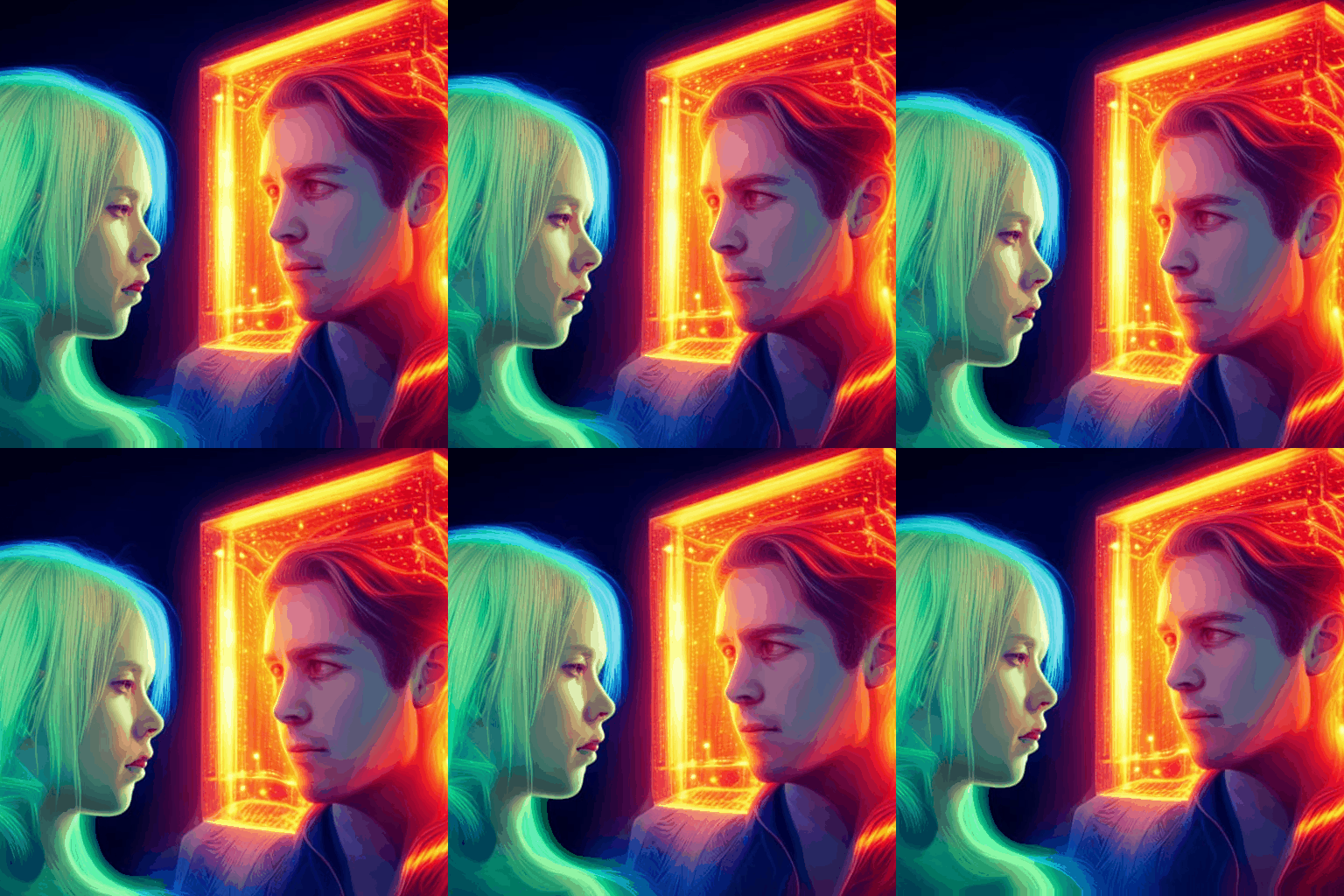
The third planet from the sun existed throughout the multiverse, nearly parallel to one another, with gentle shifts in history and industrial/technological development. You might know this planet as Earth, but the world in today’s tale was known as Ephemera, a place built on the fleetingness of human experience. And in the heart of a sprawling metropolis, a society flourished where memories and emotions had become the primary currency, an intricate market where experience was bought, sold, and traded.
Loitering in front of the Parsons Street Memory Terminal recently became a habit for Ronald. The same neighborhood faces queued up daily to select their crystalline cubes, and he watched a flicker of emotion play across their faces as they ingested the cubes containing a taste of their chosen memories. However, Ronald was not like them. Not that he thought himself better than they were; he simply had different tastes in nourishment: emotions, not memories. His woolgathering was interrupted when he felt a strange blend of emotions emanating from a nearby café.
Curiosity piqued, Ronald stepped inside and found himself entranced by a woman sitting alone, her fingers dancing over a portable Memory Terminal. But she wasn’t consuming memories; she was crafting them.
“Interesting setup you’ve got there,” Ronald ventured, captivated by the woman and the pulsating mix of emotions around her.
Heather looked up, surprised and intrigued, but sussed him out rather quickly. “You’re not just here for coffee, are you?”
During the weeks since their first encounter at the café, Ronald and Heather became research partners in the curious field of emotional and memory consumption. Ronald would often sit across from Heather, feeling the emotional resonance of her freshly crafted memories before she encapsulated them into cubes.
However, the elephant in the room was growing too large to ignore any longer: whether what they were doing was ethical? For his part, Ronald felt increasingly uneasy. Each time he consumed an emotion from Heather’s crafted memories, he wondered if he was taking something irreplaceable from her or the people who would consume these memory cubes.
“Do you ever think about the ethical implications of all this?” Ronald finally asked one day.
Heather paused, considering the weight of the question. “I do,” she admitted. “But look at our society; it’s built on commodifying memories and experiences. If people didn’t want this stuff consumed, they wouldn’t craft them into cubes.”
“But emotions are different from memories,” Ronald countered. “They’re not just experiences; they’re the fabric of our souls.”
“You don’t think I’m doing this just for the money, do you?”
“I…I honestly don’t know,” Ronald admitted.
“Well, in case you’re interested, I actually have an audacious vision, a grand plan that teeters on the edge of the impossible,” Heather said with hope and trepidation flickering in her eyes. “I want to craft a memory so sublime, so saturated with raw emotion, that it could have the power to unravel the fabric of Ephemera itself. I want to create a profound sensory and emotional experience that will force our society to question the very nature of memory and emotion, to rethink the ethics of what we consume and commodify.”
“And just what emotion will this memory contain?” Ronald asked, knowing that his ability to consume emotions might be both a gift and a curse.
Heather looked him square in the eye. “Love,” she said simply.
A tension-filled silence settled between them. Both understood the enormity of what Heather was proposing. To encapsulate love—the most complex and profound of all human emotions—into a single cube would be an unprecedented feat. But for Ronald, the stakes were even higher. Could he consume such a potent emotion without causing irrevocable harm?
Heather broke the silence. “Will you be there when I craft it? Will you experience it with me?”
“Yes,” Ronald replied, his voice barely above a whisper. “Yes, I will.”
The room was dimly lit, filled with the soft hum of the portable Memory Terminal. Heather sat before it, her eyes closed in deep concentration. Around her, the air seemed to pulsate with emotional energy, growing more intense with each passing second.
Ronald, seated across from her, felt it too—a swirling vortex of love that was both intoxicating and terrifying. He sensed the birth of a memory so potent it could rewrite the very rules of their society.
Finally, Heather opened her eyes. “It’s done,” she said, her voice tinged with awe and exhaustion. A solitary, luminescent cube floated above the Memory Terminal, its light different from any they had seen before—a vibrant blend of colors that defied description.
With a sense of fatalism, Ronald reached out and ingested the cube. The rush of emotion was overwhelming, a torrent of love so intense it felt like his soul was being torn apart and remade. For a moment, he was lost, awash in the most profound experience of his life.
Then he looked at Heather.
Her eyes, once radiant, were now dull, devoid of the emotion she had just crafted. The loss was immediate, and the realization hit them both like a tidal wave.
“What have I done?” Ronald whispered, his voice choked with regret.
“You’ve consumed love,” Heather said, her voice flat as though stating a simple fact. “And I…I can’t feel it anymore.”
Stunned by the irreversible damage he had inflicted, Ronald stumbled out of Heather’s apartment, his mind a battleground of love and guilt. Meanwhile, Heather sat there alone, contemplating the emptiness that filled her.
Days turned into weeks, and Ronald could not escape the gravity of what he had done. The experience of love, now a permanent part of him, became a constant reminder of the emotion Heather could no longer feel. Filled with remorse, he made a decision. He would turn himself in, expose the secret he had kept hidden for so long, and face the repercussions.
On the eve of his self-imposed exile, he received an unexpected message from Heather. It read: “Meet me. There’s something you need to see.”
Confused but hopeful, Ronald arrived at Heather’s workshop. The room was filled with Memory Terminals, each glowing softly as if infused with a part of Heather’s newfound purpose.
“I’ve been researching,” Heather said. “While I can’t feel love anymore, I can still feel curiosity, ambition, a sense of justice. I can’t undo what’s been done, but I can strive to understand it—to make it mean something.”
Then, she revealed her latest creation—a memory cube that glowed with an ethereal light. “It’s empathy,” she explained. “Something our society desperately needs.”
Ronald felt a mix of hope and caution. “Do you want me to consume it?”
Heather shook her head. “No. This one is for the world. If I can’t feel love, then let me create understanding. That’s my new path.”
Just as Ronald prepared to leave, an encrypted message appeared on Heather’s Memory Terminal. It was from an anonymous sender, but the message was clear: “Your abilities have not gone unnoticed. The choices you make next will determine not just your future but the future of emotions and memories. Choose wisely.”
Ronald and Heather looked at each other, realizing their secret experiments had far-reaching implications they had yet to fully understand.
“Do you really think you’re the only ones?” the message concluded, leaving both to ponder the complex emotional landscape they had only begun to explore.
 MADD FICTIONAL