
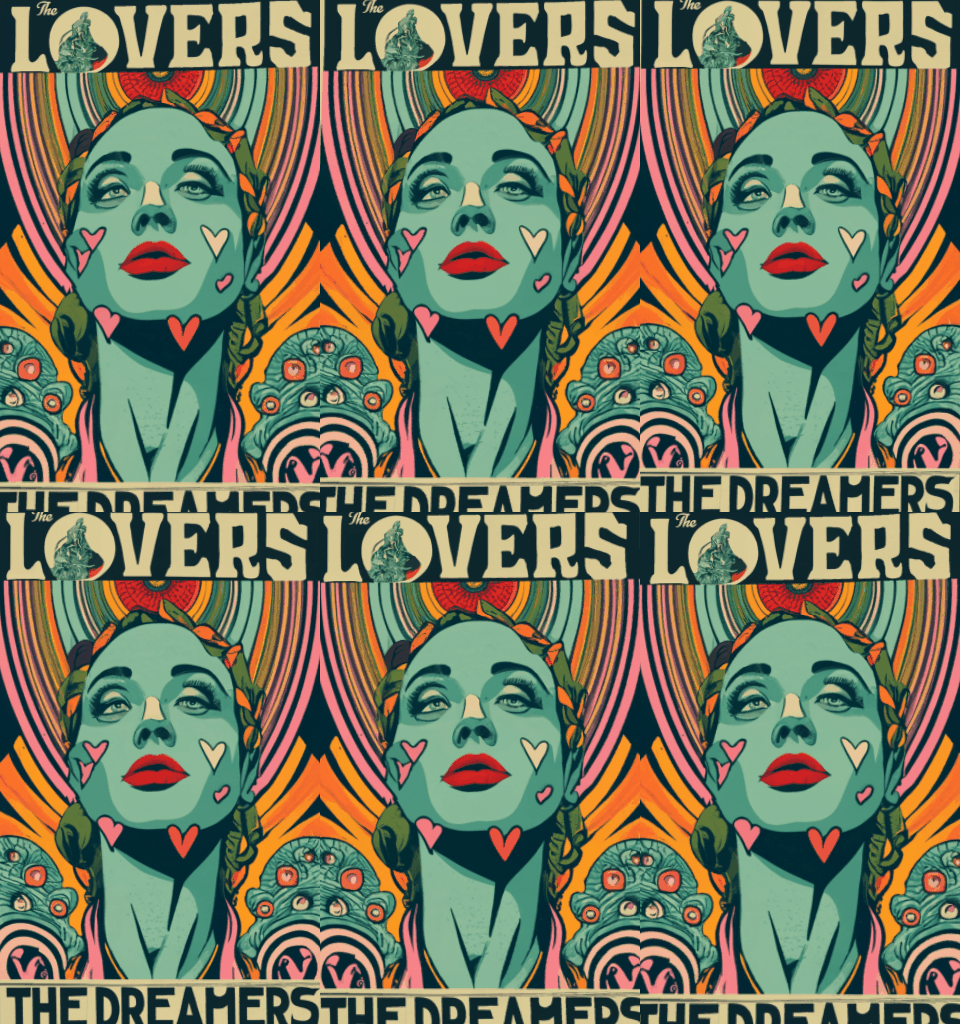
In the far future, societies would be divided into three categories: Lovers, Dreamers, and Outliers. This wasn’t to say everyone slotted into these archetypes perfectly or even easily, but that was what the reprogramming stations were for. Marla, however, stood out. As one of the top-tier Dreamers, she crafted fantasies that plugged directly into the cerebral cortex, delivered through Dream Machines sold at a premium.
On this particular evening, Marla surveyed the Dream Market from her glass-walled studio. Neon lights flickered, advertising dreams of love, adventure, and pleasure. Her eyes, however, were vacant, worn from sculpting dreams she could never experience.
At the same time, Thomas, an Outlier, navigated through the crowd with a scowl. He hated this place and everything it stood for. His sister had become a Lover, addicted to dreams that left her dazed and incoherent. Tonight was the night he’d put an end to it.
And then there was Celia. A Lover and a connoisseur of dreams, she came to the market for her hundredth purchase—a dream called “Eternal Sunset” crafted by Marla.
***
Thomas was almost panting by the time he reached Marla’s high-rise studio. He’d dodged two surveillance drones and a roving squad of Dream Company’s security enforcers to get here. The studio looked alien to him, gleaming with sterile opulence—a glass cocoon that seemed to float above the chaos below.
Marla, meanwhile, was reviewing feedback on her latest dream creation when her security feed pinged an alert. An Outlier was approaching her studio. This was unusual; they never came this close to the Dream Market’s epicenter, let alone to a Dreamer’s personal studio. Intrigued more than concerned, she activated the door mechanism and heard the buzz that allowed him entry.
Thomas stepped inside, his eyes adjusting to the ambient lighting, his nostrils flaring at the aroma of exotic incense. He felt out of place, like a moth daring to flutter around a flame.
“I need your help,” Thomas blurted out, his voice tinged with desperation.
Marla eyed him cautiously. “And why, pray tell, would I assist an Outlier? You people aren’t exactly fans of what we do.”
“That’s just it,” Thomas locked eyes with her, “I’ve discovered something you Dreamers should find very troubling. Your dreams—the fantasies and scenarios you create—they’re not just being sold for profit.”
Marla leaned back, steepling her fingers, her interest piqued. “I’m listening.”
“Someone inside the Dream Company is harvesting portions of these dreams, mixing them with… something else. They’re creating intrusive thought patterns, subliminal messaging. Basically, mind control experiments.”
Marla’s eyes widened. Her dreams were her art, her contribution to society. To think they were being altered and used for something nefarious was unsettling, to say the least.
“So, what’s in it for me if I help you?” she finally asked, breaking the tense silence.
“Isn’t the perversion of your art enough?” Thomas shot back.
“It might be,” Marla said, her voice tinged with new resolve. “But there has to be more.”
“Fine,” Thomas conceded, “The truth. The entire, unvarnished truth. And maybe, just maybe, a chance to be more than a factory of other people’s dreams. A chance to dream for yourself.”
Marla felt a shiver go down her spine. For years, she had poured her imagination into the Dream Machines, always wondering what it would be like to be on the other side—to be a Dreamer and a Lover.
“Alright,” she finally said, “I’ll do it. But this better be worth the risk.”
***
Celia had long been a fan of Marla’s creations. Tonight, she was eager to escape into “Eternal Sunset,” Marla’s latest release. The description promised a multisensory experience—golden sunsets across beaches that never end, accompanied by a symphony of rolling waves and warm winds carrying the scent of salt and freedom.
Settling into her cushioned Dream Chair, Celia plugged the interface cable into the port behind her ear. Her room’s walls faded, replaced by a breathtaking landscape—a vast, endless shore bathed in the soft glow of the setting sun. She took a deep breath, relishing the sensation of warm, moist air filling her lungs, tasting the salt on her lips.
But as she walked along the shoreline, listening to the soothing cascade of the waves, something felt off. The horizon, which usually held the shimmering mirage of the perpetual sunset, started to darken. A swirling vortex of obsidian-black tendrils began to materialize, tearing through the red and gold sky like ink spilled on a masterpiece.
Celia felt an unexpected pull, a force dragging her towards this unnatural anomaly. She tried to unplug, to yank herself back to her room, but for a split second, she was held in place, frozen. Then she saw them—figures materializing from the edges of the vortex, their faces indistinct, but their eyes clear, almost glowing. They were beckoning her, reaching out their arms in a silent plea or perhaps an invitation.
With a jolt, Celia managed to disconnect, ripping the cable from the port as she gasped for air. She was back in her room, the once-welcome walls now feeling like a cage. Her heart pounded in her chest, adrenaline surging through her veins as if she’d narrowly escaped a predator. Yet, amid the fear and confusion, a thought lingered: Who were those figures? And why did they look so eerily familiar, like forgotten friends—or warnings—from another life?
***
While Thomas meticulously set up his gear—a laptop full of hacking software designed to breach even the toughest firewalls—Marla was busy weaving her dream. She considered it her pièce de résistance, a concoction of vivid colors and disruptive elements that would overwhelm the Dream Company’s servers. As her hands glided over her Dream Console, the air around her shimmered with ethereal light, an external manifestation of the powerful dream she was crafting.
Just as they planned, Marla uploaded her dream into the public feed, where it would momentarily act like a virus. The dream was coded to disrupt the server’s normal functions, confusing the AI algorithms long enough for Thomas to do his work. As soon as she received the signal from Thomas—his eyes met hers, and he gave a slight nod—Marla hit the ‘Release’ button.
Meanwhile, Celia, her nerves still rattled from her last dream experience, walked toward the market. She thought that being around people, even if they were plugged into their dreams, might alleviate some of her anxiety. But as she approached, she noticed the large public screens that usually displayed advertisements flicker and glitch. Around her, people began to unplug from their Dream Machines, their faces a mix of confusion and disorientation.
Curiosity led her gaze away from the bewildered crowd. That’s when she saw them—Thomas and Marla, huddled in a secluded corner of the marketplace. Their focus was intense, locked onto the laptop screen that Thomas had balanced precariously on a makeshift table. He was typing at a breakneck speed, bypassing security measures while Marla watched the server statuses on a separate window, ready to upload another disruptive dream if needed.
It was that moment when it clicked for Celia. The faces she had seen in the dream, the dark vortex—it all connected back to this. The two people in front of her were altering the course of the world as she knew it, and for some reason, she felt an inexplicable urge to join them, to be part of whatever rebellion or truth they were bringing to light.
***
Thomas’s fingers flew across the laptop keyboard, each keystroke a precise maneuver in navigating the labyrinthine security protocols of the Dream Company’s mainframe. Finally, a window popped up on the screen—Access Granted. His heart pounded in his chest as he navigated through the various layers of classified information.
“Got it,” he muttered under his breath, clicking on a folder labeled “Outlier Studies.” As the files loaded, he felt a cold dread crawl up his spine.
“Marla, you need to see this,” Thomas said, his voice tinged with urgency and disbelief. He stepped aside to give her a full view of the screen.
Marla scanned through the files displayed before her. What she saw were not just codes and numbers, but detailed research reports, confidential memos, and raw data—all pointing to one horrifying reality. The Dream Company had been conducting covert studies on Outliers, surveilling them without consent. More shocking was the realization that the memories of these Outliers were being harvested, their most intimate and personal moments distorted and commodified into dreams for public consumption.
“The bastards,” Marla muttered, her eyes narrowing, “they’re turning real people’s experiences into these twisted, marketable dreams. It’s not just an invasion of privacy; it’s a violation of consciousness. They’re stealing souls and selling them.”
Thomas nodded, his face grave. “It’s darker than we thought. It’s not just about monopolizing the dream market; it’s about control, manipulation, the annihilation of what makes us human.”
Marla clenched her fists, her eyes meeting Thomas’s. “Then let’s take them down and reveal this nightmare for what it really is.”
***
Celia, her footsteps silent but purposeful, approached Thomas and Marla. She’d seen enough flickering screens and disoriented dreamers today, and something told her these two were at the center of it all.
“What exactly are you doing?” she demanded, her eyes locking onto the open laptop brimming with clandestine files.
Thomas looked up, meeting her gaze, weighing how much to reveal. “We’re freeing you. Freeing everyone,” he finally said, the gravity of the moment making his words a solemn vow.
“And how is uploading files going to accomplish that?” Celia asked skeptically, her eyes darting between Thomas and the laptop screen.
Marla intervened, her voice tinged with a sense of urgency. “It’s more than just files. It’s proof—proof of how the Dream Company has been manipulating us all. They’ve turned personal memories into twisted, commercial dreams. They’re manipulating our very consciousness.”
“And if people know the truth?” Celia pressed, now genuinely intrigued.
“Then they have the choice to unplug, to demand transparency, to reclaim their minds and lives,” Thomas said, filled with a newfound determination.
With a final, resolute click, Marla uploaded the classified files to a public server. Instantly, notifications lit up on smartphones, tablets, and screens all around the market. Faces that were once lost in dreams now reflected shock, anger, disbelief.
As the files disseminated far and wide, the buzz of conversation surged through the market like an electric current. Vendors and dreamers alike were unplugging from their Dream Machines, conversations bursting forth in pockets of chaos and revelation. Shares of the Dream Company started plummeting, live updates flashing red across financial news feeds.
Celia took it all in—the confusion, the awakening, and the two figures at the eye of this storm. “You’ve started something big,” she said softly, almost in awe.
“Or maybe,” Marla looked at Thomas and then back at Celia, “we’ve just ended something terrible.”
***
The Dream Company’s undoing was swift and decisive. Revelations flooded the media; investigative reports, interviews, and editorials dominated the headlines for weeks. Regulatory authorities cracked down hard, dismantling the empire that had monopolized the human imagination. High-ranking executives were arrested, their reputations irrevocably tarnished as they faced a litany of charges from ethical violations to psychological exploitation.
Thomas, for the first time in years, found a modicum of peace. His younger sister, who had been a chronic user of the Dream Company’s products, slowly but surely began to recover. It was as if a veil had lifted from her eyes, and the woman he remembered from their childhood started to emerge again. The newfound clarity in her eyes was worth all the risks he had taken.
Marla, once a craftsman of artificial dreams, found herself embracing the imperfect art of natural dreaming. Lying in her bed at night, she welcomed the chaotic tapestry of thoughts, feelings, and random memories that wove themselves into dreams. It was erratic, illogical, and profoundly human—attributes no machine could replicate.
As for Celia, her transformation was nothing short of revolutionary. She had been a frequent dreamer, lost in the fantasies curated by the Dream Company, but the experience of the market’s abrupt awakening had shifted something deep within her. Fueled by a newfound purpose, she joined the Outliers, dedicating herself to advocating for the intrinsic value of real, tactile experiences over artificial ones. She became a spokesperson, her compelling story inspiring thousands to reconsider the simulated realities they had grown dependent on.
But even as Thomas, Marla, and Celia found new roles in a drastically altered landscape, the global community grappled with the aftershocks. The Lovers who cherished the manufactured emotional and romantic dreams found themselves at a crossroads. With the absence of spoonfed emotions, many returned to traditional forms of connection—old-fashioned dates, heartfelt conversations, and the unpredictable rollercoaster of real love. Initially disoriented, some eventually discovered the richness of authentic relationships, replete with both their beauty and their flaws.
As for the Dreamers, the transition was more jarring. With the market for dreams effectively collapsed, they faced sudden unemployment and an identity crisis. But Marla, ever the visionary, seized this opportunity. She spearheaded a new initiative that aimed to channel the Dreamers’ unparalleled skills into other sectors, such as virtual education, psychological therapy, and even space exploration simulations. It was an endeavor that tapped into their unique abilities while adhering to ethical guidelines—a second chance at dreaming with purpose.
The publication of the Dream Company’s manipulations had another unexpected but invaluable outcome. Worldwide debates erupted about the ethics of thought manipulation, the commodification of human experiences, and the need for stringent regulations. This discourse ushered in a new era of tech ethics, influencing policy decisions at the highest levels.
So, in their quest for justice and authenticity, Thomas, Marla, and Celia had unwittingly lit the fuse for a broader societal transformation. The implosion of the Dream Company didn’t just liberate them; it catalyzed a collective awakening. For better or worse, the world had changed, but at least it was now a world where dreams were once again the private sanctuary of the individual, not the tradable assets of a faceless corporation.
 MADD FICTIONAL