How to Write a Great Story – 8 Tips From Kurt Vonnegut

6a00d8341bf7f753ef00e54f8d08d58833-800wi

  1. Use the time of a total stranger in such a way that he or she will not feel the time was wasted.
  2. Give the reader at least one character he or she can root for.
  3. Every character should want something, even if it is only a glass of water.
  4. Every sentence must do one of two things — reveal character or advance the action.
  5. Start as close to the end as possible.
  6. Be a Sadist. No matter how sweet and innocent your leading characters, make awful things happen to them-in order that the reader may see what they are made of.
  7. Write to please just one person. If you open a window and make love to the world, so to speak, your story will get pneumonia.
  8. Give your readers as much information as possible as soon as possible. To hell with suspense. Readers should have such complete understanding of what is going on, where and why, that they could finish the story themselves, should cockroaches eat the last few pages.

Neil Gaiman’s 8 Rules of Writing

  1. Write
  2. Put one word after another. Find the right word, put it down.
  3. Finish what you’re writing. Whatever you have to do to finish it, finish it.
  4. Put it aside. Read it pretending you’ve never read it before. Show it to friends whose opinion you respect and who like the kind of thing that this is.
  5. Remember: when people tell you something’s wrong or doesn’t work for them, they are almost always right. When they tell you exactly what they think is wrong and how to fix it, they are almost always wrong.
  6. Fix it. Remember that, sooner or later, before it ever reaches perfection, you will have to let it go and move on and start to write the next thing. Perfection is like chasing the horizon. Keep moving.
  7. Laugh at your own jokes.
  8. The main rule of writing is that if you do it with enough assurance and confidence, you’re allowed to do whatever you like. (That may be a rule for life as well as for writing. But it’s definitely true for writing.) So write your story as it needs to be written. Write it ­honestly, and tell it as best you can. I’m not sure that there are any other rules. Not ones that matter.

Chuck Palahniuk Shares13 Writing Tips

https://i0.wp.com/static.guim.co.uk/sys-images/Film/Pix/pictures/2008/10/21/lee_palahniuk460.jpg

1. The egg timer method.  Two years ago, when I wrote the first of these essays it was about my “egg timer method” of writing.  You never saw that essay, but here’s the method:  When you don’t want to write, set an egg timer for one hour (or half hour) and sit down to write until the timer rings.  If you still hate writing, you’re free in an hour.  But usually, by the time that alarm rings, you’ll be so involved in your work, enjoying it so much, you’ll keep going.  Instead of an egg timer, you can put a load of clothes in the washer or dryer and use them to time your work.  Alternating the thoughtful task of writing with the mindless work of laundry or dish washing will give you the breaks you need for new ideas and insights to occur.  If you don’t know what comes next in the story…  clean your toilet.  Change the bed sheets.  For Christ sakes, dust the computer.  A better idea will come.

2. Your audience is smarter than you imagine.  Don’t be afraid to experiment with story forms and time shifts.  My personal theory is that younger readers disdain most books – not because those readers are dumber than past readers, but because today’s reader is smarter.  Movies have made us very sophisticated about storytelling.  And your audience is much harder to shock than you can ever imagine.

3. Know the purpose of the scene. Before you sit down to write a scene, mull it over in your mind and know the purpose of that scene.  What earlier set-ups will this scene pay off?  What will it set up for later scenes?  How will this scene further your plot?  As you work, drive, exercise, hold only this question in your mind.  Take a few notes as you have ideas.  And only when you’ve decided on the bones of the scene – then, sit and write it.  Don’t go to that boring, dusty computer without something in mind.  And don’t make your reader slog through a scene in which little or nothing happens.

4. Surprise yourself.  If you can bring the story – or let it bring you – to a place that amazes you, then you can surprise your reader.  The moment you can see any well-planned surprise, chances are, so will your sophisticated reader.

5. When you get stuck, go back and read your earlier scenes, looking for dropped characters or details that you can resurrect as “buried guns.”  At the end of writing Fight Club, I had no idea what to do with the office building.  But re-reading the first scene, I found the throw-away comment about mixing nitro with paraffin and how it was an iffy method for making plastic explosives.  That silly aside (… paraffin has never worked for me…) made the perfect “buried gun” to resurrect at the end and save my storytelling ass.

6. Use writing as your excuse to throw a party each week – even if you call that party a “workshop.”  Any time you can spend time among other people who value and support writing, that will balance those hours you spend alone, writing.  Even if someday you sell your work, no amount of money will compensate you for your time spent alone.  So, take your “paycheck” up front, make writing an excuse to be around people.  When you reach the end of your life – trust me, you won’t look back and savor the moments you spent alone.

7. Let yourself be with Not Knowing.  This bit of advice comes through a hundred famous people, through Tom Spanbauer to me and now, you.  The longer you can allow a story to take shape, the better that final shape will be.  Don’t rush or force the ending of a story or book.  All you have to know is the next scene, or the next few scenes.  You don’t have to know every moment up to the end, in fact, if you do it’ll be boring as hell to execute.

8. If you need more freedom around the story, draft to draft, change the character names.  Characters aren’t real, and they aren’t you.  By arbitrarily changing their names, you get the distance you need to really torture a character.  Or worse, delete a character, if that’s what the story really needs.

9. Use all types of speech.  There are three types of speech – I don’t know if this is TRUE, but I heard it in a seminar and it made sense.  The three types are:  Descriptive, Instructive, and Expressive.  Descriptive:  “The sun rose high…”  Instructive:  “Walk, don’t run…”  Expressive:  “Ouch!”  Most fiction writers will only use one – at most, two – of these forms.  So use all three.  Mix them up.  It’s how people talk.

10. Write the book you want to read.

11. Get author book jacket photos taken now, while you’re young.  And get the negatives and copyright on those photos.

12. Write about the issues that really upset you.  Those are the only things worth writing about.  In his course, called “Dangerous Writing,” Tom Spanbauer stresses that life is too precious to spend it writing tame, conventional stories to which you have no personal attachment.  There are so many things that Tom talked about but that I only half remember:  the art of “manumission,” which I can’t spell, but I understood to mean the care you use in moving a reader through the moments of a story.    And “sous conversation,” which I took to mean the hidden, buried message within the obvious story.  Because I’m not comfortable describing topics I only half-understand, Tom’s agreed to write a book about his workshop and the ideas he teaches.  The working title is “A Hole In The Heart,” and he plans to have a draft ready by June 2006, with a publishing date set in early 2007.

13. Just keep working. Another Christmas window story.  Almost every morning, I eat breakfast in the same diner, and this morning a man was painting the windows with Christmas designs.  Snowmen.  Snowflakes.  Bells.  Santa Claus.  He stood outside on the sidewalk, painting in the freezing cold, his breath steaming, alternating brushes and rollers with different colors of paint.  Inside the diner, the customers and servers watched as he layered red and white and blue paint on the outside of the big windows.  Behind him the rain changed to snow, falling sideways in the wind.

The painter’s hair was all different colors of gray, and his face was slack and wrinkled as the empty ass of his jeans.  Between colors, he’d stop to drink something out of a paper cup.

Watching him from inside, eating eggs and toast, somebody said it was sad.  This customer said the man was probably a failed artist.  It was probably whiskey in the cup.  He probably had a studio full of failed paintings and now made his living decorating cheesy restaurant and grocery store windows.  Just sad, sad, sad.

This painter guy kept putting up the colors.  All the white “snow,” first.  Then some fields of red and green.  Then some black outlines that made the color shapes into Xmas stockings and trees.

A server walked around, pouring coffee for people, and said, “That’s so neat.  I wish I could do that…”

And whether we envied or pitied this guy in the cold, he kept painting.  Adding details and layers of color.  And I’m not sure when it happened, but at some moment he wasn’t there.  The pictures themselves were so rich, they filled the windows so well, the colors so bright, that the painter had left.  Whether he was a failure or a hero.  He’d disappeared, gone off to wherever, and all we were seeing was his work.

Dorothy Parker On Writing

  1. “It’s easier to write about those you hate — just as it’s easier to criticize a bad play or a bad book.”
  2. “If you’re going to write, don’t pretend to write down. It’s going to be the best you can do, and it’s the fact that it’s the best you can do that kills you.”
  3. “I hate writing, I love having written.”
  4. “All those writers who write about their childhood! Gentle God, if I wrote about mine you wouldn’t sit in the same room with me.”
  5. “Wit has truth in it; wisecracking is simply calisthenics with words.”

10 Screenwriting Tips From Billy Wilder

1. The audience is fickle.
2. Grab ‘em by the throat and never let ‘em go.
3. Develop a clean line of action for your leading character.
4. Know where you’re going.
5. The more subtle and elegant you are in hiding your plot points, the better you are as a writer.
6. If you have a problem with the third act, the real problem is in the first act.
7. Let the audience add up two plus two. They’ll love you forever.
8. In doing voice-overs, be careful not to describe what the audience already sees. Add to what they’re seeing.
9. The event that occurs at the second act curtain triggers the end of the movie.
10. The third act must build, build, build in tempo and action until the last event, and then—that’s it. Don’t hang around.

Sam Shepard On Writing

1. The great thing for me, now, is that writing has become more and more interesting. Not just as a craft but as a way into things that are not described.

2. I think without writing I would feel completely useless.

3. I’ve heard writers talk about ‘discovering a voice’, but for me that wasn’t a problem. There were so many voices that I didn’t know where to start.

4. My first job was with the Burns Detective Agency. They sent me over to the East River to guard coal barges during these god-awful hours like three to six in the morning. It wasn’t a very difficult job — all I had to do was make a round every fifteen minutes — but it turned out to be a great environment for writing. I was completely alone in a little outhouse with an electric heater and a little desk.

5. I’m a writer. The more I act, the more resistance I have to it. If you accept work in a movie, you accept to be entrapped for a certain part of time, but you know you’re getting out. I’m also earning enough to keep my horses, buying some time to write.

10 Remarkable Quotes From Arundhati Roy

Suzanna Arundhati Roy (born 24 November 1961) is an Indian author and political activist who is best known for the 1998 Man Booker Prize for Fiction winning novel The God of Small Things (1997) and for her involvement in environmental and human rights causes.

1. To love. To be loved. To never forget your own insignificance. To never get used to the unspeakable violence and the vulgar disparity of life around you. To seek joy in the saddest places. To pursue beauty to its lair. To never simplify what is complicated or complicate what is simple. To respect strength, never power. Above all, to watch. To try and understand. To never look away. And never, never, to forget.

2. I do what I do, and write what I write, without calculating what is worth what and so on. Fortunately, I am not a banker or an accountant. I feel that there is a time when a political statement needs to be made and I make it.

3. Torture has been privatized now, so you have obviously the whole scandal in America about the abuse of prisoners and the fact that, army people might be made to pay a price, but who are the privatized torturers accountable to?

4. Another world is not only possible, she is on her way. On a quiet day, I can hear her breathing.

5. That’s what careless words do. They make people love you a little less.

6. The secret of the Great Stories is that they have no secrets. The Great Stories are the ones you have heard and want to hear again. The ones you can enter anywhere and inhabit comfortably. They don’t deceive you with thrills and trick endings. They don’t surprise you with the unforeseen. They are as familiar as the house you live in. Or the smell of your lover’s skin. You know how they end, yet you listen as though you don’t. In the way that although you know that one day you will die, you live as though you won’t. In the Great Stories you know who lives, who dies, who finds love, who doesn’t. And yet you want to know again.

7. The American way of life is not sustainable. It doesn’t acknowledge that there is a world beyond America.

8. The [Booker] prize was actually responsible in many ways for my political activism. I won this thing and I was suddenly the darling of the new emerging Indian middle class – they needed a princess. They had the wrong woman. I had this light shining on me at the time, and I knew that I had the stage to say something about what was happening in my country. What is exciting about what I have done since is that writing has become a weapon, some kind of ammunition.

9. Smells, like music, hold memories.

10. I’m trained as an architect; writing is like architecture. In buildings, there are design motifs that occur again and again, that repeat — patterns, curves. These motifs help us feel comfortable in a physical space. And the same works in writing, I’ve found. For me, the way words, punctuation and paragraphs fall on the page is important as well — the graphic design of the language.

Why C.S. Lewis became a writer

“What drove me to write was the extreme manual clumsiness from which I have always suffered. I attribute it to a physical defect which my brother I both inherited from our father; we have only one joint in the thumb. The upper joint (that furthest from the nail) is visible, but it is a mere sham; we cannot bend it. But whatever the cause, nature laid on me from birth an utter incapacity to make anything. With pencil and pen I was handy enough, and I can still tie as good a bow as ever lay on a man’s collar; but with a tool or a bat or a gun, a sleeve link or corkscrew, I have always been unteachable. It was this that forced me to write.

I longed to make things, ships, houses, engines. Many sheets of cardboard and pairs of scissors I spoiled, only to turn from my hopeless failures in tears. As a last resource, I was driven to write stories instead; little dreaming to what a world of happiness I was being admitted. You can do more with a castle in a story than with the best cardboard castle that ever stood on a nursery table.”

—– From Surprised By Joy: The Shape of My Early Life

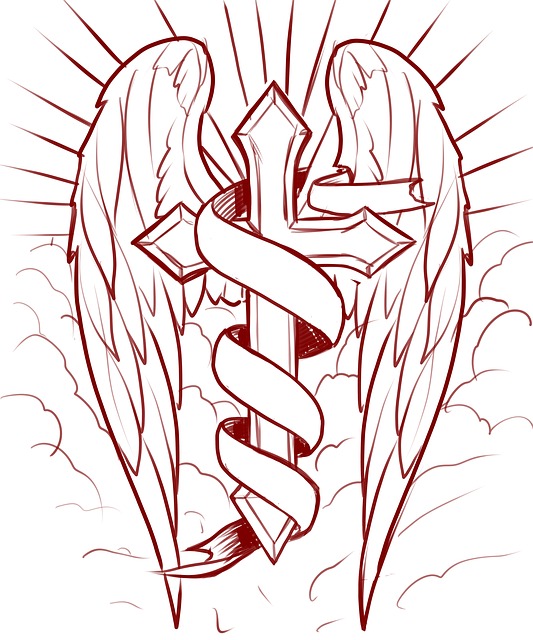
A Heavy Cross to Bear – Choosing The Right Cross Tattoo

Crux immissa. Crux capitata. Crux commissa. Crux immissa. Crux ansata. Cruz gammata.

The cross. It is the most ancient and universal symbol, which in pre-erudite cultures often symbolized a duality. Associated with the horizontal beam of the cross were the symbols of the feminine, which included the characteristics of passivity, earthiness, destruction, and death. On the other hand, the vertical beam suggested its masculine counterpart, which was considered celestial, eternal, creative, positive, active, and full of life.But before the cross became a religious and holy symbol, it was used in a cruel method of execution called crucifixion, where a victim was tied and nailed by the wrists and feet to a large wooden cross and left to hang there until dead. This practice was believed to have begun with ancient Persians, and Alexander the Great introduced crucifixion throughout his empire when he crucified a general who disagreed with his campaign plans. Later, the Roman Empire adopted the custom from Carthage and used it for slaves, rebels, enemies and criminals. After Jesus of Nazareth had been put to death, Saint Helena was said to have discovered the cross that Christ died upon in the fourth century AD. Helena was instrumental in converting the crumbling Roman Empire into the Christian Holy Roman Empire, and when Christianity became the state religion, Emperor Constantine abolished crucifixion.

Now, when it comes to religious symbol body art, the cross tattoo is by far the most popular tattoo design.

What Cross Tattoo Designs Represent On A Man Or Woman

Cross tattoos have the distinction of being one of the few tattoo designs that are, for the most part, unisex. It represents that same thing for women and men, as the symbol of the cross deals with the spiritual rather than the physical.

What Type Of Person Gets A Cross Tattoo Design

People who get cross tattoos are in tune with their spirituality and they know that they’re more than just their physical bodies. Their intuition and faith factor in heavily when the solution to a problem is beyond reasoning and thinking. Most of the problems we face day to day are intangible, so in seeking answers, these people transcend physical limitations. Cross tattoos also help spiritual people be at peace with themselves, and they seldom feel alone. The cross tattoo serves as a reminder that they are loved by God all the time, and feeling this love, they are peaceful, compassionate, open and loving to all human beings. With cross body art, a special relationship with God is implied.

Different Types Of Crosses

The Crux Immissa is shaped like a lower case “t”, with the horizontal beam inserted (which is what immissa means) at right angles to the upright post. This is the most common form of the Christian cross, and it was on a cross such as this that Christ actually died (for that reason it is sometimes referred to as the Passion cross). This cross is also called Crux Capitata (“with a head”) and the Latin cross.

The Crux Commissa is shaped like a capital “T” (commissa means “joined” or “attached”) and it is more widely known as the Tau Cross or St. Anthony’s cross.

The Crux Decussata is an “X” shaped cross (decussata comes from decus, Latin for “distinction”, “honor”, “glory” and “grace”). The crux decussata is seen in the elaborate Chi Rho Cross and Baptismal Cross, and the simple St. Andrew’s cross.

The Crux Ansata, or ansated cross, is most commonly known as the Ankh (a looped Tau cross that serves as the ancient Egyptian hieroglyph meaning “life”). The hieroglyph itself is a sketch of the womb and the sexual union of male and female genitalia, which signifies zest, energy, reproduction, regeneration, and immortality. The symbol closely resembles the Hindu depiction of a Hermaphrodite standing on a lotus flower.

The Cross of Triumph is similar to the design of the Latin cross, only it adds a large circle to the base with the outline of an upside-down T inside. This cross is a symbol that testifies to the universal triumph of the Gospel throughout the world.

The Calvary Cross is like the Crux Immissa on it’s mounted on three steps (which represent the hill of Calvary or, more often, “faith”, “hope” and “love”. It is also known as the Graded cross.

The Eastern Orthodox Cross (also known as the Russian Cross and Byzantine Cross) is another cross that is similar to the Latin Cross with two additional cross beams that sit above and below the original horizontal beam. The upper is shorter in length and runs parallel to the original cross beam while the lower slopes down from left to right at an angle.The top beam bears the plaque conveying Pontius Pilate’s inscription, “INRI” (Iesus Nazarenus Rex Iudaeorum) which is Latin, Greek and Hebrew for “Jesus the Nazorean, King of the Jews”. The true meaning of the bottom beam is a little more of a mystery. One popular theory (circa the eleventh century) is that it represents a footrest and the slant symbolizes a balance scale showing the good thief, St. Dismas, having accepted Christ would ascend to heaven, while the thief who mocked Jesus would descend to hell. In this interpretation, Christ and the cross is a balance of justice.

The Templar Cross features horizontal and vertical beams of equal length, the ends of which are flared. To fully understand the history of the cross, we must go back to the year 1118, when a military order was formed by nine French noble knights, whose ranks included Hugues de Payens and Geoffrey de Saint-Omer. The founding knights of this order, known as “The Poor Knights of Christ”, took monastic vows and were devoted to the protection of pilgrims and the defense of the Holy Land. When the King of Jerusalem, King Baldwin II (circa 1118-1131), installed the order in a part of the Palace of Jerusalem called, Solomon’s Temple, for their residence and armory, the order became known as Knights of the Temple or Templars.In 1128, the Knights of the Temple were confirmed by Pope Honorius II, and they received the white vestment as a symbol of the purity of their life, to which Pope Eugenius, in 1146, added “the red cross with two bars”. Despite many years of sacrifices and rendering service to bit Christianity and civilization, Philip the Fair, King of France (who was in the Order’s debt), arrested all the Templars in 1307, and seized their goods and possessions. But Phillip was unable to judge the Order, as it was answerable only to the Pope, so he set about to coerce Pope Clement V to act against the Order. The Pope eventually yielded to pressure in 1312 and the Order was forced to revert to its original status of a Secular Military Order of Chivalry.In 1314, noted Templar Grand Master Jacques de Molay was burned at the stake near Notre Dame Cathedral, Paris. And in England, though Edward II did not take immediate action against the Order, he permitted the Inquisitors to judge the Order at the Church of All Hallows By-the-Tower, and then set about seizing the Templar lands and possessions, including the Temple in London, for himself rather than passing them on to the nominated custodians, the Knights of Saint John.

The biggest misconception regarding the Knights Templar is that they always wore the cross as part of their raiment, when in actuality it wasn’t until 1147 that the Pope Eugene III granted the Templars the right to wear a red cross, sewn above the heart on the left side of the Templar garment. Before this time the knights wore only a white coat and their sergeants wore a brown one.

The Crusader’s Cross (also called the Jerusalem Cross) is symbolized as the crux immissa surrounded by four smaller crosses and usually represents Christ’s command to spread the Gospel around the world, a mission that started in Jerusalem. Although the true meaning of this cross is unknown, the most popular beliefs are:

* The larger cross represents the Old Testament teachings and the smaller crosses incorporate the New Testament teachings. The four apostles, Matthew, Mark, Luke and John, surrounding Christ in the center Christianity (the center cross) being broadcast by missionaries to the four corners of the world
* Five crosses representing the five wounds of Jesus on the cross (hands, feet and side)

It is believed that the name Crusader’s Cross came about because the symbol was on the papal banner given to the crusaders by Pope Urban II.

The Maltese Cross is comprised of four triangles who apexes meet to form an eight-pointed star that has varies shapes (blunt, curved and sharp). Originally used by the Knights of the Hospitaller Order, so known due to their charity toward the sick and poor in setting up hospices and hospitals, the symbol is still in use today by fire and ambulance services. During this time, battle armor was often extensive, covering bodies and faces and making it difficult in battle to differentiate friend from foe, so the need for an identifiable insignia for the knights became vital. Since they fought for a holy cause, they selected the symbol of the cross and when the Knights of Saint John of Jerusalem moved to the Island of Malta, the emblem inherited the island’s name. The Maltese cross represented the principles of charity, loyalty, chivalry, gallantry, generosities to friend and foe, protection of the weak, and dexterity in service. Because of its connection with the Knights of St. John, this cross is also called St. John’s Cross.

The Celtic Cross is simply a Latin cross with a ring in the center, and as is the case with most of the other crosses listed here, this cross is called different things by different people. For example, Episcopalians and Anglicans call it the Celtic cross, whereas Catholics refer to it as the Irish cross. Sometimes it’s even mistakenly identified as St. John’s Cross (see: Maltese Cross). Equally ambiguous is the meaning of the ring in the center of the cross. Interpretations range from it being a symbol of eternity that emphasizes the everlasting love of God, as shown through Christ’s crucifixion, to the symbolization of Christ’s resurrection, to the simplified explanation that it’s a halo. Then there’s the theory that when St. Patrick converted Druids to Christians, he took one of their standing stones etched with a circle that symbolized their moon goddess, and scratched a Latin cross mark over the circle, to show that Christianity had replaced their pagan beliefs.

The Celtic cross also contains plaitwork, which are patterns of interwoven cords that symbolize the “Thread of Life”, since the human soul was thought, by the Celts, to be a fragment of the divine, which would ultimately return to its divine source, after ridding itself of its accumulated, inherited impurities (see: Celtic Knots for more information regarding plaitwork).

The Anchor Cross is also known as St. Clement’s Cross, named after the fourth Pope who was banished from Rome in the first century by Emperor Trajan. Clement was forced to work in a Russian stone quarry and he caused trouble for himself when he located a spring of fresh water from the ground that quenched his fellow prisoners’ thirst (believed to be miracle, which aided in his later sainthood), and since no good deed goes unpunished, the prison governor ordered Clement’s death. He was subsequently tied to anchor and tossed into the Black Sea to prevent Christians from recovering the body. Clement later became the patron saint of anchorsmiths, blacksmiths, mariners, marble workers and stonecutters.

Which Cross Tattoo Is Right For Me?

Believe it or not, this is a difficult question to answer, because there is no logical thought pattern behind the choice (with the exception of the choosing the cross symbol that identifies your religion). The design could be a traditional Christian cross, a tribal cross, a Celtic cross, a gothic cross (being “goth” doesn’t make you a bad person), or a Latin cross with either a rosary, wings or praying hands. The only thing that matters is that the cross tattoo design you select, speaks to you spiritually. This decision is between you and God.

How will you show your faith and love?

Copyright ©2005 Rhyan Scorpio Rhys

Songs As Stories: Stars Go Blue

When Stars Go Blue *Inspired by the song “When The Stars Go Blue” by Ryan Adams

It was a secret place, a quarter acre of Eden abandoned and erased from the mind of mankind the instant the original sin was committed, and I had stumbled upon it quite by accident.

No, that was a lie and I promised myself I would not defile the sanctity of the garden if it could be helped.

I was not proud of the actual reason of how I came to be in this place, simply because I was a stalker. In my defense, it was only the once, I hadn’t made a habit of following women around without their knowledge. Just one woman. The one I was currently spying on, crouched here in the bushes amongst the flower blossoms, berries and leaves.

Mari.

Coworkers called her Marionette behind her back and sometimes to her face, passing it off as good-natured teasing. There was nothing good-natured about it. She acquired the nickname because she was a gangly woman who moved about in a jerky fashion, as if the unseen wires that made her move were constantly in a tangle that the puppeteer hadn’t been able to sort.

Mari did as people of her ilk often do, she kept herself to herself, stared at her shoes rather than make eye contact, and accepted all the negativity heaped upon her shoulders with nary a complaint. But she couldn’t hide the fact that she was miserable, just as I couldn’t hide that I was somehow drawn to that misery.

Although I wanted to know her for a while, I was too shy to make an approach. Today, I told myself, would be the day. As I went through my daily grind, I slowly mustered all my courage and screwed it to the sticking place. Ten minutes to quitting time, I marched to Mari’s cubicle, prepared to make my intentions known…

But she wasn’t there.

I searched by the fax machine, in the kitchen near the coffee maker, I even bore the brunt of strange stares when I loitered outside the women’s restroom, but she wasn’t anywhere to be found. Completely and utterly defeated, I grabbed my coat and left for home.

Half a block before the entrance to the subway, something grabbed my attention out the corner of my eye. Across the street, Mari sat on a bench at a bus stop as the 5:17 pulled up. I wanted to run across the street, braving the crosstown traffic and hop on the bus to make my stand. Instead, I froze. All my former courage had long abandoned me.

For the second time today, my heart sank. And for the second time today it did so without merit. The bus pulled away to find Mari still seated. And she sat as bus after bus pulled up and away. She did not read a book. She did not listen to music. She simply sat patiently.

Then when sufficient time had passed, Mari stood and walked away. I couldn’t tell you what possessed me to follow her on the crooked path that weaved through narrow alleyways, towering overpasses, black as pitch underground tunnels. Eventually her journey came to a halt in front of a lot that appeared to have been vacant for centuries.

Mari stood at the perimeter of the lot and at the precise moment the evening woke and forced the daylight into hiding, a door appeared with seven locks. She stood absolutely still and waited. In the newborn evening sky, stars bloomed and seven of them twinkled blue in a sequence that repeated seven times. The locks tumbled one after the other and the door opened slowly.

Mari stepped through the door frame but hadn’t appeared in the lot on the other side. From my vantage point, she simply vanished.

I ran to the door and managed to squeeze through before it shut, but instead of finding myself in the overgrown and refuse-filled lot, I stepped into paradise. My clothes melted from my body and ashamed of my nakedness, I hid in a nearby bush.

In the very center of the garden stood a mammoth tree that bore unrecognizable fruit of various shapes and sizes, the roots of which branched out along the grass and touched two streams on either side, one that appeared to have been made of milk and the other honey.

Standing beside the tree was Mari, naked but no longer that gangly woman who was awkward in her skin and awkward in the world. Here, her jerky movements flowed gracefully, her normally dull and lifeless eyes were polished to a fine shine, and her crooked mouth straightened and nearly split her face in half when she unleashed that radiant smile.

Mari blew a kiss up to the tree and somehow that kiss became a breeze that rustled the leaves which made a sort of melody unlike any I had ever heard. A pure music played by nature itself.

She danced around the tree all night without tiring, in time with the tune, and sang in a voice that was different from her normal mousy tone, stronger now, more confident. And I watched all the sorrow and strife, all the hurt and anger, all that was wrong with her life evaporate from her body.

When she sensed it was time to leave, Mari reached up and plucked the smallest of the fruit from a low hanging branch and dipped it in the stream of honey before washing the meal down with a cupped hand from the stream of milk.

The door reappeared and her clothing was folded neatly in a pile beside it. With each layer she put on, the transformation to her old self, the Mari that people mocked, began.

I thought about following her, but how could I ever leave this place, this patch of perfection? I knew she would be back and the next time I would talk to her, for certain. Until then I was contented to wait until she returned to dance again. I would wait until the stars went blue.

Sally forth and be dancing where the stars go bluingly writeful.

©2014 Rhyan Scorpio-Rhys

Creative Commons License