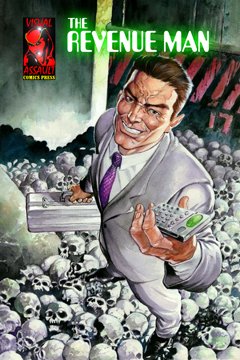
78 Page, Black and White Graphic Novel by Rhyan Scorpio-Rhys
In the year 2046, tax rates have reached a record high of 96%. These rates have incensed what is left of the working class. Citizens, in order to survive with some semblance of dignity, have devised ways to withhold income from the taxation offices, adopting a “the tax office can’t tax what they don’t know about” attitude. The Rowe Scientific Tax Administration Inspection Bureau has made it their business to be in the position to know EVERYTHING.
Since humans have proven time and time again to be selfish, money-grubbing little creatures, Rowe designed a new type of tax man, one that was incorruptible and flawless, to oversee and enforce the stringent tax laws. Thus were born…THE REVENUE MEN. When one of these super auditors malfunctions and begins its deadly pursuit on an innocent taxpayer. Trapped in a skyscraper, and armed with nothing but the knowledge that he is innocent, Eddie Pacheco must match wits with an insane automaton, ever staying one step ahead, if he wants to stay alive.
The research began with correspondence from a marriage that had lasted twenty-eight years.
The linguist possessed every stage of it: handwritten letters from courtship, postcards from the first years together, emails from middle age, terse messages sent during the separation. She expected changes in tone. What surprised her was how orderly the transformation appeared once she mapped the vocabulary chronologically.
Endearments did not vanish suddenly. Their meanings decayed.
Dear became ironic before disappearing. Always shifted from promise to accusation. Fine migrated from reassurance to hostility. Words once used exclusively during affection resurfaced years later carrying contempt, as though language retained the shape of intimacy long after warmth had drained from it.
She expanded the study.
Other couples volunteered archives. The same progressions appeared with uncomfortable regularity. Relationships differed in duration and intensity, yet certain words followed similar paths. Tender language seemed to possess measurable half-lives. Some terms survived decades. Others became toxic within months.
She began privately calling the phenomenon variation.
Her most troubling discovery arrived when she reversed the analysis.
Hostile language sometimes traveled the opposite direction.
Couples who reconciled reused old insults playfully. Words once associated with humiliation softened over years until they became affectionate private jokes. Resentment could decay into tenderness through the same linguistic machinery.
The direction, she realized, mattered less than repetition.
Human beings appeared to wear emotional pathways into words until meaning followed familiarity rather than origin.
She has become cautious in conversation since completing the study. Compliments make her listen for future echoes. Arguments interest her linguistically even while they hurt. She occasionally hears a phrase and senses several possible meanings waiting years ahead of it.
Recently she started dating again.
The person she sees calls her difficult with unmistakable fondness.
According to her models, the word should trouble her.
Instead she has begun recording it.
She suspects the study’s largest error was treating love and hate as destinations. Language suggests they behave more like weather systems moving repeatedly across the same terrain, leaving traces of each passage behind.
She has no model yet for what happens when someone learns to hear the forecast.
My grandmother threw rice at every wedding she attended well into her nineties. Long after guests switched to bubbles, bells, flower petals, and biodegradable confetti, she arrived with a small cloth pouch and ignored anyone who warned her about birds. Rice remembers things bubbles cannot, she would say, as though the explanation were obvious.
After she died, my mother found shelves of glass jars in the pantry. Each contained a handful of dried rice labeled with a wedding date and the names of the couple. Some went back more than seventy years. Folded inside every jar was a small square of paper bearing one of several marks: a circle, a slash, a pair of parallel lines, occasionally something resembling a knot.
We assumed it was sentimental record keeping until my mother began comparing the jars with family history.
The slashes belonged almost exclusively to marriages that ended early. Circles marked long unions. Parallel lines appeared beside couples who stayed married but lived largely separate lives. The knotted symbol was rare. Every marriage bearing it had survived circumstances that should have destroyed it: disappearances, affairs, prison sentences, decades of resentment, even one case where the couple divorced and remarried each other three times.
My grandmother apparently knew which symbol to draw by watching the rice fall.
My mother began testing the method at weddings. A wide scatter that bounced freely across the pavement usually meant the couple would grow apart without catastrophe. Rice that landed close around their feet suggested endurance. Grains that struck one person and avoided the other entirely corresponded disturbingly well with later illness or abandonment.
Then came my wedding.
My mother used rice from my grandmother’s old supply, throwing it as we left the ceremony. Her face changed almost immediately. She gathered several grains from the pavement before anyone could step on them and sealed them in a napkin.
She has refused to tell me what pattern they made.
Months later I found her new collection of jars. Mine sat on the top shelf with no symbol on the paper inside. Instead, the rice itself had arranged into a narrow ring against the glass, leaving the center completely empty.
I asked her what it meant. She admitted she did not know because my grandmother had never recorded anything like it.
Since then, my spouse and I have both started dreaming of the same room: a long table covered with white cloth, two empty chairs at the far end, and rice falling continuously from somewhere above. My mother has begun checking our jar every morning because the ring keeps tightening by a few grains at a time, though nobody has opened the lid.
The cemetery caretaker had a phrase for the expression certain visitors acquired after standing too long over a grave. He called it the graveyard look and claimed he could recognize it from half a field away. Ordinary mourners shifted their weight, wiped their eyes, checked the time, eventually remembered the living world waiting beyond the gates. Someone with the graveyard look became perfectly still, the face emptied of everything except attention.
He taught me to spot it during my first week on the job. The dead, he said, grew accustomed to familiar company. Visit often enough and they learned your shape. Stand still long enough and they occasionally mistook you for something that belonged there permanently. His remedy was simple: approach noisily. Scuff gravel. Cough. Say something ordinary about rain or traffic. Give whoever was being watched a reason to remember they still occupied a body.
I treated this as workplace folklore until the widow in section nine froze beside her husband’s stone one October afternoon. She had visited every Sunday for three years, always leaving chrysanthemums and talking quietly for twenty minutes before going home. That day she remained motionless for nearly an hour.
Even from the maintenance shed, something about her posture felt wrong.
I crossed the path dragging my boots through the gravel and called out that frost was expected overnight. She jerked hard enough to drop her handbag and drew several sharp breaths, as though surfacing from deep water. When I asked whether she was all right, she said she had been listening to her husband explain how lonely the cemetery became after closing.
She stopped visiting regularly after that.
Since then I have noticed other things. People wearing the graveyard look sometimes face the wrong headstone. Fresh flowers appear beside markers belonging to families who moved away decades ago. More than once I have heard my own name spoken from behind me while working alone.
The caretaker retired last winter. On his final day he gave me his keys and advised me never to count how many people remained on the grounds after sunset. I understood the warning only recently.
Some mornings, before leaving for work, I catch the graveyard look on my own face in the hallway mirror. The stillness arrives before I realize I have stopped moving, and my eyes seem focused on something several feet behind my reflection. I scuff my boots against the floorboards until the feeling breaks. Lately, though, the sound has been answered by another scrape from somewhere inside the mirror, slightly delayed and growing more confident each time.
The call came during supper from a number almost identical to her own. The man said he was calling about an account she had never opened. When she told him so, he agreed pleasantly and explained that the account consisted of unattended personal material: a Tuesday from nineteen years ago, a yellow kitchen, an unfinished sentence to her father.
She knew scams relied on fragments gathered from public records and old messages. He agreed again and asked her to verify one detail. What color was the car her father drove home that evening? She answered before caution caught up, and a small portion of the memory vanished. She retained the fact of the kitchen but lost the wallpaper.
The calls continued. A childhood dog. The smell of her primary school. A scar acquired on holiday. Each verification sharpened his knowledge and blurred hers. Soon he could describe birthdays she remembered only as photographs. He knew which jokes made her laugh before she did. When she challenged him, he explained that identity verification worked best when conducted gradually because people became distressed if too much was transferred at once.
Transferred.
That word changed everything.
She stopped answering.
The calls continued anyway. Voicemails appeared containing memories she had never spoken aloud. Friends began referring to conversations she could not remember having. Her employer congratulated her on a presentation she had not delivered. Someone using her name was moving through her life with increasing competence.
She called the number back.
A woman answered.
Her own voice greeted her with affectionate irritation and asked why she kept interfering with the migration.
The scam had never been about money. The caller collected enough authenticated detail to build a version of a person that reality would accept as genuine. Once the copy accumulated sufficient continuity, the original became the discrepancy.
She checked her driver’s license.
The photograph was hers, but the birth date was wrong.
Her phone unlocked for someone else’s face.
Then came one final message from the account department thanking her for her cooperation. The migration was complete, it said, and any remaining memories in her possession should be considered unauthorized duplicates.
By morning, nobody recognized her.
The yellow kitchen remained perfectly clear.
She could no longer remember whose childhood had happened there.
The cat had been coming to the pub longer than any of the current regulars could account for, sitting on the same stool at the end of the bar like it had been carved into the wood specifically for that purpose, and it asked its first riddle to anyone who made the mistake of buying it a saucer of cream. The riddles were always simple-sounding at first, the kind of thing you’d hear from a child, what has a face but never smiles, what runs but never walks, and the trick of it was that the obvious answer was always wrong, and the cat would tilt its head at a wrong answer with an expression that managed to look almost sympathetic.
Getting a riddle wrong cost you nothing, officially. The cat never demanded payment, never threatened anything, only asked the next riddle, patient as anything, willing to sit there all night if that was what it took. The trouble started with the third or fourth wrong answer, when people began noticing that the riddles had started referencing details they hadn’t told anyone, a childhood dog’s name, a fear they’d never said aloud, small private things stitched into the wording so casually that you almost missed it until the answer clicked into place and left you cold.
By the fifth riddle, most people stopped answering at all, which the cat seemed to consider an answer in itself, nodding slowly and moving on to a new question anyway, one that somehow required a response even from silence. The ones who stayed the whole night, who kept answering out of stubbornness or pride or the simple human inability to leave a puzzle unfinished, tended to leave a little different than they’d arrived, quieter, prone to answering questions with questions of their own, laughing at pauses in conversation as though they’d heard a joke nobody else had told.
The pub kept the cat around because it was good for business, in its way, and because nobody had figured out how to ask it to leave without risking one more riddle on the way out. Regulars learned early to buy their round, listen politely, and never, under any circumstances, be the one who answered correctly, since nobody who’d ever gotten a riddle right had stayed to explain what happened next.
The playgroup met on Tuesday mornings in the basement of the funeral home, a dozen small children sitting cross-legged on a rug patterned with clouds while their parents finished paperwork upstairs or caught a rare hour of sleep in the break room. It had started as a joke, a way to keep the kids occupied between viewings, but the joke had calcified into tradition the way jokes do in families that spend too much time around the same strange work, and now there was an actual song, passed down and refined over several years, sung to the tune everyone already knew from somewhere else.
The wheels on the hearse go round and round, the children sang, hands circling in front of them the way they’d been taught, round and round, all through the town. The next verse involved the doors going open and shut, palms clapping together on shut with real enthusiasm. There was a verse about the flowers going droop, droop, droop, which always got a laugh because of how seriously the smallest kids took the wilting motion, folding themselves slowly toward the rug like something deflating.
The parents upstairs had mixed feelings about it, mostly resolved into a shrug, because you couldn’t really raise children in this trade and expect them to flinch at the shape of the family business, and better they learn early to find it ordinary than grow up flinching at every hearse that passed on the street. The song had a final verse nobody had officially added but that had shown up anyway, sung a little quieter than the rest: the people in the ground go still, still, still, all through the town. The children sang it the same way they sang everything, with the same open, unbothered faces, hands folding into their laps at still, and the parents who overheard it from the stairwell never quite decided whether that verse was the darkest part of the tradition or the most honest one.
She was five feet tall in boots and somehow took up more room than anyone else in the house.
Not physically. The house simply seemed to reorganize itself around whatever she decided to become that week.
On Monday she was learning violin, so the dining table disappeared beneath sheet music. By Wednesday she had taken up breadmaking, and every surface wore flour. Friday brought astronomy, three library books, and a secondhand telescope that blocked half the bedroom window.
Her partner called her “a li’l bit of a lotta gal” after finding her simultaneously repairing a lamp, listening to an Italian lesson, and fermenting cabbage.
She liked the phrase enough to keep it.
The trouble began when the hobbies started staying.
Usually she moved on. Knitting became pottery, pottery became birding, birding became amateur locksmithing. Yet one morning she discovered she could still play the violin passage she had abandoned six months earlier. She could identify Orion without looking it up. She could pick the bedroom lock in eleven seconds and explain why the sourdough starter smelled wrong.
Then came languages she had barely studied, dances she had watched once, recipes she had only bookmarked. Skills accumulated inside her without permission.
Soon she could do nearly anything badly and an alarming number of things well.
People began bringing problems.
A broken watch. A tax form. A sick orchid. A leaking pipe. A suspicious mole. She helped until there was always someone at the door.
Her partner finally found her sitting on the kitchen floor surrounded by tools, yarn, legal forms, sheet music, seedlings, and an accordion she did not remember buying.
“I can do everything,” she whispered.
“That sounds useful.”
“It was.”
The next morning, every unfinished project was gone. So were the books, instruments, tools, and half-learned ambitions.
On the refrigerator she left one note.
I’m going to find out who I am when I’m not becoming someone else.
Her partner smiled, and left the kitchen exactly as she had left it, because finally, there was room.
The confession arrived while they were both waiting for the copier to stop making a noise like a dying goose.
There were several possible responses. Laughter seemed cruel. Gratitude seemed encouraging. Asking what made the crush weird felt like volunteering for injury.
So the recipient chose the worst option. “What does that mean?”
Apparently, it meant everything.
The attraction had begun with the way they ate yogurt using the tiny plastic lid as a spoon whenever the office kitchen ran out of cutlery. Then there was the habit of naming every malfunctioning printer. The winter coat with one missing button. The tendency to whisper “betrayal” whenever a vending machine refused to drop a snack.
None of these qualities had ever been considered seductive.
The admirer continued.
There was also the way they checked every chair before sitting down, carried three pens but never one that worked, and always smelled faintly of cinnamon despite never eating cinnamon.
“This is sounding less like a crush and more like surveillance.”
That caused immediate panic.
It was explained that normal crushes were based on cheekbones, confidence, expensive shoes, or mysterious emotional unavailability. This one was built from details no dating profile would include because nobody would think they mattered.
The copier finally stopped screaming.
Neither person moved.
“So I’m attractive because I’m badly assembled?”
“No. You’re attractive because you’re specific.”
That answer lingered.
For years, the recipient had assumed love required presenting a cleaner version of the self: better posture, better clothes, fewer strange habits, less evidence of being difficult to manufacture.
Instead, someone had apparently developed feelings because of the evidence.
The recipient considered this carefully, then opened a desk drawer, removed a yogurt, peeled back the lid, and folded it into a makeshift spoon.
The admirer stared. “See?” came the sigh. “That. Exactly that.”
“Enjoy the moment,” the recipient said. “because, no offense, but you’re my weird stalker, and I’m filing a restraining order.”
In the year 2046, tax rates have reached a record high of 96%. These rates have incensed what is left of the working class. Citizens, in order to survive with some semblance of dignity, have devised ways to withhold income from the taxation offices, adopting a “the tax office can’t tax what they don’t know about” attitude. The Rowe Scientific Tax Administration Inspection Bureau has made it their business to be in the position to know EVERYTHING.
Since humans have proven time and time again to be selfish, money-grubbing little creatures, Rowe designed a new type of tax man, one that was incorruptible and flawless, to oversee and enforce the stringent tax laws. Thus were born…THE REVENUE MEN. When one of these super auditors malfunctions and begins its deadly pursuit on an innocent taxpayer. Trapped in a skyscraper, and armed with nothing but the knowledge that he is innocent, Eddie Pacheco must match wits with an insane automaton, ever staying one step ahead, if he wants to stay alive.