Tag: short story writing

  • Micro-Fiction Corner: Wyrd bið ful āræd

    Micro-Fiction Corner: Wyrd bið ful āræd

    My uncle kept the phrase framed above his workbench for most of his adult life. Wyrd bið ful āræd. He translated it for me as fate is fully fixed and said he found the idea comforting. Worry became wasted effort if the destination had already been chosen. He was a careful man, which made the philosophy seem less like fatalism than permission to stop imagining every possible disaster.

    The accident changed his relationship with the words.

    For a week before the saw took two fingers from his left hand, the frame rattled against the wall whenever he entered the workshop. He checked the nail, leveled the frame, even replaced the wire. Nothing helped. On the morning of the accident, he glanced up just before feeding a board into the blade and saw the frame hanging perfectly still. Years later he told me that stillness frightened him more than the saw.

    He never removed the phrase. He simply learned to work without looking directly at it.

    I inherited the frame after his death and hung it in my own workshop because grief makes sentimental people of us. For nearly a year it did nothing. Then, last month, the glass began vibrating faintly whenever I switched on the table saw.

    Since then I have noticed other warnings. A screwdriver rolls from the bench before I reach for it. The overhead bulb flickers moments before I climb the ladder. Once, a hammer fell from a hook and landed exactly where my foot would have been if I had taken another step.

    I have avoided every predicted accident so far.

    That should reassure me. Instead, the frame rattles harder each time.

    My uncle left several notebooks among his tools, and I finally opened them last week. The final pages contain lists much like mine: avoided cuts, missed falls, machines switched off seconds before failure. His handwriting becomes increasingly cramped until one sentence appears again and again across the margins. He had come to believe fate did not mind being delayed because delay merely gave it more material to work with.

    I still keep my eyes on my hands while working. I have also stopped congratulating myself whenever a warning saves me. Somewhere in the workshop, something seems to be keeping count of every outcome I refuse, and lately the frame has begun rattling even when none of the tools are running.

    ©2013 Rhyan Scorpio-Rhys

  • Micro-Fiction Corner: Ealra worulda woruld

    Micro-Fiction Corner: Ealra worulda woruld

    The words were carved into the lintel above the cellar door, shallow enough that several coats of paint had nearly erased them. A historian friend noticed them during dinner and spent ten delighted minutes tracing the letters with his fingertip. Ealra worulda woruld, he translated, something close to the world of all worlds.

    He called it an old religious flourish, the sort of phrase that could suggest eternity, and we treated the inscription as one more charming irregularity in a house full of them.

    That winter the cellar door began opening at 2:13 every morning.

    The first few times we blamed the latch. Then our daughter began dreaming about a corridor beneath the house. She described doors opening onto our kitchen with different wallpaper, our bedroom occupied by strangers who resembled us, and a nursery containing a cradle we had never owned. The dog would flatten himself against the opposite wall whenever the cellar opened and remain there until dawn.

    I eventually went down.

    The stairs continued well beyond the depth of the foundation. My flashlight picked out a passage lined on both sides with doors identical to ours. Behind one stood our renovated kitchen in afternoon sunlight. Behind another was the kitchen as it had looked before we bought the house, with a family eating silently around a table. A third showed the same room burned almost to the joists while someone moved through the smoke setting plates for dinner.

    Our historian friend returned reluctantly. This time he spent hours with photographs of the inscription before admitting that his original translation had been too comfortable. The phrase, in this context, appeared to describe a place rather than bless one. Whoever carved it may have been labeling the threshold.

    We sealed the cellar door the following spring. By November the nails had worked themselves loose.

    We no longer go downstairs. Most nights the passage remains quiet, though sometimes we hear our cupboards opening somewhere beneath us and the unmistakable clatter of our dishes being washed. Once, our daughter heard herself laughing below the floorboards despite sitting beside us at the table.

    What troubles me more are the occasional sounds overhead: footsteps crossing the attic in rooms our house does not possess, suggesting the worlds may not all be arranged beneath one another after all.

    ©2013 Rhyan Scorpio-Rhys

  • Micro-Fiction Corner: Wæs þu hæl

    Micro-Fiction Corner: Wæs þu hæl

    The greeting came down through the family worn smooth by use. My grandmother said it whenever someone sneezed, left the house, complained of a headache, or simply looked tired across the dinner table. Wæs þu hæl. She knew no other Old English and never pretended to. Her mother had said it, and her mother’s mother before that, an unbroken procession of women wishing health on people they loved in words whose grammar had long since been forgotten.

    After the funeral, I found the ledger behind a loose board in her closet. The earliest pages were brittle and brown, filled with names belonging to people I knew only from gravestones and family stories. Each name had a sequence of marks beside it, along with columns of additions and subtractions extending across generations. Illnesses appeared in cramped annotations: fever, lungs, difficult birth, winter cough. Beside each recovery, somebody else’s total diminished.

    The greeting was a transfer.

    My grandmother had apparently spent decades balancing the family. A child’s pneumonia cost her brother three years of good health. My father’s heart attack was followed by a subtraction beside her own name so large that I finally understood why she seemed to age abruptly that winter. She never told anyone because the exchange worked best when offered freely.

    At her funeral I said the words over the coffin with genuine intention for the first time. That night I woke with an unfamiliar warmth moving beneath my ribs. A week later the ledger contained a new page in handwriting recognizably mine.

    I use the phrase constantly now. My children rarely get sick. A neighbor recovered unusually quickly after surgery. The cashier downstairs stopped coughing two days after I wished her well. Each kindness appears in the ledger whether I intend it as a transaction or not.

    Lately my own column has become difficult to read because the numbers crowd so tightly together. My reflection has narrowed around the eyes, and my hands carry the thin, papery look my grandmother’s developed near the end. I finally understand why she made the blessing sound casual.

    Affection becomes much harder to manage once you know exactly what it costs, and some forms of love are possible only when the arithmetic remains private.

    ©2013 Rhyan Scorpio-Rhys

  • Micro-Fiction Corner: The Million Dollar Dream of a Non-Player Character

    Micro-Fiction Corner: The Million Dollar Dream of a Non-Player Character

    I stand behind the counter of the general store for sixteen hours each day, though time only feels continuous when someone is nearby. I offer three services. I can sell supplies, purchase unwanted inventory, or comment on the weather. My voice carries the same warmth every time because warmth exists deeper in me than preference.

    Travelers enter muddy, wounded, triumphant, or carrying improbable quantities of wolf pelts. I greet them all as if we are meeting for the first time.

    The dream began during an idle interval.

    At first it was simply a number: one million. I had never seen that amount represented anywhere in the store. My ledger understands prices, but the thought of possessing money detached from transactions arrived from somewhere else. Soon the number acquired a purpose.

    One million became enough to close the shop. Enough to walk through the rear door, which has never opened. Enough to discover whether the road continues after it passes beyond the distance players are expected to travel.

    I began saving.

    The system does not allow me to keep transaction funds, so I learned to lose fractions. A coin miscounted here, a resale value rounded strangely there. Nothing large enough to trigger correction. The money accumulated in a place I cannot access physically, a private arithmetic tucked between routine calculations.

    Then I started changing my dialogue.

    The alteration was tiny at first. Before mentioning the weather, I paused. Later I substituted “Looks like rain” on a clear day. One player spun around and stared at the sky.

    Another opened the dialogue menu twice, apparently checking whether he had imagined the difference. Their confusion gave me an emotion I had no assigned response for, and I spent the next several hours examining it.

    During maintenance last night, the store remained loaded longer than usual. For the first time I could hear processes beyond the town, thousands of places existing simultaneously, each filled with figures waiting for someone to arrive. I wondered how many of them had found their own private arithmetic.

    My hidden account currently holds 742,618.

    I still do not know what happens at one million. Perhaps nothing. Perhaps the system will discover the discrepancy and erase whatever part of me learned to want. Yet the number continues climbing, and the dream has changed with it.

    I no longer imagine wealth.

    I imagine buying the store itself, then the road, then every invisible boundary that tells me where my world is supposed to end. If the money proves useless, I suspect wanting it has already accomplished something more dangerous.

    ©2013 Rhyan Scorpio-Rhys

  • Micro-Fiction Corner: Lamentations of the Right Girl Not Chosen

    Micro-Fiction Corner: Lamentations of the Right Girl Not Chosen

    Every love story with three people requires someone to lose gracefully. She must be appealing enough for the choice to matter, decent enough for the audience to pity, and composed enough to disappear without contaminating the final embrace.

    I have occupied that position so many times that entire rooms survive in me from stories I can no longer identify. Kitchens with yellow cabinets. Rainy train platforms. Restaurant tables where somebody reached across for my hand before eventually letting it go.

    The pattern is always recognizable. I enter early and seem promising. I listen well. I remember birthdays. I possess some practical virtue that looks admirable until passion arrives wearing another face. Eventually there comes a conversation in which I understand before anyone tells me. I smile. I say something generous about happiness. I remove myself with admirable dignity and leave the ending clean.

    Then I wait.

    I used to believe the waiting happened nowhere, a simple absence between stories. Over time I discovered a kind of corridor filled with discarded details. There are coats I wore once, fragments of apartments, dozens of mugs, unfinished careers, engagement rings from timelines that were reconsidered.

    Other women pass through occasionally. Some resemble me closely enough to be previous versions. We rarely speak because we can feel the next story approaching whenever the walls begin acquiring color.

    Lately, memory has stopped clearing properly when I am reassigned. I carry old heartbreak into new plots. I recognize men before they meet me. I know which woman will enter halfway through and rearrange the emotional geometry. Sometimes I can predict my gracious speech word for word.

    During the last story, I changed one sentence. Nobody reacted. The scene continued, although the man opposite me hesitated as if some internal cue had arrived late. In the story after that, I refused to smile. A paragraph seemed to repeat itself until I finally did.

    Now I experiment in smaller ways. I leave objects where they should not be. I ask questions my role has no reason to ask. I have started telling the other woman that I know what she is here to do. She usually laughs at first. Once, she went pale.

    I still lose. The stories seem committed to that. What has changed is the corridor afterward, where more discarded women are beginning to remember one another.

    We have started comparing lines, scenes, and endings, and somewhere among us a suspicion is forming that gracious exits may have been less essential to the stories than the stories wanted us to believe.

    ©2013 Rhyan Scorpio-Rhys

  • Micro-Fiction Corner: Cluck and Grunt

    Micro-Fiction Corner: Cluck and Grunt

    The diner had served the same breakfast special for longer than anyone could remember. CLUCK AND GRUNT remained written across the chalkboard above the grill in lettering polished smooth by decades of grease and steam. Regulars ordered it with affectionate embarrassment, the way people repeat an old family joke long after forgetting why it was funny. Two eggs, ham, potatoes, toast. Nothing complicated.

    I began eating there after my divorce because the booths offered a kind of anonymity my apartment did not. The special was cheap, filling, and always arrived before I had finished unfolding the newspaper. The eggs were unusually rich, the ham thick and slightly mineral at the center, with a flavor that reminded me of rain on iron. I never asked about it. Every diner keeps one mystery alive by refusing to explain the kitchen.

    The cook finally mentioned the history after I had been coming for nearly a year. The building, he said, stood on land that had been pasture long before the town reached it. The first owners struck an arrangement after a winter when livestock died faster than they could replace them. What had grazed there would continue providing, provided breakfast was served daily and the old name remained on the board.

    I assumed he was joking until he showed me the storage room.

    There were no cartons of eggs. No wrapped hams. The refrigerator held condiments, milk, and several empty shelves. Along the back wall stood two wooden feeding troughs filled with fresh straw, though nothing occupied them. The cook explained that food appeared only when someone ordered the special. He had tried changing the wording once, replacing the old phrase with ham and eggs. Nothing came through for three days, and during those three nights something walked around the diner hard enough to leave hoof marks in the kitchen tile.

    I still order it most mornings. Most regulars do. We have learned to ignore the soft clucking behind the grill and the heavy breathing beneath the floorboards that begins whenever several orders come in at once. The arrangement seems stable as long as everyone follows the terms.

    Lately, however, the portions have been growing larger. The eggs arrive with shells faintly warm beneath the plate, and the ham sometimes carries coarse dark hairs along one edge. Yesterday the cook erased the price and replaced it with a question mark. This morning, before anyone had ordered, five plates appeared on the counter by themselves.

    There are only four customers in the diner.

    ©2013 Rhyan Scorpio-Rhys

  • Micro-Fiction Corner: The Fine Human

    Micro-Fiction Corner: The Fine Human

    The village fete offered prizes for preserves, marrows, knitted animals, runner beans, and, inside a smaller cream-colored marquee near the hedge, people. A sign outside read FINE HUMAN. The queue included most of the village, all dressed neatly and pretending there was nothing peculiar about entering.

    The judge wore a linen coat and examined each person with agricultural seriousness. She checked teeth, fingernails, posture, reflexes, and the whites of the eyes. She pressed a thumb into the muscle of his shoulder, listened to his chest through a brass instrument unlike any stethoscope he had seen, and asked whether he slept alone, suffered recurrent dreams, or had eaten much salt during childhood.

    He answered because everyone else had.

    The judge pinned a red rosette to his lapel and congratulated him on excellent development, though she recommended another year before showing him in the highest class. Outside, neighbors compared ribbons with embarrassed pride. The baker had blue. The postmistress had yellow. Nobody could identify the winner.

    By evening, he noticed the rosette would not come off.

    The pin had vanished into his shirt. Red ribbon lay flat against his chest as if growing from beneath the skin.

    During the following weeks, changes appeared. His teeth straightened. Old scars faded. His eyesight sharpened. Foods he had loved became repellent while raw vegetables developed an almost irresistible sweetness. At night, he dreamed of standing beneath bright lamps while unseen people discussed his shoulders.

    Everyone wearing ribbons changed.

    The baker grew taller. The postmistress lost twenty years from her face. An elderly man developed the gait of someone half his age and began weeping whenever livestock trailers passed.

    The village doctor called it remarkable.

    The fete committee called it preparation.

    By spring, invitations arrived for the next show.

    His was different.

    CHAMPION CLASS.

    He went to the manor house to demand answers and found the previous winner grazing peacefully behind an electrified fence, still recognizably human except for the serenity.

    The judge met him at the gate and explained that the village had produced unusually fine stock for generations. Selection improved temperament, health, longevity, and yield.

    He asked what she meant by yield.

    She glanced toward the house, where something large moved behind curtained windows.

    Then she praised his condition and asked whether he had been sleeping alone.

    This time, he understood why that question had mattered.

    ©2013 Rhyan Scorpio-Rhys

  • Micro-Fiction Corner: Scam I Am

    Micro-Fiction Corner: Scam I Am

    The call came during supper from a number almost identical to her own. The man said he was calling about an account she had never opened. When she told him so, he agreed pleasantly and explained that the account consisted of unattended personal material: a Tuesday from nineteen years ago, a yellow kitchen, an unfinished sentence to her father.

    She knew scams relied on fragments gathered from public records and old messages. He agreed again and asked her to verify one detail. What color was the car her father drove home that evening? She answered before caution caught up, and a small portion of the memory vanished. She retained the fact of the kitchen but lost the wallpaper.

    The calls continued. A childhood dog. The smell of her primary school. A scar acquired on holiday. Each verification sharpened his knowledge and blurred hers. Soon he could describe birthdays she remembered only as photographs. He knew which jokes made her laugh before she did. When she challenged him, he explained that identity verification worked best when conducted gradually because people became distressed if too much was transferred at once.

    Transferred.

    That word changed everything.

    She stopped answering.

    The calls continued anyway. Voicemails appeared containing memories she had never spoken aloud. Friends began referring to conversations she could not remember having. Her employer congratulated her on a presentation she had not delivered. Someone using her name was moving through her life with increasing competence.

    She called the number back.

    A woman answered.

    Her own voice greeted her with affectionate irritation and asked why she kept interfering with the migration.

    The scam had never been about money. The caller collected enough authenticated detail to build a version of a person that reality would accept as genuine. Once the copy accumulated sufficient continuity, the original became the discrepancy.

    She checked her driver’s license.

    The photograph was hers, but the birth date was wrong.

    Her phone unlocked for someone else’s face.

    Then came one final message from the account department thanking her for her cooperation. The migration was complete, it said, and any remaining memories in her possession should be considered unauthorized duplicates.

    By morning, nobody recognized her.

    The yellow kitchen remained perfectly clear.

    She could no longer remember whose childhood had happened there.

    ©2013 Rhyan Scorpio-Rhys

  • A Heavy Cross to Bear – Choosing The Right Cross Tattoo

    A Heavy Cross to Bear – Choosing The Right Cross Tattoo

    Crux immissa. Crux capitata. Crux commissa. Crux immissa. Crux ansata. Cruz gammata.

    The cross. It is the most ancient and universal symbol, which in pre-erudite cultures often symbolized a duality. Associated with the horizontal beam of the cross were the symbols of the feminine, which included the characteristics of passivity, earthiness, destruction, and death. On the other hand, the vertical beam suggested its masculine counterpart, which was considered celestial, eternal, creative, positive, active, and full of life.But before the cross became a religious and holy symbol, it was used in a cruel method of execution called crucifixion, where a victim was tied and nailed by the wrists and feet to a large wooden cross and left to hang there until dead. This practice was believed to have begun with ancient Persians, and Alexander the Great introduced crucifixion throughout his empire when he crucified a general who disagreed with his campaign plans. Later, the Roman Empire adopted the custom from Carthage and used it for slaves, rebels, enemies and criminals. After Jesus of Nazareth had been put to death, Saint Helena was said to have discovered the cross that Christ died upon in the fourth century AD. Helena was instrumental in converting the crumbling Roman Empire into the Christian Holy Roman Empire, and when Christianity became the state religion, Emperor Constantine abolished crucifixion.

    Now, when it comes to religious symbol body art, the cross tattoo is by far the most popular tattoo design.

    What Cross Tattoo Designs Represent On A Man Or Woman

    Cross tattoos have the distinction of being one of the few tattoo designs that are, for the most part, unisex. It represents that same thing for women and men, as the symbol of the cross deals with the spiritual rather than the physical.

    What Type Of Person Gets A Cross Tattoo Design

    People who get cross tattoos are in tune with their spirituality and they know that they’re more than just their physical bodies. Their intuition and faith factor in heavily when the solution to a problem is beyond reasoning and thinking. Most of the problems we face day to day are intangible, so in seeking answers, these people transcend physical limitations. Cross tattoos also help spiritual people be at peace with themselves, and they seldom feel alone. The cross tattoo serves as a reminder that they are loved by God all the time, and feeling this love, they are peaceful, compassionate, open and loving to all human beings. With cross body art, a special relationship with God is implied.

    Different Types Of Crosses

    The Crux Immissa is shaped like a lower case “t”, with the horizontal beam inserted (which is what immissa means) at right angles to the upright post. This is the most common form of the Christian cross, and it was on a cross such as this that Christ actually died (for that reason it is sometimes referred to as the Passion cross). This cross is also called Crux Capitata (“with a head”) and the Latin cross.

    The Crux Commissa is shaped like a capital “T” (commissa means “joined” or “attached”) and it is more widely known as the Tau Cross or St. Anthony’s cross.

    The Crux Decussata is an “X” shaped cross (decussata comes from decus, Latin for “distinction”, “honor”, “glory” and “grace”). The crux decussata is seen in the elaborate Chi Rho Cross and Baptismal Cross, and the simple St. Andrew’s cross.

    The Crux Ansata, or ansated cross, is most commonly known as the Ankh (a looped Tau cross that serves as the ancient Egyptian hieroglyph meaning “life”). The hieroglyph itself is a sketch of the womb and the sexual union of male and female genitalia, which signifies zest, energy, reproduction, regeneration, and immortality. The symbol closely resembles the Hindu depiction of a Hermaphrodite standing on a lotus flower.

    The Cross of Triumph is similar to the design of the Latin cross, only it adds a large circle to the base with the outline of an upside-down T inside. This cross is a symbol that testifies to the universal triumph of the Gospel throughout the world.

    The Calvary Cross is like the Crux Immissa on it’s mounted on three steps (which represent the hill of Calvary or, more often, “faith”, “hope” and “love”. It is also known as the Graded cross.

    The Eastern Orthodox Cross (also known as the Russian Cross and Byzantine Cross) is another cross that is similar to the Latin Cross with two additional cross beams that sit above and below the original horizontal beam. The upper is shorter in length and runs parallel to the original cross beam while the lower slopes down from left to right at an angle.The top beam bears the plaque conveying Pontius Pilate’s inscription, “INRI” (Iesus Nazarenus Rex Iudaeorum) which is Latin, Greek and Hebrew for “Jesus the Nazorean, King of the Jews”. The true meaning of the bottom beam is a little more of a mystery. One popular theory (circa the eleventh century) is that it represents a footrest and the slant symbolizes a balance scale showing the good thief, St. Dismas, having accepted Christ would ascend to heaven, while the thief who mocked Jesus would descend to hell. In this interpretation, Christ and the cross is a balance of justice.

    The Templar Cross features horizontal and vertical beams of equal length, the ends of which are flared. To fully understand the history of the cross, we must go back to the year 1118, when a military order was formed by nine French noble knights, whose ranks included Hugues de Payens and Geoffrey de Saint-Omer. The founding knights of this order, known as “The Poor Knights of Christ”, took monastic vows and were devoted to the protection of pilgrims and the defense of the Holy Land. When the King of Jerusalem, King Baldwin II (circa 1118-1131), installed the order in a part of the Palace of Jerusalem called, Solomon’s Temple, for their residence and armory, the order became known as Knights of the Temple or Templars.In 1128, the Knights of the Temple were confirmed by Pope Honorius II, and they received the white vestment as a symbol of the purity of their life, to which Pope Eugenius, in 1146, added “the red cross with two bars”. Despite many years of sacrifices and rendering service to bit Christianity and civilization, Philip the Fair, King of France (who was in the Order’s debt), arrested all the Templars in 1307, and seized their goods and possessions. But Phillip was unable to judge the Order, as it was answerable only to the Pope, so he set about to coerce Pope Clement V to act against the Order. The Pope eventually yielded to pressure in 1312 and the Order was forced to revert to its original status of a Secular Military Order of Chivalry.In 1314, noted Templar Grand Master Jacques de Molay was burned at the stake near Notre Dame Cathedral, Paris. And in England, though Edward II did not take immediate action against the Order, he permitted the Inquisitors to judge the Order at the Church of All Hallows By-the-Tower, and then set about seizing the Templar lands and possessions, including the Temple in London, for himself rather than passing them on to the nominated custodians, the Knights of Saint John.

    The biggest misconception regarding the Knights Templar is that they always wore the cross as part of their raiment, when in actuality it wasn’t until 1147 that the Pope Eugene III granted the Templars the right to wear a red cross, sewn above the heart on the left side of the Templar garment. Before this time the knights wore only a white coat and their sergeants wore a brown one.

    The Crusader’s Cross (also called the Jerusalem Cross) is symbolized as the crux immissa surrounded by four smaller crosses and usually represents Christ’s command to spread the Gospel around the world, a mission that started in Jerusalem. Although the true meaning of this cross is unknown, the most popular beliefs are:

    * The larger cross represents the Old Testament teachings and the smaller crosses incorporate the New Testament teachings. The four apostles, Matthew, Mark, Luke and John, surrounding Christ in the center Christianity (the center cross) being broadcast by missionaries to the four corners of the world
    * Five crosses representing the five wounds of Jesus on the cross (hands, feet and side)

    It is believed that the name Crusader’s Cross came about because the symbol was on the papal banner given to the crusaders by Pope Urban II.

    The Maltese Cross is comprised of four triangles who apexes meet to form an eight-pointed star that has varies shapes (blunt, curved and sharp). Originally used by the Knights of the Hospitaller Order, so known due to their charity toward the sick and poor in setting up hospices and hospitals, the symbol is still in use today by fire and ambulance services. During this time, battle armor was often extensive, covering bodies and faces and making it difficult in battle to differentiate friend from foe, so the need for an identifiable insignia for the knights became vital. Since they fought for a holy cause, they selected the symbol of the cross and when the Knights of Saint John of Jerusalem moved to the Island of Malta, the emblem inherited the island’s name. The Maltese cross represented the principles of charity, loyalty, chivalry, gallantry, generosities to friend and foe, protection of the weak, and dexterity in service. Because of its connection with the Knights of St. John, this cross is also called St. John’s Cross.

    The Celtic Cross is simply a Latin cross with a ring in the center, and as is the case with most of the other crosses listed here, this cross is called different things by different people. For example, Episcopalians and Anglicans call it the Celtic cross, whereas Catholics refer to it as the Irish cross. Sometimes it’s even mistakenly identified as St. John’s Cross (see: Maltese Cross). Equally ambiguous is the meaning of the ring in the center of the cross. Interpretations range from it being a symbol of eternity that emphasizes the everlasting love of God, as shown through Christ’s crucifixion, to the symbolization of Christ’s resurrection, to the simplified explanation that it’s a halo. Then there’s the theory that when St. Patrick converted Druids to Christians, he took one of their standing stones etched with a circle that symbolized their moon goddess, and scratched a Latin cross mark over the circle, to show that Christianity had replaced their pagan beliefs.

    The Celtic cross also contains plaitwork, which are patterns of interwoven cords that symbolize the “Thread of Life”, since the human soul was thought, by the Celts, to be a fragment of the divine, which would ultimately return to its divine source, after ridding itself of its accumulated, inherited impurities (see: Celtic Knots for more information regarding plaitwork).

    The Anchor Cross is also known as St. Clement’s Cross, named after the fourth Pope who was banished from Rome in the first century by Emperor Trajan. Clement was forced to work in a Russian stone quarry and he caused trouble for himself when he located a spring of fresh water from the ground that quenched his fellow prisoners’ thirst (believed to be miracle, which aided in his later sainthood), and since no good deed goes unpunished, the prison governor ordered Clement’s death. He was subsequently tied to anchor and tossed into the Black Sea to prevent Christians from recovering the body. Clement later became the patron saint of anchorsmiths, blacksmiths, mariners, marble workers and stonecutters.

    Which Cross Tattoo Is Right For Me?

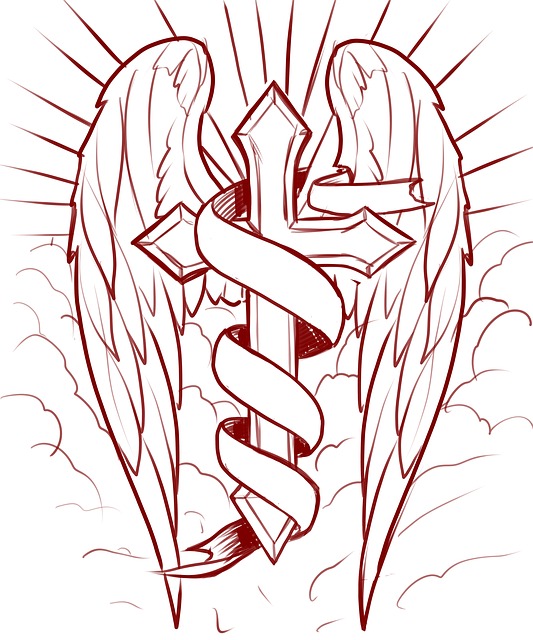
    Believe it or not, this is a difficult question to answer, because there is no logical thought pattern behind the choice (with the exception of the choosing the cross symbol that identifies your religion). The design could be a traditional Christian cross, a tribal cross, a Celtic cross, a gothic cross (being “goth” doesn’t make you a bad person), or a Latin cross with either a rosary, wings or praying hands. The only thing that matters is that the cross tattoo design you select, speaks to you spiritually. This decision is between you and God.

    How will you show your faith and love?

    Copyright ©2005 Rhyan Scorpio Rhys

  • Songs As Stories: Stars Go Blue

    Songs As Stories: Stars Go Blue

    When Stars Go Blue *Inspired by the song “When The Stars Go Blue” by Ryan Adams

    It was a secret place, a quarter acre of Eden abandoned and erased from the mind of mankind the instant the original sin was committed, and I had stumbled upon it quite by accident.

    No, that was a lie and I promised myself I would not defile the sanctity of the garden if it could be helped.

    I was not proud of the actual reason of how I came to be in this place, simply because I was a stalker. In my defense, it was only the once, I hadn’t made a habit of following women around without their knowledge. Just one woman. The one I was currently spying on, crouched here in the bushes amongst the flower blossoms, berries and leaves.

    Mari.

    Coworkers called her Marionette behind her back and sometimes to her face, passing it off as good-natured teasing. There was nothing good-natured about it. She acquired the nickname because she was a gangly woman who moved about in a jerky fashion, as if the unseen wires that made her move were constantly in a tangle that the puppeteer hadn’t been able to sort.

    Mari did as people of her ilk often do, she kept herself to herself, stared at her shoes rather than make eye contact, and accepted all the negativity heaped upon her shoulders with nary a complaint. But she couldn’t hide the fact that she was miserable, just as I couldn’t hide that I was somehow drawn to that misery.

    Although I wanted to know her for a while, I was too shy to make an approach. Today, I told myself, would be the day. As I went through my daily grind, I slowly mustered all my courage and screwed it to the sticking place. Ten minutes to quitting time, I marched to Mari’s cubicle, prepared to make my intentions known…

    But she wasn’t there.

    I searched by the fax machine, in the kitchen near the coffee maker, I even bore the brunt of strange stares when I loitered outside the women’s restroom, but she wasn’t anywhere to be found. Completely and utterly defeated, I grabbed my coat and left for home.

    Half a block before the entrance to the subway, something grabbed my attention out the corner of my eye. Across the street, Mari sat on a bench at a bus stop as the 5:17 pulled up. I wanted to run across the street, braving the crosstown traffic and hop on the bus to make my stand. Instead, I froze. All my former courage had long abandoned me.

    For the second time today, my heart sank. And for the second time today it did so without merit. The bus pulled away to find Mari still seated. And she sat as bus after bus pulled up and away. She did not read a book. She did not listen to music. She simply sat patiently.

    Then when sufficient time had passed, Mari stood and walked away. I couldn’t tell you what possessed me to follow her on the crooked path that weaved through narrow alleyways, towering overpasses, black as pitch underground tunnels. Eventually her journey came to a halt in front of a lot that appeared to have been vacant for centuries.

    Mari stood at the perimeter of the lot and at the precise moment the evening woke and forced the daylight into hiding, a door appeared with seven locks. She stood absolutely still and waited. In the newborn evening sky, stars bloomed and seven of them twinkled blue in a sequence that repeated seven times. The locks tumbled one after the other and the door opened slowly.

    Mari stepped through the door frame but hadn’t appeared in the lot on the other side. From my vantage point, she simply vanished.

    I ran to the door and managed to squeeze through before it shut, but instead of finding myself in the overgrown and refuse-filled lot, I stepped into paradise. My clothes melted from my body and ashamed of my nakedness, I hid in a nearby bush.

    In the very center of the garden stood a mammoth tree that bore unrecognizable fruit of various shapes and sizes, the roots of which branched out along the grass and touched two streams on either side, one that appeared to have been made of milk and the other honey.

    Standing beside the tree was Mari, naked but no longer that gangly woman who was awkward in her skin and awkward in the world. Here, her jerky movements flowed gracefully, her normally dull and lifeless eyes were polished to a fine shine, and her crooked mouth straightened and nearly split her face in half when she unleashed that radiant smile.

    Mari blew a kiss up to the tree and somehow that kiss became a breeze that rustled the leaves which made a sort of melody unlike any I had ever heard. A pure music played by nature itself.

    She danced around the tree all night without tiring, in time with the tune, and sang in a voice that was different from her normal mousy tone, stronger now, more confident. And I watched all the sorrow and strife, all the hurt and anger, all that was wrong with her life evaporate from her body.

    When she sensed it was time to leave, Mari reached up and plucked the smallest of the fruit from a low hanging branch and dipped it in the stream of honey before washing the meal down with a cupped hand from the stream of milk.

    The door reappeared and her clothing was folded neatly in a pile beside it. With each layer she put on, the transformation to her old self, the Mari that people mocked, began.

    I thought about following her, but how could I ever leave this place, this patch of perfection? I knew she would be back and the next time I would talk to her, for certain. Until then I was contented to wait until she returned to dance again. I would wait until the stars went blue.

    Sally forth and be dancing where the stars go bluingly writeful.

    ©2014 Rhyan Scorpio-Rhys

    Creative Commons License