
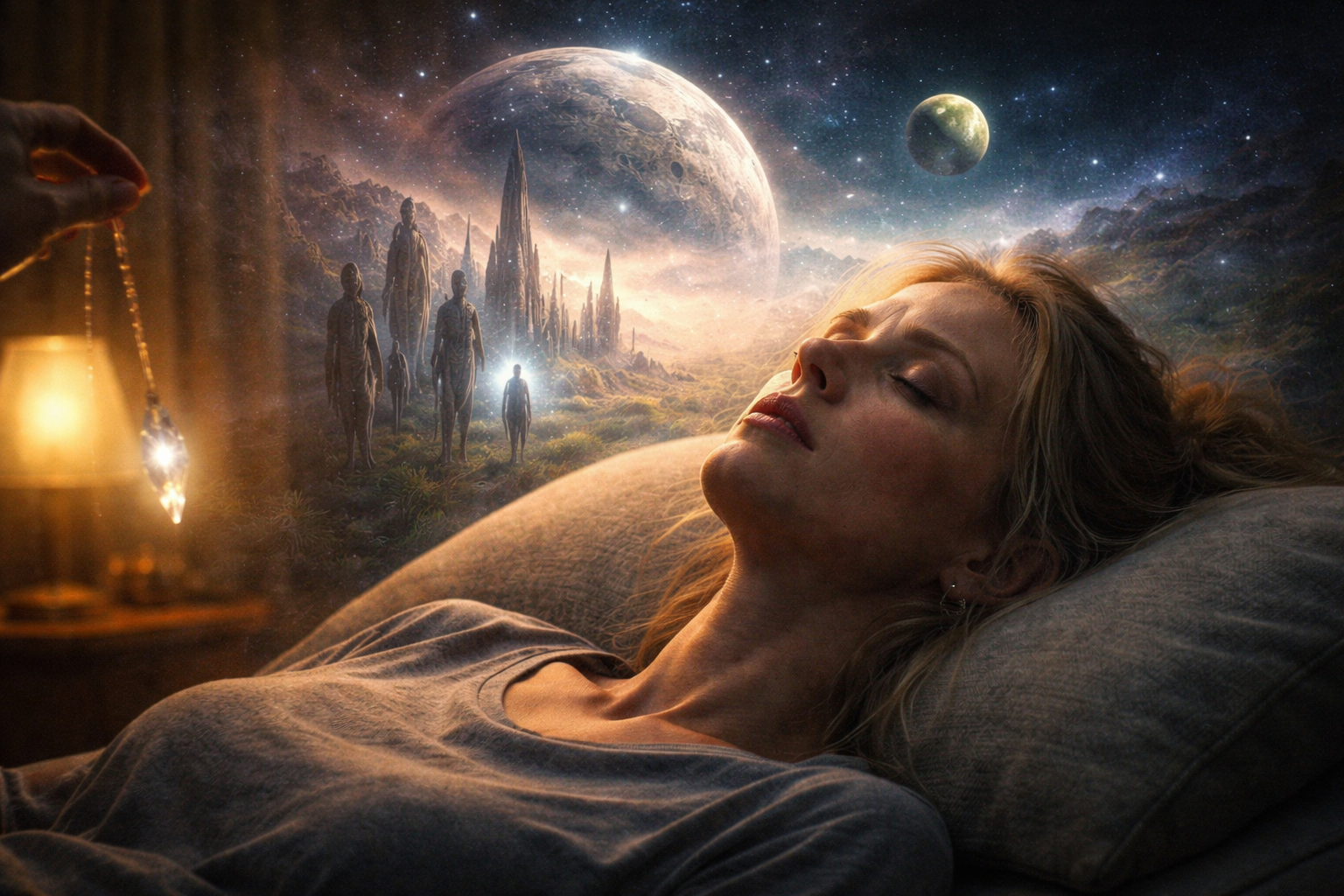
The first time I heard the word starseed, it came out of a stranger’s mouth like a secret she was tired of keeping.
We were in a community center basement that smelled like floor cleaner and old coffee, seated in a loose circle beneath fluorescent lights that made everyone look like they’d been awake too long. There were folding chairs, a stack of pamphlets on a plastic table, and a poster taped crooked to the wall that promised a future none of us had applied for.
I had come because grief makes you gullible. It makes you curious. It makes you willing to sit in any room where someone claims there is a pattern to the pain.
A woman named Corinne had lost her daughter, and she spoke about it with a steadiness that made me ache. She had a notebook filled with neat handwriting, as if enough organization could keep the universe from stealing anyone else. Another man claimed he had seen his dead brother in the reflection of a turned-off television. Someone else talked about numbers that repeated in dreams, and I watched the room lean toward him the way people lean toward a fire.
When it was my turn, I didn’t know what to say. My grief was less dramatic. Less cinematic. My father was just gone, and the world had continued in that obscene way it does, as if death were a scheduling inconvenience.
“I keep thinking about where he went,” I admitted. “Not heaven. Not… that. Just—where. Like… does anything move? Or does it just stop?”
The facilitator, a gentle man with a voice trained to soften hard truths, nodded like he’d heard this question a thousand times and never gotten used to it.
“Sometimes,” he said, “what moves isn’t the body. Sometimes it’s the pattern.”
That was when the stranger across from me spoke.
“You ever wonder if the pattern leaves Earth?” she asked.
Her hair was cut blunt, almost severe. Her eyes were tired in a way that didn’t feel purely human. Not in the science-fiction sense—more like she had lived through too many explanations.
“No,” I said, because the honest answer was that I’d never allowed myself to wonder that far. “I mean… I guess.”
She tilted her head. “What if you weren’t always from here?”
That should have made me laugh. It should have sounded ridiculous. Instead it slid into the room like a key turning in a lock I didn’t know existed.
“Starseed,” she said again, and this time the word landed with intent. “Some people are.”
Corinne scoffed softly. It wasn’t cruel, just exhausted. “So my kid is on Mars now?” she asked, and the pain under her sarcasm made me flinch.
The stranger didn’t flinch. “Maybe,” she said. “Or somewhere worse. Or somewhere better. Or somewhere you couldn’t name without breaking your own mouth.”
I should have dismissed her then. I should have decided this was another form of grief tourism, another way to dress the unknown in costumes that made it bearable.
But later, when I got home, I found myself staring out my apartment window at the slice of night sky between buildings. The stars looked like pinholes in a painted ceiling. Beautiful, distant, indifferent.
And I wondered, very quietly, what my father would think of me if he could see me now—sitting in the dark, looking for him in the wrong places.
I didn’t sleep that night. Instead, I opened my laptop and fell down a rabbit hole of forums and books and phrases that all sounded like they’d been translated from something older than language. Reincarnation. Quantum entanglement. Universal consciousness. Past-life regression. Starseeds. Souls that came from elsewhere to help the planet “evolve.”
Most of it read like wish fulfillment. Most of it read like people trying to give themselves a heroic reason for feeling alien in their own lives.
But every so often, buried beneath the glittering nonsense, I found something that tightened my throat.
A person describing a childhood memory of a sky with two moons. Another person insisting that gravity felt wrong in their bones. Someone else describing a family structure where names were temporary and identity was assigned like weather.
Details. Specificity. The kind of specificity that either meant imagination or something more unsettling.
I could accept imagination. Imagination was human. Imagination was honorable.
What I couldn’t accept—what snagged in my mind like a thorn—was the repeating image of a place that felt familiar to me in a way it had no right to.
A world with a pale ring around it like a faint bruise. A horizon too sharp, as if the planet had been cut out of space with scissors. Buildings that rose like coral, curved and seamless. A language that wasn’t spoken so much as… felt, like light pressed into meaning.
I had never been there.
And yet, when I saw the descriptions, something in me recognized them like an old wound recognizes weather.
Two weeks after the meeting, I booked a past-life regression session with a woman who did not advertise miracles. Her website was plain. Her office was in a dull strip mall between a dentist and a place that sold phone cases. Everything about it suggested practicality, which made me trust it more than I wanted to.
Her name was Dr. Nisha Patel. She had kind eyes and a skeptical mouth, like someone who had made peace with how strange people were without becoming impressed by it.
“I should tell you,” she said, after I’d filled out paperwork and tried not to feel embarrassed, “I’m not here to convince you reincarnation is real.”
“Good,” I said, relieved. “Because I don’t know what I believe.”
She nodded. “My job is to guide you into a state where your mind can show you what it’s holding. Sometimes that looks like memory. Sometimes it looks like metaphor. Sometimes it’s both. Either way, it tends to be useful.”
Useful. I liked that word. It didn’t ask me to worship the experience. It asked me to learn from it.
She led me into a room with a reclining chair and soft lighting and a faint scent of lavender that felt almost annoyingly cliché. I lay down anyway. I closed my eyes anyway. I let my body sink because it was easier than carrying it.
Her voice became a thread. It pulled gently.
She guided me through breathing, through muscle relaxation, through the slow descent into that liminal place between sleep and waking where the mind becomes porous. I felt my thoughts loosen. I felt the edges of my identity soften, like chalk under water.
“Imagine a door,” she said. “Not a metaphorical door. A real one. What does it look like?”
“A hatch,” I said, surprised at the immediacy of the image. “Round. Metal. Like… like on a ship.”
“Good,” she said, calm. “Open it.”
The sound that came next wasn’t in the room. It wasn’t in my ears. It arrived inside my skull as if it had always lived there.
A low hum. A chord. A vibration that made my teeth feel slightly wrong.
My breath caught.
“What do you see?” Dr. Patel asked.
I tried to speak, but language faltered. My throat tightened as if the words were too small.
“I—” I began.
The hum deepened.
The hatch opened.
And suddenly I was looking up at a sky with two moons.
One was pale and large and pocked like a bruise. The other was smaller, sharp, and faintly green, like a gemstone held too far away to appreciate. The stars behind them were different—arranged in unfamiliar clusters, as if someone had changed the ceiling and expected me not to notice.
I felt cold air on skin that wasn’t my skin.
I felt my lungs fill differently, like the atmosphere carried another ingredient my human body had never tasted.
I tried to sit up in the chair and couldn’t. My body was heavy, but not in the way it was heavy on Earth. Heavy in a way that felt… designed.
“What do you feel?” Dr. Patel asked, steady.
I swallowed. “I’m… not alone,” I said.
And I wasn’t.
There were others around me, moving with a purposeful grace. They weren’t the grey, big-eyed caricatures of alien movies. They were taller than me, yes, but not towering. Their faces had structure that felt almost familiar until you looked too long and realized the symmetry was wrong. Their eyes reflected light in a way that suggested more than one layer. Their mouths did not move when they communicated.
They didn’t speak.
They patterned.
Meaning arrived in my mind like a warm press of hands against my temples. A language made of images and sensation and emotion braided together. It wasn’t mystical. It was efficient.
And it was intimate in a way that made me want to cry.
“Who are you there?” Dr. Patel asked.
The answer came before I could think.
“I’m… a translator,” I said. “I take… minds. And I… make them compatible.”
A ripple of emotion moved through the other beings around me: approval, urgency, the slight melancholy of a task done too many times.
The next images came in a sequence, not a narrative. They were flashes of a life that didn’t fit neatly into my human concept of time.
A room without corners, lit from within its walls. A wall that displayed moving constellations like weather maps. A long corridor of curved windows looking out into blackness. A hand—my hand there, long-fingered and unfamiliar—resting against glass as a ship moved through space.
Then: a feeling of failure.
Then: a feeling of sacrifice.
Then: a sensation like falling through a thin membrane.
And finally, the sharp, brutal shock of birth.
A hospital light. The smell of antiseptic. The weight of gravity returning like a debt. My human lungs screaming. My human mouth opening.
I jerked so hard in the reclining chair that my shoulders tensed.
Dr. Patel’s voice stayed calm. “It’s okay,” she said. “Stay with it. What is the emotion?”
I lay there, eyes closed, tears leaking sideways into my hair.
“Loneliness,” I whispered. “Not… human loneliness. Bigger. Like being cut off from… a whole system.”
A pause.
Then Dr. Patel said, gently, “And what does your mind want you to understand from this?”
The hum returned—softer now, like a remembered song.
The meaning arrived, and it was not comforting.
It was clarifying.
I had not been abducted.
I had volunteered.
I had not been stolen.
I had been sent.
Not as a hero. Not as a savior. Not as a chosen one with glittering destiny.
As a function.
As someone who could inhabit more than one kind of mind.
As someone built—raised, trained, shaped—to translate between forms of consciousness that could not otherwise touch without breaking.
The word starseed suddenly felt childish. Romantic. A sticker someone slapped over the mouth of an open wound.
This wasn’t romance.
This was logistics.
A door.
A hatch.
A transfer.
Dr. Patel counted me upward slowly, bringing me back into my body like returning a knife to its sheath.
When I opened my eyes, the room looked unchanged. The lamp still glowed. The air still smelled faintly of lavender. The strip mall still existed beyond the walls like a mundane joke.
But my mind felt… rearranged.
Dr. Patel handed me a tissue. I took it with hands that shook only slightly.
“Well,” she said, and her tone was careful, not condescending, “that was vivid.”
“That wasn’t my imagination,” I said.
She held my gaze. “It might be,” she replied. “And it might not be. What matters is what it did to you.”
I laughed once, bitter and disbelieving. “It made me feel like I don’t belong anywhere.”
Dr. Patel nodded. “That’s one interpretation.”
“What’s the other?” I asked, because my voice needed something to cling to.
She folded her hands. “That you belong to something larger than you thought,” she said. “That there’s more continuity in you than the life you can remember.”
Continuity. The word prickled.
On the drive home, traffic lights seemed too bright. People in crosswalks seemed too fragile. The radio played a pop song that sounded suddenly like it was written in a language I used to speak fluently and had forgotten.
At home, I made tea I didn’t want and sat at my kitchen table with my phone face down like a small accusation.
I thought of my father.
I thought of his hands, rough from work. I thought of his laugh. I thought of the way he’d held my shoulder at my mother’s funeral and said, “We keep going. That’s what we do.”
I thought of him dying, and the unbearable silence after.
Then I thought of the two moons.
I thought of a life where I’d been a translator, an in-between, a bridge.
I thought of the possibility—terrifying, beautiful, grotesque—that whatever moved on after death might not care about Earthly boundaries. That the soul, if it existed, might not be loyal to a single planet. That consciousness might be a traveler and the body only a local costume.
The phone buzzed.
A text from Corinne, the woman from the basement circle. We had exchanged numbers after the meeting because grief makes you reach for other grieving hands.
Weird question, the text read. Did you ever look at your kid pictures and feel like you’re staring at someone else?
I stared at the message until my eyes stung.
Then I typed back:
Yes.
Three dots appeared. Disappeared. Appeared again.
My daughter said something today, Corinne wrote. She’s four. She pointed at the moon and said, “That’s not the right one.” Then she laughed like it was a joke. She’s never said anything like that.
My throat tightened.
I looked up at my window. The sky outside was cloudy, the city light washing the stars away. The moon was a pale smear behind haze.
Only one moon.
Only one that we could see.
I imagined the other one anyway, sharp and faintly green, hanging somewhere just beyond the thin membrane of our atmosphere like a forgotten coin.
I set my phone down and pressed my palm against the center of my chest, where my heart kept beating with stubborn human insistence.
If my mind was lying to me, it was a lie with terrifying architecture.
If my mind was telling the truth, then the universe was not indifferent. It was busy.
It was full of doors.
And it was full of travelers who didn’t remember they’d ever left home until something small—grief, a basement circle, a sky too familiar—tugged the latch.
I opened my laptop and began to type, not as an article, not as a theory, but as the only thing that felt honest.
A story.
Because if alien reincarnation was real, it wouldn’t arrive as proof. It would arrive as the ache of recognition.
And if it wasn’t real, the ache still mattered.
Either way, I needed language big enough to hold the idea that death wasn’t an ending so much as a border, and borders—every border I’d ever known—could be crossed.
 MADD FICTIONAL